Articles by Adam Thierer 
 Senior Fellow in Technology & Innovation at the R Street Institute in Washington, DC. Formerly a senior research fellow at the Mercatus Center at George Mason University, President of the Progress & Freedom Foundation, Director of Telecommunications Studies at the Cato Institute, and a Fellow in Economic Policy at the Heritage Foundation.
Before commenting on Lawrence Lessig’s latest call to abolish the Federal Communications Commission (he issued a similar call for the FCC’s abolition earlier this year, which I commented on here), let’s recall what Tim Lee posted yesterday about “Real Regulators“:
Too many advocates of regulation seem to have never considered the possibility that the FCC bureaucrats in charge of making these decisions at any point in time might be lazy, incompetent, technically confused, or biased in favor of industry incumbents. That’s often what “real regulators” are like, and it’s important that when policy makers are crafting regulatory scheme, they assume that some of the people administering the law will have these kinds of flaws, rather than imagining that the rules they write will be applied by infallible philosopher-kings.
Ironically, Prof. Lessig — who typically defends many forms of high-tech regulation like Net neutrality and online content labeling — is essentially agreeing with Tim’s critique of bureaucracy. But Lessig seems to ignore the underlying logic of Tim’s critique and instead imagines that we need only reinvent bureaucracy in order to save it. But I’m getting ahead of myself. First, let’s hear what Lessig proposes.
In a
Newsweek column this week entitled “Reboot the FCC,” Lessig argues that the FCC is beyond saving because, instead of protecting innovation, the agency has succumb to an “almost irresistible urge to protect the most powerful instead.” Consequently, he continues:
The solution here is not tinkering. You can’t fix DNA. You have to bury it. President Obama should get Congress to shut down the FCC and similar vestigial regulators, which put stability and special interests above the public good. In their place, Congress should create something we could call the Innovation Environment Protection Agency (iEPA), charged with a simple founding mission: “minimal intervention to maximize innovation.” The iEPA’s core purpose would be to protect innovation from its two historical enemies–excessive government favors, and excessive private monopoly power.
As was the case with his earlier call to “blow up the FCC,” I am tickled to hear Lessig call for shutting down an agency that many of us have been fighting against for the last few decades. (Here’s a 1995 blueprint for abolishing the FCC that I contributed to, and here’s PFF’s recent “DACA” project to comprehensively reform and downsize the agency.)
But is Lessig really calling for the same sort of sweeping regulatory reform and downsizing that others have been calling for? And has he identified the real source of the problem that he hopes to correct? I don’t think so. There are 3 basic problems with the argument Lessig is putting forward in his essay. I will address each in turn.
Continue reading →

My Kid is the Man of Steel! ... in his mind.
Regular readers will recall my great interest in video games and the public policy debates surrounding efforts to regulate “violent” games in particular. One thing I bring up in almost every essay I write on this subject is how fears about kids and video games are almost always overblown and that kids can typically separate fantasy from reality. Nonetheless, kids have active imaginations and adults sometimes fear that which they cannot understand or appreciate. Friendly mentoring and open-minding parenting can go a long way to encouraging kids to make smart choices and understand where to draw lines, whereas efforts to demonize video games and youth culture almost always backfire.
Anyway, what got me thinking about all this again was an entertaining column in today’s
Washington Post by Ron Stanley (“Who Needs a TV to Play Video Games“), which describes the author’s experiences with his nephew when they played out video game-like scenarios using traditional toys and household items. It’s a wonderful piece worth reading in its entirety, but here’s the key takeaway that I’d like to discuss:
There was no evidence that television and video games had stifled the kids’ creativity. Nor was there any evidence that technology had made them smarter than earlier generations. They simply had a different frame of reference, one that included video games and computers as well as ponies, pet stores and sword fights. Children play with the tools at hand, and they’re great at thinking metaphorically — at imagining that a landspeeder is a sentient robot or that a stick is a gun or that salt-and-pepper shakers are a bride and groom or that a card table is a horse’s stable.
They’re also geniuses at figuring out simple mechanics. My 6-year-old nephew had to explain to me that miniature low-rider cars don’t roll very well on carpet and will flip over more than if racing on hardwood floors. Novice that I was, I was choosing cars that looked the coolest. And they are geniuses at intuiting rules and systems, and at re-creating these rules and systems in their own play. Children who play lots of card games will invent their own card games. Children who play lots of board games will invent their own board games. And children who play lots of video games will invent their own video-game-like games when they don’t have access to the game controllers.
Continue reading →
In several of our previous podcasts (see episodes 34, 35,and 37), we’ve discussed what we’ve called the “Comcast Kerfuffle,” which was the controversy surrounding the steps Comcast took to manage BitTorrent traffic on its networks. Critics called it a violation of Net neutrality principles while Comcast and others called it sensible network management.
This week we saw a new kerfuffle of sorts develop over the revelation in a Monday front-page Wall Street Journal story that Google had approached major cable and phone companies and supposedly proposed to create a fast lane for its own content. What exactly is it that Google is proposing, and does it mean – as the Wall Street Journal and some others have suggested – that Google is somehow going back on their support for Net neutrality principles and regulation? More importantly, what does it all mean for the future of the Internet, network management, and consumers. That’s what we discussed on the TLF’s latest “Tech Policy Weekly” podcast.
Today’s 30-minute discussion featured two of our regular contributors at the TLF, who both wrote about this issue multiple times this week.
Cord Blomquist of the Competitive Enterprise Institute wrote about the issue here and here, and Bret Swanson of the Progress & Freedom Foundation wrote about it here and here. To help us wade through some of the more technical networking issues in play, we were also joined on the podcast by Richard Bennett, a computer scientist and network engineer guru who blogs at Broadband Politics as well as Circle ID and he also pens occasional columns for The Register. Also appearing on the show was Adam Marcus, Research Fellow & Senior Technologist at PFF, who wrote a “nuts and bolts” essay full of excellent technical background on edge caching and net neutrality.
You can download the MP3 file here, or use the online player below to start listening to the show right now.
[display_podcast]
Jack Shafer, editor at large of Slate, is my favorite media pundit. Everything he does is worth reading, and his column this week is no different. It’s entitled “The Digital Slay-Ride: What’s killing newspapers is the same thing that killed the slide rule,” and in it he notes how “Hardly a day goes by, it seems, without some laid-off or bought-out journalist writing a letter of condolence to himself and his profession.” “The underlying cause of their grief,” Shafer argues, “can be traced to the same force that has destroyed other professions and industries: digital technology.” He recalls how people scoffed back in 1993 when Wired founder Louis Rossetto’s said that the “digital revolution is whipping through our lives like a Bengali typhoon” and destroying the old order. But no one is laughing anymore. As I noted in my Media Metrics report, digital disruption and disintermediation has completely upended the media marketplace, as well as countless others. Toward that end, Shafer actually starts a list of professions or technologies that have been “typhooned” by the digital revolution. It’s a pretty amazing (and entertaining) list for those of us old enough to remember when all these things were dominate in our society and economy. Can you think of others?
• Bank tellers
• Typewriters
• Typesetting
• Carburetors
• Vacuum tubes
• Slide rules
• Disc jockeys
• Stockbrokers
• Telephone operators
• Yellow pages
• Repair guys
• Bookbinders
• Pimps (displaced by the cell phone and the Web)
• Cassette and reel-to-reel recorders
• VCRs
• Turntables
• Video stores
• Record stores
• Bookstores
• Recording industry
• Courier/messenger services
• Travel agencies
• Print and cinematic porn
• Porn actors
• Stenographers
• Wired telcos
• Drummers
• Toll collectors (slayed by the E-ZPass)
• Book publishing (especially reference works)
• Conventional-watch makers
• “Browse” shopping
• U.S. Postal Service
• Printing-press makers
• Film cameras
• Kodak (and other film-stock makers)
[This represents a bit of a departure from the traditional format of my ongoing “Media Deconsolidiation Series,” but you will see how it ties in…]
So, some guy from the (Un)Free Press — the activist group that wants to regulate every facet of the media and broadband universe — has created a scary looking chart about “Information Control” [seen below]. It’s based loosely on the Periodic Table of Elements, you know, to give it the aura of science and fact. In reality, it’s just another silly scare tactic that tells us very little about the true nature of our modern media marketplace.
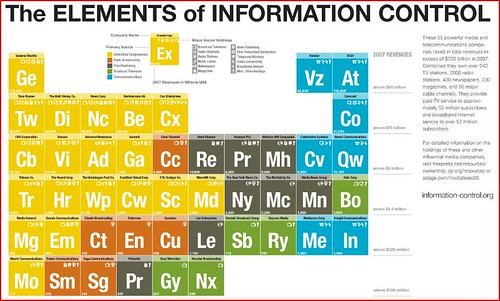
The chart is accompanied by the typical Free Press gloom-and-doom rhetoric about the unfolding media apocalypse. “Nearly everything you see, hear and read that isn’t from a friend — whether on TV, the radio, or even on the Web — comes from a for-profit gatekeeper.” And then comes the obligatory A.J. Liebling quote about how “Freedom of the press belongs to those who own one,” followed quickly by the typical punch line about how just a handful of companies (in this case 55 of ’em) are puppeteering all our thoughts in America today:
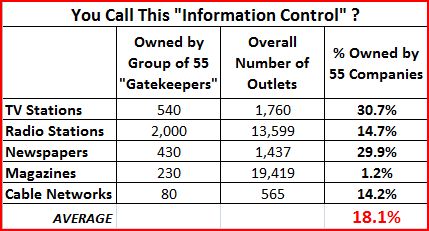
Combined, these 55 powerful media and telecommunications companies raked in total revenues in excess of $700 billion in 2007. Together they own over 540 TV stations, 2000 radio stations, 430 newspapers, 230 magazines, and 80 major cable channels in the United States. They provide paid TV service to approximately 52 million subscribers and broadband Internet service to over 57 million subscribers. They’re the bottlenecks through which our news, our entertainment, and our political discourse must travel. What they want to promote becomes prominent; what they suppress stays out of the mainstream. As such, these companies are the elements of information control.
Oh my God! We are all just brainwashed sheep!
Except we’re not. It amazes me how these “information control” and “media monopoly” myths keep getting widespread circulation. But the first thing to note is how the media reformistas can’t get even their story straight when it comes to how many “monopolists” are supposedly out there today. As I noted in my 2005 book, Media Myths: Making Sense of the Debate over Media Ownership, the critics seem to just pull their numbers out of a hat. Some say as few as 3 companies control everything. Others says 5 or 6. Still others say it might be a few dozen. And now this guy says its 55. Hey, that’s progress that even the Free Press should love!
Regardless of the number, does this really represent the totality of our modern media universe? Do those 55 companies really “own most of the 21st-century presses in America” as the “Info Control” website states? Answer: NOT. EVEN. CLOSE. Here are the facts. [I happened to have compiled them for a PFF special report entitled Media Metrics: The True State of the Modern Media Marketplace to debunk myths just like this.]
Continue reading →
Man, I’d love to bring one of these mobile phone jamming devices into the movie theater with me. I’m getting tired of all the rude jackasses who don’t mute their phone, or even take calls, during the middle of movies. Of course, as this WSJ article notes, such devices violate FCC rules and would disrupt all sorts of beneficial uses. (The company is apparently trying to get them authorized for use in prisons to disable smuggled-in phones from being used and creating problems).
Oh well. I guess I’ll just have to keep throwing popcorn at those idiots in the theater until they shut their pie holes.

This is just a listing of the installments of my ongoing “Media Deconsolidation Series.” I needed to create a single repository of all the essays so I could point back to them in future articles and papers. For those not familiar with it, this series represents an effort to set the record straight regarding the many myths surrounding the media marketplace. These myths are usually propagated by a group of radical anti-media regulatory activists who I call the “media reformistas.” Sadly, however, many policymakers, journalists, and members of the public are buying into some of these myths, too.
In particular, I have spent much time here debunking the notion that rampant consolidation is taking place and that media operators are only growing larger and devouring more and more companies. In fact, nothing could be further from the truth. Over the past several years, traditional media operators and sectors have been coming apart at the seams in the face of unprecedented innovation and competition. The volume of divestiture activity has been quite intense, and most traditional media operators have been getting smaller, not bigger. As a result, America’s media marketplace is growing more fragmented and atomistic with each passing day.
Anyway, here’s the series so far…
Continue reading →
Over just the past 24 hours, there’s been quite a hullabaloo surrounding the Wall Street Journal’s controversial front-page story on Google’s edge caching plan and whether it violates Net neutrality. (See Cord’s post and Bret’s). Lessig calls it a “made-up drama“, David Isenberg says it’s “bogus” and “bullshit,” and Google’s Rick Whitt has said it’s much ado about nothing.
Regardless, here’s the important thing not to overlook about this episode: It is a prime example of the what Tim Lee has referred to as “the fundamental problem of backlash” that ensues whenever there is even
a hint of a potential violation of network neutrality (however one defines it). As Tim argued in his excellent Cato paper on Net neutrality, “No widespread manipulation would go unnoticed for very long,” and a “firestorm of controversy would… be unleashed if a major network owner embarked on a systematic campaign of censorship on its network.” (p. 23). Indeed, this (non-)story about Google’s edge-caching plans have spawned an intense “firestorm of controversy” over the past 24 hours and it doesn’t even involve serious network meddling or censorship! I’ve been trying to keep up with all the traffic about this on TechMeme and Google News during that time, but I have given up trying to digest it all. (Take a look at those snapshots I pasted down below to get a feel for the volume we are talking about here).
In that regard, I love this quote from the always-bloodthirsty Tim Karr of the (inappropriately-named) regulatory activist group Free Press:
If Google or any other tech company were secretly violating Net Neutrality, there would be an absolute and cataclysmic backlash from the grassroots and netroots who have made Net Neutrality a signature issue in 21st Century politics. The Internet community would come crashing down on their heads like Minutemen on Benedict Arnold.
Indeed, that’s exactly what we saw today. But it wasn’t just pro-regulatory fanatics like Free Press. The entire tech and business blogoshere and even some of the mainstream media were on top of this. That’s the “fundamental problem of backlash” at work, and with a vengeance.


It almost seems pointless for me to continue my ongoing media DE-consolidation series, which has been an ongoing effort to debunk myths about the media marketplace (specifically, the notion that rampant consolidation is taking place and that operators are only growing larger and devouring more and more companies.) After all, even the kookiest of the media reformistas can’t deny the truth anymore: Traditional media operators are struggling to keep their heads above water, and markets are growing more atomistic by the day, not more concentrated.
The
New York Times website seems to run a story per day about traditional media giants falling apart as consumers and advertisers disappear. For those of you with short attention spans, you can even follow the death of old media on Twitter now via “The Media is Dying.” If 140 characters per entry is still too much for you to read, here’s the cribbed version: Lots of downsizing, bankruptcies, and closing of doors. The Tribune’s bankruptcy has been the biggest news this week, but few noticed the amazing statement by CBS Corp. Chief Executive Les Moonves that within 10 years he thinks CBS may dump all its affiliated TV stations and just sell programming direct to cable and satellite operators (and the Net, too). Once other networks take that path, that’s pretty much the end of traditional broadcast local affiliates. (I wonder who the FCC will impose those “localism” regulations on then!)
For those working in the business, the news couldn’t be any worse. As Ad Week reported a few days ago:
Continue reading →
It’s been a big year for tech policy books. Several important titles were released in 2008 that offer interesting perspectives about the future of the Internet and the impact digital technologies are having on our lives, culture, and economy. Back in September, I compared some of the most popular technology policy books of the past five years and tried to group them into two camps: “Internet optimists” vs. “Internet pessimists.” That post generated a great deal of discussion and I plan on expanding it into a longer article soon. In this post, however, I will merely list what I regard as the most important technology policy books of the past year.

What qualifies as an “important” tech policy book? Basically, it’s a title that many people in this field are currently discussing and that we will likely be talking about for many years to come. I want to make it clear, however, that merely because a book appears on this list it does not necessarily mean I agree with everything said in it. In fact, I found much with which to disagree in my picks for the two most important books of 2008, as well as many of the other books on the list. [Moreover, after reading all these books, I am more convinced than ever that libertarians are badly losing the intellectual battle of ideas over Internet issues and digital technology policy. There’s just very few people defending a “Hands-Off-the-Net” approach anymore. But that’s a subject for another day!]
Another caveat: Narrowly focused titles lose a few points on my list. For example, as was the case in past years, a number of important IP-related books have come out this year. If a book deals exclusively with copyright or patent issues, it does not exactly qualify as the same sort of “tech policy book” as other titles found on this list since it is a narrow exploration of just one set of issues that have a bearing on digital technology policy. The same could be said of a book that deals exclusively with privacy policy, like Solove’s
Understanding Privacy. It’s an important book with implications for the future of tech policy, but I demoted it a bit because of its narrow focus.
With those caveats in mind, here are my Top 10 Most Important Tech Policy Books of 2008 (and please let me know about your picks for book of the year):
Continue reading →

 The Technology Liberation Front is the tech policy blog dedicated to keeping politicians' hands off the 'net and everything else related to technology.