 Ian Brown and Christopher T. Marsden’s new book, Regulating Code: Good Governance and Better Regulation in the Information Age, will go down as one of the most important Internet policy books of 2013 for two reasons. First, their book offers an excellent overview of how Internet regulation has unfolded on five different fronts: privacy and data protection; copyright; content censorship; social networks and user-generated content issues; and net neutrality regulation. They craft detailed case studies that incorporate important insights about how countries across the globe are dealing with these issues. Second, the authors endorse a specific normative approach to Net governance that they argue is taking hold across these policy arenas. They call their preferred policy paradigm “prosumer law” and it envisions an active role for governments, which they think should pursue “smarter regulation” of code.
In terms of organization, Brown and Marsden’s book follows the same format found in Milton Mueller’s important 2010 book Networks and States: The Global Politics of Internet Governance; both books feature meaty case studies in the middle bookended by chapters that endorse a specific approach to Internet policymaking. (Incidentally, both books were published by MIT Press.) And, also like Mueller’s book, Brown and Marsden’s Regulating Code does a somewhat better job using case studies to explore the forces shaping Internet policy across the globe than it does making the normative case for their preferred approach to these issues. Continue reading →
[UPDATE
4/30/13: This article was subsequently published in Volume 65, Issues 2 of the Federal Communications Law Journal in April 2013. The links below now point to the final FCLJ version.]
The Mercatus Center at George Mason University has just released a new paper by Brent Skorup and me entitled, “Uncreative Destruction: The War on Vertical Integration in the Information Economy.” Brent, who is the research director for the Information Economy Project at the George Mason University School of Law, and I have been working on this paper since the Spring and we are looking forward to getting it published in a law review shortly. The paper focuses on Tim Wu’s “separations principle” for the digital economy, something I’ve spent some time critiquing here in the past. Here’s the introduction from the 44-page paper that Brent and I just released:
Are information sectors sufficiently different from other sectors of the economy such that more stringent antitrust standards should be applied to them preemptively? Columbia Law School professor Tim Wu responds in the affirmative in his book The Master Switch: The Rise and Fall of Information Empires. Having successfully pushed net-neutrality regulation into the policy spotlight, Wu has turned his attention to what he regards as excessive market concentration and threats to free speech throughout the entire information economy.To support his call for increased antitrust intervention, Wu explains his view of competition in the information economy—a view that deviates substantially from current mainstream antitrust theory.
Continue reading →
The Mercatus Center at George Mason University has just released my new white paper, “The Perils of Classifying Social Media Platforms as Public Utilities.” [PDF] I first presented a draft of this paper last November at a Michigan State University conference on “The Governance of Social Media.” [Video of my panel here.]
In this paper, I note that to the extent public utility-style regulation has been debated within the Internet policy arena over the past decade, the focus has been almost entirely on the physical layer of the Internet. The question has been whether Internet service providers should be considered “essential facilities” or “natural monopolies” and regulated as public utilities. The debate over “net neutrality” regulation has been animated by such concerns.
While that debate still rages, the rhetoric of public utilities and essential facilities is increasingly creeping into policy discussions about other layers of the Internet, such as the search layer. More recently, there have been rumblings within academic and public policy circles regarding whether social media platforms, especially social networking sites, might also possess public utility characteristics. Presumably, such a classification would entail greater regulation of those sites’ structures and business practices.
Proponents of treating social media platforms as public utilities offer a variety of justifications for regulation. Amorphous “fairness” concerns animate many of these calls, but privacy and reputational concerns are also frequently mentioned as rationales for regulation. Proponents of regulation also sometimes invoke “social utility” or “social commons” arguments in defense of increased government oversight, even though these notions lack clear definition.
Social media platforms do not resemble traditional public utilities, however, and there are good reasons why policymakers should avoid a rush to regulate them as such. Continue reading →
 In my work critiquing the Lessig-Zittrain-Wu school of thinking–which fears the decline and fall of online “openness” and digital “generativity”–I have argued that, while there is no such thing as perfect “openness,” things are actually getting more open and generative all the time. All that really counts from my perspective is that we are witnessing healthy innovation across the generativity continuum.
Will some devices and platforms continue to be “closed”? Sure. Think Apple and cable set-top boxes. But (a) there’s a ton of innovation taking place on top of those supposedly “closed” platforms and (b) there are other options consumers can exercise if they don’t like those content /information delivery methods. [See this chapter from the Next Digital Decade book for my fuller critique.]
And, even if one adopts a rigid Zittrainian view of openness and generativity, each day seems to bring more good news. From that perspective it’s hard to find a better headline than this one: ”
Smartphone Makers Bow to Demands for More Openness.” That’s from ArsTechnica today and it refers to the fact that smartphone giant HTC just announced it would no longer attempt to lock the bootloader on its smartphones, meaning geeks like me can root and hack their devices to their heart’s content. As the Ars story notes:
Continue reading →
 Hanno F. Kaiser, a U.S. and EU antitrust lawyer and partner with Latham & Watkins LLP, has just released an important essay on a topic I have devoted much time to here over the years: the debate over the relative advantages of “open” vs. “closed” technological systems and the Lessig-Zittrain-Wu school of thinking about these issues.
Kaiser’s essay is entitled, ”
Are Closed Systems an Antitrust Problem?” and it appears in the latest edition of Competition Policy International. This essay is not to be missed. Kaiser’s terrific paper helps us better understand and debunk many of the myths and misperceptions that continue to riddle this debate. Here’s Kaiser’s key insight:
At bottom, the bad reputation of closed systems or walled gardens in the “open versus closed” debate is quite undeserved. Walled gardens generally benefit their environments—both in the real world and the digital realm. The primary purpose of a garden wall, after all, is to shelter plants from wind and frost, not to keep intruders out. In the protected space of the garden, flowers can grow that would not otherwise survive in the wild. Walled gardens thus deliberately create a microcosm that is different from the surrounding ecosystem. Therefore, as long as the garden does not take over the entire ecosystem, walled gardens increase, not reduce, overall diversity. From a competition policy perspective, enjoying the fruits of a walled garden is generally not a guilty pleasure.
Therefore, “as a policy matter, ‘open’ is not necessarily better than ‘closed’,” Kaiser argues, and elaborates as follows: Continue reading →
I’ve spent a great deal of time here defending “techno-optimism” or “Internet optimism” against various attacks through the years, so I was interested to see Cory Doctorow, a novelist and Net activist, take on the issue in a new essay at Locus Online. I summarized my own views on this issue in two recent book chapters. Both chapters appear in The Next Digital Decade and are labeled “The Case for Internet Optimism.” Part 1 is sub-titled “Saving the Net From Its Detractors” and Part 2 is called “Saving the Net From Its Supporters.” More on my own thoughts in a moment. But let’s begin with Doctorow’s conception of the term.
Doctorow defines “techno-optimism” as follows:
In order to be an activist, you have to be… pessimistic enough to believe that things will get worse if left unchecked, optimistic enough to believe that if you take action, the worst can be prevented. […]
Techno-optimism is an ideology that embodies the pessimism and the optimism above: the concern that technology could be used to make the world worse, the hope that it can be steered to make the world better.
What this definition suggests is that Doctorow has a very clear vision of what constitutes “good” vs. “bad” technology or technological developments. He turns to that dichotomy next as he seeks to essentially marry “techno-optimism” to a devotion to the free/open software movement and a rejection of “proprietary technology”: Continue reading →
This is the second of two essays making “The Case for Internet Optimism.” This essay was included in the book, The Next Digital Decade: Essays on the Future of the Internet (2011), which was edited by Berin Szoka and Adam Marcus of TechFreedom. In my previous essay, which I discussed here yesterday, I examined the first variant of Internet pessimism: “Net Skeptics,” who are pessimistic about the Internet improving the lot of mankind. In this second essay, I take on a very different breed of Net pessimists: “Net Lovers” who, though they embrace the Net and digital technologies, argue that they are “dying” due to a lack of sufficient care or collective oversight. In particular, they fear that the “open” Internet and “generative” digital systems are giving way to closed, proprietary systems, typically run by villainous corporations out to erect walled gardens and quash our digital liberties. Thus, they are pessimistic about the long-term survival of the Internet that we currently know and love.
Leading exponents of this theory include noted cyberlaw scholars Lawrence Lessig, Jonathan Zittrain, and Tim Wu. I argue that these scholars tend to significantly overstate the severity of this problem (the supposed decline of openness or generativity, that is) and seem to have very little faith in the ability of such systems to win out in a free market. Moreover, there’s nothing wrong with a hybrid world in which some “closed” devices and platforms remain (or even thrive) alongside “open” ones. Importantly, “openness” is a highly subjective term, and a constantly evolving one. And many “open” systems or devices are as perfectly open as these advocates suggest.
Finally, I argue that it’s likely that the “openness” advocated by these advocates will devolve into expanded government control of cyberspace and digital systems than that unregulated systems will become subject to “perfect control” by the private sector, as they fear. Indeed, the implicit message in the work of all these hyper-pessimistic critics is that markets must be steered in a more sensible direction by those technocratic philosopher kings (although the details of their blueprint for digital salvation are often scarce). Thus, I conclude that the dour, depressing “the-Net-is-about-to-die” fear that seems to fuel this worldview is almost completely unfounded and should be rejected before serious damage is done to the evolutionary Internet through misguided government action.
I’ve embedded the entire essay down below in Scribd reader, but it can also be found on TechFreedom’s Next Digital Decade book website and SSRN.
Continue reading →
[I am currently helping Berin Szoka edit a collection of essays from various Internet policy scholars for a new PFF book called “The Next Digital Decade: Essays about the Internet’s Future.” I plan on including two chapters of my own in the book responding to the two distinct flavors of Internet pessimism that I increasingly find are dominating discussions about Internet policy. Below you will see how the first of these two chapters begins. I welcome input as I refine this draft. ]
Surveying the prevailing mood surrounding cyberlaw and Internet policy circa 2010, one is struck by the overwhelming sense of pessimism about our long-term prospects for a better future. “Internet pessimism,” however, comes in two very distinct flavors:
- Net Skeptics, Pessimistic about the Internet Improving the Lot of Mankind: The first variant of Internet pessimism is rooted in general skepticism regarding the supposed benefits of cyberspace, digital technologies, and information abundance. The proponents of this pessimistic view often wax nostalgic about some supposed “good ‘ol days” when life was much better (although they can’t seem to agree when those were). At a minimum, they want us to slow down and think twice about life in the Information Age and how it is personally affecting each of us. Other times, however, their pessimism borders on neo-Ludditism, with proponents recommending steps be taken to curtail what they feel is the destructive impact of the Net or digital technologies on culture or the economy. Leading proponents of this variant of Internet pessimism include: Neil Postman (Technopoly: The Surrender of Culture to Technology), Andrew Keen, (The Cult of the Amateur: How Today’s Internet is Killing our Culture), Lee Siegel, (Against the Machine: Being Human in the Age of the Electronic Mob), Mark Helprin, (Digital Barbarism) and, to a lesser degree, Jaron Lanier (You Are Not a Gadget) and Nicholas Carr (The Big Switch and The Shallows).
- Net Lovers, Pessimistic about the Future of Openness: A different type of Internet pessimism is on display in the work of many leading cyberlaw scholars today. Noted academics such as Lawrence Lessig, (Code and Other Laws of Cyberspace), Jonathan Zittrain (The Future of the Internet & How to Stop It), and Tim Wu (The Master Switch The Rise and Fall of Information Empires), embrace the Internet and digital technologies, but argue that they are “dying” due to a lack of sufficient care or collective oversight. In particular, they fear that the “open” Internet and “generative” digital systems are giving way to closed, proprietary systems, typically run by villainous corporations out to erect walled gardens and quash our digital liberties. Thus, they are pessimistic about the long-term survival of the wondrous Internet that we currently know and love.
Despite their different concerns, two things unite these two schools of techno-pessimism. Continue reading →
by Berin Szoka & Adam Thierer, Progress Snapshot 5.11 (PDF)
Ten years ago, Nobel Prize-winning economist Milton Friedman lamented the “Business Community’s Suicidal Impulse:” the persistent propensity to persecute one’s competitors through regulation or the threat thereof. Friedman asked: “Is it really in the self-interest of Silicon Valley to set the government on Microsoft?” After yesterday’s FCC vote’s to open a formal “Net Neutrality” rule-making, we must ask whether the high-tech industry—or consumers—will benefit from inviting government regulation of the Internet under the mantra of “neutrality.”
The hatred directed at Microsoft in the 1990s has more recently been focused on the industry that has brought broadband to Americans’ homes (Internet Service Providers) and the company that has done more than any other to make the web useful (Google). Both have been attacked for exercising supposed “gatekeeper” control over the Internet in one fashion or another. They are now turning their guns on each other—the first strikes in what threatens to become an all-out, thermonuclear war in the tech industry over increasingly broad neutrality mandates. Unless we find a way to achieve “Digital Détente,” the consequences of this increasing regulatory brinkmanship will be “mutually assured destruction” (MAD) for industry and consumers.
New Fronts in the Neutrality Wars
The FCC’s proposed rules would apply to all broadband providers, including wireless, but not to Google or many other players operating in other layers of the Net who favor such broadband-specific rules. With this rulemaking looming, AT&T came after Google with letters to the FCC in late September and then another last week accusing the company of violating neutrality principles in their business practices and arguing that any neutrality rules that apply to ISPs should apply equally to Google’s panoply of popular services. In particular, AT&T accused Google of “search engine bias,” suggesting that only government-enforced neutrality mandates could protect consumers from Google’s supposed “monopolist” control.
The promise made yesterday by the FCC—to only apply neutrality principles to the infrastructure layer of the Net—is hollow and will ultimately prove unenforceable. Continue reading →
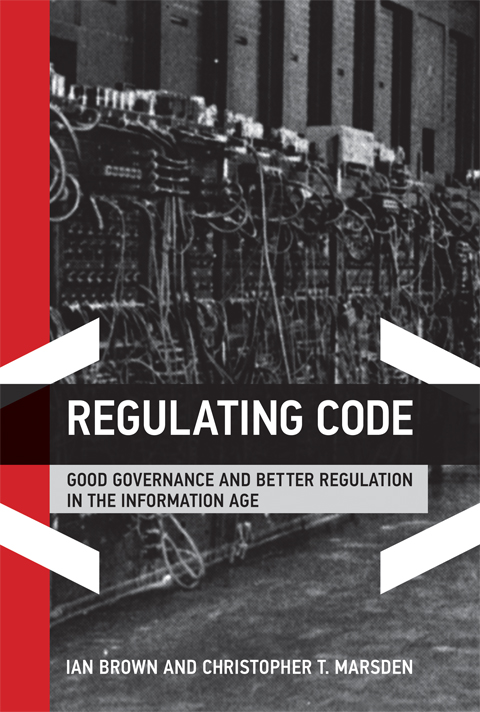 Ian Brown and Christopher T. Marsden’s new book, Regulating Code: Good Governance and Better Regulation in the Information Age, will go down as one of the most important Internet policy books of 2013 for two reasons. First, their book offers an excellent overview of how Internet regulation has unfolded on five different fronts: privacy and data protection; copyright; content censorship; social networks and user-generated content issues; and net neutrality regulation. They craft detailed case studies that incorporate important insights about how countries across the globe are dealing with these issues. Second, the authors endorse a specific normative approach to Net governance that they argue is taking hold across these policy arenas. They call their preferred policy paradigm “prosumer law” and it envisions an active role for governments, which they think should pursue “smarter regulation” of code.


 The Technology Liberation Front is the tech policy blog dedicated to keeping politicians' hands off the 'net and everything else related to technology.