Profectus is an excellent new online magazine featuring essays and interviews on the intersection of academic literature, public policy, civilizational progress, and human flourishing. The Spring 2022 edition of the magazine features a “Progress Roundtable” in which six different scholars were asked to contribute their thoughts on three general questions:
What is progress?
What are the most significant barriers holding back further progress?
If those challenges can be overcome, what does the world look like in 50 years?
I was honored to be asked by Clay Routledge to contribute answers to those questions alongside others, including: Steven Pinker (Harvard University), Jason Crawford (Roots of Progress), Matt Clancy (Institute for Progress), Marian Tupy (HumanProgress.org), James Pethokoukis (AEI). I encourage you to jump over the roundtable and read all their excellent responses. I’ve included my answers down below:
On Thursday, June 9, it was my great pleasure to return to my first work office at the Adam Smith Institute in London and give a talk on the future of innovation policy and the governance of artificial intelligence. James Lawson, who is affiliated with the ASI and wrote a wonderful 2020 study on AI policy, introduced me and also offered some remarks. Among the issues discussed:
What sort of governance vision should govern the future of innovation generally and AI in particular: the “precautionary principle” or “permissionless innovation”?
Which AI sectors are witnessing the most exciting forms of innovation currently?
What are the fundamental policy fault lines in the AI policy debates today?
Will fears about disruption and automation lead to a new Luddite movement?
How can “soft law” and decentralized governance mechanism help us solve pressing policy concerns surrounding AI?
How did automation affect traditional jobs and sectors?
Will the European Union’s AI Act become a global model for regulation and will it have a “Brussels Effect” in terms of forcing innovators across the world to come into compliance with EU regulatory mandates?
How will global innovation arbitrage affect the efforts by governments in Europe and elsewhere to regulate AI innovation?
Can the common law help address AI risk? How is the UK common law system superior to the US legal system?
What do we mean by “existential risk” as it pertains to artificial intelligence?
I have a massive study in the works addressing all these issues. In the meantime, you can watch the video of my London talk here. And thanks again to my friends at the Adam Smith Institute for hosting!
I became a little bit more of a cyborg this month with the addition of two new eyes—eye lenses, actually. Before I had even turned 50, the old lenses that Mother Nature gave me were already failing due to cataracts. But after having two operations this past month and getting artificial lenses installed, I am seeing clearly again thanks to the continuing miracles of modern medical technology.
Cataracts can be extraordinarily debilitating. One day you can see the world clearly, the next you wake up struggling to see through a cloudy ocular soup. It is like looking through a piece of cellophane wrap or a continuously unfocused camera.
If you depend on your eyes to make a living as most of us do, then cataracts make it a daily struggle to get even basic things done. I spend most of my time reading and writing each workday. Once the cataracts hit, I had to purchase a half-dozen pair of strong reading glasses and spread them out all over the place: in my office, house, car, gym bag, and so on. Without them, I was helpless.
Reading is especially difficult in dimly lit environments, and even with strong glasses you can forget about reading the fine print on anything. Every pillbox becomes a frightening adventure. I invested in a powerful magnifying glass to make sure I didn’t end up ingesting the wrong things.
For those afflicted with particularly bad cataracts, it becomes extraordinarily risky to drive or operate machinery. More mundane things—watching TV, tossing a ball with your kid, reading a menu at many restaurants, looking at art in a gallery—also become frustrating. Continue reading →
This week I will be traveling to Montreal to participate in the 2018 G7 Multistakeholder Conference on Artificial Intelligence. This conference follows the G7’s recent Ministerial Meeting on “Preparing for the Jobs of the Future” and will also build upon the G7 Innovation Ministers’ Statement on Artificial Intelligence. The goal of Thursday’s conference is to, “focus on how to enable environments that foster societal trust and the responsible adoption of AI, and build upon a common vision of human-centric AI.” About 150 participants selected by G7 partners are expected to participate, and I was invited to attend as a U.S. expert, which is a great honor.
I look forward to hearing and learning from other experts and policymakers who are attending this week’s conference. I’ve been spending a lot of time thinking about the future of AI policy in recent books, working papers, essays, and debates. My most recent essay concerning a vision for the future of AI policy was co-authored with Andrea O’Sullivan and it appeared as part of a point/counterpoint debate in the latest edition of the Communications of the ACM. The ACM is the Association for Computing Machinery, the world’s largest computing society, which “brings together computing educators, researchers, and professionals to inspire dialogue, share resources, and address the field’s challenges.” The latest edition of the magazine features about a dozen different essays on “Designing Emotionally Sentient Agents” and the future of AI and machine-learning more generally.
In our portion of the debate in the new issue, Andrea and I argue that “Regulators Should Allow the Greatest Space for AI Innovation.” “While AI-enabled technologies can pose some risks that should be taken seriously,” we note, “it is important that public policy not freeze the development of life-enriching innovations in this space based on speculative fears of an uncertain future.” We contrast two different policy worldviews — the precautionary principle versus permissionless innovation — and argue that:
artificial intelligence technologies should largely be governed by a policy regime of permissionless innovation so that humanity can best extract all of the opportunities and benefits they promise. A precautionary approach could, alternatively, rob us of these life-saving benefits and leave us all much worse off.
That’s not to say that AI won’t pose some serious policy challenges for us going forward that deserve serious attention. Rather, we are warning against the dangers of allowing worst-case thinking to be the default position in these discussions. Continue reading →
Written with Christopher Koopman and Brent Skorup (originally published on Medium on 4/10/17)
Innovation isn’t just about the latest gee-whiz gizmos and gadgets. That’s all nice, but something far more profound is at stake: Innovation is the single most important determinant of long-term human well-being. There exists widespread consensus among historians, economists, political scientists and other scholars that technological innovation is the linchpin of expanded economic growth, opportunity, choice, mobility, and human flourishing more generally. It is the ongoing search for new and better ways of doing things that drives human learning and prosperity in every sense — economic, social, and cultural.
As the Industrial Revolution revealed, leaps in economic and human growth cannot be planned. They arise from societies that reward risk takers and legal systems that accommodate change. Our ability to achieve progress is directly proportional to our willingness to embrace and benefit from technological innovation, and it is a direct result of getting public policies right.
The United States is uniquely positioned to lead the world into the next era of global technological advancement and wealth creation. That’s why we and our colleagues at the Technology Policy Program at the Mercatus Center at George Mason University devote so much time and energy to defending the importance of innovation and countering threats to it. Unfortunately, those threats continue to multiply as fast as new technologies emerge. Continue reading →
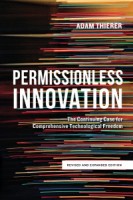
I am pleased to announce the release of the second edition of my book, Permissionless Innovation: The Continuing Case for Comprehensive Technological Freedom. As with the first edition, the book represents a short manifesto that condenses — and attempts to make more accessible — arguments that I have developed in various law review articles, working papers, and blog posts over the past few years. The book attempts to accomplish two major goals.
First, I attempt to show how the central fault line in almost all modern technology policy debates revolves around “the permission question,” which asks:
Must the creators of new technologies seek the blessing of public officials before they develop and deploy their innovations? How that question is answered depends on the disposition one adopts toward new inventions. Two conflicting attitudes are evident.
One disposition is known as the “precautionary principle.” Generally speaking, it refers to the belief that new innovations should be curtailed or disallowed until their developers can prove that they will not cause any harms to individuals, groups, specific entities, cultural norms, or various existing laws, norms, or traditions.
The other vision can be labeled “permissionless innovation.” It refers to the notion that experimentation with new technologies and business models should generally be permitted by default. Unless a compelling case can be made that a new invention will bring serious harm to society, innovation should be allowed to continue unabated and problems, if they develop at all, can be addressed later.
I argue that we are witnessing a grand clash of visions between these two mindsets today in almost all major technology policy discussions today. Continue reading →
I’ve spent much of the past year studying the potential public policy ramifications associated with the rise of the Internet of Things (IoT). As I was preparing some notes for my Jan. 6th panel discussing on “Privacy and the IoT: Navigating Policy Issues” at this year’s 2015 CES show, I went back and collected all my writing on IoT issues so that I would have everything in one place. Thus, down below I have listed most of what I’ve done over the past year or so. Most of this writing is focused on the privacy and security implications of the Internet of Things, and wearable technologies in particular.
I plan to stay on top of these issues in 2015 and beyond because, as I noted when I spoke on a previous CES panel on these issues, the Internet of Things finds itself at the center of what we might think of a perfect storm of public policy concerns: Privacy, safety, security, intellectual property, economic / labor disruptions, automation concerns, wireless spectrum issues, technical standards, and more. When a new technology raises one or two of these policy concerns, innovators in those sectors can expect some interest and inquiries from lawmakers or regulators. But when a new technology potentially touches all of these issues, then it means innovators in that space can expect an avalanche of attention and a potential world of regulatory trouble. Moreover, it sets the stage for a grand “clash of visions” about the future of IoT technologies that will continue to intensify in coming months and years.
That’s why I’ll be monitoring developments closely in this field going forward. For now, here’s what I’ve done on this issue as I prepare to head out to Las Vegas for another CES extravaganza that promises to showcase so many exciting IoT technologies. Continue reading →
But I recently heard three policymakers articulate their recommended vision for the Internet of Things (IoT) and I found their approach so inspiring that I wanted to discuss it here in the hopes that it will become the foundation for future policy in this arena.
Last Thursday, it was my pleasure to attend a Center for Data Innovation (CDI) event on “How Can Policymakers Help Build the Internet of Things?” As the title implied, the goal of the event was to discuss how to achieve the vision of a more fully-connected world and, more specifically, how public policymakers can help facilitate that objective. It was a terrific event with many excellent panel discussions and keynote addresses.
Two of those keynotes were delivered by Senators Deb Fischer (R-Neb.) and Kelly Ayotte (R-N.H.). Below I will offer some highlights from their remarks and then relate them to the vision set forth by Federal Trade Commission (FTC) Commissioner Maureen K. Ohlhausen in some of her recent speeches. I will conclude by discussing how the Ayotte-Fischer-Ohlhausen vision can be seen as the logical extension of the Clinton Administration’s excellent 1997
Framework for Global Electronic Commerce, which proposed a similar policy paradigm for the Internet more generally. This shows how crafting policy for the IoT can and should be a nonpartisan affair. Continue reading →
I want to bring to everyone’s attention an important new white paper by Dr. Robert Graboyes, a colleague of mine at the Mercatus Center at George Mason University who specializes in the economics of health care. His new 67-page study, Fortress and Frontier in American Health Care, seeks to move away from the tired old dichotomies that drive health care policy discussions: Left versus Right, Democrat versus Republican, federal versus state, and public versus private, and so on. Instead, Graboyes seeks to reframe the debate over the future of health care innovation in terms of “Fortress versus Frontier” and to highlight what lessons we can learn from the Internet and the Information Revolution when considering health care policy.
What does Graboyes mean by “Fortress and Frontier”? Here’s how he explains this conflict of visions:
The Fortress is an institutional environment that aims to obviate risk and protect established producers (insiders) against competition from newcomers (outsiders). The Frontier, in contrast, tolerates risk and allows outsiders to compete against established insiders. . . . The Fortress-Frontier divide does not correspond neatly with the more familiar partisan or ideological divides. Framing health care policy issues in this way opens the door for a more productive national health care discussion and for unconventional policy alliances. (p. 4)
We live in an entitlement era, when rights are seemingly invented out of whole-cloth. It should come as no surprise, therefore, that a bit of “rights inflation” is creeping into debates about Internet policy. Today, for example, a coalition of groups and individuals (many of which typically advocate greater government activism), have floated a “Declaration of Internet Freedom.” My concern with their brief manifesto is that is seems to based on a confused interpretation of the word “freedom,” which many of the groups behind the effort take to mean freedom for the government to reorder the affairs of cyberspace to achieve values they hold dear.
The manifesto begins with the assertion that “We stand for a free and open Internet,” and then says “We support transparent and participatory processes for making Internet policy and the establishment of five basic principles:”
Expression: Don’t censor the Internet.
Access: Promote universal access to fast and affordable networks.
Openness: Keep the Internet an open network where everyone is free to connect, communicate, write, read, watch, speak, listen, learn, create and innovate.
Innovation: Protect the freedom to innovate and create without permission. Don’t block new technologies, and don’t punish innovators for their users actions.
Privacy: Protect privacy and defend everyone’s ability to control how their data and devices are used.
This effort follows close on the heels of a proposal from Rep. Darrell Issa (R-CA) and Sen. Ron Wyden (D-OR) to craft a “Digital Bill of Rights” that, not to be outdone, includes ten principles. They are: Continue reading →
The Technology Liberation Front is the tech policy blog dedicated to keeping politicians' hands off the 'net and everything else related to technology. Learn more about TLF →


 This week I will be traveling to Montreal to participate in the

 The Technology Liberation Front is the tech policy blog dedicated to keeping politicians' hands off the 'net and everything else related to technology.