Posts tagged as:

I was pleased to see the American Psychological Association’s new statement slowly reversing course on misguided past statements about video games and acts of real-world violence. As Kyle Orland reports in Ars Technica, the APA has clarified its earlier statement on this relationship between watching video game depictions of violence and actual youth behavior. The APA’s old statement said that evidence “confirms [the] link between playing violent video games and aggression.”  But the APA has come around and now says that, “there is insufficient scientific evidence to support a causal link between violent video games and violent behavior.” More specifically, the APA says: 

The following resolution should not be misinterpreted or misused by attributing violence, such as mass shootings, to violent video game use. Violence is a complex social problem that likely stems from many factors that warrant attention from researchers, policy makers and the public. Attributing violence to violent video gaming is not scientifically sound and draws attention away from other factors.

This is a welcome change of course because the APA’s earlier statements were being used by politicians and media activists who favored censorship of video games. Hopefully that will no longer happen.

“Monkey see, monkey do” theories of media exposure leading to acts of real-world violence have long been among the most outrageously flawed theories in the fields of psychology and media studies.  All the evidence points the opposite way, as I documented a decade ago in a variety of studies. (For a summary, see my 2010 essay, “More on Monkey See-Monkey Do Theories about Media Violence & Real-World Crime.”)

In fact, there might even be something to the “cathartic effect hypothesis,” or the idea first articulated by Aristotle (“katharsis”) that watching dramatic portrayals of violence could lead to “the proper purgation of these emotions.” (See my 2010 essay on this, “Video Games, Media Violence & the Cathartic Effect Hypothesis.”)

Of course, this doesn’t mean that endless exposure to video game or TV and movie violence is a good thing. Prudence and good parenting are still essential. Some limits are smart. But the idea that a kid playing or watching violent act will automatically become violent themselves was always nonsense. It’s time we put that theory to rest. Thanks to the new APA statement, we are one step closer.

P.S. I recently penned an essay about my long love affair with video games that you might find entertaining: “Confessions of a ‘Vidiot’: 50 Years of Video Games & Moral Panics

This essay originally appeared on The Bridge under the title “Confessions of a Vidiot” on July 16, 2019.


I have a confession: I’m 50 years old and still completely in love with video games.

Image result for Time magazine video games coverI feel silly saying that, even though I really shouldn’t. Video games are now fully intertwined with the fabric of modern life and, by this point, there have been a couple of generations of adults who, like me, have played them actively over the past few decades. Somehow, despite the seemingly endless moral panics about video games, we came out alright. But that likely will not stop some critics from finding new things to panic over.

As a child of the 1970s, I straddled the divide between the old and new worlds of gaming. I was (and remain) obsessed with board and card games, which my family played avidly. But then Atari’s home version of “Pong” landed in 1976. The console had rudimentary graphics and controls, and just one game to play, but it was a revelation. After my uncle bought Pong for my cousins, our families and neighbors would gather round his tiny 20-inch television to watch two electronic paddles and a little dot move around the screen.

Every kid in the world immediately began lobbying their parents for a Pong game of their own, but then a year later something even more magical hit the market: Atari’s 2600 gaming platform. It was followed by Mattel’s “Intellivision” and Coleco’s “ColecoVision.” The platform wars had begun, and home video games had gone mainstream.

My grandmother, who lived with us at the time, started calling my brother and me “vidiots,” which was short for “video game idiots.” My grandmother raised me and was an absolute treasure to my existence, but when it came to video games (as well as rock music), the generational tensions between us were omnipresent. She was constantly haranguing my brother and me about how we were never going to amount to much in life if we didn’t get away from those damn video games!

I used to ask her why she never gave us as much grief about playing board or card games. She thought those were mostly fine. There was just something about the electronic or more interactive nature of video games that set her and the older generation off.

And, of course, there was the violence. There is no doubt that video games contained violent themes and images that were new to the gaming experience. In the analog gaming era, violent action was left mostly to the imagination. With electronic games, it was right there for us to see in all its (very bloody) glory. Continue reading →

Thomas Rid on cyber war

by on September 3, 2013 · 0 comments

Thomas Rid, author of the new book Cyber War Will Not Take Place discusses whether so-called “cyber war” is a legitimate threat or not. Since the early 1990s, talk of cyber war has caused undue panic and worry and, despite major differences, the military treats the protection of cyberspace much in the same way as protection of land or sea. Rid also covers whether a cyber attack should be considered an act of war; whether it’s correct to classify a cyber attack as “war” considering no violence takes place; how sabotage, espionage and subversion come into play; and offers a positive way to view cyber attacks — have such attacks actually saved millions of lives?

Download

Related Links

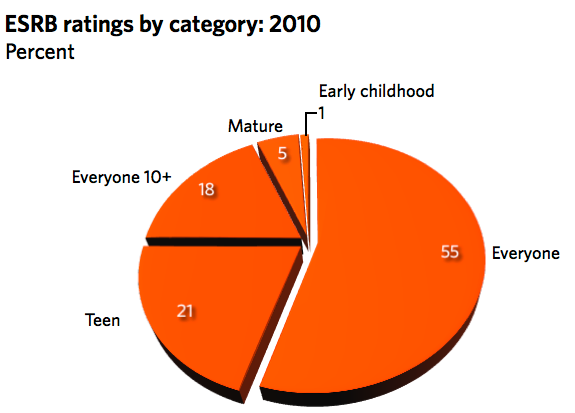
Five years ago this month, I penned a white paper on “Fact and Fiction in the Debate over Video Game Regulation” that I have been meaning to update ever since but just never seem to get around to it. One of the myths I aimed to debunk in the paper was the belief that most video games contain intense depictions of violence or sexuality.  This argument drives many of the crusades to regulate video games. In my old study, I aggregated several years worth of data about video game ratings and showed that the exact opposite was the case: the majority of games sold each year were rating “E” for everyone or “E10+” (Everyone 10 and over) by the Entertainment Software Rating Board (ESRB).

Thanks to this new article by Ars Technica‘s Ben Kuchera, we know that this trend continues. Kuchera reports that out of 1,638 games rated by the ESRB in 2010, only 5% were rated “M” for Mature. As a percentage of top sellers, the percentage of “M”-rated games is a bit higher, coming in at 29%. But that’s hardly surprising since there are always a few big “M”-rated titles that are the power-sellers among young adults each year.  Still, most of the best sellers don’t contain extreme violence or sexuality.

Continue reading →

By Berin Szoka & Adam Thierer

Yesterday, the Progress & Freedom Foundation (PFF) and Electronic Frontier Foundation (EFF)  filed a joint amicus brief with the U.S. Supreme Court urging the Court to protect the free speech rights of videogame creators and users and asking the justices to uphold a ruling throwing out unconstitutional restrictions on violent videogames.  At issue is a California law that bans the sale or rental of “violent” videogames to anyone under the age of 18, among other regulations. While the law was passed in 2005, it has never taken effect, as courts have repeatedly ruled it unconstitutional. California appealed its loss at the Ninth Circuit Court of Appeals to the Supreme Court.  The case is Schwarzenegger vs. EMA.

This case has profound ramifications for the future of not just videogames, but all media, and the Internet as well. Although we’ve had 15 years of fairly solid Supreme Court case law on new media issues, a loss in the Schwarzenegger case could reverse that tide.  In the amicus brief, we explain how the current videogame content rating system empowers parents to make their own decisions without unconstitutionally restricting this new and evolving form of free speech.  Our brief is focused on three major arguments:

  1. Parental Control Tools, Household Media Control Methods, Self-Regulation and Enforcement of Existing Laws Constitute Less Restrictive Means of Limiting Access to Objectionable Content than Government Regulation of Constitutionally Protected Speech
  2. Videogame Content is Constitutionally Protected Speech Deserving Strict Scrutiny
  3. The State Has Not Established a Compelling Government Interest in Restricting the Sale of Videogames to Minors

The filing can be found online here and it is embedded down below.  As always, the Media Coalition has done an outstanding job summarizing the case and listing all the major briefs filed with the Court in this matter, so check out their Schwarzenegger v. EMA page for everything you need to know about this case.  GamePolitics.com also offers excellent ongoing coverage of the case. Continue reading →

I’m hoping to get some input from readers as I look to finish up an amicus brief for the forthcoming Schwarzenegger v. EMA video game case. (Respondent briefs are due in mid-Sept and the State of California just filed its brief with the Court today). You will recall that the Supreme Court accepted the case for review in April, meaning it will be the first major case regarding video game speech rights heard by our nation’s highest court. It raises questions about the First Amendment status of games and what rights minors have to buy or play “violent” video games.  One section I hope to include in the brief I’m working on deals with how other forms of media content are increasingly intertwined with video game content. In it, I explain how video games are less of a discreet category of visual entertainment than they once were. I’d welcome ideas for other examples to use relative to the ones you see below.

I begin by discussing games that were inspired by major motion pictures, such as both the recent Star Wars and Lord of the Rings movie trilogies, for example.  I also note that many games were inspired by notable books, such as the LotR games being inspired by Tolkien, and The Godfather video games that were inspired by Mario Puzo’s novel of the same name. I also make mention of The Terminator movies starring California Governor Arnold Schwarzenegger, which inspired a wide variety of video games, many of which featured his likeness.

More importantly, I highlight how many video games are now inspiring movies, music, books, and comics, including: Prince of Persia, Max Payne, Resident Evil, Tomb Raider, Doom, Final Fantasy, Halo, and Gears of War. The characters and storylines in the books, comics, and movies based on these games often closely track the video games that inspired them.  Increasingly, therefore, games are developed along parallel tracks with these other forms of content. Thus, to regulate games under the standard California proposes in this case raises the question of whether those other types of media should be regulated in a similar fashion.  Should every iteration of the original game title be regulated under the standard California has suggested if those books, comics, or movies contain violent themes? Continue reading →

David Leonhardt of The New York Times penned an interesting essay a few days ago entitled, “Do Video Games Equal Less Crime?” reflecting upon the same FBI crime data I wrote about earlier this week, which showed rapid drops in violent crime last year (on top of years of steady declines).  Crimes of all sorts plummeted last year despite the serious economic recession we find ourselves in.  Downturns in the economy are typically followed by upticks in crime. Not so this time.  Which leads Leonhardt to wonder if perhaps exposure to violent media (especially violent video games) could have played a positive role in tempering criminal activity in some fashion:

Video games can not only provide hours of entertainment. They can also give people — especially young men, who play more than their fair share of video games and commit more than their fair share of crimes — an outlet for frustration that doesn’t involve actual violence. Video games obviously have many unfortunate side effects. They can promote obsessive, antisocial behavior and can make violent situations seem ordinary. But might video games also have an upside? I’m willing to consider the idea.

Go Back to the Greeks

What Leonhardt is suggesting here goes by the name “cathartic effect hypothesis” and debates have raged over it for centuries.  Seriously, the fight goes all the way back to the great Greek philosophers Plato and Aristotle. And, as with everything else, Aristotle had it right! Well, at least in my opinion he did, but I am a rabid Aristotealian.  While Plato thought the media of his day (poetry, plays & music) had a deleterious impact on culture and humanity, Aristotle took a very different view. Indeed, most historians believe it was Aristotle who first used the term katharsis when discussing the importance of Greek tragedies, which often contained violent overtones and action. He suggested that these tragedies helped the audience, “through pity and fear effecting the proper purgation of these emotions.” (See Part IV of Aristotle’s Poetics,) Aristotle spoke highly of tragedies that used provocative or titillating storytelling to its fullest effect:

Continue reading →

The website ProCon.org has a new debate online laying out the different perspectives about the question: “Do violent video games contribute to youth violence?” It includes citations for a wide variety of studies that come down on both sides of the question. Simply put, there’s a study for everyone out there. Do you want to find a study suggesting that there’s a strong correlation between violently-themed media and aggression? You can find plenty. Or do you want to hear that there’s no correlation between these things? Well, there’s plenty of studies suggesting that, too.

As someone who briefly flirted with a degree in psychology, I find this an interesting intellectual debate. But here’s the thing I can’t get away from — lab studies by psychology professors and students are not the real-world. I am consistently shocked and disappointed at the lack of scrutiny these studies receive when they are little more than artificial constructions of reality.

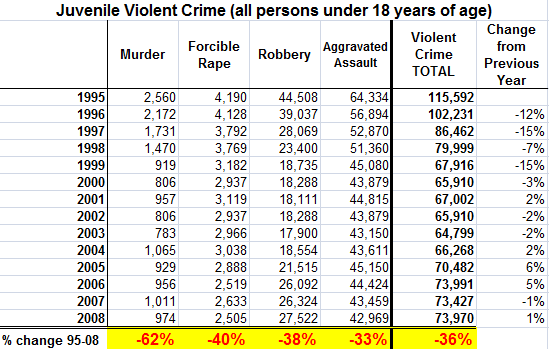
So, how can we determine whether watching depictions of violence will turn us all into killing machines, rapists, robbers, or just plain ol’ desensitized thugs? Well, how about looking at the real world! Whatever lab experiments might suggest, the evidence of a link between depictions of violence in media and the real-world equivalent just does not show up in the data. The FBI produces ongoing Crime in the United States reports that document violent crimes trends. Here’s what the data tells us about overall violent crime, forcible rape, and juvenile violent crime rates over the past two decades: They have all fallen. Perhaps most impressively, the juvenile crime rate has fallen an astonishing 36% since 1995 (and the juvenile murder rate has plummeted by 62%).

Juv violence table

Continue reading →

The Parents Television Council (PTC) released a new report today entitled Women in Peril: A Look at TV’s Disturbing New Storyline Trend. The report argues that “by depicting violence against women with increasing frequency, or as a trivial, even humorous matter, the broadcast networks may ultimately be contributing to a desensitized atmosphere in which people view aggression and violence directed at women as normative, even acceptable,” said PTC President Tim Winter.  As evidence the report cites… Nicole Kidman.  OK, it cites more than Nicole Kidman, but the 7-page report and accompanying press release does seem to place a lot of stock in the fact that, while being questioning by a House Foreign Affairs subcommittee hearing about violence against women overseas, “Ms. Kidman conceded that Hollywood has probably contributed to violence against women by portraying them as weak sex objects, according to the Associated Press.”  I’m not sure what Ms. Kidman was doing testifying before Congress on the matter of violence against women overseas — dare I suggest some congressmen were out for another photo-op with a Hollywood celeb? — but the better question is whether Ms. Kidman’s opinion has any bearing on the question of what relationship, if any, there is between televised violence and real-world violence against women. (Incidentally, if she really feels passionately about all this, is she prepared to go back and recut some of her old scenes in “Dead Calm,” “To Die For,” and “Eyes Wide Shut“?)

Violent Crime Rate

But let’s not nitpick about the credentials Ms. Kidman brings to the table or whether it makes any sense for PTC to elevate her opinions to proof of theory when it comes to a supposed connection between depictions of violence against women in film or television and real world acts of violence against women. PTC, however, suggests that’s exactly what is going on today. They allude to a few lab studies which are of the “monkey see, monkey do” variety — where the results of artificial lab experiments are used to claim that watching depictions of violence will turn us all into killing machines, rapists, robbers, or just plain ol’ desensitized thugs.

There’s just one problem with such studies, and the PTC report:  Reality.  Continue reading →

I’ve been meaning to say something about this new paper by Renee Newman Knake of Michigan State University College of Law, which calls for a new paradigm to analyze, and then likely regulate, video game content. Knake’s paper is entitled, “From Research Conclusions to Real Change: Understanding the First Amendment’s (Non)Response to Negative Effects of Mass Media on Children by Looking to the Example of Violent Video Game Regulations.” In it, she proposes to extend an emerging legal philosophy known as “ecogenerism” to the field of video games and the First Amendment treatment thereof. “Ecogenerism” is largely the creation of Barbara Bennett Woodhouse and the theory argues that we should apply lessons or legal frameworks from the field of environmental law to the area of media and children. “Under an ecogenerist model,” states Knake, “media harm decisions should prioritize concern about the level of ‘toxic’ media which children are exposed over free speech interests.”  Simply stated, we should treat “toxic media” like toxic chemicals.

There have been other efforts to get courts to relax the legal scrutiny applied to video game content from “strict” to something more relaxed or intermediate in character. For example, there is the “violence as obscenity” approach proposed by Kevin Saunders, who, like Knake, is also with the Michigan State University College of Law. But whereas Saunders has proposed applying an adjacent legal theory or framework (obscenity law) to legal analysis of the constitutionality of regulation of video game content, Woodhouse and now Knake propose a much broader, and more radical, reformulation of First Amendment law along the lines of entirely different body of jurisprudence — again, environment law and regulation.

Of course, this is nuts. The notion that words or images are as “toxic” as chemicals is preposterous, and yet that is exactly what Knake and Woodhouse want us to accept. We can determine with a great deal of certainly the physiological impact of too much mercury or lead on the development of the human brain or body. Generally speaking, we know what dose would kill or deform. The same cannot possibly be said of media, and the very allusion to toxic materials or chemicals is ludicrous to begin with since words and images have never directly killed anyone. EVER! Continue reading →