What explains the rebirth of analog era media? Many people (including me!) predicted that vinyl records, turntables, broadcast TV antennas and even printed books seemed destined for the dustbin of technological history. We were so wrong, as I note in this new oped that has gone out through the Tribune Wire Service.
“Many of us threw away our record collections and antennas and began migrating from physical books to digital ones,” I note. “Now, these older technologies are enjoying a revival. What explains their resurgence, and what’s the lesson?”
I offer some data about the rebirth of analog era media as well as some possible explanations for their resurgence. “With vinyl records and printed books, people enjoy making a physical connection with the art they love. They want to hold it in their hands, display it on their wall and show it off to their friends. Digital music or books don’t satisfy that desire, no matter how much more convenient and affordable they might be. The mediums still matter.”
Read more here. Meanwhile, my own personal vinyl collection continues to grow without constraint! …
Last Friday I attended a fascinating conference hosted by the Duke Law School’s Center for Innovation Policy about television regulation and competition. It’s remarkable how quickly television competition has changed and how online video providers are putting pressure on old business models.
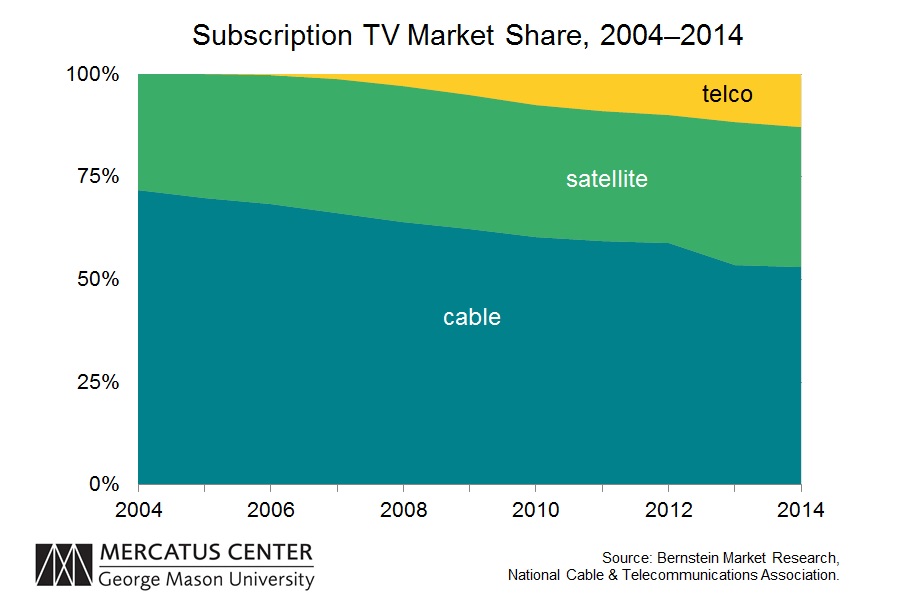
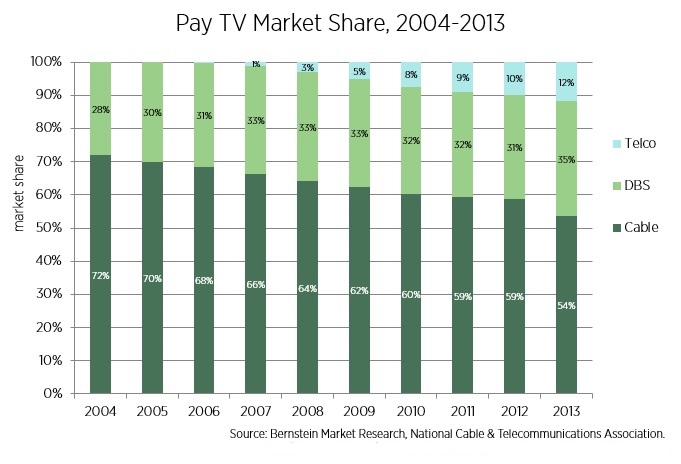
I’ve been working on a project about competition in technology, communications, and media and one chart that stands out is one that shows increasing competition in pay television, below. Namely, that cable providers have lost nearly 15 million subscribers since 2002. Cable was essentially the only game in town in 1990 for pay television (about 100% market share). Yet today, cable’s market share approaches 50%. This competitive pressure accounts for some cable companies trying to merge in recent years.
Much of this churn by subscribers was to satellite providers but it’s the “telephone” companies providing TV that’s really had a competitive impact in recent years. Telcos went from about 0% market share in 2005 to 13% in 2014. This new competition can be tied to Congress finally allowing telephone companies to provide TV in 1996. However, these new services didn’t really get started until a decade ago when 1) digital and IP technology improved, and 2) the FCC made it clear by deregulating DSL ISPs that telephone companies could expect a market return for investing in fiber broadband nationwide.
UPDATE:
And below is market share data going back ten more years to 1994 using FCC data, which uses a slightly different measurement methodology (hence the kink around 2003-2004). I’ve also omitted market share of Home Satellite Dish (those large dishes you sometimes see in rural areas). Though HSD has negligible market share today, it had a few million subscribers in the mid-1990s. I may add HSD later.
Congress is considering reforming television laws and solicited comment from the public last month. On Friday, I submitted a letter encouraging the reform effort. I attached the paper Adam and I wrote last year about the current state of video regulations and the need for eliminating the complex rules for television providers.
As I say in the letter, excerpted below, pay TV (cable, satellite, and telco-provided) is quite competitive, as this chart of pay TV market share illustrates. In addition to pay TV there is broadcast, Netflix, Sling, and other providers. Consumers have many choices and the old industrial policy for mass media encourages rent-seeking and prevents markets from evolving.
One factor I identify as contributing to panics is the fact that “bad news sells.” As I noted in the book, “Many media outlets and sensationalist authors sometimes use fear-based tactics to gain influence or sell books. Fear mongering and prophecies of doom are always effective media tactics; alarmism helps break through all the noise and get heard.”
In line with that, I want to highly recommend you check out this excellent new oped by John Stossel of Fox Business Network on “Good News vs. ‘Pessimism Porn‘.” Stossel correctly notes that “the media win by selling pessimism porn.” He says:
Are you worried about the future? It’s hard not to be. If you watch the news, you mostly see violence, disasters, danger. Some in my business call it “fear porn” or “pessimism porn.” People like the stuff; it makes them feel alive and informed.
Of course, it’s our job to tell you about problems. If a plane crashes — or disappears — that’s news. The fact that millions of planes arrive safely is a miracle, but it’s not news. So we soak in disasters — and warnings about the next one: bird flu, global warming, potential terrorism. I won Emmys hyping risks but stopped winning them when I wised up and started reporting on the overhyping of risks. My colleagues didn’t like that as much.
He continues on to note how, even though all the data clearly proves that humanity’s lot is improving, the press relentlessly push the “pessimism porn.” Continue reading →
Aereo’s antenna system is frequently characterized perjoratively as a Rube Goldberg contraption, including in the Supreme Court oral arguments. Funny enough, Preston Padden, a veteran television executive, has characterized the legal system producing over-the-air broadcast television–Aereo’s chief legal opponents–precisely the same way. It’s also ironic that Aereo is in a fight for its life over alleged copyright violations since communications law diminishes the import of copyright law and makes copyright almost incomprehensible. Larry Downes calls the legal arguments for and against Aereo a “tangled mess.” David Post at the Volokh Conspiracy likewise concluded the situation is “pretty bizarre, when you think about it” after briefly exploring how copyright law interacts with communications law.
I agree, but Post actually understates how distorted the copyright law becomes when TV programs pass through a broadcaster’s towers, as opposed to a cable company’s headend. In particular, a broadcaster, which is mostly a passive transmitter of TV programs, gains more control over the programs than the copyright owners. It’s nearly impossible to separate the communications law distortions from the copyright issues, but the Aereo issue could be solved relatively painlessly by the FCC. It’s unfortunate copyright and television law intertwine like this because a ruling adverse to Aereo could potentially–and unnecessarily–upend copyright law.
This week I’ve seen many commentators, even Supreme Court justices, mischaracterize the state of television law when discussing the Aereo case. This is a very complex area and below is my attempt to lay out some of the deeper legal issues driving trends in the television industry that gave rise to the Aereo dispute. Crucially, the law is even more complex than most people realize, which benefits industry insiders and prevents sensible reforms. Continue reading →
Some recent tech news provides insight into the trajectory of broadband and television markets. These stories also indicate a poor prognosis for a net neutrality. Political and ISP opposition to new rules aside (which is substantial), even net neutrality proponents point out that “neutrality” is difficult to define and even harder to implement. Now that the line between “Internet video” and “television” delivered via Internet Protocol (IP) is increasingly blurring, net neutrality goals are suffering from mission creep.
First, there was the announcement that Netflix, like many large content companies, was entering into a paid peering agreement with Comcast, prompting a complaint from Netflix CEO Reed Hastings who argued that ISPs have too much leverage in negotiating these interconnection deals.
Second, Comcast and Apple discussed a possible partnership whereby Comcast customers would receive prioritized access to Apple’s new video service. Apple’s TV offering would be a “managed service” exempt from net neutrality obligations.
Interconnection and managed services are generally not considered net neutrality issues. They are not “loopholes.” They were expressly exempted from the FCC’s 2010 (now-defunct) rules. However, net neutrality proponents are attempting to bring interconnection and managed services to the FCC’s attention as the FCC crafts new net neutrality rules. Net neutrality proponents have an uphill battle already, and the following trends won’t help. Continue reading →
There are few things more likely to get constituents to call their representative than TV programming blackouts, and the increase in broadcasting disruptions arising from licensing disputes in recent years means Congress may be forced to once again fix television and copyright laws. As Jerry Brito explains at Reason, the current standoff between CBS and Time Warner Cable is the result of bad regulations, which contribute to more frequent broadcaster blackouts. While each type of TV distributor (cable, satellite, broadcasters, telcos) is both disadvantaged and advantaged through regulation, broadcasters are particularly favored. As the US Copyright Office has said, the rule at issue in CBS-TWC is “part of a thicket of communications law requirements aimed at protecting and supporting the broadcast industry.”
But as we approach a damaging tipping point of rising programming costs and blackouts, Congress’ potential rescuer–Aereo–appears on the horizon, possibly buying more time before a major regulatory rewrite. Aereo, for the uninitiated, is a small online company that sets up tiny antennas in certain cities to capture broadcast television station signals–like CBS, NBC, ABC, Fox, the CW, and Univision–and streams those signals online to paying customers, who can watch live or record the local signals captured by their own “rented” Aereo antenna. Broadcasters hate this because the service deprives them of lucrative retransmission fees and unsuccessfully sued to get Aereo to cease operations. Continue reading →
CBS and Time Warner Cable have been embroiled in a heated contractual battle over the past week that has resulted in viewers in some major markets losing access to CBS programming. When disputes like these go nuclear and signal blackouts occur, it is inevitable that some folks will call for policy interventions since nobody likes it when the content they love goes dark.
While some policy responses are warranted in this matter, policymakers should proceed with caution. Heated contractual negotiations are a normal part of any capitalist marketplace. We shouldn’t expect lawmakers to intervene to speed up negotiations or set content prices because that would disrupt the normal allocation of programming by placing a regulatory thumb too heavily on one side of the scale. This is why I am somewhat sympathetic to CBS in this fight. In an age when content creators struggle to protect their copyrighted content and get compensation for it, the last thing we need is government intervention that undermines the few distribution schemes that actually work well.
On the other hand, Time Warner Cable deserves sympathy here, too, since CBS currently enjoys some preexisting regulatory benefits. As I noted in this 2012
Forbes oped, “Toward a True Free Market in Television Programming,” many layers of red tape still encumber America’s video marketplace and prevent a truly free market in video programming from developing. The battle here revolves around the “retransmission consent” rules that were put in place as part of the Cable Act of 1992 and govern how video distributors carry signals from TV broadcasters, which includes CBS.
But those “retrans” rules are not the only part of the regulatory mess here. Continue reading →
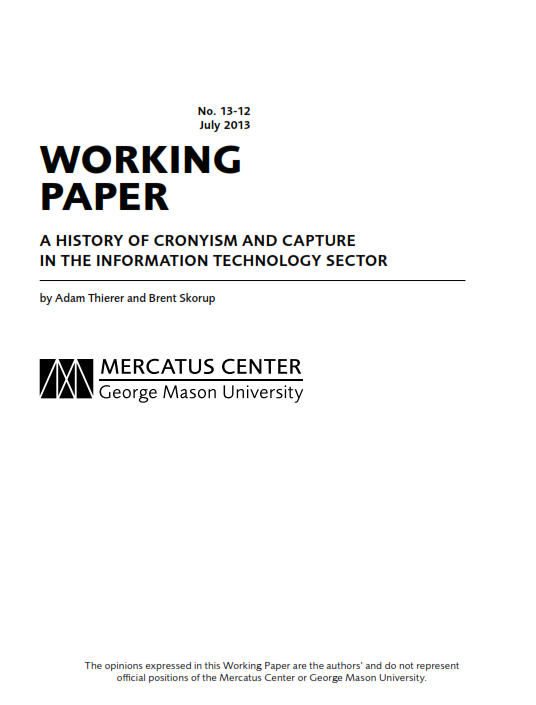
The Mercatus Center at George Mason University has just released a new paper by Brent Skorup and me entitled, “A History of Cronyism and Capture in the Information Technology Sector.” In this 73-page working paper, which we hope to place in a law review or political science journal shortly, we document the evolution of government-granted privileges, or “cronyism,” in the information and communications technology marketplace and in the media-producing sectors. Specifically, we offer detailed histories of rent-seeking and regulatory capture in: the early history of the telephony and spectrum licensing in the United States; local cable TV franchising; the universal service system; the digital TV transition in the 1990s; and modern video marketplace regulation (i.e., must-carry and retransmission consent rules, among others.
Our paper also shows how cronyism is slowly creeping into new high-technology sectors.We document how Internet companies and other high-tech giants are among the fastest-growing lobbying shops in Washington these days. According to the Center for Responsive Politics, lobbying spending by information technology sectors has almost doubled since the turn of the century, from roughly $200 million in 2000 to $390 million in 2012. The computing and Internet sector has been responsible for most of that growth in recent years. Worse yet, we document how many of these high-tech firms are increasingly seeking and receiving government favors, mostly in the form of targeted tax breaks or incentives. Continue reading →
Gina Keating, author of Netflixed: The Epic Battle for America’s Eyeballs, discusses the startup of Netflix and their competition with Blockbuster.
Keating begins with the history of the company and their innovative improvements to the movie rental experience. She discusses their use of new technology and marketing strategies in DVD rental, which inspired Blockbuster to adapt to the changing market.
Keating goes on to describe Netflix’s transition to internet streaming and Blockbuster’s attempts to retain their market share.
The Technology Liberation Front is the tech policy blog dedicated to keeping politicians' hands off the 'net and everything else related to technology. Learn more about TLF →



 There are few things more likely to get constituents to call their representative than TV programming blackouts, and the increase in broadcasting disruptions arising from licensing disputes in recent years means Congress may be forced to once again fix television and copyright laws. As
 The Technology Liberation Front is the tech policy blog dedicated to keeping politicians' hands off the 'net and everything else related to technology.