Posts tagged as:

Discourse magazine recently published my essay on what “Industrial Policy Advocates Should Learn from Don Lavoie.” With industrial policy enjoying a major revival in the the U.S. — with several major federal proposals are pending or already set to go into effect — I argue that Lavoie’s work is worth revisiting, especially as this weekend was the 20th anniversary of his untimely passing. Jump over to Discourse to read the entire thing.

But one thing I wanted to just briefly highlight here is the useful tool Lavoie created that helped us think about the “planning spectrum,” or the range of different industrial policy planning motivations and proposals. On one axis, he plotted “futurist” versus “preservationist” advocates and proposals, with the futurists wanting to invest in new skills and technologies, while the preservationists seek to prop up existing sectors. On the other axis, he contrasted “left-wing or pro-labor” and “right-wing or pro-business” advocates and proposals.

Lavoie used this tool to help highlight the remarkable intellectual schizophrenia among industrial policy planners, who all claimed to have the One Big Plan to save the economy. The problem was, Lavoie noted, all their plans differed greatly. For example, he did a deep dive into the work of Robert Reich and Felix Rohatyn, who were both outspoken industrial policy advocates during the 80s. Reich as affiliated with the Harvard School of Government at that time, and Rohatyn was a well-known Wall Street financier. The industrial policy proposals set forth by Reich and Rohatyn received enormous media and academic attention at the time, yet no one except Lavoie seriously explored the many ways in which their proposals differed so fundamentally. Rohatyn was slotted on the lower right quadrant because of his desire to prop up old sectors and ensure the health of various private businesses. Reich fell into the upper quadrant of being more of futurist in his desire to have the government promote newer skills, sectors, and technologies. Continue reading →

An interesting divide has opened up in recent months among right-of-center groups about what the FCC should do with the “C Band.” A few weeks ago, the FCC requested public comment on how to proceed with the band.

The C Band is 500 MHz of spectrum that the FCC, like regulators around the globe, dedicated for satellite use years ago and gave to satellite companies to share among each other. Satellite operators typically use it to transmit cable programming to a regional cable network operations center, where it is bundled and relayed to cable subscribers. However, the C Band would work terrifically if repurposed for 5G and cellular services. As Joe Kane explained in a white paper, the FCC and telecom companies are exploring various ways of accomplishing that.

Free-market groups disagree. Should the FCC prioritize:

The quick deployment of new wireless services? Or:

Deficit reduction and limiting FCC-granted windfalls?

This is a complex question since we’re dealing with the allocation of public property. Both sides, in my view, have a defensible free-market position. There are other non-trivial C Band issues like interference protection and the FCC’s authority to act here, but I’ll address the ideological split on the right.

The case for secondary markets

The full 500 MHz of “clean” C Band in the US would be worth tens of billions to cellular companies. However, the current satellite users don’t want to part with all of it and a group of satellite companies using the spectrum estimate they could sell 200 MHz to cellular carriers if the FCC would liberalize its rules to allow flexible uses (like 5G), not merely satellite services. The satellite providers would then be able to sell much of their spectrum on the secondary market (probably to cellular providers) at a nice premium.

Prof. Dan Lyons and Roslyn Layton wrote in support of the secondary market plan on the AEI blog and at Forbes, respectively. Joe Kane also favors the approach. As they say, the benefit of secondary market sales is that it will likely lead a significant and fast repurposing of the C Band for mobile use. The consumer benefits of “upzoned” spectrum are large and with every year of inaction, billions of dollars of consumer welfare evaporate. Hazlett and Munoz estimate that spectrum reallocated from a restricted use to flexible use generates annual consumer benefits in the same order of magnitude as auction value of the spectrum.

I’d add that there’s a history of the FCC upzoning spectrum (SMR spectrum in 2004, EBS spectrum in 2004, AWS-4 in 2011, WCS spectrum in 2012). The FCC is considering doing this with some government spectrum that Ligado or others could repurpose for mobile broadband. In these cases, the FCC upzoned spectrum so that it can be used for higher-valued uses, not legacy uses required by previous FCCs. The circumstances and technologies vary, but some of these bands were repurposed quickly for better uses by cellular providers and are used for 4G LTE today by tens of millions of Americans.

The case for FCC auction

Liberalizing spectrum quickly gets spectrum to higher-valued uses but does raise the complaint that the existing users are gaining an unfair windfall. I’m not sure when the C Band was allocated for satellite but many legacy assignments of spectrum were given to industries for free.

When the FCC upzones spectrum, it typically increases the value of the band. The “secondary market” plan is akin to the government giving away a parcel of public land to a developer to be used for a gas station, then deciding years later to upzone the land so that condo or office buildings can be built on it. It’s a better use for the land, but the gas station operator gains a big windfall when the property value increases. Not only is there a windfall, the government captures no revenue from the increase in the value of public property.

Free-market groups like Americans for Tax Reform, Taxpayers Protection Alliance, and Citizens Against Government Waste favor the FCC reclaiming the spectrum from satellite providers, perhaps via incentive auction, and collecting government revenue by re-selling it. If the FCC went the incentive auction route, the FCC would purchase the “satellite spectrum” (ie a low price) from the current C Band users, upzone it, and re-sell that spectrum as “mobile spectrum” (ie a high price) in an open auction. The FCC and the Treasury pocket the difference, probably several billion dollars here.

The FCC has only done one incentive auction, the 600 MHz auction. There, the FCC purchased “TV spectrum” from broadcasters and re-sold it to wireless carriers.

The benefit of this is deficit reduction and there’s more perceived fairness since there’s no big, FCC-granted windfall to legacy users. The downside is that it’s a slower, more complicated process since the FCC is deeply involved in the spectrum transfer. Arguably, however, the FCC should be deeply involved and interested in government revenue since spectrum is public property.

My view

A few years ago I would have definitely favored speed and the secondary market plan. I still lean towards that approach but I’m a little more on the fence after reading Richard Epstein’s work and others’ about the “public trust doctrine.” This is a traditional governance principle that requires public actors to receive fair value when disposing of public property. It prevents public institutions from giving discounted public property to friends and cronies. Clearly, cronyism isn’t the case here and FCC can’t undo what FCCs did generations ago in giving away spectrum. I think the need for speedy deployment trumps the windfall issue here, but it’s a closer call for me than in the past.

One proposal that hasn’t been contemplated with the C Band but might have merit is an overlay auction with a deadline. With such an auction, the FCC gives incumbent users a deadline to vacate a band (say, 5 years). The FCC then auctions flexible-use licenses in the band. The FCC receives the auction revenues and the winning bidders are allowed to deploy services immediately in the “white spaces” unoccupied by the incumbents. The winning bidders are allowed to pay the incumbents to move out before the deadline.

With an overlay auction, you get fairly rapid deployment–at least in the white spaces–and the government gains revenue from the auction. This type of auction was used to deploy cellular (PCS) in the 1990s and cellular (AWS-1) in the 2000s. However, incumbents dislike it because the deadline devalues their existing spectrum holdings.

I think overlay auctions should be considered in more spectrum proceedings because they avoid the serious windfall problems while also allowing rapid deployment of new services. That doesn’t seem in the cards, however, and secondary markets seems like the next best option.

By Brent Skorup and Michael Kotrous

In 1999, the FCC completed one of its last spectrum “beauty contests.” A sizable segment of spectrum was set aside for free for the US Department of Transportation (DOT) and DOT-selected device companies to develop DSRC, a communications standard for wireless automotive communications, like vehicle-to-vehicle (V2V) and vehicle-to-infrastructure (V2I). The government’s grand plans for DSRC never materialized and in the intervening 20 years, new tech—like lidar, radar, and cellular systems—advanced and now does most of what regulators planned for DSRC.

Too often, however, government technology plans linger, kept alive by interest groups that rely on the new regulatory privilege, even when the market moves on. At the eleventh hour of the Obama administration, NHTSA proposed mandating DSRC devices in all new vehicles, an unprecedented move that Brent and other free-market groups opposed in public interest comment filings.  As Brent wrote last year ,

In the fast-moving connected car marketplace, there is no reason to force products with reliability problems [like DSRC] on consumers. Any government-designed technology that is “so good it must be mandated” warrants extreme skepticism….

Further,

Rather than compel automakers to add costly DSRC systems to cars, NHTSA should consider a certification or emblem system for vehicle-to-vehicle safety technologies, similar to its five-star crash safety ratings. Light-touch regulatory treatment would empower consumer choice and allow time for connected car innovations to develop.

Fortunately, the Trump administration put the brakes on the mandate , which would have added cost and complexity to cars for uncertain and unlikely benefits.

However, some regulators and companies are trying to revive the DSRC device industry while NHTSA’s proposed DSRC mandate is on life support. Marc Scribner at CEI uncovered a sneaky attempt to create DSRC technology sales via an EPA proceeding. The stalking horse DSRC boosters have chosen is the Corporate Average Fuel Economy (CAFE) regulations—specifically the EPA’s off-cycle program. EPA and NHTSA jointly manage these regulations. That program rewards manufacturers who adopt new technologies that reduce a vehicle’s emissions in ways not captured by conventional measures like highway fuel economy.

Under the proposed rules , auto makers that install V2V or V2I capabilities can receive credit for having reduced emissions. The EPA proposal doesn’t say “DSRC” but it singles out only one technology standard that would be favored in this scheme: a standard underlying DSRC

This proposal comes as a bit of surprise for those who have followed auto technology; we’re aware of no studies showing DSRC improves emissions. (DSRC’s primary use-case today is collision warnings to the driver.) But the EPA proposes a helpful end-around that problem: simply waiving the requirement that manufacturers provide data showing a reduction in harmful emissions. Instead of requiring emissions data, the EPA proposes a much lower bar, that auto makers show that these devices merely “have some connection to overall environmental benefits.” Unless the agency applies credits in a tech-neutral way and requires more rigor in the final rules, which is highly unlikely, this looks like a backdoor subsidy to DSRC via gaming of emission reduction regulations.

Hopefully EPA regulators will discover the ruse and drop the proposal. It was a pleasant surprise last week when a DOT spokesman committed that the agency favored a tech-neutral approach for this “talking car” band. But after 20 years,  this 75 MHz of spectrum gifted to DSRC device makers should be repurposed by the FCC for flexible-use. Fortunately, the FCC has started thinking about alternative uses for the DSRC spectrum. In 2015 Commissioners O’Rielly and Rosenworcel said the agency should consider flexible-use alternatives to this DSRC-only band.

The FCC would be wise to follow through and push even farther. Until the gifted spectrum that powers DSRC is reallocated to flexible use, interest groups will continue to pull any regulatory lever it has to subsidize or mandate adoption of talking-car technology. If DSRC is the best V2V technology available, device makers should win market share by convincing auto companies, not by convincing regulators.

In the waning days of the Obama administration, the US Department of Transportation (USDOT) proposed to mandate a government-designed “talking cars” technology–so-called DSRC devices–on all new cars. Fortunately, in part because of opposition from free-market advocates, the Trump administration paused the proposed mandate. The FCC had set aside spectrum in the 5.9 GHz band for DSRC technologies in 1999 but it’s been largely unused since then and these new developments raise the question: What to do with that 75 MHz of fairly “clean” spectrum? Hopefully the FCC will take the opportunity to liberalize the use of the DSRC band so it can be put to better uses.

Background

Since the mid-1990s, the USDOT and auto device suppliers have needed the FCC’s assistance–via free spectrum–to jumpstart the USDOT’s vehicle-to-vehicle technology plans. The DSRC disappointment provides an illustration of what the FCC (and other agencies) should not do. DSRC was one of the FCC’s last major “beauty contests,” which is where the agency dispenses valuable spectrum for free on the condition it be used for certain, narrow uses–in this case, only USDOT-approved wireless systems for transportation. The grand plans for DSRC haven’t lived up to its expectations (USDOT officials in 2004 were predicting commercialization as early as 2005) and the device mandate in 2016–now paused–was a Hail Mary attempt to compel widespread adoption of the technology.

Last year, I submitted public interest comments to the USDOT opposing the proposed DSRC mandate as premature, anticompetitive, and unsafe (researchers found, for instance, that “the system will be able to reliably predict collisions only about 35% of the time”). I noted that, a fter nearly 20 years of work on DSRC, the USDOT and their hand-selected vendors had made little progress and were being leapfrogged by competing systems, like automatic emergency brakes,  to say nothing of self-driving cars. The FCC has noticed the fallow DSRC spectrum and Commissioners O’Rielly and Rosenworcel proposed in 2015 to allow other, non-DSRC wireless technologies, like WiFi, into the band.

The FCC’s Role

These DSRC devices use spectrum in the 5.9 GHz band. The FCC set aside  radio spectrum in the band for DSRC applications in 1999 based on a scant 19 comments and reply comments from outside parties. 

Despite the typical flowery language in the 1999 Order, FCC commissioners and Wireless Bureau staff must have had an inkling this was not a good idea. After decades of beauty contests, it was clear the spectrum set-asides were inefficient and anticonsumer, and in 1993 Congress gave the FCC authority to auction spectrum to the highest bidder. The FCC also moved towards “flexible-use” licenses in the 1990s, thus replacing top-down technology choices with market-driven ones. The DSRC set-aside broke from those practices, likely because DSRC in 1999 had powerful backers that the FCC simply couldn’t ignore: the USDOT, device vendors, automakers, and some members of Congress.

The FCC then codified the first DSRC standards in 2003. However, innovation at the speed of government, it turns out, isn’t very speedy at all. The fast-moving connected car industry simply moved ahead without waiting for DSRC technology to catch up.  (Government-selected vendors making devices according to 15-year old government-prescribed technical standards on spectrum allocated by the government in 1999 in a fast-moving technology sector. What could go wrong?)

A Second Chance

So if the DSRC plans didn’t pan out, what should be done with that spectrum? Hopefully the FCC will liberalize the band and, possibly, combine it with the adjacent bands.

The gold standard for maximizing the use of spectrum is flexible-use, licensed spectrum, so the best option is probably liberalizing the DSRC spectrum, combining it with the adjacent higher band (5.925 GHz to 6.425 GHz) and auctioning it. In November 2017, the FCC asked about freeing this latter band for flexible, licensed use.  

The other (probably more popular) option is liberalizing the DSRC band and making it available for free, that is, unlicensed use. Giving away spectrum for free often leads to misallocation but this option is better than keeping it dedicated for DSRC technology. Unlicensed is for flexible uses and allows for many consumer technologies like WiFi, Bluetooth, and unlicensed LTE devices.

Further, because of global technical standards, unlicensed devices in the DSRC band make far more sense, it seems to me, in 5.9 GHz than in the CBRS band* (3.6 GHz), which many countries are using for licensed services like LTE. The FCC is currently trying to simplify the rules in the CBRS band to encourage investment in licensed services, and perhaps that’s a compromise the FCC will reach with those who want more unlicensed spectrum: make 3.6 GHz more accommodating for licensed, flexible uses but in return open the DSRC band to unlicensed devices.

Either way, the FCC has an opportunity to liberalize the use of the DSRC band. Grand plans for DSRC didn’t work out and hopefully the FCC can repurpose that spectrum for flexible uses, either licensed or unlicensed.


*Technically, the GAA devices in the CBRS band are non-exclusive licenses, but the rules intentionally resemble an unlicensed framework.

The Wall Street Journal reported yesterday that the White House is crafting a plan for $1 trillion in infrastructure investment. I was intrigued to learn that President Trump “inquired about the possibility of auctioning the broadcast spectrum to wireless carriers” to help fund the programs. Spectrum sales are the rare win-win-win: they stimulate infrastructure investment (cell towers, fiber networks, devices), provide new wireless services and lower prices to consumers, and generate billions in revenue for the federal government.

Broadcast TV spectrum is good place to look for revenue but the White House should also look at federal agencies, who possess about ten times what broadcasters hold.

Large portions of spectrum are underused or misallocated because of decades of command-and-control policies. Auctioning spectrum for flexible uses, on the other hand, is a free-market policy that is often lucrative for the federal government. Since 1993, when Congress authorized spectrum auctions, wireless carriers and tech companies have spent somewhere around $120 billion for about 430 MHz of flexible-use spectrum, and the lion’s share of revenue was deposited in the US Treasury.

A few weeks ago, the FCC completed the $19 billion sale of broadcast TV spectrum, the so-called incentive auction. Despite underwhelming many telecom experts, this was the third largest US spectrum auction ever in terms of revenue and will transfer a respectable 70 MHz from restricted (broadcast TV) use to flexible use.

The remaining broadcast TV spectrum that President Trump is interested in totals about 210 MHz. But even more spectrum is under the President’s nose.

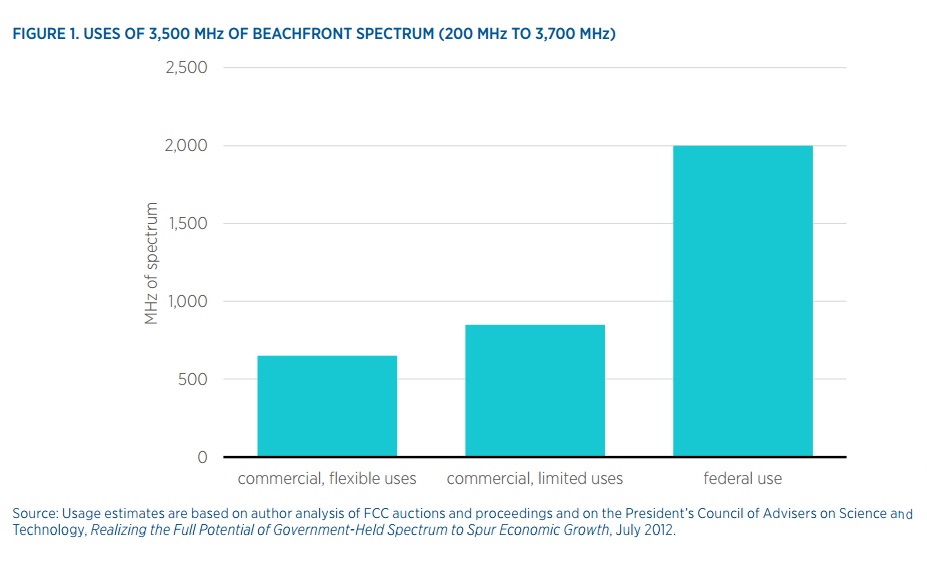
As Obama’s Council of Advisors on Science and Technology pointed out in 2012, federal agencies possess around 2,000 MHz of “beachfront” (sub-3.7 GHz) spectrum. I charted various spectrum uses in a December 2016 Mercatus policy brief.

This government spectrum is very valuable if portions can be cleared of federal users. Federal spectrum was part of the frequencies the FCC auctioned in 2006 and 2015, and the slivers of federal spectrum (around 70 MHz of the federal total) sold for around $27 billion combined.

The Department of Commerce has been analyzing which federal spectrum bands could be used commercially and the Mobile Now Act, a pending bill in Congress, proposes more sales of federal spectrum. These policies have moved slowly (and the vague language about unlicensed spectrum in the Mobile Now bill has problems) but the Trump administration has a chance to expedite spectrum reallocation processes and sell more federal spectrum to commercial users.

The proposed Mobile Now Act signals that spectrum policy is being prioritized by Congress and there’s some useful reforms in the bill. However, the bill encourages unlicensed spectrum allocations in ways that I believe will create major problems down the road.

Congress and the FCC need to proceed much more carefully before allocating more unlicensed spectrum. The FCC’s 2008 decision, for instance, to allow unlicensed devices in the “TV white spaces” has been disappointing. As some economists recently noted, “[s]imply stated, the FCC’s TV white space policy to date has been a flop.” Unlicensed spectrum policy is also generating costly fights (see WiFi v. LTE-U, Bluetooth v. TLPS, LightSquared v. GPS) as device makers and carriers lobby about who gains regulatory protection and how to divide this valuable resource that the FCC parcels out for free.

The unlicensed spectrum provisions in the Mobile Now Act may force the FCC to referee innumerable fights over who has access to unlicensed spectrum. Section 18 of the Mobile Now bill encourages unlicensed spectrum. It says the FCC must

make available on an unlicensed basis radio frequency bands sufficient to meet demand for unlicensed wireless broadband operations if doing so is…reasonable…and…in the public interest.

Note that we have language about supply and demand here. But unlicensed spectrum is free to all users using an approved device (that is, nearly everyone in the US). Quantity demanded will always outstrip quantity supplied when a valuable asset (like spectrum or real estate) is handed out when price = 0. By removing a valuable asset from the price system, large allocation distortions are likely.

Any policy originating from Congress or the FCC to satisfy “demand” for unlicensed spectrum biases the agency towards parceling out an excessive amount of unlicensed spectrum. 

The problems from unlicensed spectrum allocation could be mitigated if the FCC decided, as part of a “public interest” conclusion, to estimate the opportunity cost of any unlicensed spectrum allocated.  That way, the government will have a rough idea of the market value of unlicensed spectrum being given away. There have been several auctions and there is an active secondary market for spectrum so estimates are achievable, and the UK has required the calculation of the opportunity cost of spectrum for over a decade.

With these estimates, it will be more difficult but still possible for the FCC to defend giving away spectrum for free. Economist Coleman Bazelon, for instance, estimates that the incremental value of a nationwide megahertz of licensed spectrum is more than 10x the equivalent unlicensed spectrum allocation. Significantly, unlike licensed spectrum, allocations of unlicensed bands are largely irreversible.

People can quibble with the estimates but it is unclear that unlicensed use is the best use of additional spectrum. In any case, hopefully the FCC will attempt to bring some economic rigor to public interest determinations.

Is the incentive auction a disappointment? For consumers, this auction is not a disappointment. At least–not yet.

Scott Wallsten at the Technology Policy Institute has a good rundown. My thoughts below:

By my count, this was the eighth major auction of commercial, flexible-use spectrum since auctions were authorized in 1993. On the most important question–how much spectrum was repurposed from restricted uses to flexible, licensed uses?–this auction stacks up pretty well.

At 70 MHz, this was the third largest auction in terms of total spectrum repurposed, trailing the mid-1990s PCS auction (120 MHz) and 2006 AWS-1 auction (90 MHz).

On the next most important question–how quickly will new services be deployed?–the verdict is still out. Historically, repurposing spectrum like this typically takes six to twelve years. Depending on how you classify it, this proceeding commenced in 2010 (when the FCC proposed the incentive auction) or 2012 (when Congress authorized the auction). With the auction over, broadcasters have over three years to clear out of the spectrum but some believe it will take longer. Right now, it looks like the process will take seven to eleven years total–not great but pretty typical. 

Some people are disappointed, however, with this auction, particularly some in the broadcasting industry and in the FCC or Congress, who expected higher auction revenues.

High revenue gets nice headlines but is far less important than the amount of spectrum repurposed. It’s an underreported story but close to 290 MHz of spectrum, nearly 45% of all liberalized, licensed spectrum, was de-zoned by the FCC, not auctioned. De-zoning spectrum generates zero auction revenue for the government but consumers see substantial benefits from this de-zoning, even if the government does not directly benefit. I recently wrote a policy brief about the benefits of de-zoning spectrum.

In any case, in terms of revenue, this auction was not a failure. At around $17 billion, it’s third out of eight, trailing the 2008 700 MHz band auction (about $21 billion in 2015 dollars) and the massive haul from the 2015 AWS-3 auction (about $42 billion).

At close, broadcasters will receive $10 billion for the 70 MHz of available licensed spectrum. Some broadcasters consider it a failure, just as a home seller is disappointed when her home sells below list price. The broadcasters initially requested $86 billion for 100 MHz of available spectrum. When the carriers’ bids didn’t match that price, some broadcasters pulled out and the remaining broadcasters lowered their price.

Were there better ways of repurposing broadcast spectrum? Broadcasters have a point that the complexity of the auction might have reduced buyer and seller participation (which means lower bids and fewer deals). As Wallsten notes, an overlay auction (like AWS-1) or simply de-zoning the spectrum might have been better (faster) alternatives. But it goes too far deem this auction a failure (at least until we know how long the broadcaster repack takes).

Those of us with deep reservations about the push for ever more unlicensed spectrum are having many of our fears realized with the new resistance to novel technologies using unlicensed spectrum. By law unlicensed spectrum users have no rights to their spectrum; unlicensed spectrum is a managed commons. In practice, however, existing users frequently act as if they own their spectrum and they can exclude others. By entertaining these complaints, the FCC simply encourages NIMBYism in unlicensed spectrum.

The general idea behind unlicensed spectrum is that by providing a free spectrum commons to any device maker who complies with certain simple rules (namely, Part 15’s low power operation requirement), device makers will develop wireless services that would never have developed if the device makers had to shell out millions for licensed spectrum. For decades, unlicensed spectrum has stimulated development and sale of millions of consumer devices, including cordless phones, Bluetooth devices, wifi access points, RC cars, and microwave ovens.

Now, however, many device makers are getting nervous about new entrants. For instance, Globalstar is developing a technology, TLPS, based on wifi standards that will use some unlicensed spectrum at 2.4 GHz and mobile carriers would like to market an unlicensed spectrum technology, LTE-U, based on 4G LTE standards that will use spectrum at 5 GHz.

This resistance from various groups and spectrum incumbents, who fear interference in “their” spectrum if these new technologies catch on, was foreseeable, which makes these intractable conflicts even more regrettable. As Prof. Tom Hazlett wrote in a 2001 essay, long before today’s conflicts, when it comes to unlicensed devices, “economic success spells its own demise.” Hazlett noted, “Where an unlicensed firm successfully innovates, open access guarantees imitation. This not only results in competition…but may degrade wireless emissions — perhaps severely.”

On the other hand, the many technical filings about potential interference to existing unlicensed devices are red herrings. Prospective device makers in these unlicensed bands have no duty to protect existing users. Part 15 rules say that unlicensed users like wifi and Bluetooth “shall not be deemed to have any vested or recognizable right to continued use of any given frequency by virtue of prior registration or certification of equipment” and that “interference must be accepted.” These rules, however, put the FCC in a self-created double bind: the agency provides no interference protection to existing users but its open access policy makes interference conflicts likely. Continue reading →

The most pressing challenge in wireless telecommunications policy is transferring spectrum from inefficient legacy operators like federal agencies to the commercial sector for consumer use.

Reflecting high consumer demand for more wireless services, in early 2015 the FCC completed an auction for a small slice of prime spectrum–currently occupied by federal agencies and other non-federal incumbents–that grossed over $40 billion for the US Treasury. Increasing demand for mobile services such as Web browsing, streaming video, the Internet of Things, and gaming requires even more spectrum. Inaction means higher smartphone bills, more dropped calls, and stuttering downloads.

My latest research for the Mercatus Center, “Sweeten the Deal: Transfer of Federal Spectrum through Overlay Licenses,” was published recently and recommends the use of overlay licenses to transfer federal spectrum into commercial use. Purchasing an overlay license is like acquiring real property that contains a few tenants with unexpired leases. While those tenants have a superior possessory right to use the property, a high enough cash payment or trade will persuade them to vacate the property. The same dynamic applies for spectrum. Continue reading →

The FCC is being dragged–reluctantly, it appears–into disputes that resemble the infamous beauty contests of bygone years, where the agency takes on the impossible task of deciding which wireless services deliver more benefits to the public. Two novel technologies used for wireless broadband–TLPS and LTE-U–reveal the growing tensions in unlicensed spectrum. The two technologies are different and pose slightly different regulatory issues but each is an attempt to bring wireless Internet to consumers. Their advocates believe these technologies will provide better service than existing wifi technology and will also improve wifi performance. Their major similarity is that others, namely wifi advocates, object that the unlicensed bands are already too crowded and these new technologies will cause interference to existing users.

The LTE-U issue is new and developing. The TLPS proceeding, on the other hand, has been pending for a few years and there are warning signs the FCC may enter into beauty contests–choosing which technologies are entitled to free spectrum–once again.

What are FCC beauty contests and why does the FCC want to avoid them? Continue reading →