In my latest R Street Institute blog post, “Mapping the AI Policy Landscape Circa 2023: Seven Major Fault Lines,” I discuss the big issues confronting artificial intelligence and machine learning in the coming year and beyond. I note that the AI regulatory proposals are multiplying fast and coming in two general varieties: broad-based and targeted. Broad-based algorithmic regulation would address the use of these technologies in a holistic fashion across many sectors and concerns. By contrast, targeted algorithmic regulation looks to address specific AI applications or concerns. In the short-term, it is more likely that targeted or “sectoral” regulatory proposals have a chance of being implemented.
I go on to identify seven major issues of concern that will drive these policy proposals. They include:
I’ve been floating around in conservative policy circles for 30 years and I have spent much of that time covering media policy and child safety issues. My time in conservative circles began in 1992 with a 9-year stint at the Heritage Foundation, where I launched the organization’s policy efforts on media regulation, the Internet, and digital technology. Meanwhile, my work on child safety has spanned 4 think tanks, multiple blue ribbon child safety commissions, countless essays, dozens of filings and testimonies, and even a multi-edition book.
During this three-decade run, I’ve tried my hardest to find balanced ways of addressing some of the legitimate concerns that many conservatives have about kids, media content, and online safety issues. Raising kids is the hardest job in the world. My daughter and son are now off at college, but the last twenty years of helping them figure out how to navigate the world and all the challenges it poses was filled with difficulties. This was especially true because my daughter and son faced completely different challenges when it came to media content and online interactions. Simply put, there is no one-size-fits-all playbook when it comes to raising kids or addressing concerns about healthy media interactions. Continue reading →
It was my pleasure this week to participate in a panel discussion about the future of innovation policy at the James Madison Institute’s 2022 Tech and Innovation Summit in Coral Gables, FL. Our conversation focused on the future of Progress Studies, which is one of my favorite topics. We were asked to discuss five major questions and below I have summarized some of my answers to them, plus some other thoughts I had about what I heard at the conference from others.
What is progress studies and why is it so needed today?
In a sense, Progress Studies is nothing new. Progress studies goes back at least to the days of Adam Smith and plenty of important scholars have been thinking about it ever since. Those scholars and policy advocates have long been engaged in trying to figure out what’s the secret sauce that powers economic growth and human prosperity. It’s just that we didn’t call that Progress Studies in the old days.
The reason Progress Studies is important is because technological innovation has been shown to be the fundamental driver in improvements in human well-being over time. When we can move the needle on progress, it helps individuals extend and improve their lives, incomes, and happiness. By extension, progress helps us live lives of our choosing. As Hans Rosling brilliantly argued, the goal of expanding innovation opportunities and raising incomes “is not just bigger piles of money” or more leisure time. “The ultimate goal is to have the freedom to do what we want.” Continue reading →
This a running list of all the essays and reports I’ve already rolled out on the governance of artificial intelligence (AI), machine learning (ML), and robotics. Why have I decided to spend so much time on this issue? Because this will become the most important technological revolution of our lifetimes. Every segment of the economy will be touched in some fashion by AI, ML, robotics, and the power of computational science. It should be equally clear that public policy will be radically transformed along the way.
Eventually, all policy will involve AI policy and computational considerations. As AI “eats the world,” it eats the world of public policy along with it. The stakes here are profound for individuals, economies, and nations. As a result, AI policy will be the most important technology policy fight of the next decade, and perhaps next quarter century. Those who are passionate about the freedom to innovate need to prepare to meet the challenge as proposals to regulate AI proliferate.
There are many socio-technical concerns surrounding algorithmic systems that deserve serious consideration and appropriate governance steps to ensure that these systems are beneficial to society. However,
there is an equally compelling public interest in ensuring that AI innovations are developed and made widely available to help improve human well-being across many dimensions. And that’s the case that I’ll be dedicating my life to making in coming years.
Here’s the list of what I’ve done so far. I will continue to update this as new material is released: Continue reading →
On July 12, I participated in a Bipartisan Policy Center event on “Civil Society Perspectives on Artificial Intelligence Impact Assessments.” It was an hour-long discussion moderated by Michele Nellenbach, Vice President of Strategic Initiatives at the Bipartisan Policy Center, and which also featured Miriam Vogel, President and CEO of EqualAI. We discussed the ins and outs of algorithmic auditing and impact assessments for artificial intelligence. This is one of the hottest topics in the field of AI governance today, with proposals multiplying rapidly in academic and public policy circles. Several governments are already considering mandating AI auditing and impact assessments.
You can watch the entire discussion here, and down below I have included some of my key talking points from the session. I am currently finishing up my next book, which is on how to craft a flexible governance framework for AI and algorithmic technologies. It includes a lengthy chapter on this issue and I also plan on eventually publishing a stand-alone study on this topic.
A growing number of conservatives are calling for Big Government censorship of social media speech platforms. Censorship proposals are to conservatives what price controls are to radical leftists: completely outlandish, unworkable, and usually unconstitutional fantasies of controlling things that are ultimately much harder to control than they realize. And the costs of even trying to impose and enforce such extremist controls are always enormous.
I’ll offer a few more thoughts here in addition to what I’ve already said elsewhere. First, here is my response to the Rosen essay. National Review gave me 250 words to respond to her proposal:
While admitting that “law is a blunt instrument for solving complicated social problems,” Christine Rosen (“Keep Them Offline,” June 27) nonetheless downplays the radicalness of her proposal to make all teenagers criminals for accessing the primary media platforms of their generation. She wants us to believe that allowing teens to use social media is the equivalent of letting them operate a vehicle, smoke tobacco, or drink alcohol. This is false equivalence. Being on a social-media site is not the same as operating two tons of steel and glass at speed or using mind-altering substances.
Teens certainly face challenges and risks in any new media environment, but to believe that complex social pathologies did not exist before the Internet is folly. Echoing the same “lost generation” claims made by past critics who panicked over comic books and video games, Rosen asks, “Can we afford to lose another generation of children?” and suggests that only sweeping nanny-state controls can save the day. This cycle is apparently endless: Those “lost generations” grow up fine, only to claim it’s the
next generation that is doomed!
Rosen casually dismisses free-speech concerns associated with mass-media criminalization, saying that her plan “would not require censorship.” Nothing could be further from the truth. Rosen’s prohibitionist proposal would deny teens the many routine and mostly beneficial interactions they have with their peers online every day. While she belittles media literacy and other educational and empowerment-based solutions to online problems, those approaches continue to be a better response than the repressive regulatory regime she would have Big Government impose on society.
I have a few more things to say beyond these brief comments. Continue reading →
[This is a draft of a section of a forthcoming study on “A Flexible Governance Framework for Artificial Intelligence,” which I hope to complete shortly. I welcome feedback. I have also cross-posted this essay at Medium.]
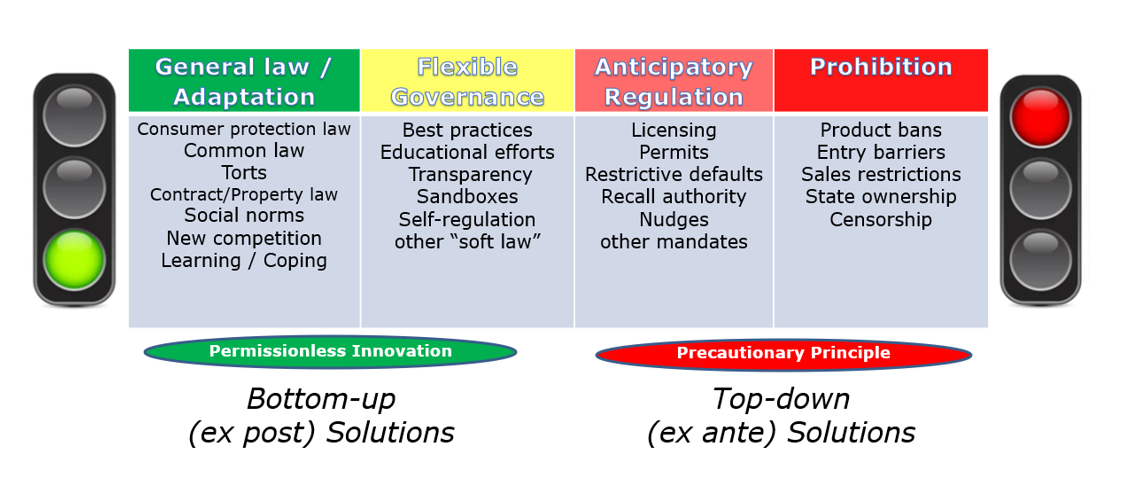
Debates about how to embed ethics and best practices into AI product design is where the question of public policy defaults becomes important. To the extent AI design becomes the subject of legal or regulatory decision-making, a choice must be made between two general approaches: the precautionary principle or the proactionary principle.[1] While there are many hybrid governance approaches in between these two poles, the crucial issue is whether the initial legal default for AI technologies will be set closer to the red light of the precautionary principle (i.e., permissioned innovation) or to the green light of the proactionary principle (i.e., (permissionless innovation). Each governance default will be discussed.
This weekend, The Wall Street Journal ran my short letter to the editor entitled, “We Can Protect Children and Keep the Internet Free.” My letter was a response to columnist Peggy Noonan’s April 9 oped, “Can Anyone Tame Big Tech?” in which she proposed banning everyone under 18 from all social-media sites. She specifically singled out TikTok, Youtube, and Instagram and argued “You’re not allowed to drink at 14 or drive at 12; you can’t vote at 15. Isn’t there a public interest here?”
I briefly explained why Noonan’s proposal is neither practical nor sensible, noting how it:
would turn every kid into an instant criminal for seeking access to information and culture on the dominant medium of their generation. I wonder how she would have felt about adults proposing to ban all kids from listening to TV or radio during her youth.
Let’s work to empower parents to help them guide their children’s digital experiences. Better online-safety and media-literacy efforts can prepare kids for a hyperconnected future. We can find workable solutions that wouldn’t usher in unprecedented government control of speech.
Let me elaborate just a bit because this was the focus of much of my writing a decade ago, including my book, Parental Controls & Online Child Protection: A Survey of Tools & Methods, which spanned several editions. Online child safety is a matter I take seriously and the concerns that Noonan raised in her oped have been heard repeatedly since the earliest days of the Internet. Regulatory efforts were immediately tried. They focused on restricting underage access to objectionable online content (as well as video games), but were immediately challenged and struck down as unconstitutionally overbroad restrictions on free speech and a violation of the First Amendment of the U.S. Constitution. Continue reading →
This essay originally appeared on The Bridge on September 25, 2019.
It is quickly becoming one of the iron laws of technology policy that by attempting to address one problem (like privacy, security, safety, or competition), policymakers often open up a different problem on another front. Trying to regulate to protect online safety, for example, might give rise to privacy concerns, or vice versa. Or taking steps to address online privacy through new regulations might create barriers to new entry, thus hurting online competition.
In a sense, this is simply a restatement of the law of unintended consequences. But it seems to be occurring with greater regularity in the technology policy today, and it serves as another good reminder why humility is essential when considering new regulations for fast-moving sectors.
Consider a few examples.
Privacy vs security & competition
Many US states and the federal government are considering data privacy regulations in the vein of the European Union’s wide-reaching General Data Privacy Regulation (GDPR). But as early experiences with the GDPR and various state efforts can attest, regulations aimed at boosting consumer privacy can often butt against other security and competition concerns. Continue reading →
Over at the Mercatus Center Bridge blog, Trace Mitchell and I just posted an essay entitled, “A Non-Partisan Way to Help Workers and Consumers,” which discusses the new Federal Trade Commission’s (FTC) Economic Liberty Task Force report on occupational licensing.
We applaud the FTC’s calls for greater occupational licensing uniformity and portability, but regret the missed opportunity to address root problem of excessive licensing more generally. But while FTC is right to push for greater occupational licensing uniformity and portability, policymakers need to confront the sheer absurdity of licensing so many jobs that pose
zero risk to public health & safety. Licensing has become completely detached from risk realities and actual public needs.
As the FTC notes, excessive licensing limits employment opportunities, worker mobility, and competition while also “resulting in higher prices, reduced quality, and less convenience for consumers.” These are unambiguous facts that are widely accepted by experts of all stripes. Both the Obama and Trump Administrations, for example, have been completely in league on the need for comprehensive licensing reforms. Continue reading →
The Technology Liberation Front is the tech policy blog dedicated to keeping politicians' hands off the 'net and everything else related to technology. Learn more about TLF →

 The Technology Liberation Front is the tech policy blog dedicated to keeping politicians' hands off the 'net and everything else related to technology.
Running List of My Research on AI, ML & Robotics Policy
by Adam Thierer on July 29, 2022 · 0 comments
[last updated 4/3/2025 – Check my Medium page for latest posts]
This a running list of all the essays and reports I’ve already rolled out on the governance of artificial intelligence (AI), machine learning (ML), and robotics. Why have I decided to spend so much time on this issue? Because this will become the most important technological revolution of our lifetimes. Every segment of the economy will be touched in some fashion by AI, ML, robotics, and the power of computational science. It should be equally clear that public policy will be radically transformed along the way.
Eventually, all policy will involve AI policy and computational considerations. As AI “eats the world,” it eats the world of public policy along with it. The stakes here are profound for individuals, economies, and nations. As a result, AI policy will be the most important technology policy fight of the next decade, and perhaps next quarter century. Those who are passionate about the freedom to innovate need to prepare to meet the challenge as proposals to regulate AI proliferate.
There are many socio-technical concerns surrounding algorithmic systems that deserve serious consideration and appropriate governance steps to ensure that these systems are beneficial to society. However, there is an equally compelling public interest in ensuring that AI innovations are developed and made widely available to help improve human well-being across many dimensions. And that’s the case that I’ll be dedicating my life to making in coming years.
Here’s the list of what I’ve done so far. I will continue to update this as new material is released: Continue reading →