Those who advocate regulating Internet service providers as common carriers subject to “open access” mandates (a/k/a “Net Neutrality”) want us to believe that their cause is the “Civil Rights” issue of the digital age, with huge popular support and opposed only by self-interested cable companies and their henchmen. In fact, such regulations would actually harm consumers, increase broadband prices, retard the heretofore-explosive growth of bandwidth, and dramatically increase government control over the Internet. Of course, the degree of public interest in a cause doesn’t actually tell us anything about its justice and, fortunately, we live in a democratic oligarchic republic, not a pure democracy. But it’s worth asking whether Americans are really up in arms about the need for “Net Neutrality” regulations. Google Trends suggests not:
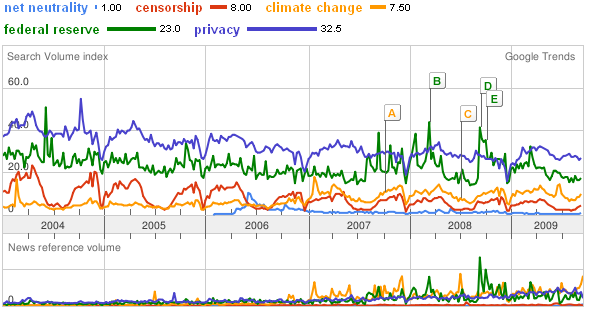 This kind of comparison should dispel once and for all the myth of a popular groundswell for net neutrality regulation—especially since online search volumes heavily over-represent the interests of the digerati, thus over-stating general interest in web-related topics.
In fact, “Net Neutrality” regulation is a
niche cause trumpeted incessantly by the blogosphere with about the same level of broad popular interest online as “housing rights”—a topic about which most of us probably don’t often fall into conversation (unless we happen to live in Bakuninist Berkeley or the Bolivarian Caliphate of Cambridge, MA, ground-zero of American Chavismo). Continue reading →
Libertarian folk-hero Rep. Ron Paul has apparently convinced (WSJ) House Financial Services Committee Chairman Barney Frank to implement his proposal (HR 1207) for an audit of the Federal Reserve by the end of 2010. Paul’s Bill would expand existing audits considerably because, under current law, the Government Accountability Office,
can’t review most of the Fed’s monetary policy actions or decisions, including discount window lending (direct loans to financial institutions), open-market operations and any other transactions made under the direction of the Federal Open Market Committee. It also can’t look into the Fed’s transactions with foreign governments, foreign central banks and other international financing organizations…
While the bill only seeks a one-time audit, [Paul] said he wants the Fed to be audited at least annually with the report — and details of its transactions — disclosed publicly.
I’d like to up the ante: Let’s make sure that any data disclosures are made in eXtensible Business Reporting Language (XBRL), as Mark Cuban and our own Jim Harper have previously suggested. Such machine-readable disclosures would be much more useful, because the data could be analyzed or “mashed-up” with other data sets to answer questions we might not even be able to formulate today.
The New York Times, that dinosaur of old media, is currently live-blogging the most important Congressional debate since that epochal, thoughtful discussion back in October 2002 as to whether Iraq posed a clear and present danger to the United States justifying a declaration of war—I mean, total non-debate that preceded Congress’s decision to issue President a blank checkthat has proved nearly as expensive as the blank check currently before the Congress.
The highlight of the debate thus far:
11:39 a.m. | No socialism!: After Jeb Hensarling, a Republican representative from Texas, affirmed that he was voting against the bill because it smacks of socialism and might represent limits on liberty, Barney Frank, a Democratic representative from Massachusetts, said that he is “ever mindful” that George Bush might “lead us down the road to socialism,” and so Congress would monitor the bailout closely.
Wow. When Barney Frank, just about the closest thing to an avowed socialist in Congress after Bernie Sanders, warns about the dangers of a Republican president and supposed “free market” champion leading us down the “Road to (socialist) Serfdom,” we should all feel a terrible chill. To paraphrase the over-paraphrased Yeats:
Surely some revelation is at hand
Surely the Second Coming is at hand!
… what rough beast, its hour come round at last,
Slouches towards [Washington] to be born?

 The Technology Liberation Front is the tech policy blog dedicated to keeping politicians' hands off the 'net and everything else related to technology.