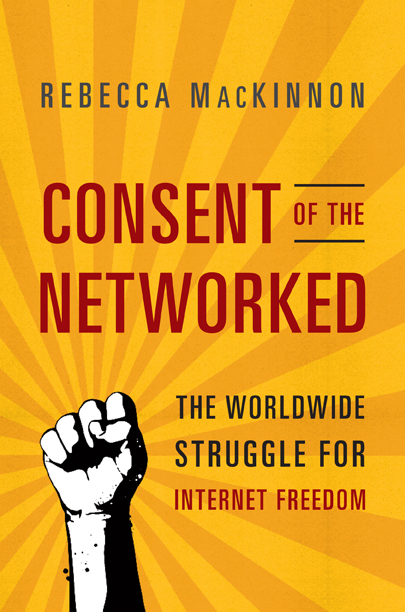
 Rebecca MacKinnon’s new book, Consent of the Networked: The Worldwide Struggle for Internet Freedom, is well-researched exploration of the forces driving Internet developments and policy across the globe today. She serves up an outstanding history of recent global protest movements and social revolutions and explores the role that Internet technologies and digital networks played in those efforts. She also surveys some of the recent policy fights here and abroad over issues such as online privacy, Net neutrality regulation, free speech matters, and the copyright wars. The Consent of the Networked is certainly worth reading and will go down as one of the most important Internet policy books of 2012.
A Call to Action
Of course, it’s not just a history lesson. MacKinnon has also issued a call-to-arms here. As a well-known web activist, MacKinnon has emerged as a leading force in the broad-based, if loosely-defined, “Net freedom” movement. The term “Net freedom,” she notes, means very different things to different people. It’s “like a Rorschach inkblot test: different people look at the same ink splotch and see very different things.” (p. 188) Nonetheless, on the global stage, the Internet freedom movement is fundamentally tied up with efforts to hold both governments and corporate actors more accountable for their actions toward the Netizens, digital networks, and online speech and expression. Continue reading →
Well, even though I just recently put to bed my annual list of the “Most Important Info-Tech Policy Books of 2010,” I’ve already started investigating what new titles we’ll need to pay attention to in 2011. Accordingly, I’ve started this list and hope that others can suggest other books I may have missed. Here’s what I’ve got so far:
Rebecca MacKinnon has an important piece in the Wall Street Journal today about China’s “Green Dam Youth Escort” filtering mandate and the danger of this model catching on with other governments. “More and more governments — including democracies like Britain, Australia and Germany — are trying to control public behavior online, especially by exerting pressure on Internet service providers,” she notes. “Green Dam has only exposed the next frontier in these efforts: the personal computer.”
She’s right, and that’s cause for serious concern. Moreover, there’s the question of how corporations doing business in China should respond to demands and threats related to installing such filters. She notes:
In a world that includes child pornographers and violent hate groups, it is probably not reasonable to oppose all censorship in all situations. But if technical censorship systems are to be put in place, they must be sufficiently transparent and accountable so that they do not become opaque extensions of incumbent power — or get hijacked by politically influential interest groups without the public knowing exactly what is going on.
Which brings us back to companies: the ones that build and run Internet and telecoms networks, host and publish speech, and that now make devices via which citizens can go online and create more speech. Companies have a duty as global citizens to do all they can to protect users’ universally recognized right to free expression, and to avoid becoming opaque extensions of incumbent power — be it in China or Britain.
I generally agree with all that but this is a difficult issue and one that I have struggled with personally. (See this “Friendly Conversation about Corporate High-Tech Engagement with China” that Jim Harper and I had three years ago). But I do hope that more companies take a hard line with the Chinese as well as there own governemnts when it comes to filtering mandates or even restricitve parental control defaults and settings [an issue I wrote more about in this paper: “The Perils of Mandatory Parental Controls and Restrictive Defaults.”] On that note, kudos to the business groups that already signed on to a joint letter oppossing China’s new filtering mandate.

 The Technology Liberation Front is the tech policy blog dedicated to keeping politicians' hands off the 'net and everything else related to technology.