The Parents Television Council (PTC) released a new report today entitled Women in Peril: A Look at TV’s Disturbing New Storyline Trend. The report argues that “by depicting violence against women with increasing frequency, or as a trivial, even humorous matter, the broadcast networks may ultimately be contributing to a desensitized atmosphere in which people view aggression and violence directed at women as normative, even acceptable,” said PTC President Tim Winter. As evidence the report cites… Nicole Kidman. OK, it cites more than Nicole Kidman, but the 7-page report and accompanying press release does seem to place a lot of stock in the fact that, while being questioning by a House Foreign Affairs subcommittee hearing about violence against women overseas, “Ms. Kidman conceded that Hollywood has probably contributed to violence against women by portraying them as weak sex objects, according to the Associated Press.” I’m not sure what Ms. Kidman was doing testifying before Congress on the matter of violence against women overseas — dare I suggest some congressmen were out for another photo-op with a Hollywood celeb? — but the better question is whether Ms. Kidman’s opinion has any bearing on the question of what relationship, if any, there is between televised violence and real-world violence against women. (Incidentally, if she really feels passionately about all this, is she prepared to go back and recut some of her old scenes in “Dead Calm,” “To Die For,” and “Eyes Wide Shut“?)
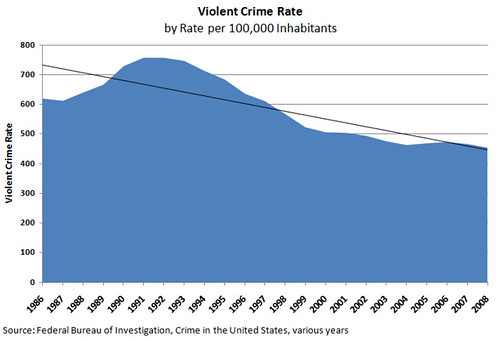
But let’s not nitpick about the credentials Ms. Kidman brings to the table or whether it makes any sense for PTC to elevate her opinions to proof of theory when it comes to a supposed connection between depictions of violence against women in film or television and real world acts of violence against women. PTC, however, suggests that’s exactly what is going on today. They allude to a few lab studies which are of the “monkey see, monkey do” variety — where the results of artificial lab experiments are used to claim that watching depictions of violence will turn us all into killing machines, rapists, robbers, or just plain ol’ desensitized thugs.
There’s just one problem with such studies, and the PTC report: Reality. Continue reading →
Over at Ars Technica, Matt Lasar does a nice job pointing out how the FCC’s quarterly indecency complaint totals have again been inflated by one group: the Parents Television Council. This is something Lasar has written about before and he’s one of the few journalists who continues to ask sharp questions about the ongoing manipulation of these statistics by PTC. As Lasar notes in his latest piece:
for the first quarter of this year, show the viewers relatively calm at 578 complaints in January, then 505 in February, followed by 179,997 in March? 179,997? Um, did we miss something? Did television really get that much more indecent in March? No worries. In these situations, we know what to do. We go over and check out the Parents Television Council‘s website. And sure enough, there’s a plausible instigator—a PTC viewer action alert crusade against a March 8 episode of the animated comedy show the PTC just loves to hate, Fox TV’s Family Guy.
This “complaint box stuffing” is something I wrote quite a bit about in the past, especially in my 2005 paper, “Examining the FCC’s Complaint-Driven Broadcast Indecency Enforcement Process.” As I pointed out there, “The PTC’s increasingly effective use of computer-generated campaigns against specific TV programs is a leading factor in explaining the large jump in indecency complaints in recent years.” Specifically, as I noted in that paper (as well as a Supreme Court filing with my friends at CDT), the FCC quietly and without major notice made two methodological changes to its tallying of broadcast indecency complaints in 2003 & 2004 that PTC requested: Continue reading →
As I mentioned in a post last month, dozens of comments were filed with the Federal Communications Commission (FCC) as part of the agency’s “Child Safe Viewing Act” Notice of Inquiry. Again, this proceeding was required under the “Child Safe Viewing Act of 2007,” which Congress passed last year and President Bush signed last December. The goal of the bill and the FCC’s proceeding (MB 09-26) is to study “advanced blocking technologies” that “may be appropriate across a wide variety of distribution platforms, including wired, wireless, and Internet platforms.” I filed 150+ pages worth of comments in this matter, and here’s my analysis of why this bill and the FCC’s proceeding are worth monitoring closely.
Anyway, this week saw many of the same groups that filed before (and some new ones) file reply comments about those earlier submissions. To make things simple, I have collected most of the notable reply comments down below in case anyone is interested.
Continue reading →
I’ve been blathering on about this week’s big Supreme Court decision in FCC v. Fox, [See Parts 1, 2, 3, 4, 5], so I thought I would just wrap this series of essays up with a collection of other articles and views on the decision in case readers are looking for alternative perspectives:
Mainstream Media Stories
Conservative, Religious, & “Family” Groups
Free Speech Advocates or Other Views
The Parents Television Council (PTC), a media activist group that routinely petitions Congress and the FCC for greater content regulation, recently released a new poll which they say proves that the V-Chip and parental control technologies have been a failure.
Their poll finds that only 11% of those surveyed said they used the V-chip or their cable box parental controls to block unwanted content from their television during the past week. And that result is virtually unchanged from a poll they took last September asking the same question. Therefore, the PTC concludes that recent efforts by broadcasters and cable companies to spend hundreds of millions of dollars educating families about these parental control tools have been a failure. And, unsurprisingly, the PTC feels that this again shows the need for government regulators need to step in and do more national nannying for us.
As I’ll make clear in a moment, the V-Chip and current television ratings are certainly not perfect. And I have no doubt that household usage of these tools is quite low for reasons I’ll get into. But let me first address what appears to be a rather glaring methodological deficiency of this PTC poll which makes it difficult to take seriously.
Continue reading →

 The Technology Liberation Front is the tech policy blog dedicated to keeping politicians' hands off the 'net and everything else related to technology.
Reply Comments in FCC’s “Child Safe Viewing Act” Notice of Inquiry
by Adam Thierer on May 20, 2009 · 17 comments
As I mentioned in a post last month, dozens of comments were filed with the Federal Communications Commission (FCC) as part of the agency’s “Child Safe Viewing Act” Notice of Inquiry. Again, this proceeding was required under the “Child Safe Viewing Act of 2007,” which Congress passed last year and President Bush signed last December. The goal of the bill and the FCC’s proceeding (MB 09-26) is to study “advanced blocking technologies” that “may be appropriate across a wide variety of distribution platforms, including wired, wireless, and Internet platforms.” I filed 150+ pages worth of comments in this matter, and here’s my analysis of why this bill and the FCC’s proceeding are worth monitoring closely.
Anyway, this week saw many of the same groups that filed before (and some new ones) file reply comments about those earlier submissions. To make things simple, I have collected most of the notable reply comments down below in case anyone is interested. Continue reading →