Today is the 33rd anniversary of the Supreme Court’s landmark First Amendment decision, FCC v. Pacifica Foundation. By a narrow 5-4 vote in this 1978 decision, the Court held that the FCC could impose fines on radio and TV broadcasters who aired indecent content during daytime and early evening hours. The Court used some rather tortured reasoning to defend the proposition that broadcast platforms deserved lesser First Amendment treatment than all other media platforms. The lynchpin of the decision was the so-called “pervasiveness theory,” which held that broadcast speech was “uniquely pervasive” and an “intruder” in the home, and therefore demanded special, artificial content restrictions.
Back in 2008, when
Pacifica turned 30, I penned a 6-part series critiquing the decision and discussing its impact on First Amendment jurisprudence:
In addition to those essays, I brought all my thinking together on this issue in a 2007 law review article, “Why Regulate Broadcasting: Toward a Consistent First Amendment Standard for the Information Age.” Importantly, this could be the last year we “celebrate” a Pacifica anniversary. Earlier this week, on the same day it handed down a historical video game free speech win, the Supreme Court announced that next term it will examine the constitutionality of FCC efforts to regulate “indecent” speech on broadcast TV and radio. Here’s hoping the Supreme Court takes the sensible step of undoing the unjust regulatory mess they created with Pacifica 33 years ago. Speech is speech is speech. Lawmakers should not be regulating it differently just because it’s on TV or radio instead of cable TV, satellite radio or TV, physical media, or the Internet. Continue reading →
The Second Circuit just threw out the FCC’s broadcast indecency rules—which had led to heavy fines for “fleeting expletives”—as “unconstitutionally vague, creating a chilling effect that goes far beyond the fleeting expletives at issue here.” What’s ultimately most important about this decision is not what the court did, but what it said: The Constitutional framework that has allowed broadcast censorship has been rendered obsolete by the rise of the Internet and parental empowerment tools for new and old media.
In short, the court utterly rejected the Supreme Court’s 1978
Pacifica decision
—which gave the FCC great discretion in regulating indecency on broadcast radio and television in order to protect children who might be in the audience during daytime and early evening hours, citing the unique “pervasiveness” and “invasiveness” of broadcasting into the home. The court fully embraced what we’ve been saying for years—neither rationale holds true anymore:
we face a media landscape that would have been almost unrecognizable in 1978. Cable television was still in its infancy. The Internet was a project run out of the Department of Defense with several hundred users. Not only did Youtube, Facebook,and Twitter not exist, but their founders were either still in diapers or not yet conceived. In this environment, broadcast television undoubtedly possessed a “uniquely pervasive presence in thelives of all Americans.”
The same cannot be said today. The past thirty years has seen an explosion of media sources, and broadcast television has become only one voice in the chorus. Cable television is almost as pervasive as broadcast…. The internet, too, has become omnipresent, offering access to everything from viral videos to feature films and, yes, even broadcast television programs…. Moreover, technological changes have given parents the ability to decide which programs they will permit their children to watch. (15-16)
Thus, the Second Circuit all but begged the Supreme Court to throw out
Pacifica completely, but quickly noted that it is “bound by Supreme Court precedent, regardless of whether it reflects today’s realities” (17). Fortunately, the court was able to reach the same result on vagueness grounds. It’s worth reading this key passage to see what a consistent approach to the First Amendment would look like: Continue reading →
Glen Robinson, my favorite professor back at Virginia Law, will be giving a lecture about “Regulating Communications: Stories from the First Hundred Years” at George Mason Law School this Thursday (2/18) at 4 pm. You simply couldn’t find a better person to give that talk. Robinson isn’t quite old enough to first-hand stories all the way back to the birth of the Federal Radio Commission in 1926 and the FCC in 1934, but he started practicing communications law back in 1961, was an FCC Commissioner 1974-76, and has taught at UVA since 1976 (until finally retiring in 2008).
Reading about his long career is a bit like watching the British comedy series Black Adder: Somehow, like Rowan Atkinson’s character Black Adder, Robinson keeps popping up again and again at pivotal moments in communications law history—most notably, he worked to draft early anti-cable rules in the 1960s and voted for the FCC’s indecency prosecution against George Carlin’s “Filthy Words” monologue. But unlike Black Adder, who always happens to be at the right place at the right time, make the wrong decisions and foolishly learns nothing, Robinson sometimes made the wrong decision, but demonstrated that rare ability to rethink his approach and admit he was wrong—an intellectual honesty most famously exemplified by FA Hayek. Robinson grew to become among the most trenchant, and certainly the most sage, critic of the FCC’s constant evolution towards censorship and curtailing competition in the communications industry. His general skepticism about administrative regulation is perhaps the most thoughtful and refined you’ll find in academe—and not just in communications law. Continue reading →
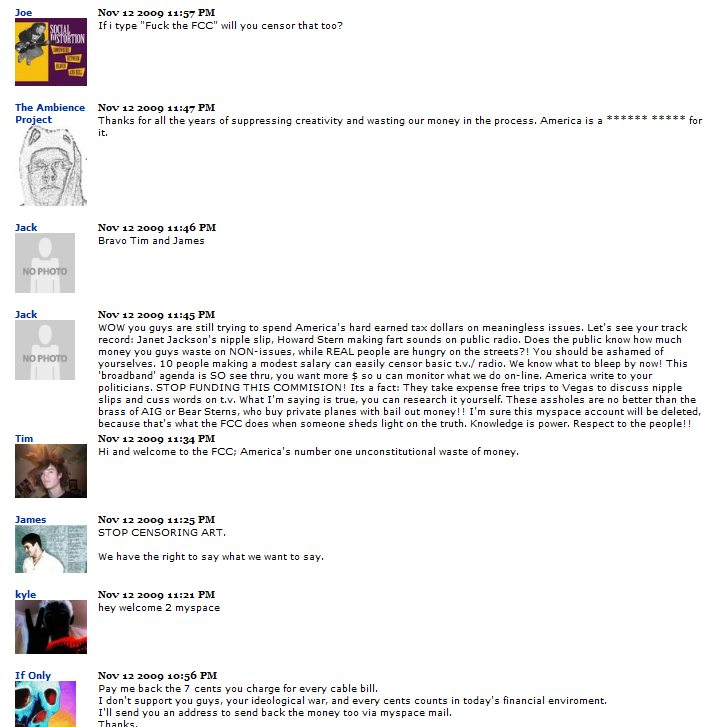
Oh my. So today, as part of its ongoing effort to look like the hip new regulatory agency on the block, the Federal Communications Commission decided to launch a MySpace page. Really. Big. Mistake.
I mean, shouldn’t someone over there have known it would take about 2 milliseconds for various cranks to launch into profanity-laced rants that would make George Carlin blush? Sure enough, the page is already littered with some of the most colorful language you’ll ever lay your eyes on, mixed in with some 9/11 conspiracy theories, a plug for the Marijuana Policy Posse, and something about the FCC “build[ing] a cone of terror in [our] homes.”
Go check it out, but avert the children’s eyes first. It ain’t pretty. Which begs the question: Will the FCC apply its Pacifica indecency standard to its own MySpace page? Seems like their site is pretty “pervasive” to me, and there could be “children in the viewing audience.” Time to censor these “fleeting expletives” on the FCC’s MySpace page!
 The latest edition (Version 4.0) of my PFF special report on “Parental Controls and Online Child Protection: A Survey of Tools & Methods” is now up. For those not familiar with the report, it explores the market for parental control tools, rating schemes, education and media literacy efforts, and various other tools, methods, and initiatives aimed at promoting online child safety. After evaluating that state of this market, I conclude: “There has never been a time in our nation’s history when parents have had more tools and methods at their disposal to help them decide what constitutes acceptable media content in their homes and in the lives of their children.” Moreover, I believe that the parental controls and content management tools cataloged in the report represent a better, less restrictive alternative to government regulation.
Version 4.0 of the report is now over 250 pages long (up from 200 pages in Version 3.0) and it contains almost 70 exhibits (up from 50), 725 references (up from roughly 500), and numerous updates in all five sections of the book. Major updates have been made to the Internet, social networking, and mobile media sections, reflecting the growing importance of those sectors and issues. Other new sections or appendices have also been added to the report, including:
- a new section examining how many households really need parental control tools;
- a new appendix on the downsides of mandatory parental controls and restrictive default settings;
- a new section on the dangers of “deputizing the online middleman” solution as an approach to solving child safety concerns;
- a new appendix reviewing the findings of 5 past online safety task forces;
- … and much more.
I issue major updates once a year and 1 or 2 minor tweaks during the course of the year to reflect the evolution of the parental control and online child safety marketplace and debate. The report is available free-of-charge on the PFF website, and the previous editions of the report are housed there too in case you want to see how it has evolved over the past couple of years. For those interested in taking a quick look at the report, I have embedded it down below the fold as a Scribd file. Finally, as is always the case, I encourage readers to send me updates and suggestions for how to improve the report and I will incorporate them into future versions.
Continue reading →
I’ve been commenting on yesterday’s Supreme Court decision in FCC v. Fox, and criticizing the logic of the majority’s decision the case, which was driven solely by procedural / admin law considerations. [See Part 3.] I also discussed Justice Thomas’s very interesting concurring opinion, which took a serious look at the constitutional issues in play here and signaled his willingness to potentially overturn Red Lion and Pacifica. [See Part 4.] In this fifth installment, I will briefly outline some of the dissenting arguments.
Justice Stephen Breyer penned a lengthy dissent and was joined by Justices Stevens, Souter and Ginsburg. Like the Scalia majority decision, the Breyer dissent also focused on the procedural / APA-related issues at stake in the case. Breyer, however, was not buying the FCC’s assertion that it had adequately justified its significant expansion of indecency enforcement in recent years. Whereas the majority deferred to the agency and found “no basis in the Act or this Court’s opinions for a requirement that all agency change be subjected to more searching review,” the four dissenting justices saw things quite differently. Breyer noted that while the “law grants those in charge of independent administrative agencies broad authority to determine relevant policy,” it “does not permit them to make policy choices for purely political reasons nor to rest them primarily upon unexplained policy preferences.” He goes on to appropriately note that:
Federal Communications Commissioners have fixed terms of office; they are not directly responsible to the voters; and they enjoy an independence expressly designed to insulate them, to a degree, from “‘the exercise of political oversight.’” [citations omitted] That insulation helps to secure important governmental objectives, such as the constitutionally related objective of maintaining broadcast regulation that does not bend too readily before the political winds. But that agency’s comparative freedom from ballot-box control makes it all the more important that courts review its decision making to assure compliance with applicable provisions of the law — including law requiring that major policy decisions be based upon articulable reasons.
Breyer goes on to restate much of what is already clear from the APA and all that surrounds it. “[A]n agency must act consistently. The agency must follow its own rules,” he notes. Moreover: Continue reading →
With today’s historic Supreme Court decision in FCC v. Fox, I have been commenting on the logic and implications of the decision. Part 3 dealt with the majority’s decision in the case, which was driven solely by procedural / admin law considerations. This installment will discuss the very interesting concurring opinion penned by Justice Thomas, which is the only one that takes a serious look at the constitutional foundations of the FCC’s current regulatory regime. While I was sad to see Justice Thomas join the majority’s decision upholding the FCC’s radical expansion of speech regulation in recent years, he joined that majority only on straightforward procedural grounds. On the underlying constitutional issues at stake here, it is clear from his concurring statement that he is ready for the Court to hear a challenge to the previous court precedents and traditional regulatory doctrines that have long supported FCC speech and media controls.
“I write separately,” Justice Thomas says “to note the questionable viability of the two precedents that support the FCC’s assertion of constitutional authority to regulate the programming at issue in this case.” Specifically, he addresses the two key cases upon which almost all FCC speech regulation rests: Red Lion Broadcasting Co. v. FCC, 395 U. S. 367 (1969) and FCC v. Pacifica Foundation, 438 U. S. 726 (1978). Thomas continues: “Red Lion and Pacifica were unconvincing when they were issued, and the passage of time has only increased doubt regarding their continued validity.”
BOOM! With those words, Justice Thomas has dropped the hammer and taken what will hopefully be the first swing at toppling the house of cards that is modern FCC speech regulation. Justice Thomas goes on to itemize the many problems with what I have referred to as “America’s Jurisprudential Twilight Zone” when it comes to how we apply the First Amendment to media platforms in this country. He states:
Continue reading →
Today, it was my great privilege to guest lecture at Princeton University’s Center for Information Technology Policy. Under the leadership of Ed Felten, who also runs the excellent “Freedom to Tinker” blog, the CITP has quickly become one of America’s premier institutions in the field of IT policy matters. David Robinson, who some of you will remember from his days as an editor at The American, serves as associate director of the CITP program and was kind enough to invite me to speak. And our own Tim Lee is currently studying there as well. I wish I was smart enough to get into that program!
The topic of my talk was “The Future of the First Amendment in an Age of Technological Convergence” and I used the opportunity to create a narrated video of this presentation, which I have made to several other groups through the years. In this presentation, I talk about “America’s First Amendment Twilight Zone,” which refers to the fact that identical words and images are being regulated in completely different ways today depending on the mode of transmission. This illogical and unfair situation could eventually threaten the Internet, video games, and all new media with many of the misguided regulations that have long been imposed on broadcast television and radio operators. In my presentation, which you can watch below, I make the case for changing our First Amendment regime to ensure “bit equality”; all speech and media platforms should be accorded the gold standard of First Amendment protection.
http://www.youtube.com/v/xJo3tVMScyI&hl=en&fs=1
Continue reading →
My new article on “FCC v. Fox and the Future of the First Amendment” has just been published in the February 2009 edition of Engage, the journal of the Federalist Society. Here’s how it begins:
On November 4th, 2008, the Supreme Court heard oral arguments in the potentially historic free speech case of Federal Communications Commission v. Fox Television Stations, Inc. This case, which originated in the Second Circuit Court of Appeals, deals with the FCC’s new policy for “fleeting expletives” on broadcast television. The FCC lost and appealed to the Supreme Court. By contrast, the so-called “Janet Jackson case” — CBS v. FCC — was heard in the Third Circuit Court of Appeals. The FCC also lost that case and has also petitioned the Supreme Court to review the lower court’s ruling.
These two cases reflect an old and odd tension in American media policy and First Amendment jurisprudence. Words and images presented over one medium-in this case broadcast television-are regulated differently than when transmitted through any other media platform (such as newspapers, cable TV, DVDs, or the Internet). Various rationales have been put forward in support of this asymmetrical regulatory standard. Those rationales have always been weak, however. Worse yet, they have opened the door to an array of other regulatory shenanigans, such as the so-called Fairness Doctrine, and many other media marketplace restrictions.
Whatever sense this arrangement made in the past, technological and marketplace developments are now calling into question the wisdom and efficacy of the traditional broadcast industry regulatory paradigm. This article will explore both the old and new rationales for differential First Amendment treatment of broadcast television and radio operators and conclude that those rationales: (1) have never been justified, and (2) cannot, and should not, survive in our new era of media abundance and technological convergence.
I go on in the piece to make the case against the those rationales and the call for the Supreme Court to use the
Fox and CBS cases to end this historical First Amendment anomaly of differential treatment of broadcast platforms relative to all other media providers.
This article can be downloaded as a PDF here, or viewed down below the fold in the Scribd reader.
Continue reading →
Just FYI, the latest update of my booklet on “Parental Controls and Online Child Protection: A Survey of Tools & Methods” is now live. The new version, Version 3.1, provides minor updates to all sections of the book and a new appendix of relevant research in the field. I issue major updates early each year and 1 or 2 tweaks during the course of the year to reflect the evolution of the parental control and online child safety market and debate.
For those not familiar with the report, it explores the market for parental control tools, rating schemes, education efforts, and initiatives aimed at promoting online child safety. I believe that the parental controls and content management tools cataloged in the report represent a better, less restrictive alternative to government regulation. As I conclude after evaluating that state of the market: “There has never been a time in our nation’s history when parents have had more tools and methods at their disposal to help them decide what constitutes acceptable media content in their homes and in the lives of their children.”
The report is available free-of-charge on the PFF website, and the previous editions of the report are housed there too in case you want to see how it has evolved over the past two years. For those interested in taking a quick look at the report, I have embedded it down below the fold as a Scribd file. Finally, as is always the case, I encourage readers to send me updates and suggestions for how to improve the report and I will incorporate them into future versions.
Continue reading →

 The Technology Liberation Front is the tech policy blog dedicated to keeping politicians' hands off the 'net and everything else related to technology.