This weekend, The Wall Street Journal ran my short letter to the editor entitled, “We Can Protect Children and Keep the Internet Free.” My letter was a response to columnist Peggy Noonan’s April 9 oped, “Can Anyone Tame Big Tech?” in which she proposed banning everyone under 18 from all social-media sites. She specifically singled out TikTok, Youtube, and Instagram and argued “You’re not allowed to drink at 14 or drive at 12; you can’t vote at 15. Isn’t there a public interest here?”
I briefly explained why Noonan’s proposal is neither practical nor sensible, noting how it:
would turn every kid into an instant criminal for seeking access to information and culture on the dominant medium of their generation. I wonder how she would have felt about adults proposing to ban all kids from listening to TV or radio during her youth.
Let’s work to empower parents to help them guide their children’s digital experiences. Better online-safety and media-literacy efforts can prepare kids for a hyperconnected future. We can find workable solutions that wouldn’t usher in unprecedented government control of speech.
Let me elaborate just a bit because this was the focus of much of my writing a decade ago, including my book, Parental Controls & Online Child Protection: A Survey of Tools & Methods, which spanned several editions. Online child safety is a matter I take seriously and the concerns that Noonan raised in her oped have been heard repeatedly since the earliest days of the Internet. Regulatory efforts were immediately tried. They focused on restricting underage access to objectionable online content (as well as video games), but were immediately challenged and struck down as unconstitutionally overbroad restrictions on free speech and a violation of the First Amendment of the U.S. Constitution. Continue reading →
I have been covering telecom and Internet policy for almost 30 years now. During much of that time – which included a nine year stint at the Heritage Foundation — I have interacted with conservatives on various policy issues and often worked very closely with them to advance certain reforms.
If I divided my time in Tech Policy Land into two big chunks of time, I’d say the biggest tech-related policy issue for conservatives during the first 15 years I was in the business (roughly 1990 – 2005) was preventing the resurrection of the so-called Fairness Doctrine. And the biggest issue during the second 15-year period (roughly 2005 – present) was stopping the imposition of “Net neutrality” mandates on the Internet. In both cases, conservatives vociferously blasted the notion that unelected government bureaucrats should sit in judgment of what constituted “fairness” in media or “neutrality” online.
Many conservatives are suddenly changing their tune, however. President Trump and Sen. Ted Cruz, for example, have been increasingly critical of both traditional media and new tech companies in various public statements and suggested an openness to increased regulation. The President has gone after old and new media outlets alike, while Sen. Cruz (along with others like Sen. Lindsay Graham) has suggested during congressional hearings that increased oversight of social media platforms is needed, including potential antitrust action.
Meanwhile, during his short time in office, Sen. Josh Hawley (R-Mo.) has become one of the most vocal Internet critics on the Right. In a shockingly-worded USA Today editorial in late May, Hawley said, “social media wastes our time and resources” and is “a field of little productive value” that have only “given us an addiction economy.” He even referred to these sites as “parasites” and blamed them for a long list of social problems, leading him to suggest that, “we’d be better off if Facebook disappeared” along with various other sites and services.
Hawley’s moral panic over social media has now bubbled over into a regulatory crusade that would unleash federal bureaucrats on the Internet in an attempt to dictate “fair” speech on the Internet. He has introduced an astonishing piece of legislation aimed at undoing the liability protections that Internet providers rely upon to provide open platforms for speech and commerce. If Hawley’s absurdly misnamed new “Ending Support for Internet Censorship Act” is implemented, it would essentially combine the core elements of the Fairness Doctrine and Net Neutrality to create a massive new regulatory regime for the Internet. Continue reading →
[originally published on Plaintext on June 21, 2017.]
This summer, we celebrate the 20th anniversary of two developments that gave us the modern Internet as we know it. One was a court case that guaranteed online speech would flow freely, without government prior restraints or censorship threats. The other was an official White House framework for digital markets that ensured the free movement of goods and services online.
The result of these two vital policy decisions was an unprecedented explosion of speech freedoms and commercial opportunities that we continue to enjoy the benefits of twenty years later.
While it is easy to take all this for granted today, it is worth remembering that, in the long arc of human history, no technology or medium has more rapidly expanded the range of human liberties — both speech and commercial liberties — than the Internet and digital technologies. But things could have turned out much differently if not for the crucially important policy choices the United States made for the Internet two decades ago. Continue reading →
I wanted to draw your attention to this important address on online platform regulation by Alex Chisholm, the head of UK’s Competition and Markets Authority. That’s the non-ministerial department in the UK responsible for competition policy issues. Chisholm delivered the address on October 27th at the Bundesnetzagentur conference in Bonn. It’s a terrific speech that other policymakers would be wise to read and mimic to ensure that antitrust and competition policy decisions don’t derail the many benefits of the Information Revolution.
“Today, as regulators, we have the responsibility but also the great historical privilege of playing an influential role in the deployment throughout the economy of the latest of these defining technological eras,” Chisholm began. “As regulators, we must try to minimise the inevitable mismatch between how we’ve done things before and the opportunities and risks of the new,” he argued.
He continued on to specify three recommendations for those crafting policy on this front: Continue reading →
On Thursday, it was my great pleasure to participate in a Washington Legal Foundation (WLF) event on “Online Privacy Regulation: The Challenge of Defining Harm.” The entire event video can be found on YouTube here, but down below I pasted the clip of just my remarks. Other speakers at the event included: FTC Commissioner Maureen K. Ohlhausen, Commissioner; John B. Morris, Jr., the Associate Administrator and Director of Internet Policy athe U.S. Department of Commerce’s National Telecommunications and Information Administration; and Katherine Armstrong, Counsel at the law firm of Hogan Lovells. Glenn Lammi of the WLF moderated the session.
My remarks drew upon a few recent law review articles I have published relating digital privacy debates to previous debates over free speech and online child safety issues. (Here are those articles: 1, 2, 3).
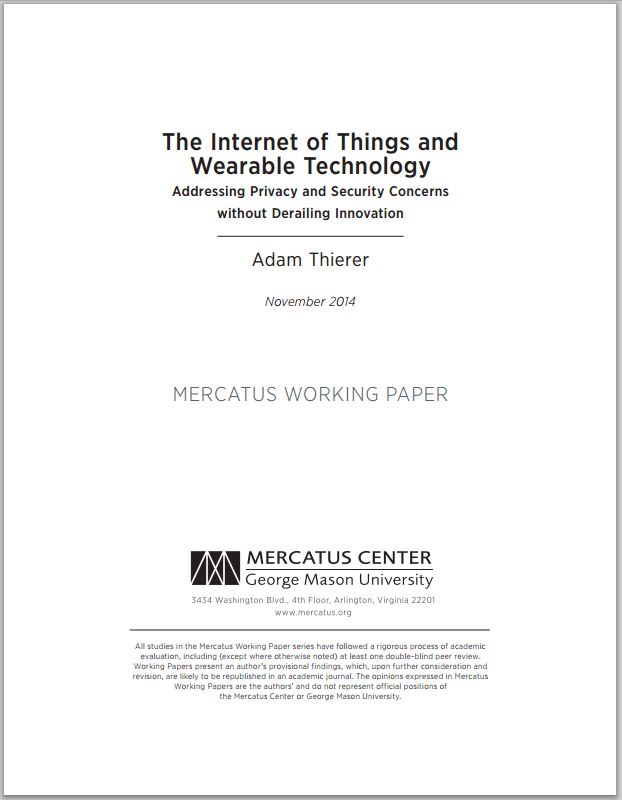
The Mercatus Center at George Mason University has just released my latest working paper, “The Internet of Things and Wearable Technology: Addressing Privacy and Security Concerns without Derailing Innovation.” The “Internet of Things” (IoT) generally refers to “smart” devices that are connected to both the Internet and other devices. Wearable technologies are IoT devices that are worn somewhere on the body and which gather data about us for various purposes. These technologies promise to usher in the next wave of Internet-enabled services and data-driven innovation. Basically, the Internet will be “baked in” to almost everything that consumers own and come into contact with.
Some critics are worried about the privacy and security implications of the Internet of Things and wearable technology, however, and are proposing regulation to address these concerns. In my new 93-page article, I explain why preemptive, top-down regulation would derail the many life-enriching innovations that could come from these new IoT technologies. Building on a recent book of mine, I argue that “permissionless innovation,” which allows new technology to flourish and develop in a relatively unabated fashion, is the superior approach to the Internet of Things.
As I note in the paper and my earlier book, if we spend all our time living in fear of the worst-case scenarios — and basing public policies on them — then best-case scenarios can never come about. As the old saying goes: nothing ventured, nothing gained. Precautionary principle-based regulation paralyzes progress and must be avoided. We instead need to find constructive, “bottom-up” solutions to the privacy and security risks accompanying these new IoT technologies instead of top-down controls that would limit the development of life-enriching IoT innovations. Continue reading →
On Thursday, it was my great pleasure to present a draft of my forthcoming paper, “The Internet of Things & Wearable Technology: Addressing Privacy & Security Concerns without Derailing Innovation,” at a conference that took place at the Federal Communications Commission on “Regulating the Evolving Broadband Ecosystem.” The 3-day event was co-sponsored by the American Enterprise Institute and the University of Nebraska College of Law.
The 65-page working paper I presented is still going through final peer review and copyediting, but I posted a very rough first draft on SSRN for conference participants. I expect the paper to be released as a Mercatus Center working paper in October and then I hope to find a home for it in a law review. I will post the final version once it is released. [UPDATE:The final version of this working paper was released on November 19, 2014.]
In the meantime, however, I thought I would post the 46 slides I presented at the conference, which offer an overview of the nature of the Internet of Things and wearable technology, the potential economic opportunities that exist in this space, and the various privacy and security challenges that could hold this technological revolution back. I also outlined some constructive solutions to those concerns. I plan to be very active on these issues in coming months.
My latest law review article is entitled, “Privacy Law’s Precautionary Principle Problem,” and it appears in Vol. 66, No. 2 of the Maine Law Review. You can download the article on my Mercatus Center page, on the Maine Law Review website, or via SSRN. Here’s the abstract for the article:
Privacy law today faces two interrelated problems. The first is an
information control problem. Like so many other fields of modern cyberlaw—intellectual property, online safety, cybersecurity, etc.—privacy law is being challenged by intractable Information Age realities. Specifically, it is easier than ever before for information to circulate freely and harder than ever to bottle it up once it is released.
This has not slowed efforts to fashion new rules aimed at bottling up those information flows. If anything, the pace of privacy-related regulatory proposals has been steadily increasing in recent years even as these information control challenges multiply.
This has led to privacy law’s second major problem:
the precautionary principle problem. The precautionary principle generally holds that new innovations should be curbed or even forbidden until they are proven safe. Fashioning privacy rules based on precautionary principle reasoning necessitates prophylactic regulation that makes new forms of digital innovation guilty until proven innocent.
This puts privacy law on a collision course with the general freedom to innovate that has thus far powered the Internet revolution, and privacy law threatens to limit innovations consumers have come to expect or even raise prices for services consumers currently receive free of charge. As a result, even if new regulations are pursued or imposed, there will likely be formidable push-back not just from affected industries but also from their consumers.
In light of both these information control and precautionary principle problems, new approaches to privacy protection are necessary. Continue reading →
Patrick Byrne, CEO of Overstock.com, discusses how Overstock.com became one of the first online retail stores to accept Bitcoin. Byrne provides insight into how Bitcoin lowers transaction costs, making it beneficial to both retailers and consumers, and how governments are attempting to limit access to Bitcoin. Byrne also discusses his project DeepCapture.com, which raises awareness for market manipulation and naked short selling, as well as his philanthropic work and support for education reform.
Jack Schinasi discusses his recent working paper, Practicing Privacy Online: Examining Data Protection Regulations Through Google’s Global Expansion published in the Columbia Journal of Transnational Law. Schinasi takes an in-depth look at how online privacy laws differ across the world’s biggest Internet markets — specifically the United States, the European Union and China. Schinasi discusses how we exchange data for services and whether users are aware they’re making this exchange. And, if not, should intermediaries like Google be mandated to make its data tracking more apparent? Or should we better educate Internet users about data sharing and privacy? Schinasi also covers whether privacy laws currently in place in the US and EU are effective, what types of privacy concerns necessitate regulation in these markets, and whether we’ll see China take online privacy more seriously in the future.
The Technology Liberation Front is the tech policy blog dedicated to keeping politicians' hands off the 'net and everything else related to technology. Learn more about TLF →

 The Technology Liberation Front is the tech policy blog dedicated to keeping politicians' hands off the 'net and everything else related to technology.