Here’s a new animated explainer video that I narrated for the Federalist Society’s Regulatory Transparency Project. The 3-minute video discusses how earlier “tech giants” rose and fell as technological innovation and new competition sent them off to what the New York Times once appropriately called “The Hall of Fallen Giants.” It’s a continuing testament to the power of “creative destruction” to upend and reorder markets, even as many pundits insist that there’s no possibility change can happen.
Alice Marwick, assistant professor of communication and media studies at Fordham University, discusses her newly-released book, Status Update: Celebrity, Publicity, and Branding in the Social Media Age. Marwick reflects on her interviews with Silicon Valley entrepreneurs, technology journalists, and venture capitalists to show how social media affects social dynamics and digital culture. Marwick answers questions such as: Does “status conscious” take on a new meaning in the age of social media? Is the public using social media the way the platforms’ creators intended? How do you quantify the value of online social interactions? Are social media users becoming more self-censoring or more transparent about what they share? What’s the difference between self-branding and becoming a micro-celebrity? She also shares her advice for how to make Twitter, Tumblr, Instagram and other platforms more beneficial for you.
David Garcia, post doctoral researcher at the Swiss Federal Institute of Technology and co-author of Social Resilience in Online Communities: The Autopsy of Friendster, discusses the concept of social resilience and how online communities, like Facebook and Friendster, withstand changes in their environment.
Garcia’s paper examines one of the first online social networking sites, Friendster, and analyzes its post-mortem data to learn why users abandoned it.
Garcia goes on to explain how opportunity cost and cost benefit analysis can affect a user’s decision whether or not to remain in an online community.
In this new Money Morning article, “The Antitrust Curse: What Apple Can Learn From Microsoft, IBM,” David Zeiler wonders whether the antitrust lawsuit filed against Apple and several book publishers by the U.S. Department of Justice last week could open the door to a broader case against Apple or, at a minimum, simply become a major distraction to the firm and it’s ability to innovate going forward. He uses IBM and Microsoft as case studies in this regard and notes that, “the problem with being in the DOJ’s gunsight is that it distracts management, makes the company hesitant to innovate, and blemishes the company’s public image. While antitrust woes may not have been entirely responsible for Microsoft and IBM ceding their dominant positions in tech, they were clearly a major factor,” he says. “And worse for Apple, the e-book case could be just the beginning.”
Even if Apple beats back [the eBooks] investigation, broader questions are being raised about the company’s power that could invite a much broader investigation. The danger for Apple is that antitrust becomes an omnipresent threat that must be factored into all ongoing business decisions. Antitrust is a particular danger to Apple because the firm is highly vertically integrated and that integration is the source of many of their innovations. As earlier tech titans like IBM and Microsoft learned, when antitrust hangs like the Sword of Damocles, every decision about how to evolve and innovate becomes a calculated gamble.
Regarding the earlier impact that antitrust Sword of Damocles had on Microsoft, Zeiler unearthed this terrific 2005 quote from Mark Kroese, a general manager of information services at the Microsoft Network, who described the impact of the MS antitrust case on innovation at the firm as follows: “Working at Microsoft today vs. five years ago is different,” Kroese said. “If anyone thinks the antitrust case hasn’t slowed us down, you’re wrong. If I want to meet with a products manager for Windows, there needs to be three lawyers in the room. We have to be so careful, we err on the side of caution. We are on such a fine line of conduct.” Regarding how antitrust chilled IBM, Zeiler cites veteran tech journalist Steve Wildstrom of Tech.pinionswho noted, “Twelve years of litigation were an enormous distraction in a time of rapid technological and business change. IBM management became cautious and over-lawyered, constantly looking over its shoulder-a condition that persisted for years after the case ended. The antitrust case was almost certainly a major cause of the serious decline of IBM in the late 1980s and early 90s,” Wildstrom said.
Of course, it is impossible to scientifically determine to what degree antitrust harassment contributed to either IBM or Microsoft’s inability to innovate and adapt to the rapidly changing market conditions. And let’s be clear: both IBM and MS have found ways to rebound and innovate in other ways. But one wonders what was lost in the process as the threat of antitrust constantly loomed and potentially chilled innovative efforts that could have kept both firms on the cutting-edge. Continue reading →
In this paper, I note that to the extent public utility-style regulation has been debated within the Internet policy arena over the past decade, the focus has been almost entirely on the physical layer of the Internet. The question has been whether Internet service providers should be considered “essential facilities” or “natural monopolies” and regulated as public utilities. The debate over “net neutrality” regulation has been animated by such concerns.
While that debate still rages, the rhetoric of public utilities and essential facilities is increasingly creeping into policy discussions about other layers of the Internet, such as the search layer. More recently, there have been rumblings within academic and public policy circles regarding whether social media platforms, especially social networking sites, might also possess public utility characteristics. Presumably, such a classification would entail greater regulation of those sites’ structures and business practices.
Proponents of treating social media platforms as public utilities offer a variety of justifications for regulation. Amorphous “fairness” concerns animate many of these calls, but privacy and reputational concerns are also frequently mentioned as rationales for regulation. Proponents of regulation also sometimes invoke “social utility” or “social commons” arguments in defense of increased government oversight, even though these notions lack clear definition.
Social media platforms do not resemble traditional public utilities, however, and there are good reasons why policymakers should avoid a rush to regulate them as such. Continue reading →
The European Commission has a new report out today on “Implementation of the Safer Social Networking Principles for the EU.” It’s a status report on the implementation of “Safer Social Networking Principles for the EU“, a “self-regulatory” agreement the EC brokered with 17 social networking sites and other online operators back in 2009. (Co-regulatory would be more accurate here, since the EC is steering, and industry is simply rowing.) The goal was to make the profiles of minors more private and provide other safeguards.
Generally speaking, the EC’s evaluation suggests that great progress has been made, although there’s always room for improvement. For example, the report found that “13 out of the 14 sites tested provide safety information, guidance and/or educational materials specifically targeted at minors;” “Safety information for minors is quite clear and age-appropriate on all sites that provide it, good progress since the first assessment last year; “Reporting mechanisms are more effective now than in 2010;” and most sites have improved Terms of Use that are easy for minors to understand and/or a child-friendly version of the Terms of Use or Code of Conduct; and many “provide safety information for children and parents which is both easy to find and to understand.” Again, there’s always room for improvement, but the general direction is encouraging, especially considering how new many of these sites are.
Unfortunately, Neelie Kroes, Vice President of the European Commission for the Digital Agenda, spun the report in the opposite direction. She issued a statement saying: Continue reading →
Did you know that Facebook has a crack team of employees whose mission is to deal with offensive content and user complaints? Their ranks number in the hundreds. But while most websites have people on staff to deal with porn and violence, none of them have 350 million users to manage… Now the world’s largest social network found a way to deal with this shortage of manpower, though. Facebook has begun testing a new feature called the Facebook Community Council [currently invite-only]. According to a guest post on the Boing Boing blog by one of the council’s members, its goal is to purge Facebook of nudity, drugs, violence, and spam.
The Facebook Community Council is actually a Facebook app and tool for evaluating content for various offenses… The app’s tagging system allows council members to tag content with one of eight phrases: Spam, Acceptable, Not English, Skip, Nudity, Drugs, Attacking, and Violence. If enough council members tag a piece of content with the same tag, action is taken, often a takedown.
What Facebook is doing here is nothing all that new. Many other social networking sites or platforms such MySpace, Ning, and many others, do much the same. Video hosting sites like YouTube do as well. [See my summary of YouTube’s efforts down below]**
No doubt, some will be quick to decry “private censorship” with moves by social networking sites, video hosting sites, and others to flag and remove objectionable content within their communities, but such critics need to understand that:
Continue reading →
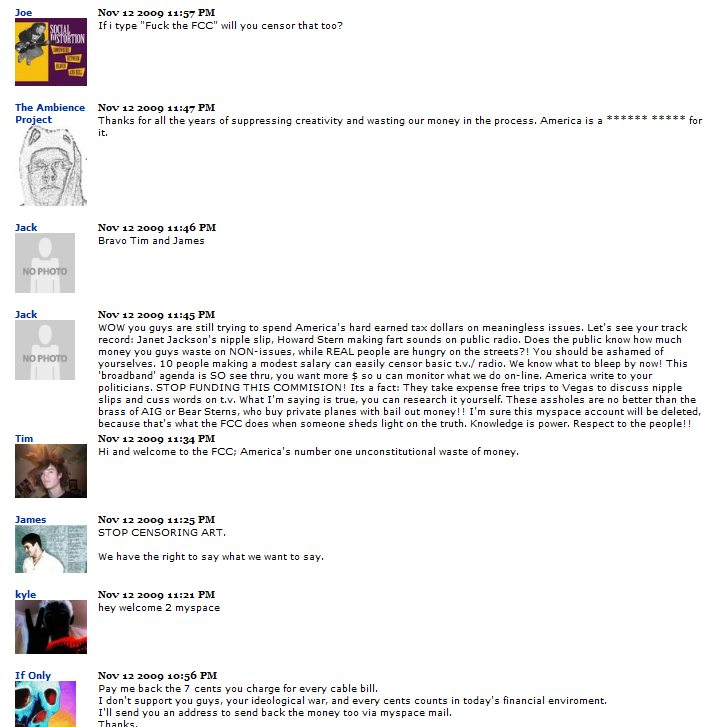
I got some feedback from readers about my post last night regarding the irony of the FCC’s newly-created MySpace page containing some rather vulgar user comments. I wondered if the agency would continue to allow such comments when the agency regulates similar words when they are uttered on broadcast TV or radio. A few people asked me why the agency hasn’t bother using the comment management tools that MySpace puts at the public’s disposal. It’s a good question, and actually I’m not sure why they didn’t do that right from the start. Perhaps the agency is concerned about being accused of censoring public comment. [Incidentally, the White House and some federal agencies have MySpace pages, so perhaps I need to look into how those agencies manage comments.]
Regardless, the FCC now
has taken steps to deal with this. John Eggerton of Broadcasting & Cable and Kim Hart of The Hill point out that the agency has removed some vulgar comments on their MySpace page (namely, any comment with the F-bomb in it). And I assume the agency is now taking steps to screen comments going forward. For those who are not aware, MySpace empowers users (including government agencies if they choose to set up profiles) to require approval before new comments appear on their profiles (accessed by clicking “My Account” and then “Spam”). Here are the options:
Moreover, I should also mention that if people want to see the FCC’s MySpace profile but don’t want to see all the comments, they can always change their default view to MySpace’s “Lite View,” which hides all comments, third party applications, and some other sections of a page. To switch to Lite View, click on “My Account” in the upper-right corner of any MySpace page, then click on “Miscellaneous” to access the Default View setting. It’s another nice way that MySpace empowers users to control their site experience.
Regardless, this will be a difficult issue for federal agencies to manage going forward. If agencies are going to take the plunge and boldly enter the social networking world, they’ll need to understand that the vibrant exchange of views will sometimes entail some salty language and occasional insults. Yet, when they take steps to deal with some of the most offensive comments posted on their pages, accusations of censorship are bound to fly. It’s a tough position for agencies to be in since they want to encourage maximum public interaction and input, and yet some of that input is bound to get heated, even ugly.
So, here are some questions that both agencies and policy wonks will need to consider going forward. Continue reading →
Oh my. So today, as part of its ongoing effort to look like the hip new regulatory agency on the block, the Federal Communications Commission decided to launch a MySpace page. Really. Big. Mistake.
I mean, shouldn’t someone over there have known it would take about 2 milliseconds for various cranks to launch into profanity-laced rants that would make George Carlin blush? Sure enough, the page is already littered with some of the most colorful language you’ll ever lay your eyes on, mixed in with some 9/11 conspiracy theories, a plug for the Marijuana Policy Posse, and something about the FCC “build[ing] a cone of terror in [our] homes.”
Go check it out, but avert the children’s eyes first. It ain’t pretty. Which begs the question: Will the FCC apply its Pacifica indecency standard to its own MySpace page? Seems like their site is pretty “pervasive” to me, and there could be “children in the viewing audience.” Time to censor these “fleeting expletives” on the FCC’s MySpace page!
by Berin Szoka & Adam Thierer, Progress Snapshot 5.11 (PDF)
Ten years ago, Nobel Prize-winning economist Milton Friedman lamented the “Business Community’s Suicidal Impulse:” the persistent propensity to persecute one’s competitors through regulation or the threat thereof. Friedman asked: “Is it really in the self-interest of Silicon Valley to set the government on Microsoft?” After yesterday’s FCC vote’s to open a formal “Net Neutrality” rule-making, we must ask whether the high-tech industry—or consumers—will benefit from inviting government regulation of the Internet under the mantra of “neutrality.”
The hatred directed at Microsoft in the 1990s has more recently been focused on the industry that has brought broadband to Americans’ homes (Internet Service Providers) and the company that has done more than any other to make the web useful (Google). Both have been attacked for exercising supposed “gatekeeper” control over the Internet in one fashion or another. They are now turning their guns on each other—the first strikes in what threatens to become an all-out, thermonuclear war in the tech industry over increasingly broad neutrality mandates. Unless we find a way to achieve “Digital Détente,” the consequences of this increasing regulatory brinkmanship will be “mutually assured destruction” (MAD) for industry and consumers.
New Fronts in the Neutrality Wars
The FCC’s proposed rules would apply to all broadband providers, including wireless, but not to Google or many other players operating in other layers of the Net who favor such broadband-specific rules. With this rulemaking looming, AT&T came after Google with letters to the FCC in late September and then another last week accusing the company of violating neutrality principles in their business practices and arguing that any neutrality rules that apply to ISPs should apply equally to Google’s panoply of popular services. In particular, AT&T accused Google of “search engine bias,” suggesting that only government-enforced neutrality mandates could protect consumers from Google’s supposed “monopolist” control.
The promise made yesterday by the FCC—to only apply neutrality principles to the infrastructure layer of the Net—is hollow and will ultimately prove unenforceable. Continue reading →
The Technology Liberation Front is the tech policy blog dedicated to keeping politicians' hands off the 'net and everything else related to technology. Learn more about TLF →

 The Technology Liberation Front is the tech policy blog dedicated to keeping politicians' hands off the 'net and everything else related to technology.
Federal Agencies Can Easily Manage Settings on Their MySpace Page, but How Should They?
by Adam Thierer on November 13, 2009 · 9 comments
I got some feedback from readers about my post last night regarding the irony of the FCC’s newly-created MySpace page containing some rather vulgar user comments. I wondered if the agency would continue to allow such comments when the agency regulates similar words when they are uttered on broadcast TV or radio. A few people asked me why the agency hasn’t bother using the comment management tools that MySpace puts at the public’s disposal. It’s a good question, and actually I’m not sure why they didn’t do that right from the start. Perhaps the agency is concerned about being accused of censoring public comment. [Incidentally, the White House and some federal agencies have MySpace pages, so perhaps I need to look into how those agencies manage comments.]
Regardless, the FCC now has taken steps to deal with this. John Eggerton of Broadcasting & Cable and Kim Hart of The Hill point out that the agency has removed some vulgar comments on their MySpace page (namely, any comment with the F-bomb in it). And I assume the agency is now taking steps to screen comments going forward. For those who are not aware, MySpace empowers users (including government agencies if they choose to set up profiles) to require approval before new comments appear on their profiles (accessed by clicking “My Account” and then “Spam”). Here are the options:
So, here are some questions that both agencies and policy wonks will need to consider going forward. Continue reading →