I specifically highlight the danger of new measures from big states like NY and California, but it’s the patchwork of all the state and local regs that will result in a sort of ‘death-by-a-thousand-cuts’ for AI innovation as the red tape grows and hinders innovation and capital formation.
What we need is the same sort of principled, pro-innovation federal framework or AI that we adopted for the Internet a generation ago. Specifically, we need some sort of preemption of most of the state and local constraints on what is inherently national (and even global) commerce and speech.
Alas, Congress appears incapable of getting even basic things done on tech policy these days. Continue reading →
Yesterday was National Lemonade Day. Over at the Mercatus Bridge blog, Jennifer Skees and I used the opportunity to highlight the increasing regulatory crackdown on kids operating ventures without first seeking the proper permits from local authorities. We ask, “wouldn’t it be better to teach them the value of hard work and entrepreneurial effort instead of threatening them with penalties for not getting costly permits to do basic jobs?” Here’s our answer:
Today is National Lemonade Day. For many Americans a lemonade stand was their first experience in entrepreneurship. But unfortunately, this time honored tradition that teaches the value of hard work, entrepreneurship, and innovation may be under threat from overzealous grown-ups.
Should we really force kids to get licenses to start lemonade stands, sell bottles of water outside a ballpark, or mow lawns for a little extra money? And wouldn’t it be better to teach them the value of hard work and entrepreneurial effort instead of threatening them with penalties for not getting costly permits to do basic jobs?
Recent news stories have highlighted examples of kids being confronted with local regulations that essential tell them not to be entrepreneurial until they’ve gotten someone’s blessing–or else face fines or other penalties for those efforts.
Out in San Francisco, for example, a neighbor threatened to call the police on an eight-year-old girl selling water to raise money for a trip to Disneyland after her mother had lost her job. The neighbor berated the little girl for “illegally selling water without a permit.” Luckily, national outrage seems to have fallen in favor of this rogue entrepreneur instead of “Permit Patty.” But this is far from an isolated case.
Another story went viral earlier this year involving kids and lemonade stands. Country Time lemonade pledged to pay the fines received or the permit cost for children’s lemonade stands. Who thought we’d reach the day when we need a Lemonade Legal Defense Fund? But just prior to the launch, Stapleton, Colorado police were called to shut down the lemonade stand of four and six year-old brothersfor failing to have a business license. Kids who probably can’t read or fill out the necessary forms are expected to obtain a formal license for a tradition that dates back about 120 years. Continue reading →
Yesterday, the White House Council of Economic Advisers released an important new report entitled, “Occupational Licensing: A Framework for Policymakers.” (PDF, 76 pgs.) The report highlighted the costs that outdated or unneeded licensing regulations can have on diverse portions of the citizenry. Specifically, the report concluded that:
the current licensing regime in the United States also creates substantial costs, and often the requirements for obtaining a license are not in sync with the skills needed for the job. There is evidence that licensing requirements raise the price of goods and services, restrict employment opportunities, and make it more difficult for workers to take their skills across State lines. Too often, policymakers do not carefully weigh these costs and benefits when making decisions about whether or how to regulate a profession through licensing.
The report supported these conclusions with a wealth of evidence. In that regard, I was pleased to see that research from Mercatus Center-affiliated scholars was cited in the White House report (specifically on pg. 34). Mercatus Center scholars have repeatedly documented the costs of occupational licensing and offered suggestions for how to reform or eliminate unnecessary licensing practices. Most recently, my colleagues and I have explored the costs of licensing restrictions for new sharing economy platforms and innovators. The White House report cited, for example, the recently-released Mercatus paper on “How the Internet, the Sharing Economy, and Reputational Feedback Mechanisms Solve the ‘Lemons Problem,’” which I co-authored with Christopher Koopman, Anne Hobson, and Chris Kuiper. And it also cited a new essay by Tyler Cowen and Alex Tabarrok on “The End of Asymmetric Information.” Continue reading →
Along with colleagues at the Mercatus Center at George Mason University, I am releasing two major new reports today dealing with the regulation of the sharing economy. The first report is a 20-page filing to the Federal Trade Commissionthat we are submitting to the agency for its upcoming June 9th workshop on “The “Sharing” Economy: Issues Facing Platforms, Participants, and Regulators.” We have been invited to participate in that event and I will be speaking on the fourth panel of the workshop. The filing I am submitting today for that workshop was co-authored with my Mercatus colleagues Christopher Koopman and Matt Mitchell.
In this new paper, Koopman, Mitchell, and I discuss how the sharing economy has changed the way many Americans commute, shop, vacation, borrow, and so on. Of course, the sharing economy “has also disrupted long-established industries, from taxis to hotels, and has confounded policymakers,” we note. “In particular, regulators are trying to determine how to apply many of the traditional ‘consumer protection’ regulations to these new and innovative firms.” This has led to a major debate over the public policies that should govern the sharing economy.
We argue that, coupled with the Internet and various new informational resources, the rapid growth of the sharing economy alleviates the need for much traditional top-down regulation. These recent innovations are likely doing a much better job of serving consumer needs by offering new innovations, more choices, more service differentiation, better prices, and higher-quality services. In particular, the sharing economy and the various feedback mechanism it relies upon helps solve the tradition economic problem of “asymmetrical information,” which is often cited as a rationale for regulation. We conclude, therefore, that “the key contribution of the sharing economy is that it has overcome market imperfections without recourse to traditional forms of regulation. Continued application of these outmoded regulatory regimes is likely to harm consumers.” Continue reading →
Ajit Pai, a Republican commissioner at the Federal Communications Commission (FCC), had an outstanding op-ed in the L.A. Times yesterday about state and local efforts to regulate private taxi or ride-sharing services such as Uber, Lyft, and Sidecar. “Ever since Uber came to California,” Pai notes, “regulators have seemed determined to send Uber and companies like it on a one-way ride out of the Golden State.” Regulators have thrown numerous impediments in their way in California as well as in other states and localities (including here in Washington, D.C.). Pai continues on to discuss how, sadly, “tech start-ups in other industries face similar burdens”:
For example, Square has created a credit card reader for mobile devices. Small businesses love Square because it reduces costs and is convenient for customers. But some states want a piece of the action. Illinois, for example, has ordered Square to stop doing business in the Land of Lincoln until it gets a money transmitter license, even though the money flows through existing payment networks when Square processes credit cards. If Square had to get licenses in the 47 states with such laws, it could cost nearly half a million dollars, an extraordinary expense for a fledgling company.
He also notes that “Obstacles to entrepreneurship aren’t limited to the tech world”:
Across the country, restaurant associations have tried to kick food trucks off the streets. Auto dealers have used franchise laws to prevent car company Tesla from cutting out the middleman and selling directly to customers. Professional boards, too, often fiercely defend the status quo, impeding telemedicine by requiring state-by-state licensing or in-person consultations and even restricting who can sell tooth-whitening services.
What’s going on here? It’s an old and lamentable tale of incumbent protectionism and outright cronyism, Pai notes: Continue reading →
The Mercatus Center at George Mason University has just released a new paper by Brent Skorup and me entitled, “A History of Cronyism and Capture in the Information Technology Sector.” In this 73-page working paper, which we hope to place in a law review or political science journal shortly, we document the evolution of government-granted privileges, or “cronyism,” in the information and communications technology marketplace and in the media-producing sectors. Specifically, we offer detailed histories of rent-seeking and regulatory capture in: the early history of the telephony and spectrum licensing in the United States; local cable TV franchising; the universal service system; the digital TV transition in the 1990s; and modern video marketplace regulation (i.e., must-carry and retransmission consent rules, among others.
Our paper also shows how cronyism is slowly creeping into new high-technology sectors.We document how Internet companies and other high-tech giants are among the fastest-growing lobbying shops in Washington these days. According to the Center for Responsive Politics, lobbying spending by information technology sectors has almost doubled since the turn of the century, from roughly $200 million in 2000 to $390 million in 2012. The computing and Internet sector has been responsible for most of that growth in recent years. Worse yet, we document how many of these high-tech firms are increasingly seeking and receiving government favors, mostly in the form of targeted tax breaks or incentives. Continue reading →
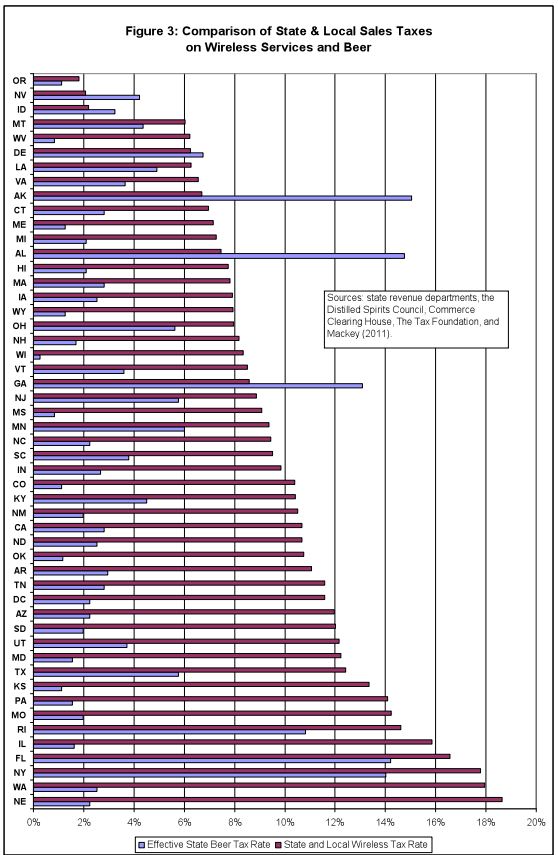
As we’ve noted herebefore, state and local politicians just love wireless taxes. They are going up, up, up. Dan Rothschild outlined this disturbing trend in his recent Mercatus Center paper making “The Case Against Taxing Cell Phone Subscribers,” and I discussed it in my recent Forbes essay lambasting the “Talking Tax.” Another new study by Glenn Woroch of the Georgetown University School of Business notes how “The ‘Wireless Tax Premium’ Harms American Consumers and Squanders the Potential of the Mobile Economy.” Woroch estimates that “the American consumer forgoes over $15 billion in surplus annually compared to when cell phones receive the
same tax treatment as other goods and service.” Read the entire study but I want to draw everyone’s attention to this chart that appears on page 7 of the report comparing state and local wireless taxes burdens to beer taxes. It really makes you realize just how drunk on wireless taxes are local lawmakers have become! [Click to enlarge. Red bar = wireless taxes.]
PFF today released the fifth installment in our ongoing series on “The Wrong Way to Reinvent Media.” This series of papers explores various tax and regulatory proposals that would have government play an expanded role in supporting the press, journalism, or other media content. In the latest essay, Berin Szoka, Ken Ferree, and I discuss proposals for direct subsidies for failing media outlets and out-of-work journalists.
We argue taxpayer support for failing outlets and unemployed journalists implicates significant First Amendment concerns. On the whole, subsidies can make “journalists and media operators more dependent upon the State; compromise press independence and diminish public trust in the free press; and result in government discrimination in the politically inescapable dilemma of determining eligibility for subsidies.” Such an agenda would also entail huge cost to taxpayers—initially about $35 billion per year according to advocates—and would represent “a massive wealth transfer from one class of speakers to another…”
We warn that calls for seemingly beneficent bailouts “to save” the media and journalism may actually be driven by those who have something more nefarious in mind: a “post-corporate” world shorn of media capitalists, and “such radicalism must be rejected if we hope to sustain a truly free press and uphold America’s proud tradition of keeping a high and tight wall of separation between Press and State.”
The ideas within these and other essays in the series will be worked into a major PFF filing in the Federal Communications Commission’s (FCC) proceeding on the “Future of Media” on May 7. The paper may be viewed online here and I’ve attached it down below in a Scribd reader.
As I’ve mentioned here previously, PFF has been rolling out a new series of essays examining proposals that would have the government play a greater role in sustaining struggling media enterprises, “saving journalism,” or promoting more “public interest” content. We’re releasing these as we get ready to submit a big filing in the FCC’s “Future of Media” proceeding (deadline is May 7th). Here’s a podcast Berin Szoka and I did providing an overview of the series and what the FCC is doing.
In the first installment of the series, Berin and I critiqued an old idea that’s suddenly gained new currency: taxing media devices or distribution systems to fund media content. In the second installment, I took a hard look at proposals to impose fees on broadcast spectrum licenses and channeling the proceeds to a “public square channel” or some other type of public media or “public interest” content.
In our latest essay, “The Wrong Way to Reinvent Media, Part 3: Media Vouchers,” Berin and I consider whether it is possible to steer citizens toward so-called “hard news” and get them to financially support it through the use of “news vouchers” or “public interest vouchers”? We argue that using the tax code to “nudge” people to support media — while less problematic than direct subsidies for the press — will likely raise serious issues regarding eligibility and be prone to political meddling. Moreover, it’s unlikely the scheme will actually encourage people to direct more resources to hard news but instead just become a method of subsidizing other content they already consume.
The Technology Liberation Front is the tech policy blog dedicated to keeping politicians' hands off the 'net and everything else related to technology. Learn more about TLF →




 The Technology Liberation Front is the tech policy blog dedicated to keeping politicians' hands off the 'net and everything else related to technology.