By Adam Thierer & Berin Szoka
In a series of upcoming essays, we will be examining proposals being put forward today that would have the government play a greater role in sustaining struggling media enterprises, “saving journalism,” or promoting more “public interest” content. The reason we’re working up this multi-part series is because, with many traditional media operators struggling, and questions being raised about how journalism in particular will be supported in the future, Washington policymakers are currently considering what role government can and should play in helping media providers reinvent themselves in the face of tumultuous technological change wrought by the Digital Revolution.
For example, the Federal Communications Commission (FCC) recently kicked off a new “Future of Media” effort with a workshop on “Serving the Public Interest in the Digital Era.” (The filing deadline for the FCC’s “Future of Media” proceeding is May 7th). Likewise, the Federal Trade Commission (FTC) has hosted two workshops asking “How Will Journalism Survive the Internet Age?” Meanwhile, the Senate has already held hearings about “the future of journalism,” and Senator Benjamin L. Cardin (D-MD) recently introduced the “Newspaper Revitalization Act,” which would allow newspapers to become tax-exempt non-profits in an effort to help them stay afloat.
Thus, in light of Washington’s sudden interest in the future of media and journalism, we will be taking a hard look at several issues and proposals that are being floated today, including:
- Taxes on media devices, mobile phones, or broadband bills to channel money to media enterprises / content;
- Taxes / fees on broadcasters to funnel support to their public sector competitors or to public interest programs;
- “News vouchers” or “public interest vouchers” that would encourage citizens to channel support to media providers;
- Taxes on private advertising to subsidize non-commercial / public media content;
- Expanded postal subsidies for media mail; and
- Targeted welfare programs for out-of-work journalists or corporate welfare in the form of bailouts for failing media enterprises.
You won’t be surprised to hear that we are generally quite skeptical of most of these ideas, but we promise to give each one serious consideration. We’ll kick things off tomorrow with our essay on why taxing media devices or distribution systems to fund media content is not a particularly good idea.
I testified this morning in the House Energy and Commerce Committee’s Subcommittee on Communications, Technology, and the Internet at a hearing titled, “An Examination of the Proposed Combination of Comcast and NBC Universal.” Among those testifying were Comcast Chairman and CEO Brian L. Roberts, and NBC Universal President and CEO Jeff Zucker. Down below I have attached my brief remarks (we only had 5 minutes), but see the Scribd doc at the very bottom to also see the embedded charts. I also wrote a paper about the proposed deal back in December entitled, “A Brief History of Media Merger Hysteria: From AOL-Time Warner to Comcast-NBC” as well as this editorial for Forbes.
____________
Mr. Chairman and members of the Committee, thank you for inviting me here today. My name is Adam Thierer and I am the President of The Progress & Freedom Foundation (PFF).
Although we are still early in this process, there has already been a great deal of hand-wringing and even some dire predictions about the pending merger of Comcast and NBC Universal. I hope to put this proposed marriage in some historical context and explain why the deal certainly won’t have the detrimental impact some critics fear, and also explain why it might even be one potential model for how to sustain traditional media going forward.
Beware Media Merger Hysteria
First, let’s remember that we’ve been here before. Paranoid predictions of a media apocalypse have accompanied the announcements of many previous media mergers, from AOL-Time Warner to News Corp.-DirecTV to XM-Sirius.[i] In these cases and almost all others, however, the “sky is falling” claims proved to be greatly overstated.[ii] The only “harm” that one could reasonably claim came from those mergers was not to consumers or content providers, but to the merging firms themselves and their shareholders. That’s because many mergers simply fail to create the sort of synergies and benefits originally hoped for and consequently die of natural causes over time.
Other firms, however, have found ways to make deals work and deliver important new services that previously were unimaginable or simply too expensive to offer alone.[iii] Regardless, the point here is that we’ll never know what works unless we permit marketplace experimentation with new and innovative business models. Continue reading →
There was a hearing today in the House Energy and Commerce Committee on “Reauthorization of the Satellite Home Viewer Extension and Reauthorization Act,” which got into the sticky of issue of whether must carry mandates should be applied to satellite television (DBS) operators. My boss, Ken Ferree, president of the Progress & Freedom Foundation, testified in opposition to that notion. Here’s what he had to say about proposals that would require satellite operators to carry local broadcast TV stations from even the smallest markets:
Because Congress cannot repeal the laws of physics, there are only two ways in which a satellite company might comply with such a mandate: 1) it may add capacity (i.e., launch new satellites and build associated ground equipment), or 2) it may convert capacity currently used for other purposes to local television carriage in the most sparsely populated parts of the country. Neither approach makes economic sense. That is, these proposals, if they were to become law, would impose considerable costs on satellite operators while generating no appreciable revenue.
Continue reading →
The WSJ reports on the intensifying economic pressure on local TV stations: declining viewership, ad revenue and the threat that national networks might go straight to cable.
Many stations are looking to the Internet for salvation:
Stations are scrambling to find new revenue streams. Some are testing out technology that will send their signals to cellphones and mobile devices, and beefing up their Web sites to boost online advertising. Others say rather than shrinking local news coverage, they’re expanding it, since it’s the only original content they still have…. Nexstar Broadcasting Group Inc., a Texas-based company that owns or manages 51 stations around the country, launched highly local “community” Web sites. Stations owned by NBC Universal are piping content and ads to TV screens in supermarkets, taxi cabs and their own Web sites.
“These tough times really force you to look at everything,” says John Wallace, president of NBC Local Media, the cadre of stations owned by NBC. “It remains to be seen how this is going to evolve, but I do believe there will be a market for local television well into the future.”
Over on the Poynter Online blog, Amy Gahran has a very smart piece on some of the confusion surrounding debates about “media localism.” In her essay asking “How Important is Local, Really?”, she challenges some of the assumptions underlying the Knight Foundation’s new Commission on the Information Needs of Communities in a Democracy.
I particularly like her line about how, “in many senses, ‘local’ is just one set of ripples on the lake of information — especially when it comes to ‘news.’ And for many people, it’s not even the biggest or most important set of ripples.” That is exactly right. Today, local choices are just a few more choices along the seemingly endless continuum of media choices. It’s foolish to assume that “media localism”
in a geographic sense is as important now as it was in the past for the reasons Gahran makes clear in her essay:
I’m glad that the Knight Foundation is asking basic questions about what kinds of information people need support community and democracy. However, I question the Commission’s strong focus on geographically defined local communities. It seems to me that with the way the media landscape has been evolving, geographically defined local communities are becoming steadily less crucial from an information perspective. I suspect that defining communities by other kinds of commonalities (age, economic status/class, interests, social circles, etc.) would be far more relevant to more people — although more complex to define.
Continue reading →
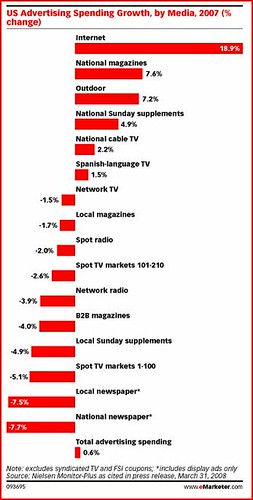 As we’ve discussed here before, newspapers are struggling. We all know that. The question is what, if anything, will save them? Most pundits tend to point to a two-fold solution: (1) get serious about leveraging the natural local advantages newspapers hold; (2) and find away to do so online as quickly as possible before they lose the bulk of the local online ad market to other competitors. This is why there’s a lot of talk these days about turning traditional papers into “hyper-local” web portals for their communities. Of course, there’s no guarantee that will work, especially in light of changing attitudes about “media localism.”
But let’s assume that that is indeed the best path forward. Will it really save newspapers? As eMarketer reports in today’s newsletter on “Can Local Web Ads Save Newspapers,” it’s a bit of a good news–bad news story:
The good news is that newspaper site ad revenues are growing along with other online ad spending, especially for local news sites. Local newspaper online ad revenues are predicted to reach $3.7 billion this year, according to eMarketer calculations based on Borrell Associates data.
The bad news is that this spending will not make up for print ad losses for some time, according to Lisa Phillips, senior analyst at eMarketer. Ms. Phillips noted that advertisers still pay more for print readers than for online readers. “This is a transition that will take several years,” she said. “Local advertisers are paying attention to the shift in reader behavior, but it will take a while for everyone to adjust.”
And so we will have to wait to see how it all plays out. But I am highly skeptical that traditional newspapers operators will be able to make up anywhere near the amount of revenue online that they are hemorrhaging over on the print side of the business. There’s just too much other competition out there online already for our eyes and ears. The age of “protectable scarcity” is dead and that means newspapers just don’t have the lock on local or regional markets they once did.

 The Technology Liberation Front is the tech policy blog dedicated to keeping politicians' hands off the 'net and everything else related to technology.