Posts tagged as:

In all my work on online child safety issues, I always try to stress how important education and media literacy efforts are. Indeed, technical parental control tools and methods, while important, should be viewed as just one part of a more holistic approach to encouraging digital literacy and digital citizenship.  In recent years, many scholars and child development experts such as Nancy Willard of the Center for Safe and Responsible Internet Use, Anne Collier and Larry Magid of ConnectSafely.org, Marsali Hancock of iKeepSafe, Common Sense Media, the Family Online Safety Institute, and many others have worked to expand traditional education and media literacy strategies to place the notion of digital citizenship at the core of their lessons and recommendations.

What does it mean? Anne Collier defines digital citizenship as “Critical thinking and ethical choices about the content and impact on oneself, others, and one’s community of what one sees, says, and produces with media, devices, and technologies.” And Common Sense Media defines digital literacy and digital citizenship as follows:

Digital Literacy programs are an essential element of media education and involve basic learning tools and a curriculum in critical thinking and creativity. Digital Citizenship means that kids appreciate their responsibility for their content as well as their actions when using the Internet, cell phones, and other digital media. All of us need to develop and practice safe, legal, and ethical behaviors in the digital media age. Digital Citizenship programs involve educational tools and a basic curriculum for kids, parents, and teachers.

Stephen Balkam, CEO of the Family Online Safety Institute, had an excellent essay in The Huffington Post yesterday on “21st Century Citizenship,” that did a fine job of explaining these concepts in practical terms:

Continue reading →

As I pointed out here before (see, “And so the Comcast-NBC Merger Hysteria Begins: Help Me Document It!“), every time a media merger is proposed we hear all sorts of silly Chicken Little predictions of impending doom as well as preposterous conspiracy theories about supposed nefarious schemes to take over the media universe and control our minds. For good measure, there’s also plenty of talk of “the death of deliberative democracy,” or efforts to weed out one sort of perspective or another.

As history has shown, it’s all complete bunk. But that doesn’t stop critics from concocting asinine theories about media providers seeking to “silence critics.”  Here’s two bits of Chicken Little-ism that I missed in my previous essay documenting this silliness.  First, over at Huffington Post, Marvin Ammori tells us that America is about to become Italy or Argentina because of the deal:

Putting so much power in the hands of one company–and, specifically, its executives–is dangerous for a democracy. There is a reason why autocratic regimes control the media–media shape public opinion and define what is “possible” in politics. We have seen the problem of private media consolidation in many countries. In Italy, Silvio Berlusconi used his massive media empire to win elections and is now Prime Minister (Italy’s longest serving ever). In Argentina, the government had to pass a media consolidation law because of the power of one media company that happens to be far smaller than a combined Comcast-NBCU.

And then we have Wade Norris writing about the deal over at the Daily Kos, saying: “If you don’t want to see the progressive voices on MSNBC silenced, then join the ‘no merger’ petition.”  Ah yes, another automated “stuff-the-online-complaint-ballot-box” petition.  I love those gimmicks.  But ignore fake complaints for a moment and focus on the accusations at hand here. The Ammori-Norris theory is: If Comcast and NBCU are allowed to marry (a) progressive voices will be driven off their platforms and (b) Silvio Berlusconi will take over America democracy will somehow suffer.  Is there really any truth to this? Continue reading →

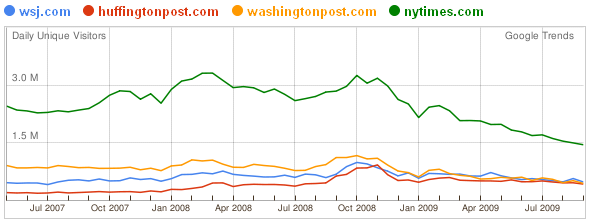
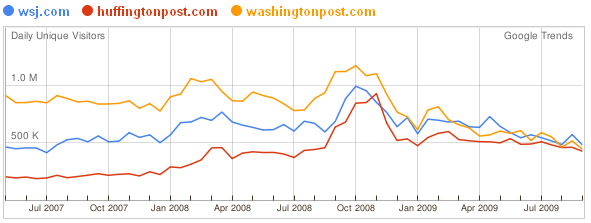
Google Trends for websites reveals all kinds of fascinating insights into the way technology is reshaping the world. Among them is the fact that the HuffingtonPost.com has matured from a scruffy group blog into a new media powerhouse to rival the Wall Street Journal and Washington Post:

HuffPo WSJ WashPo

Note that the convergence of these three sites has happened both because HuffPo has doubled its audience and because the audience for the WashingtonPost.com has shrunk by half.  While WSJ.com’s audience has returned to roughly its pre-election level, the decline of NYTimes.com suggests that the Internet really is splintering audiences and bringing the giants of news media like the “Gray Lady” down from their once unassailable heights:

HuffPo WSJ WashPo NyTimes

Last month, Digital Barbarism book cover National Review magazine published a review that I penned of Mark Helprin’s new book, Digital Barbarism: A Writer’s Manifesto.  Helprin’s book is both a passionate defense of copyright law as well as a mini-autobiography.  Helprin is one of the great novelists and essayists of the past half-century, and his book A Soldier of a Great War is one of my all-time favorite novels.  I cannot in strong enough words encourage you to read that book; it is profoundly moving. (I almost named my son after the lead character in the book!)

Thus, I was quite excited when I learned that Helprin had penned a defense of copyright and I jumped at the chance to review it when the folks at National Review asked me to do so.  Alas, as you will see in my review, I was terribly disappointed.  I wish Helprin would have stuck with the very reasonable tone he adopted in this excellent podcast interview he did recently with John J. Miller of National Review Online. Unfortunately, he went a different direction in the book, as I make clear in my review:


National Review July 20, 2009

“Man, Machine, and Copyright” a review of Digital Barbarism: A Writer’s Manifesto, by Mark Helprin by Adam Thierer

It would be difficult to think of anyone more ideally suited to pen a passionate defense of copyright law than novelist Mark Helprin.  Helprin has written several of the finest works of modern literature, including his masterpiece, A Soldier of the Great War, a narrative of transcendent beauty. In Digital Barbarism, Helprin sets out to use his formidable gift for the written word to repel the “cyber mob” that has attacked copyright law and called for its curtailment, or even abolition.

Unfortunately, while Helprin occasionally rises to great heights in his defense of copyright, he too often sinks to lamentable lows — by resorting to the same unbecoming rhetorical tactics used by the mob he seeks to condemn. Indeed, his book is filled with gratuitous vitriol and neo-Luddite ramblings about the Internet and Information Age that severely detract from his defense of copyright. This is a shame, because, in places, Digital Barbarism makes a fine case against those critics who wrongly view copyright as an impediment to the creation and diffusion of content. “The availability of information is not and will not be restrained by the copyright system any more than it is or will be restrained by the delivery systems that make it possible,” Helprin argues. Why, he asks, “must ‘content’ be free” when everything else — access to the Internet, digital devices, etc. — costs good money? He notes that the movement that advocates “free,” universal access to all copyrighted material in the name of “openness” and “the public good” would, ironically, “destroy the dream it advocates”: Continue reading →