Wishful thinking is a dangerous drug. Some pundits and policymakers believe that, if your intentions are pure and you have the “right” people in power, all government needs to do is sprinkle a little pixie dust (in the form of billions of taxpayer dollars) and magical things will happen.
Of course, reality has a funny way of throwing a wrench into the best-laid plans. Which brings me to the question I raise in a new 2-part series for
Discourse magazine: Can governments replicate Silicon Valley everywhere?
In the first installment, I explore the track record of federal and state attempts to build tech clusters, science parks & “regional innovation hubs” using state subsidies and industrial policy. This is highly relevant today because of the huge new industrial policy push at the federal level is building on top of growing state and local efforts to create tech hubs, science parks, or various other types of industrial “clusters.
At the federal level, this summer, the Senate passed a 2,300-page industrial policy bill, the “United States Innovation and Competition Act of 2021,” that included almost $10 billion over four years for a Department of Commerce-led effort to fund 20 new regional technology hubs, “in a manner that ensures geographic diversity and representation from communities of differing populations.” A similar proposal that is moving in the House, the “Regional Innovation Act of 2021,” proposes almost $7 billion over five years for 10 regional tech hubs. Meanwhile, the Biden administration also is pitching ideas for new high-tech hubs. In late July, the Commerce Department’s Economic Development Administration announced plans to allocate $1 billion in pandemic recovery funds to create or expand “regional industry clusters” as part of the administration’s new Build Back Better Regional Challenge. Among the possible ideas the agency said might win funding are an “artificial intelligence corridor,” an “agriculture-technology cluster” in rural coal counties, a “blue economy cluster” in coastal regions, and a “climate-friendly electric vehicle cluster.”
In my essay, I note that the economic literature on these efforts has been fairly negative, to put it mildly. Continue reading →
Discourse magazine has just published my latest essay, “‘Japan Inc.’ and Other Tales of Industrial Policy Apocalypse.” It is a short history of the hysteria surrounding the growth of Japan in the 1980s and early 1990s and its various industrial policy efforts. I begin by noting that, “American pundits and policymakers are today raising a litany of complaints about Chinese industrial policies, trade practices, industrial espionage and military expansion. Some of these concerns have merit. In each case, however, it is easy to find identical fears that were raised about Japan a generation ago.” I then walk through many of the leading books, opeds, movies, and other things from that past era to show how that was the case.
“Hysteria” is not too strong a word to use in this case. Many pundits and politicians were panicking about the rise of Japan economically and more specifically about the way Japan’s Ministry of International Trade and Industry (MITI) was formulating industrial policy schemes for industrial sectors in which they hoped to make advances. This resulted in veritable “MITI mania” here in America. “U.S. officials and market analysts came to view MITI with a combination of reverence and revulsion, believing that it had concocted an industrial policy cocktail that was fueling Japan’s success at the expense of American companies and interests,” I note. Countless books and essays were being published with breathless titles and predictions. I go through dozens of them in my essay. Meanwhile, the debate in policy circles and Capitol Hill even took on an ugly racial tinge, with some lawmakers calling the the Japanese “leeches.” and suggesting the U.S. should have dropped more atomic bombs on Japan during World War II. At one point, several members of Congress gathered on the lawn of the U.S. Capitol in 1987 to smash Japanese electronics with sledgehammers. Continue reading →
Industrial Policy is a red-hot topic once again with many policymakers and pundits of different ideological leanings lining up to support ambitious new state planning for various sectors — especially 5G, artificial intelligence, and semiconductors. A remarkably bipartisan array of people and organizations are advocating for government to flex its muscle and begin directing more spending and decision-making in various technological areas. They all suggest some sort of big plan is needed, and it is not uncommon for these industrial policy advocates to suggest that hundreds of billions will need to be spent in pursuit of those plans.
Others disagree, however, and I’ll be using this post to catalog some of their concerns on an ongoing basis. Some of the criticisms listed here are portions of longer essays, many of which highlight other types of steps that governments can take to spur innovative activities. Industrial policy is an amorphous term with many definitions of a broad spectrum of possible proposals. Almost everyone believes in
some form of industrial policy if you define the term broadly enough. But, as I argued in a September 2020 essay “On Defining ‘Industrial Policy‘,” I believe it is important to narrow the focus of the term such that we can continue to use the term in a rational way. Toward that end, I believe a proper understanding of industrial policy refers to targeted and directed efforts to plan for specific future industrial outputs and outcomes.
The collection of essays below is merely an attempt to highlight some of the general concerns about the most ambitious calls for expansive industrial policy, many of which harken back to debates I was covering in the late 1980s and early 1990s, when I first started a career in policy analysis. During that time, Japan and South Korea were the primary countries of concern cited by industrial policy advocates. Today, it is China’s growing economic standing that is fueling calls for ambitious state-led targeted investments in “strategic” sectors and technologies. To a lesser extent, grandiose European industrial policy proposals are also prompting new US counter-proposals.
All this activity is what has given rise to many of the critiques listed below. If you have suggestions for other essays I might add to this list, please feel free to pass them along. FYI: There’s no particular order here.
The Federal Trade Commission (FTC) is taking a more active interest in state and local barriers to entry and innovation that could threaten the continued growth of the digital economy in general and the sharing economy in particular. The agency recently announced it would be hosting a June 9th workshop “to examine competition, consumer protection, and economic issues raised by the proliferation of online and mobile peer-to peer business platforms in certain sectors of the [sharing] economy.” Filings are due to the agency in this matter by May 26th. (Along with my Mercatus Center colleagues, I will be submitting comments and also releasing a big paper on reputational feedback mechanisms that same week. We have already released this paper on the general topic.)
Relatedly, just yesterday, the FTC sent a letter to Michigan policymakers about restricting entry by Tesla and other direct-to-consumer sellers of vehicles. Michigan passed a law in October 2014 prohibiting such direct sales. The FTC’s strongly-worded letter decries the state’s law as “protectionism for independent franchised dealers” noting that “current provisions operate as a special protection for dealers—a protection that is likely harming both competition and consumers.” The agency argues that:
consumers are the ones best situated to choose for themselves both the vehicles they want to buy and how they want to buy them. Automobile manufacturers have an economic incentive to respond to consumer preferences by choosing the most effective distribution method for their vehicle brands. Absent supportable public policy considerations, the law should permit automobile manufacturers to choose their distribution method to be responsive to the desires of motor vehicle buyers.
The agency cites the “well-developed body of research on these issues strongly suggests that government restrictions on distribution are rarely desirable for consumers” and the staff letter continues on to utterly demolish the bogus arguments set forth by defenders of the blatantly self-serving, cronyist law. (For more discussion of just how anti-competitive and anti-consumer these laws are in practice, see this January 2015 Mercatus Center study, “State Franchise Law Carjacks Auto Buyers,” by Jerry Ellig and Jesse Martinez.) Continue reading →
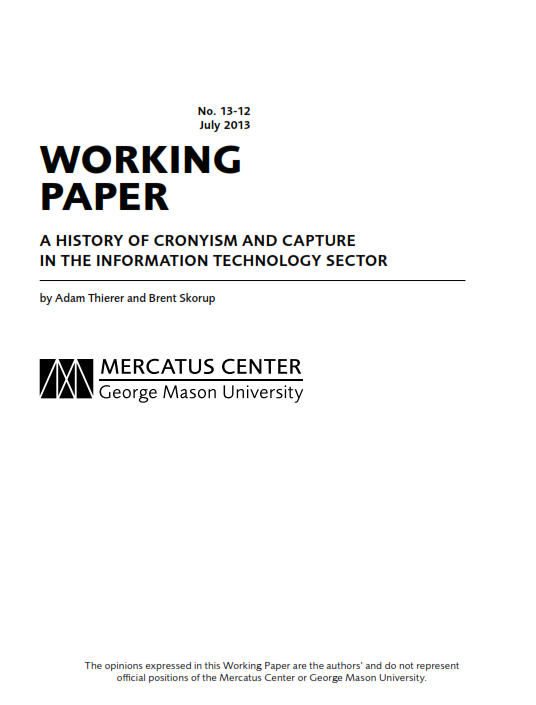
The Mercatus Center at George Mason University has just released a new paper by Brent Skorup and me entitled, “A History of Cronyism and Capture in the Information Technology Sector.” In this 73-page working paper, which we hope to place in a law review or political science journal shortly, we document the evolution of government-granted privileges, or “cronyism,” in the information and communications technology marketplace and in the media-producing sectors. Specifically, we offer detailed histories of rent-seeking and regulatory capture in: the early history of the telephony and spectrum licensing in the United States; local cable TV franchising; the universal service system; the digital TV transition in the 1990s; and modern video marketplace regulation (i.e., must-carry and retransmission consent rules, among others.
Our paper also shows how cronyism is slowly creeping into new high-technology sectors.We document how Internet companies and other high-tech giants are among the fastest-growing lobbying shops in Washington these days. According to the Center for Responsive Politics, lobbying spending by information technology sectors has almost doubled since the turn of the century, from roughly $200 million in 2000 to $390 million in 2012. The computing and Internet sector has been responsible for most of that growth in recent years. Worse yet, we document how many of these high-tech firms are increasingly seeking and receiving government favors, mostly in the form of targeted tax breaks or incentives. Continue reading →
In July 2012, the D.C. Council approved the Social E-Commerce Job Creation Tax Incentive Act of 2012. The deal provided LivingSocial, a popular online coupon service, with corporate and property tax exemptions in Washington, D.C. worth approximately $32.5 million over five years beginning in 2015. Legislators feared that LivingSocial would relocate to areas with a lower tax rate. In exchange for the $32.5 million, LivingSocial said it would attempt to add 1,000 employees to its payroll (roughly doubling its number of employees in the District), although no contractual guarantee for job creation exists and even though the firm had never been profitable. Some of the few contractual obligations required for LivingSocial to receive these tax exemptions are that it must establish a program to mentor D.C. high school students, provide internships for D.C. students, and stay located in the District. LivingSocial must also ensure 50% of newly hired employees live in the District in order to receive the Act’s full $32.5 million in exemptions.
Just a few months after the deal was struck it had already become apparent just how risky of a bet the DC government has made with taxpayer dollars. In late November 2012, LivingSocial announced a net loss of $566 million for the third quarter and that hundreds of employees would be laid off. The promise to roughly doubling the size of its DC-based workforce seems fairly unlikely and some analysts doubt the company will survive much longer.
This serves as another case study for just how foolish it is for governments to make risky, taxpayer-backed bets on information tech companies. Continue reading →
Here’s a presentation I delivered on “The War on Vertical Integration in the Digital Economy” at the latest meeting of the Southern Economic Association this weekend. It outlines concerns about vertical integration in the tech economy and specifically addresses regulatory proposals set forth by Tim Wu (arguing for a “separations principle” for the tech economy) & Jonathan Zittrain (arguing for “API neutrality” for social media and digital platforms). This presentation is based on two papers published by the Mercatus Center at George Mason University: “Uncreative Destruction: The Misguided War on Vertical Integration in the Information Economy” (with Brent Skorup) & “The Perils of Classifying Social Media Platforms as Public Utilities.”
Ronald Cass, Dean Emeritus of Boston University School of Law, has penned the best paper on antitrust regulation that you will read this year, especially if you’re interested in the relationship between antitrust and information technology sectors. His paper is entitled, “Antitrust for High-Tech and Low: Regulation, Innovation, and Risk,” and it makes two straightforward points:
Antitrust enforcement has characteristics and risks similar to other forms of regulation.
Antitrust authorities need to exercise special care in making enforcement decisions respecting conduct of individual dominant firms in high-technology industries.
Here are some highlights from the paper that build on those two points. Continue reading →
As federal regulators launch fresh investigations into Silicon Valley, their history of drawn-out cases has companies on edge. In taking on an industry that moves at lightening speed, federal officials risk actions that could appear to be too heavy-handed or embarrassingly outdated, some analysts and antitrust experts say.
For example, she cites ongoing regulatory oversight of Microsoft and MySpace, even though both companies have fallen from the earlier King of the Hill status in their respective fields. Kang notes that some “want the government to aggressively pursue abusive practices but question whether antitrust laws are too dated to rein in firms that are continually redefining themselves and using their dominance in one arena to press into others.”
Simply put, antitrust can’t keep up with an economy built on Moore’s Law, which refers to the rule of thumb that the processing power of computers doubles roughly every 18 months while prices remain fairly constant. This issue has been the topic of several of my
Forbes columns over the past year, as well as several other essays I’ve written here and elsewhere. [See the list at bottom of this essay.] Moore’s Law has been a relentless regulator of markets and has helped keep the power of “tech titans” in check better than any Beltway regulator ever could. As I noted here before in my essay, “Antitrust & Innovation in the New Economy: The Problem with the Static Equilibrium Mindset“: Continue reading →
In this new Money Morning article, “The Antitrust Curse: What Apple Can Learn From Microsoft, IBM,” David Zeiler wonders whether the antitrust lawsuit filed against Apple and several book publishers by the U.S. Department of Justice last week could open the door to a broader case against Apple or, at a minimum, simply become a major distraction to the firm and it’s ability to innovate going forward. He uses IBM and Microsoft as case studies in this regard and notes that, “the problem with being in the DOJ’s gunsight is that it distracts management, makes the company hesitant to innovate, and blemishes the company’s public image. While antitrust woes may not have been entirely responsible for Microsoft and IBM ceding their dominant positions in tech, they were clearly a major factor,” he says. “And worse for Apple, the e-book case could be just the beginning.”
Even if Apple beats back [the eBooks] investigation, broader questions are being raised about the company’s power that could invite a much broader investigation. The danger for Apple is that antitrust becomes an omnipresent threat that must be factored into all ongoing business decisions. Antitrust is a particular danger to Apple because the firm is highly vertically integrated and that integration is the source of many of their innovations. As earlier tech titans like IBM and Microsoft learned, when antitrust hangs like the Sword of Damocles, every decision about how to evolve and innovate becomes a calculated gamble.
Regarding the earlier impact that antitrust Sword of Damocles had on Microsoft, Zeiler unearthed this terrific 2005 quote from Mark Kroese, a general manager of information services at the Microsoft Network, who described the impact of the MS antitrust case on innovation at the firm as follows: “Working at Microsoft today vs. five years ago is different,” Kroese said. “If anyone thinks the antitrust case hasn’t slowed us down, you’re wrong. If I want to meet with a products manager for Windows, there needs to be three lawyers in the room. We have to be so careful, we err on the side of caution. We are on such a fine line of conduct.” Regarding how antitrust chilled IBM, Zeiler cites veteran tech journalist Steve Wildstrom of Tech.pinionswho noted, “Twelve years of litigation were an enormous distraction in a time of rapid technological and business change. IBM management became cautious and over-lawyered, constantly looking over its shoulder-a condition that persisted for years after the case ended. The antitrust case was almost certainly a major cause of the serious decline of IBM in the late 1980s and early 90s,” Wildstrom said.
Of course, it is impossible to scientifically determine to what degree antitrust harassment contributed to either IBM or Microsoft’s inability to innovate and adapt to the rapidly changing market conditions. And let’s be clear: both IBM and MS have found ways to rebound and innovate in other ways. But one wonders what was lost in the process as the threat of antitrust constantly loomed and potentially chilled innovative efforts that could have kept both firms on the cutting-edge. Continue reading →
The Technology Liberation Front is the tech policy blog dedicated to keeping politicians' hands off the 'net and everything else related to technology. Learn more about TLF →





 The Technology Liberation Front is the tech policy blog dedicated to keeping politicians' hands off the 'net and everything else related to technology.