Profectus is an excellent new online magazine featuring essays and interviews on the intersection of academic literature, public policy, civilizational progress, and human flourishing. The Spring 2022 edition of the magazine features a “
Progress Roundtable” in which six different scholars were asked to contribute their thoughts on three general questions:
- What is progress?
- What are the most significant barriers holding back further progress?
- If those challenges can be overcome, what does the world look like in 50 years?
I was honored to be asked by Clay Routledge to contribute answers to those questions alongside others, including: Steven Pinker (Harvard University), Jason Crawford (Roots of Progress), Matt Clancy (Institute for Progress), Marian Tupy (HumanProgress.org), James Pethokoukis (AEI). I encourage you to jump over the roundtable and read all their excellent responses. I’ve included my answers down below:
Continue reading →
This is a compendium of readings on “
progress studies
,” or essays and books which generally make the case for technological innovation, dynamism, economic growth, and abundance. I will update this list as additional material of relevance is brought to my attention.
[Last update: 10/11/22]
Recent Essays
- Marc Andreessen, “The Techno-Optimist Manifesto,” a16z.com, October 16, 2023.
- Will Rinehart, “The Abundance Agenda,” The Exformation Newsletter, October 15, 2022.
- Sarah Constantin, “Unblocking Abundance: A Model for Activism,” Rough Diamonds, October 10, 2022.
- Derek Thompson, “The Forgotten Stage of Human Progress,” The Atlantic, May 11, 2022.
- Adam Thierer, “Where is ‘Progress Studies’ Going?” Progress Forum, April 23, 2022.
- Katherine Boyle, “The Case for American Seriousness,” Common Sense, April 18, 2022.
- William Rinehart, “Vetocracy, the Costs of Vetos and Inaction,” Center for Growth & Opportunity at Utah State University, March 24, 2022.
- James Pethokoukis, “Forget about Left Wing and Right Wing. How about an Up Wing America?” Faster Please, March 23, 2022.
- John W. Lettieri & Kenan Fikri, “The Case for Economic Dynamism and Why it Matters for the American Worker,” Economic Innovation Group, March 2022.
- Adam Kovacevich, “Saying YIMBY (Yes In My Back Yard) to “Civic Innovation,” Chamber of Progress, March 21, 2022.
- Eli Dourado, “Remove Barriers to Productivity,” City Journal, March 18, 2022.
- “A Case for Innovation and Optimism,” (A conversation with Jason Crawford), Discourse, March 2, 2022.
- Noah Smith, “A New Industrialist Roundup,” Noahpinion, February 3, 2022.
- James Pethokoukis, “When Will the Next Big Thing Arrive?” Faster Please, February 3, 2022.
- Alec Stapp & Caleb Watney, “
Progress is a Policy Choice
,” Institute for Progress, January 20, 2022.
- Adam Thierer, “
How to Get the Future We Were Promised
,” Discourse, January 18, 2022.
- Katherine Boyle, “
Building American Dynamism
,” Future, January 14, 2022.
- Derek Thompson, “
A Simple Plan to Solve All of America’s Problems
,” The Atlantic, January 12, 2022.
- Jason Crawford, “Progress, Humanism, Agency: An Intellectual Core for the Progress Movement,” Roots of Progress, January 11, 2022.
- Adam Thierer, “Defending Innovation Against Attacks from All Sides,” Discourse, November 9, 2021.
- Matthew Yglesias, “The Case for More Energy,” October 7, 2021.
- Jason Crawford, “
We need a new philosophy of progress
,” The Roots of Progress, August 23, 2021.
- Gale Pooley & Marian L. Tupy, “The Simon Abundance Index 2021,” Human Progress, April 22, 2021.
- Noah Smith, “
Techno-optimism for the 2020s
,” December 3, 2020.
- Ezra Klein, “
Why We Can’t Build
,” Vox, April 22, 2020.
- Marc Andreesen, “
It’s Time to Build
,” Future, April 18, 2020.
- Eli Dourado, “
How do we move the needle on progress
?” September 26, 2019.
- José Luis Ricón, “
About the ‘Progress’ in Progress Studies
” September 6, 2019.
- Will Rinehart, “
Progress Studies: Some Initial Thoughts
,” August 30, 2019.
- Adam Thierer, “
Is There a Science of Progress
?” AIER, August 8, 2019.
- Patrick Collison and Tyler Cowen, “
We Need a New Science of Progress
,” The Atlantic, July 30, 2019.
- Tyler Cowen, “
The Case for the Longer Term
,” Cato Unbound, January 9, 2019.
- Vinod Khosla, “
We Need Large Innovations
,” Medium, January 1, 2018.
- Adam Thierer, “
How Technology Expands the Horizons of Our Humanity
,” Medium, November 19, 2018.
- Chelsea Follett, “Utopianism: One of the Biggest Obstacles to Progress,” Human Progress, August15, 2018.
- Eli Dourado, “
How Technological Innovation Can Massively Reduce the Cost of Living
,” PlainText, January 29, 2016.
Continue reading →
[Updated: March 2022]
I was speaking at a conference recently and discussing my life’s work, which for 30 years has been focused on the importance of innovation and intellectual battles over what we mean progress. I put together up a short list of some things I have written over the last few years on this topic and thought I would just re-post them here. I will try to keep this regularly updated, at least for a few years.
UNDERSTANDING THE CHALLENGE WE FACE:
HOW WE MUST RESPOND = “Rational Optimism” / Right to Earn a Living / Permissionless Innovation
Continue reading →
Why should we really care about technological innovation? My Mercatus Center colleague James Broughel and I have just published a paper answering that question. In “Technological Innovation and Economic Growth: A Brief Report on the Evidence,” we summarize the extensive body of evidence that discusses the relationship between innovation, growth, and human prosperity. We note that while economists, political scientists, and historians don’t agree on much, there exists widespread consensus among them that there is a symbiotic relationship between the pace of innovation and the progress of civilization. Our 27-page paper documenting the academic evidence on this issue can be downloaded on SSRN or from the Mercatus website. Here’s the abstract:
Technological innovation is a fundamental driver of economic growth and human progress. Yet some critics want to deny the vast benefits that innovation has bestowed and continues to bestow on mankind. To inform policy discussions and address the technology critics’ concerns, this paper summarizes relevant literature documenting the impact of technological innovation on economic growth and, more broadly, on living standards and human well-being. The historical record is unambiguous regarding how ongoing innovation has improved the way we live; however, the short-term disruptive aspects of technological change are real and deserve attention as well. The paper concludes with an extended discussion about the relevance of these findings for shaping cultural attitudes toward technology and the role that public policy can play in fostering innovation, growth, and ongoing improvements in the quality of life of citizens.
FCC Chairman Ajit Pai recently delivered an excellent speech at the Resurgent Conference, Austin, TX. In it, he stressed the importance of adopting a permissionless innovation policy vision to ensure a bright future for technology, economic growth, and consumer welfare. The whole thing is worth your time, but the last two paragraphs make two essential points worth highlighting.
Pai correctly notes that we should reject the sort of knee-jerk hysteria or technopanic mentality that sometimes accompanies new technologies. Instead, we should have some patience and humility in the face of uncertainty and be open to new ideas and technologies creations.
“Here’s the bottom line,” Pai concludes:
Whenever a technological innovation creates uncertainty, some will always have the knee-jerk reaction to presume it’s bad. They’ll demand that we do whatever’s necessary to maintain the status quo. Strangle it with a study. Call for a commission. Bemoan those supposedly left behind. Stipulate absolute certainty. Regulate new services with the paradigms of old.
But we should resist that temptation. “Guilty until proven innocent” is not a recipe for innovation, and it doesn’t make consumers better off. History tells us that it is not preemptive regulation, but permissionless innovation made possible by competitive free markets that best guarantees consumer welfare. A future enabled by the next generation of technology can be bright, if only we choose to let the light in.
Read the whole thing here. Good stuff. I also appreciate him citing my work on the topic, which you can find in my last book and other publications.
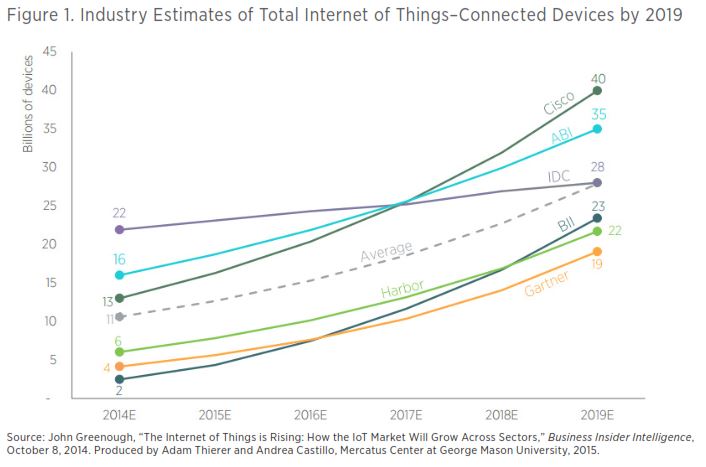
The “Internet of Things” (IoT) is already growing at a breakneck pace and is expected to continue to accelerate rapidly. In a short new paper (“Projecting the Growth and Economic Impact of the Internet of Things“) that I’ve just released with my Mercatus Center colleague Andrea Castillo, we provide a brief explanation of IoT technologies before describing the current projections of the economic and technological impacts that IoT could have on society. In addition to creating massive gains for consumers, IoT is projected to provide dramatic improvements in manufacturing, health care, energy, transportation, retail services, government, and general economic growth. Take a look at our paper if you’re interested, and you might also want to check out my 118-page law review article, “The Internet of Things and Wearable Technology: Addressing Privacy and Security Concerns without Derailing Innovation” as well as my recent congressional testimony on the policy issues surrounding the IoT.)
Over the course of the year, I collect some of my favorite (and least favorite) tech policy essays and put them together in an end-of-year blog post so I will remember notable essays in the future. (Here’s my list from 2013.) Here are some of the best tech policy essays I read in 2014 (in chronological order).
- Joel Mokyr – “The Next Age of Invention,” City Journal, Winter 2014. (An absolutely beautiful refutation of the technological pessimism that haunts our age. Mokry concludes by noting that, “technology will continue to develop and change human life and society at a rate that may well dwarf even the dazzling developments of the twentieth century. Not everyone will like the disruptions that this progress will bring. The concern that what we gain as consumers, viewers, patients, and citizens, we may lose as workers is fair. The fear that this progress will create problems that no one can envisage is equally realistic. Yet technological progress still beats the alternatives; we cannot do without it.” Mokyr followed it up with a terrific August 8 Wall Street Journal oped, “What Today’s Economic Gloomsayers Are Missing.“)
- Michael Moynihan – “
Can a Tweet Put You in Prison? It Certainly Will in the UK
,”
The Daily Beast
, January 23, 2014. (Great essay on the right and wrong way to fight online hate. Here’s the kicker: “There is a presumption that ugly ideas are contagious and if the already overburdened police force could only disinfect the Internet, racism would dissipate. This is arrant nonsense.”)
- Hanni Fakhoury –
“
The U.S. Crackdown on Hackers Is Our New War on Drugs,”
Wired
, January 23, 2014.
(“We shouldn’t let the government’s fear of computers justify disproportionate punishment. . . . It’s time for the government to learn from its failed 20th century experiment over-punishing drugs and start making sensible decisions about high-tech punishment in the 21st century.”)
- Carole Cadwalladr – “Meet Cody Wilson, Creator of the 3D-gun, Anarchist, Libertarian,” Guardian/Observer, February 8, 2014. (Entertaining profile of one of the modern digital age’s most fascinating characters. “There are enough headlines out there which ask: Is Cody Wilson a terrorist? Though my favourite is the one that asks: ‘Cody Wilson: troll, genius, patriot, provocateur, anarchist, attention whore, gun nut or Second Amendment champion.’ Though it could have added, ‘Or b) all of the above?'”)
Continue reading →
Very cool little video here by Jess3 documenting Internet growth and activity. Ironically, Berin sent it to me as Adam Marcus and I were updating the lengthy list of Net & online media stats you’ll find down below. Many of the stats we were compiling are shown in the video. Enjoy!
http://vimeo.com/moogaloop.swf?clip_id=9641036&server=vimeo.com&show_title=1&show_byline=1&show_portrait=1&color=ffffff&fullscreen=1
- 1.73 billion Internet users worldwide as of Sept 2009; an 18% increase from the previous year.
[1]
- 81.8 million .COM domain names at the end of 2009; 12.3 million .NET names & 7.8 million .ORG names.
[2]
- 234 million websites as of Dec 2009; 47 million were added in 2009.
[3] In 2006, Internet users in the United States viewed an average of 120.5 Web pages each day.
[4]
- There are roughly 26 million blogs on the Internet
[5] and even back in 2007, there were over 1.5 million new blog posts every day (17 posts per second).
[6] Continue reading →
[Hat tip to Richard Bennett for the recommendation here..] I haven’t had a chance to read through the entire thing yet, but this new study by Nemertes Research seems worthy of attention: “Internet Interrupted: Why Architectural Limitations Will Fracture the ‘Net.” From the exec sum:
In 2007, Nemertes Research conducted the first-ever study to independently model Internet and IP infrastructure (which we call “capacity”) and current and projected traffic (which we call “demand”) with the goal of evaluating how each changes over time. In that study, we concluded that if current trends were to continue, demand would outstrip capacity before 2012. Specifically, access bandwidth limitations will throttle back innovation, as users become increasingly frustrated with their ability to run sophisticated applications over primitive access infrastructure. This year, we revisit our original study, update the data and our model, and extend the study to look beyond physical bandwidth issues to assess the impact of potential logical constraints. Our conclusion? The situation is worse than originally thought!
We continue to project that capacity in the core, and connectivity and fiber layers will outpace all conceivable demand for the near future. However, demand will exceed access line capacity within the next two to four years. Even factoring in the potential impact of a global economic recession on both demand (users purchasing fewer Internet-attached devices and services) and capacity (providers slowing their investment in infrastructure) changes the impact by as little as a year (either delaying or accelerating, depending on which is assumed to have the greater effect).
This is a subject that my colleague Bret Swanson has written a great deal about, so I’m sure he’ll be commenting on this study at some point. Even if you don’t agree with the conclusion Nemertes reaches, as Richard Bennett notes, the report is well worth reading just the background information on public and private peering, content delivery networks, and overlay networks.

 The Technology Liberation Front is the tech policy blog dedicated to keeping politicians' hands off the 'net and everything else related to technology.