On December 13th, I will be participating in an Atlas Network panel on, “Big Tech, Free Speech, and Censorship: The Classical Liberal Approach.” In anticipation of that event, I have also just published a new op-ed for The Hill entitled, “Left and right take aim at Big Tech — and the First Amendment.” In this essay, I expand upon that op-ed and discuss the growing calls from both the Left and the Right for a variety of new content regulations. I then outline the classical liberal approach to concerns about free speech platforms more generally, which ultimately comes down to the proposition that innovation and competition are always superior to government regulation when it comes to content policy.
In the current debates, I am particularly concerned with calls by many conservatives for more comprehensive governmental controls on speech policies enforced by various private platforms, so I will zero in on those efforts in this essay. First, here’s what both the Left and the Right share in common in these debates: Many on both sides of the aisle desire more government control over the editorial decisions made by private platforms. They both advocate more political meddling with the way private firms make decisions about what types of content and communications are allowed on their platforms. In today’s hyper-partisan world,” I argue in my
Hill column, “tech platforms have become just another plaything to be dominated by politics and regulation. When the ends justify the means, principles that transcend the battles of the day — like property rights, free speech and editorial independence — become disposable. These are things we take for granted until they’ve been chipped away at and lost.”
Despite a shared objective for greater politicization of media markets, the Left and the Right part ways quickly when it comes to the underlying objectives of expanded government control. As I noted in my
Hill op-ed:
there is considerable confusion in the complaints both parties make about “Big Tech.” Democrats want tech companies doing more to limit content they claim is hate speech, misinformation, or that incites violence. Republicans want online operators to do less, because many conservatives believe tech platforms already take down too much of their content.
This makes life very lonely for free speech defenders and classical liberals. Usually in the past, we could count on the Left to be with us in some free speech battles (such as putting an end to “indecency” regulations for broadcast radio and television), while the Right would be with us on others (such as opposition to the “Fairness Doctrine,” or similar mandates). Today, however, it is more common for classical liberals to be fighting with both sides about free speech issues.
My focus is primarily on the Right because, with the rise of Donald Trump and “national conservatism,” there seems to be a lot of soul-searching going on among conservatives about their stance toward private media platforms, and the editorial rights of digital platforms in particular. Continue reading →
Over at Discourse magazine I’ve posted my latest essay on how conservatives are increasingly flirting with the idea of greatly expanding regulatory control of private speech platforms via some sort of common carriage regulation or new Fairness Doctrine for the internet. It begins:
Conservatives have traditionally viewed the administrative state with suspicion and worried about their values and policy prescriptions getting a fair shake within regulatory bureaucracies. This makes their newfound embrace of common carriage regulation and media access theory (i.e., the notion that government should act to force access to private media platforms because they provide an essential public service) somewhat confusing. Recent opinions from Supreme Court Justice Clarence Thomas as well as various comments and proposals of Sen. Josh Hawley and former President Trump signal a remarkable openness to greater administrative control of private speech platforms.
Given the takedown actions some large tech companies have employed recently against some conservative leaders and viewpoints, the frustration of many on the right is understandable. But why would conservatives think they are going to get a better shake from state-regulated monopolists than they would from today’s constellation of players or, more importantly, from a future market with other players and platforms?
I continue on to explain why conservatives should be skeptical of the administrative state being their friend when it comes to the control of free speech. I end by reminding conservatives what President Ronald Reagan said in his 1987 veto of legislation to reestablish the Fairness Doctrine: “History has shown that the dangers of an overly timid or biased press cannot be averted through bureaucratic regulation, but only through the freedom and competition that the First Amendment sought to guarantee.”
Read more at Discourse, and down below you will find several other recent essays I’ve written on the topic.
Section 230 is in trouble. Both presidential candidates have made its elimination a priority. In January, Joe Biden told the New York Times that the liability protections for social media companies should be revoked “immediately.” This week, President Trump called for revoking Section 230 as well. Most notably, after a few years of threatening action, the President issued an Executive Order about Section 230, its liability protections, and free speech online. (My article with Jennifer Huddleston about Section 230, its free speech benefits, and the common law precedents for Section 230 was published in the Oklahoma Law Review earlier this year.)
There have been thousands of reactions to and news stories about the Executive Order and a lot of hyperbole. No, the Order doesn’t eliminate tech companies’ Section 230 protection and make it easier for conservatives to sue. No, the Order isn’t “plainly illegal.”
It’s fairly modest in reach actually. The Executive Order can’t change the deregulatory posture and specific protections of Section 230 but the President has broad authority to interpret the unclear meanings of statutes. Some of the thoughtful responses that stuck out are from Adam Thierer, Jennifer Huddleston, Patrick Hedger, and Adam White. I won’t reiterate what they’ve said but will focus on what the Order does and what the FCC can do.
Election Year Jawboning
The Order is a political document. For the baseball fans, it’s the political equivalent of a brushback pitch to tech companies–the pitcher throws an inside fastball intended to scare the batter without hitting him. (Enjoy 4 minutes of brushback pitches on YouTube.) Most of the time, a pitcher won’t get ejected by the umpire for throwing a brushback pitch. Likewise, here, I don’t see much chance of the Order being struck down by judges. The Order was wordsmithed, even in the last 24 hours before release, in a way to avoid legal troubles.
As Jesse Blumenthal points out in Slate, the Order is just the latest example of the long tradition of politicians using informal means and publicity to pressure media outlets. The political threats to TV and radio broadcasters during the Nixon, LBJ, and Kennedy years were extreme examples and are pretty well-documented.
More recently, there was a huge amount of jawboning of media companies in the runup to the 2004 election. Newspaper condemnation and legal threats forced a documentary critical of John Kerry off the air nationwide. Stations either pulled the documentary or only ran a few minutes of it because activists’ threatened to challenge TV station licenses for years at the FCC if stations ran the documentary. Many people remember the Citizens United case, which derived from the FEC’s censorship of an anti-John Kerry documentary in 2004 and an anti-Hillary Clinton documentary in 2008. Less remembered is that the conservative group started creating political documentaries only after the FEC rejected its complaint to get a Michael Moore’s anti-Bush documentary, Fahrenheit 9/11, off the air before the 2004 election.
The timing of the Order–a few months before the election–seems intended to accomplish two things:
Rally the Trump base by publicly threatening tech companies’ liability protections and provoking tech companies’ ire.
Focus public and media scrutiny on tech companies so they think twice before suspending, demonetizing, or banning conservatives online.
The legal effect in the short term is negligible. Unless the relevant agencies (DOJ, FTC, NTIA, FCC) patched something together hastily, the Order won’t have an effect on tech companies and their susceptibility to lawsuits in the near term. The most immediate practical effect of the Order is the instructions to the NTIA. The agency is directed to petition the FCC to clarify what some unclear provisions of Sec. 230 mean, particularly the “good faith” requirement and how (c)(2) in the statute interacts with (c)(1).
It’s not clear why the Order makes this roundabout instruction to the NTIA and FCC. (The FCC is an independent agency and can refuse instructions from the White House.) “Good faith” is a term of art in contract law. It seems to me that referring this to the DOJ’s Office of Legal Counsel, not the FCC, would be the natural place for an administration to turn to to interpret legal terms of art and how provisions in federal statutes interact with each other.
One reason the White House might use the roundabout method is because the administration knows the downsides of weakening Section 230 and isn’t actually intending to make material changes to existing interpretations of Sec. 230. The roundabout request to the FCC allows the White House to do something on the issue without upsetting established interpretations. And if the FCC refuses to take it up, the White House can tell supporters they tried but it was out of their hands.
Alternatively it could be that this was referred to the FCC because Section 230 is within the Communications Act and the FCC has more expertise and jurisdiction in communications law. The FCC has interpreted Section 230 before and has also interpreted what “good faith” means because Congress requires good faith negotiations between cable TV and broadcast TV operators.
If they took it up, I suspect FCC review would be perfunctory. The NTIA petition need not even get decided at the commission level. The FCC can delegate issues to bureau chiefs or other FCC staff. Bureaus can respond to a petition with an enforcement advisory or, after notice-and-comment, a declaratory ruling regarding the interpretative issues. It would take months to complete, but the full commission could also consider and rule on the NTIA petition.
But I suspect the commissioners don’t want to get dragged into election-year controversies. (As I mentioned above, White House staff may have even sent this to the FCC in order to let the issue die quietly.) The FCC is busy with pressing issues like spectrum auctions and rural broadband. Further, the NTIA-FCC relationship, while cordial, is not particularly good at the moment. Finally, the commissioners know the agency’s history of mission creep and media regulation. The Republican majority has consistently tried to untangle itself from legacy media regulations. An FCC inquiry into what “good faith” means in the statute and how (c)(2) in the statute interacts with (c)(1)–while an intriguing academic and legal interpretation exercise–would be a small but significant step towards FCC oversight of Internet services.
Section 230 is in Trouble
The fact is, Section 230 is in trouble. Courts have applied it reluctantly since its inception because of its broad protections. As Prof. Eric Goldman has meticulously documented, in recent years, courts have undermined Section 230 precedent and protection.
At some level the President and his advisors know that opening the door to regulation of the Internet will end badly for right-of-center and free speech. This was the foundation of the President’s opposition to Title II net neutrality rules. As he’s stated on Twitter:
Obama’s attack on the internet is another top down power grab. Net neutrality is the Fairness Doctrine. Will target conservative media.
Obama’s attack on the internet is another top down power grab. Net neutrality is the Fairness Doctrine. Will target conservative media.
The Executive Order, while it doesn’t allow the FCC to regulate online media like Title II net neutrality did, is the Administration playing with fire. It’s essentially a bet that the Trump administration can get a short-term political win without unleashing long-term problems for conservatives and free speech online.
The Trump team may be right. But the Order, by inviting FCC involvement, represents a small step to regulation of Internet services. More significantly, there’s a reason prominent Democrats are calling for the elimination of Section 230. The trial bar, law school clinics, and advocacy nonprofits would like nothing more than to make it expensive for tech companies to defend their hosting and disseminating conservative publications and provocateurs.
Prominent Democrats are calling for the elimination of Sec. 230 and replacing it with a Fairness Doctrine for the Internet. If things go Democrats’ way, the Executive Order could give regulators, much of the legal establishment, and the left a foothold they’ve sought for years to regulate Internet services and online speech. Be careful what you wish for.
A few highlights: Chairman Pai’s legacy is still being written, but I suspect one of his lasting marks on the agency will be his integrating more economics and engineering in the FCC’s work.
He points out that that in recent decades, the FCC’s work has focused on the legal and policy aspects of telecommunications. My take: much of the dysfunctional legalism and regulatory arcana that’s built up in communications law is because Congress refuses to give the FCC a clean slate. Instead, communications laws have piled on to communications laws for 80 years. The regulatory thicket gives attorneys and insiders undue power in telecom policy. With the creation of the Office of Economics and Analytics and Engineering Honors program, Chairman Pai is creating institutions within the FCC to shift some expertise and resources to the economists and engineers.
We also discussed Marc Andreessen’s It’s Time to Build essay. A thought-provoking polemic (Adam has a response) that offers a challenge:
[T]o everyone around us, we should be asking the question, what are you building? What are you building directly, or helping other people to build, or teaching other people to build, or taking care of people who are building? If the work you’re doing isn’t either leading to something being built or taking care of people directly, we’ve failed you, and we need to get you into a position, an occupation, a career where you can contribute to building.
As we discuss in the podcast, the FCC has outperformed most public institutions on this front. The FCC in the past few years has untangled itself from the nonstop legal trench warfare of net neutrality regulation–an immense waste of time–to focus on making it faster and easier to build networks. As a result, the US is seeing impressive increases in network investment, coverage, and capacity relative to peer countries.
The COVID-19 crisis has been a stress test for the FCC and the broadband industry, and we’re grateful the Chairman took the time to discuss the agency, industry trends, and more with us.
Last month, Senator and presidential candidate Elizabeth Warren released a campaign document, Plan for Rural America. The lion’s share of the plan proposed government-funded and -operated health care and broadband. The broadband section of the plan proposes raising $85 billion (from taxes?) to fund rural broadband grants to governments and nonprofits. The Senator then placed a Washington Post op-ed to decrying the state of rural telecommunications in America.
While it’s commendable she has a plan, it doesn’t materially improve upon existing, flawed rural telecom subsidy programs, which receive only brief mention. In particular, the Plan places an unwarranted faith in the power of government telecom subsidies, despite red flags about their efficacy. The op-ed misdiagnoses rural broadband problems and somehow lays decades of real and perceived failure of government policy at the feet of the current Trump FCC, and Chairman Pai in particular.
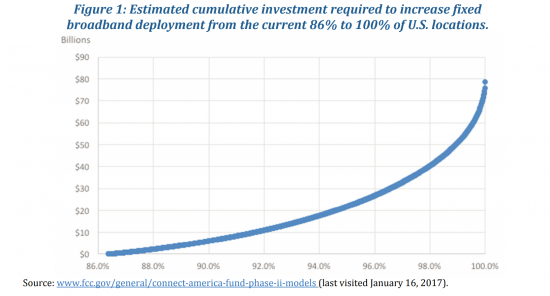
As a result, the proposals–more public money, more government telecom programs–are the wrong treatment. The Senator’s plan to wire every household is undermined by “the 2% problem”–the cost to build infrastructure to the most remote homes is massive.
Other candidates (and perhaps President Trump) will come out with rural broadband plans so it’s worth diving into the issue. Doubling down on a 20 year old government policy–more subsidies to more providers–will mostly just entrench the current costly system.
How dire is the problem?
Somewhere around 6% of Americans (about 20 million people) are unserved by a 25 Mbps landline connection. But that means around 94% of Americans have access to 25 Mbps landline broadband. (Millions more have access if you include broadband from cellular and WISP providers.)
Further, rural buildout has been improving for years, despite the high costs. From 2013 to 2017, under Obama and Trump FCCs, landline broadband providers covered around 3 or 4 million new rural customers annually. This growth in coverage seems to be driven by unsubsidized carriers because, as I found in Montana, FCC-subsidized telecom companies in rural areas are losing subscribers, even as universal service subsidies increased.
This rural buildout is more impressive when you consider that most people who don’t subscribe today simply don’t want Internet access. Somewhere between 55% to 80% of nonadopters don’t want it, according to Department of Commerce and Pew surveys. The fact is, millions of rural homes are connected annually despite the fact that most nonadopters today don’t want the service.
These are the core problems for rural telecom: (1) poorly-designed, overlapping, and expensive programs and (2) millions of consumers who are uninterested in subscribing to broadband.
Tens of billions for government-operated networks
The proposed new $85 billion rural broadband fund gets most of the headlines. It resembles the current universal service programs–the fund would disburse grants to providers, except the grants would be restricted to nonprofit and government operators of networks. Most significant: Senator Warren promises in her Plan for Rural America that, as President, she will “make sure every home in America has a fiber broadband connection.”
Every home?
This fiber-to-every-farm idea had advocates 10 years ago. The idea has failed to gain traction because it runs into the punishing economics of building networks.
Costs rise non-linearly for the last few percent of households and $85 billion would bring fiber only to a small sliver of US households. According to estimates from the Obama FCC, it would cost $40 billion to build fiber to the final 2% of households. Further, the network serving those 2% of households would require an annual subsidy of $2 billion simply to maintain those networks since revenues are never expected to cover ongoing costs.
Recent history suggests rapidly diminishing returns and that $85 billion of taxpayer money will be misspent. If the economics wasn’t difficult enough, real-world politics and government inefficiency also degrade lofty government broadband plans. For example, Australia’s construction of a nationwide publicly-owned fiber network–the nation’s largest-ever infrastructure project–is billions over budget and years behind schedule. The RUS broadband grant debacle in the US only supports the case that $85 billion simply won’t go that far. As Will Rinehart says, profit motive is not the cause of rural broadband problems. Government funding doesn’t fix the economics and government efficacy.
Studies will probably be come out saying it can be done more cheaply but America has been running a similar experiment for 20 years. Since 1998, as economists Scott Wallsten and Lucía Gamboa point out, the US government has spent around $100 billion on rural telecommunications. What does that $100 billion get? Mostly maintenance of existing rural networks and about a 2% increase of phone adoption.
Would the Plan improve or repurpose the current programs and funding? We don’t know. The op-ed from Sen. Warren complains that:
the federal government has shoveled more than a billion in taxpayer dollars per year to private ISPs to expand broadband to remote areas, but these providers have done the bare minimum with these resources.
This understates the problem. The federal government “shovels” not $1 billion, but about $5 billion, annually to providers in rural areas, mostly from the Universal Service Fund Congress established in 1996.
As for the “public option for broadband”–extensive construction of publicly-run broadband networks–I’m skeptical. Broadband is not like a traditional utility. Unlike electricity, water, or sewer, a city or utility network doesn’t have a captive customer base. There are private operators out there.
As a result, public operation of networks is a risky way to spend public funds. Public and public-private operation of networks often leads to financial distress and bankruptcy, as residents in Provo, Lake County, Kentucky, and Australia can attest.
Rural Telecom Reform
I’m glad Sen. Warren raised the issue of rural broadband, but the Plan’s drafters seem uninterested in digging into the extent of the problem and in solutions aside from throwing good money after bad. Lawmakers should focus on fixing the multi-billion dollar programs already in existence at the FCC and Ag Department, which are inexplicably complex, expensive to administer, and unequal towards ostensible beneficiaries.
Why, for instance, did rural telecom subsidies break down to about $11 per rural household in Sen. Warren’s Massachusetts in 2016 when it was about $2000 per rural household in Alaska?
Alabama and Mississippi have similar geographies and rural populations. So why did rural households in Alabama receive only about 20% of what rural Mississippi households receive?
Why have administrative costs as a percentage of the Universal Service Fund more than doubled since 1998? It costs $200 million annually to administer the USF programs today. (Compare to the FCC’s $333 million total budget request to Congress in FY 2019 for everything else the FCC does.)
I’ve written about reforms under existing law, like OTARD rule reform–letting consumers freely install small, outdoor antennas to bring broadband to rural areas–and transforming the current program funds into rural broadband vouchers. There’s also a role for cities and counties to help buildout by constructing long-lasting infrastructure like poles, towers, and fiber conduit. These assets could be leased out a low cost to providers.
Conclusion
After years of planning, the FCC reformed some of the rural telecom program in 2017. However, the reforms are partial and it’s too early to evaluate the results. The foundational problem is with the structure of existing programs. Fixing that structure should be a priority for any Senator or President concerned about rural broadband. Broadband vouchers for rural households would fix many of the problems, but lawmakers first need to question the universal service framework established over 20 years ago. There are many signs it’s not fit for purpose.
One year ago, the FCC majority passed the 2017 Restoring Internet Freedom Order, largely overturning the 2015 Open Internet Order. I consider the 2017 Order the most significant FCC action in a generation. The FCC did a rare thing for an agency—it voluntarily narrowed its authority to regulate a powerful and massive industry.
In addition to returning authority to the Federal Trade Commission and state attorneys general, the 2017 Order restored common-sense regulatory humility, despite the court’s blessing the Obama FCC’s unconvincing, expansive interpretation of FCC authority. National policy, codified in law, is that the Internet and Internet services should be “unfettered by Federal or State regulation,” which, if it means anything, means Internet services cannot be regulated as common carriers.
Net neutrality is dead
Net neutrality advocates who want the FCC to have common carriage powers over Internet applications and networking practices were outraged by the approval of the 2017 Order. Joe Kane at R Street has a good roundup of some of the death-of-the-Internet hyperbole from the political class and advocates. Some disturbed net neutrality supporters took it too far, including threats to the lives and families of the Republican commissioners, especially Chairman Pai.
But the 2017 Order hadn’t killed net neutrality. It was already dead. A few hours after the passage of the Restoring Internet Freedom Order, I was on a net neutrality panel in DC for an event about the First Amendment and the Internet. (One of my co-panelists dropped out out of caution because of the credible bomb threat at the FCC that day.) I pointed out at that event that while you wouldn’t know it from the news coverage, the Obama FCC had already killed net neutrality’s core principle—the prohibition against content blocking. The 2015 “net neutrality” Order allowed ISPs to block content. Attributing things to the 2015 Order that it simply doesn’t do is what Commissioner Carr has called the “Title II head fake.” The 2017 Order simply freed ISPs and app companies to invest and innovate without fear of plodding scrutiny and inconclusive findings from a far-off FCC bureau.
Long live net neutrality
The net neutrality movement will live on, however. The main net neutrality proponents aren’t that concerned with ISP content blocking; they want FCC regulation of the Internet companies and new media. It’s no coincidence that most of the prominent net neutrality advocates come out of the media access movement, which urged the FCC’s Fairness Doctrine, equal time laws, and programming mandates for TV and radio broadcasts.
The newer net neutrality coalition, as then-FCC Chairman Wheeler conceded frankly, doesn’t know precisely what Internet regulation would look like. What they do know is that ISPs and Internet companies are operating with inadequate public supervision and government design.
As Public Knowledge CEO Gene Kimmelman has said, the 2015 Order was about threatening the industry with vague but severe rules: “Legal risk and some ambiguity around what practices will be deemed ‘unreasonably discriminatory’ have been effective tools to instill fear for the last 20 years” for the telecom industry. Title II functions, per Kimmelman, as a “way[] to keep the shadow and the fear of ‘going too far’ hanging over the dominant ISPs.” Internet regulation advocates, he said at the time, “have to have fight after fight over every claim of discrimination, of new service or not.”
So it’s Internet regulation, not strict net neutrality, that is driving the movement. As former Obama administration and FCC adviser Kevin Werbach said last year, “It’s not just broadband providers that are fundamental public utilities, at some level Google is, at some level Facebook is, at some level Amazon is.”
Fortunately, because of the Restoring Internet Freedom Order, IP networks and apps companies have a few years of regulatory reprieve at a critical time. Net neutrality was invented in 2003 and draws on common carriage principles that cannot be applied sensibly to the various services carried on IP networks. Unlike the “single app” phone network regulated with common carriage, these networks transmit thousands of services and apps–like VoIP, gaming, conferencing, OTT video, IPTV, VoLTE, messaging, and Web–that require various technologies, changing topologies, and different quality-of-service requirements. 5G wireless will only accelerate the service differentiation that is at severe tension with net neutrality norms.
Rather than distract agency staff and the Internet industry with metaphysical debates about “reasonable network” practices, the Trump FCC has prioritized network investment, spectrum access, and rural broadband. Hopefully the next year is like the last.
Addendum: The net neutrality reprieve has not only freed up FCC staff to work on more pressing matters, it’s freed up my time to write about tech policy areas that the public will benefit from. In November I published a Mercatus working paper and a Wall Street Journalop-ed about flying car policy.
Congress is considering reforming television laws and solicited comment from the public last month. On Friday, I submitted a letter encouraging the reform effort. I attached the paper Adam and I wrote last year about the current state of video regulations and the need for eliminating the complex rules for television providers.
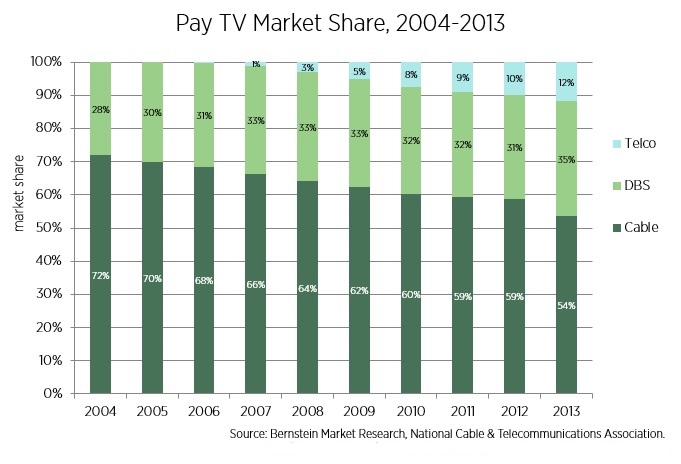
As I say in the letter, excerpted below, pay TV (cable, satellite, and telco-provided) is quite competitive, as this chart of pay TV market share illustrates. In addition to pay TV there is broadcast, Netflix, Sling, and other providers. Consumers have many choices and the old industrial policy for mass media encourages rent-seeking and prevents markets from evolving.
Many readers will recall the telecom soap opera featuring the GPS industry and LightSquared and the subsequent bankruptcy of LightSquared. Economist Thomas W. Hazlett (who is now at Clemson, after a long tenure at the GMU School of Law) and I wrote an article published in the Duke Law & Technology Review titled Tragedy of the Regulatory Commons: Lightsquared and the Missing Spectrum Rights. The piece documents LightSquared’s ambitions and dramatic collapse. Contrary to popular reporting on this story, this was not a failure of technology. We make the case that, instead, the FCC’s method of rights assignment led to the demise of LightSquared and deprived American consumers of a new nationwide wireless network. Our analysis has important implications as the FCC and Congress seek to make wide swaths of spectrum available for unlicensed devices. Namely, our paper suggests that the top-down administrative planning model is increasingly harming consumers and delaying new technologies.
Read commentary from the GPS community about LightSquared and you’ll get the impression LightSquared is run by rapacious financiers (namely CEO Phil Falcone) who were willing to flaunt FCC rules and endanger thousands of American lives with their proposed LTE network. LightSquared filings, on the other hand, paint the GPS community as defense-backed dinosaurs who abused the political process to protect their deficient devices from an innovative entrant. As is often the case, it’s more complicated than these morality plays. We don’t find villains in this tale–simply destructive rent-seeking triggered by poor FCC spectrum policy.
We avoid assigning fault to either LightSquared or GPS, but we stipulate that there were serious interference problems between LightSquared’s network and GPS devices. Interference is not an intractable problem, however. Interference is resolved everyday in other circumstances. The problem here was intractable because GPS users are dispersed and unlicensed (including government users), and could not coordinate and bargain with LightSquared when problems arose. There is no feasible way for GPS companies to track down and compel users to use more efficient devices, for instance, if LightSquared compensated them for the hassle. Knowing that GPS mitigation was unfeasible, LightSquared’s only recourse after GPS users objected to the new LTE network was through the political and regulatory process, a fight LightSquared lost badly. The biggest losers, however, were consumers, who were deprived of another wireless broadband network because FCC spectrum assignment prevented win-win bargaining between licensees. Continue reading →
As 2014 draws to a close, we take a look back at the most-read posts from the past year at The Technology Liberation Front. Thank you for reading, and enjoy. Continue reading →
The FCC is currently considering ways to make municipal broadband projects easier to deploy, an exercise that has drawn substantial criticism from Republicans, who passed a bill to prevent FCC preemption of state laws. Today the Mercatus Center released a policy analysis of municipal broadband projects, titled Community Broadband, Community Benefits? An Economic Analysis of Local Government Broadband Initiatives. The researcher is Brian Deignan, an alumnus of the Mercatus Center MA Fellowship. Brian wrote an excellent, empirical paper about the economic effects of publicly-funded broadband.
It’s remarkable how little empirical research there is on municipal broadband investment, despite years of federal data and billions of dollars in federal investment (notably, the American Recovery and Reinvestment Act). This dearth of research is in part because muni broadband proponents, as Brian points out, expressly downplay the relevance of economic evidence and suggest that the primary social benefits of muni broadband cannot be measured using traditional metrics. The current “research” about muni broadband, pro- and anti-, tends to be unfalsifiable generalizations based on extrapolations of cherry-picked examples. (There are several successes and failures, depending on your point of view.)
Brian’s paper provides researchers a great starting point when they attempt to answer an increasingly important policy question: What is the economic impact of publicly-funded broadband? Brian uses 23 years of BLS data from 80 cities that have deployed broadband and analyzes muni broadband’s effect on 1) quantity of businesses; 2) employee wages; and 3) employment. Continue reading →
The Technology Liberation Front is the tech policy blog dedicated to keeping politicians' hands off the 'net and everything else related to technology. Learn more about TLF →

 The Technology Liberation Front is the tech policy blog dedicated to keeping politicians' hands off the 'net and everything else related to technology.