Sen. Josh Hawley (R-MO) recently delivered remarks at the National Conservatism Conference and a Young America’s Foundation conference in which he railed against political and academic elites, arguing that, “the old era is ending and the old ways will not do.” “It’s time that we stood up to big government, to the people in government who think they know better,” Hawley noted at the YAF event. “[W]e are for free competition… we are for the free market.”
That’s all nice-sounding rhetoric but it sure doesn’t seem to match up with Hawley’s recent essays and policy proposals, which are straight out of the old era’s elitist and highly paternalistic Washington-Knows-Best playbook. Specifically, Hawley has called for a top-down, technocratic regulatory regime for the Internet and the digital economy more generally. Hawley has repeatedly made claims that digital technology companies have gotten a sweetheart deal from government and they they have censored conservative voices. That’s utter nonsense, but those arguments have driven his increasingly fanatic rhetoric and command-and-control policy proposals. If he succeeds in his plan to empower unelected bureaucrats inside the Beltway to reshape the Internet, it will destroy one of the greatest American success stories in recent memory. It’s hard to understand how that could be labelled “conservative” in any sense of the word. Continue reading →
Written with Christopher Koopman and Brent Skorup (originally published on Medium on 4/10/17)
Innovation isn’t just about the latest gee-whiz gizmos and gadgets. That’s all nice, but something far more profound is at stake: Innovation is the single most important determinant of long-term human well-being. There exists widespread consensus among historians, economists, political scientists and other scholars that technological innovation is the linchpin of expanded economic growth, opportunity, choice, mobility, and human flourishing more generally. It is the ongoing search for new and better ways of doing things that drives human learning and prosperity in every sense — economic, social, and cultural.
As the Industrial Revolution revealed, leaps in economic and human growth cannot be planned. They arise from societies that reward risk takers and legal systems that accommodate change. Our ability to achieve progress is directly proportional to our willingness to embrace and benefit from technological innovation, and it is a direct result of getting public policies right.
The United States is uniquely positioned to lead the world into the next era of global technological advancement and wealth creation. That’s why we and our colleagues at the Technology Policy Program at the Mercatus Center at George Mason University devote so much time and energy to defending the importance of innovation and countering threats to it. Unfortunately, those threats continue to multiply as fast as new technologies emerge. Continue reading →
I wanted to draw your attention to this important address on online platform regulation by Alex Chisholm, the head of UK’s Competition and Markets Authority. That’s the non-ministerial department in the UK responsible for competition policy issues. Chisholm delivered the address on October 27th at the Bundesnetzagentur conference in Bonn. It’s a terrific speech that other policymakers would be wise to read and mimic to ensure that antitrust and competition policy decisions don’t derail the many benefits of the Information Revolution.
“Today, as regulators, we have the responsibility but also the great historical privilege of playing an influential role in the deployment throughout the economy of the latest of these defining technological eras,” Chisholm began. “As regulators, we must try to minimise the inevitable mismatch between how we’ve done things before and the opportunities and risks of the new,” he argued.
He continued on to specify three recommendations for those crafting policy on this front: Continue reading →
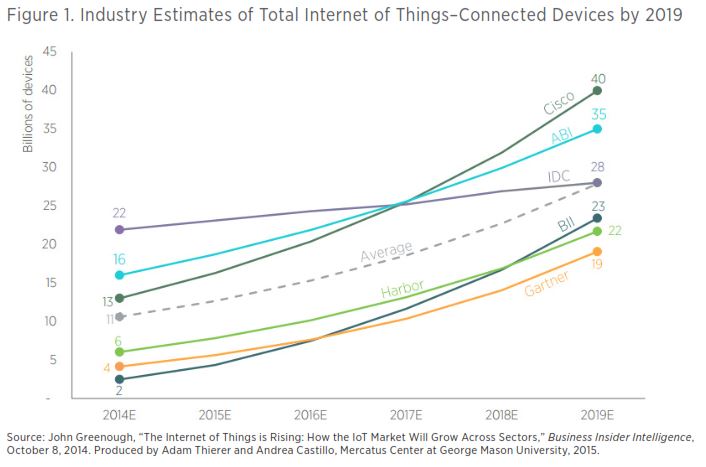
The “Internet of Things” (IoT) is already growing at a breakneck pace and is expected to continue to accelerate rapidly. In a short new paper (“Projecting the Growth and Economic Impact of the Internet of Things“) that I’ve just released with my Mercatus Center colleague Andrea Castillo, we provide a brief explanation of IoT technologies before describing the current projections of the economic and technological impacts that IoT could have on society. In addition to creating massive gains for consumers, IoT is projected to provide dramatic improvements in manufacturing, health care, energy, transportation, retail services, government, and general economic growth. Take a look at our paper if you’re interested, and you might also want to check out my 118-page law review article, “The Internet of Things and Wearable Technology: Addressing Privacy and Security Concerns without Derailing Innovation” as well as my recent congressional testimony on the policy issues surrounding the IoT.)
The FTC has now posted the videos from their workshop and down below I have embedded my particular panel. My remarks begin around the 5-minute mark of the video.
Along with colleagues at the Mercatus Center at George Mason University, I am releasing two major new reports today dealing with the regulation of the sharing economy. The first report is a 20-page filing to the Federal Trade Commissionthat we are submitting to the agency for its upcoming June 9th workshop on “The “Sharing” Economy: Issues Facing Platforms, Participants, and Regulators.” We have been invited to participate in that event and I will be speaking on the fourth panel of the workshop. The filing I am submitting today for that workshop was co-authored with my Mercatus colleagues Christopher Koopman and Matt Mitchell.
The Federal Trade Commission (FTC) is taking a more active interest in state and local barriers to entry and innovation that could threaten the continued growth of the digital economy in general and the sharing economy in particular. The agency recently announced it would be hosting a June 9th workshop “to examine competition, consumer protection, and economic issues raised by the proliferation of online and mobile peer-to peer business platforms in certain sectors of the [sharing] economy.” Filings are due to the agency in this matter by May 26th. (Along with my Mercatus Center colleagues, I will be submitting comments and also releasing a big paper on reputational feedback mechanisms that same week. We have already released this paper on the general topic.)
Relatedly, just yesterday, the FTC sent a letter to Michigan policymakers about restricting entry by Tesla and other direct-to-consumer sellers of vehicles. Michigan passed a law in October 2014 prohibiting such direct sales. The FTC’s strongly-worded letter decries the state’s law as “protectionism for independent franchised dealers” noting that “current provisions operate as a special protection for dealers—a protection that is likely harming both competition and consumers.” The agency argues that:
consumers are the ones best situated to choose for themselves both the vehicles they want to buy and how they want to buy them. Automobile manufacturers have an economic incentive to respond to consumer preferences by choosing the most effective distribution method for their vehicle brands. Absent supportable public policy considerations, the law should permit automobile manufacturers to choose their distribution method to be responsive to the desires of motor vehicle buyers.
The agency cites the “well-developed body of research on these issues strongly suggests that government restrictions on distribution are rarely desirable for consumers” and the staff letter continues on to utterly demolish the bogus arguments set forth by defenders of the blatantly self-serving, cronyist law. (For more discussion of just how anti-competitive and anti-consumer these laws are in practice, see this January 2015 Mercatus Center study, “State Franchise Law Carjacks Auto Buyers,” by Jerry Ellig and Jesse Martinez.) Continue reading →
Today, Eli Dourado, Ryan Hagemann and I filed comments with the Federal Aviation Administration (FAA) in its proceeding on the “Operation and Certification of Small Unmanned Aircraft Systems” (i.e. small private drones). In this filing, we begin by arguing that just as “permissionless innovation” has been the primary driver of entrepreneurialism and economic growth in many sectors of the economy over the past decade, that same model can and should guide policy decisions in other sectors, including the nation’s airspace. “While safety-related considerations can merit some precautionary policies,” we argue, “it is important that those regulations leave ample space for unpredictable innovation opportunities.”
We continue on in our filing to note that “while the FAA’s NPRM is accompanied by a regulatory evaluation that includes benefit-cost analysis, the analysis does not meet the standard required by Executive Order 12866. In particular, it fails to consider all costs and benefits of available regulatory alternatives.” After that, we itemize the good and the bad of the FAA propose with an eye toward how the agency can maximize innovation opportunities. We conclude by noting:
The FAA must carefully consider the potential effect of UASs on the US economy. If it does not, innovation and technological advancement in the commercial UAS space will find a home elsewhere in the world. Many of the most innovative UAS advances are already happening abroad, not in the United States. If the United States is to be a leader in the development of UAS technologies, the FAA must open the American skies to innovation.
The Obama Administration has just released a draft “Consumer Privacy Bill of Rights Act of 2015.” Generally speaking, the bill aims to translate fair information practice principles (FIPPs) — which have traditionally been flexible and voluntary guidelines — into a formal set of industry best practices that would be federally enforced on private sector digital innovators. This includes federally-mandated Privacy Review Boards, approved by the Federal Trade Commission, the agency that will be primarily responsible for enforcing the new regulatory regime.
Many of the principles found in the Administration’s draft proposal are quite sensible as best practices, but the danger here is that they could soon be converted into a heavy-handed, bureaucratized regulatory regime for America’s highly innovative, data-driven economy.
No matter how well-intentioned this proposal may be, it is vital to recognize that restrictions on data collection could negatively impact innovation, consumer choice, and the competitiveness of America’s digital economy.
Online privacy and security is vitally important, but we should look to use alternative and less costly approaches to protecting privacy and security that rely on education, empowerment, and targeted enforcement of existing laws. Serious and lasting long-term privacy protection requires a layered, multifaceted approach incorporating many solutions.
That is why flexible data collection and use policies and evolving best practices will ultimately serve consumers better than one-size-fits all, top-down regulatory edicts. Continue reading →
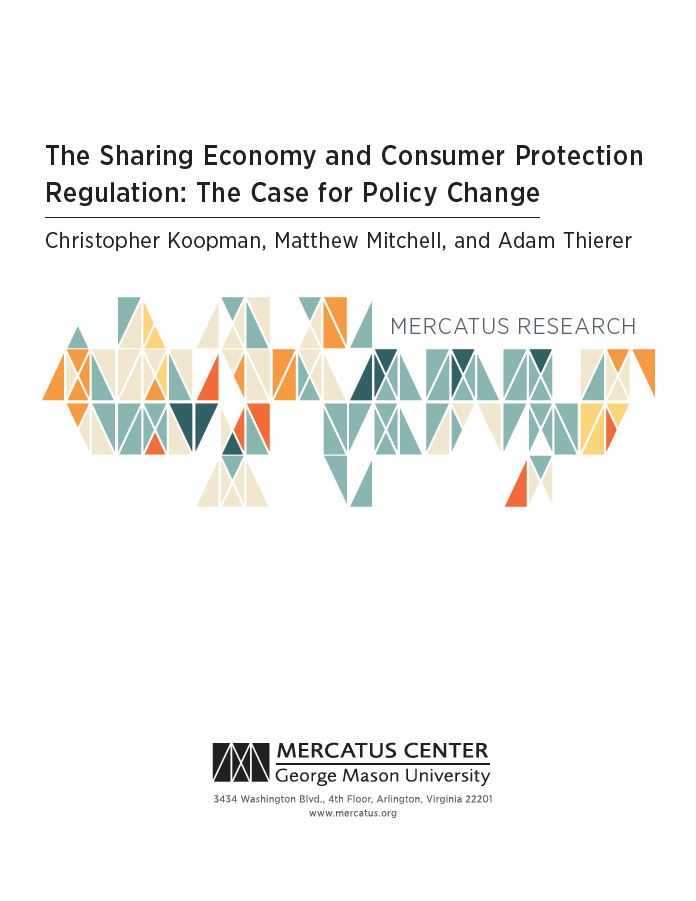
In this new paper, Koopman, Mitchell, and I discuss how the sharing economy has changed the way many Americans commute, shop, vacation, borrow, and so on. Of course, the sharing economy “has also disrupted long-established industries, from taxis to hotels, and has confounded policymakers,” we note. “In particular, regulators are trying to determine how to apply many of the traditional ‘consumer protection’ regulations to these new and innovative firms.” This has led to a major debate over the public policies that should govern the sharing economy.
We argue that, coupled with the Internet and various new informational resources, the rapid growth of the sharing economy alleviates the need for much traditional top-down regulation. These recent innovations are likely doing a much better job of serving consumer needs by offering new innovations, more choices, more service differentiation, better prices, and higher-quality services. In particular, the sharing economy and the various feedback mechanism it relies upon helps solve the tradition economic problem of “asymmetrical information,” which is often cited as a rationale for regulation. We conclude, therefore, that “the key contribution of the sharing economy is that it has overcome market imperfections without recourse to traditional forms of regulation. Continued application of these outmoded regulatory regimes is likely to harm consumers.” Continue reading →
The Technology Liberation Front is the tech policy blog dedicated to keeping politicians' hands off the 'net and everything else related to technology. Learn more about TLF →



 The Technology Liberation Front is the tech policy blog dedicated to keeping politicians' hands off the 'net and everything else related to technology.