The sharing economy is growing faster than ever and becoming a hot policy topic these days. I’ve been fielding a lot of media calls lately about the nature of the sharing economy and how it should be regulated. (See latest clip below from the Stossel show on Fox Business Network.) Thus, I sketched out some general thoughts about the issue and thought I would share them here, along with some helpful additional reading I have come across while researching the issue. I’d welcome comments on this outline as well as suggestions for additional reading. (Note: I’ve also embedded some useful images from Jeremiah Owyang of Crowd Companies.)
1)
Just because policymakers claim that regulation is meant to protect consumers does not mean it actually does so.
Cronyism/ Rent-seeking: Regulation is often “captured” by powerful and politically well-connected incumbents and used to their own benefit. (+ Lobbying activity creates deadweight losses for society.)
Innovation-killing: Regulations become a formidable barrier to new innovation, entry, and entrepreneurism.
Unintended consequences: Instead of resulting in lower prices & better service, the opposite often happens: Higher prices & lower quality service. (Example: Painting all cabs same color destroying branding & ability to differentiate).
With each booth I pass and presentation I listen to at the 2014 International Consumer Electronics Show (CES), it becomes increasingly evident that the “Internet of Things” era has arrived. In just a few short years, the Internet of Things (IoT) has gone from industry buzzword to marketplace reality. Countless new IoT devices are on display throughout the halls of the Las Vegas Convention Center this week, including various wearable technologies, smart appliances, remote monitoring services, autonomous vehicles, and much more.
This isn’t vaporware; these are devices or services that are already on the market or will launch shortly. Some will fail, of course, just as many other earlier technologies on display at past CES shows didn’t pan out. But many of these IoT technologies will succeed, driven by growing consumer demand for highly personalized, ubiquitous, and instantaneous services.
But will policymakers let the Internet of Things revolution continue or will they stop it dead in its tracks? Interestingly, not too many people out here in Vegas at the CES seem all that worried about the latter outcome. Indeed, what I find most striking about the conversation out here at CES this week versus the one about IoT that has been taking place in Washington over the past year is that there is a large and growing disconnect between consumers and policymakers about what the Internet of Things means for the future.
When every device has a sensor, a chip, and some sort of networking capability, amazing opportunities become available to consumers. And that’s what has them so excited and ready to embrace these new technologies. But those same capabilities are exactly what raise the blood pressure of many policymakers and policy activists who fear the safety, security, or privacy-related problems that might creep up in a world filled with such technologies.
But at least so far, most consumers don’t seem to share the same worries. Continue reading →
Here are a few Internet policy essays I collected over the past year which I thought were particularly well done and worth highlighting once more. They are listed in chronological order:
L. Gordon Crovitz – “Silicon Valley’s ‘Suicide Impulse,'” Wall Street Journal, January 28. (“It’s a measure of how far Silicon Valley has strayed from its entrepreneurial roots that a top regulator is calling on technology companies to do less lobbying and more competing,” Crovitz argued. “Rather than lobby government to go after one another, Silicon Valley lobbyists should unite to go after overreaching government. Instead of the “suicide impulse” of lobbying for more regulation, Silicon Valley should seek deregulation and a long-overdue freedom to return to its entrepreneurial roots.”)
John Gruber – “Open and Shut,” Daring Fireball, March 1. (An absolutely brutal evisceration of Tim Wu’s recent work.)
Julian Sanchez – “A Reply to Epstein & Pilon on NSA’s Metadata Program,” Cato at Liberty, June 16. (A meticulous point-by-point takedown of an essay by Roger Pilon & Richard Epstein defending NSA’s online surveillance tactics.)
Tomorrow, the Federal Trade Commission (FTC) will host an all-day workshop entitled, “Internet of Things: Privacy and Security in a Connected World.” [Detailed agenda here.] According to the FTC: “The workshop will focus on privacy and security issues related to increased connectivity for consumers, both in the home (including home automation, smart home appliances and connected devices), and when consumers are on the move (including health and fitness devices, personal devices, and cars).”
Where is the FTC heading on this front? This Politico story by Erin Mershon from last week offers some possible ideas. Yet, it still remains unclear whether this is just another inquiry into an exciting set of new technologies or if it is, as I worried in my recent comments to the FTC on this matter, “the beginning of a regulatory regime for a new set of information technologies that are still in their infancy.”
First, for those not familiar with the “Internet of Things,” this short new report from Daniel Castro & Jordan Misra of the Center for Data Innovation offers a good definition:
The “Internet of Things” refers to the concept that the Internet is no longer just a global network for people to communicate with one another using computers, but it is also a platform or devices to communicate electronically with the world around them. The result is a world that is alive with information as data flows from one device to another and is shared and reused for a multitude of purposes. Harnessing the potential of all of this data for economic and social good will be one of the primary challenges and opportunities of the coming decades.
The report continues on to offer a wide range of examples of new products and services that could fulfill this promise.
What I find somewhat worrying about the FTC’s sudden interest in the Internet of Things is that it opens to the door for some regulatory-minded critics to encourage preemptive controls on this exciting new wave of digital age innovation, based almost entirely on hypothetical worst-case scenarios they have conjured up. Continue reading →
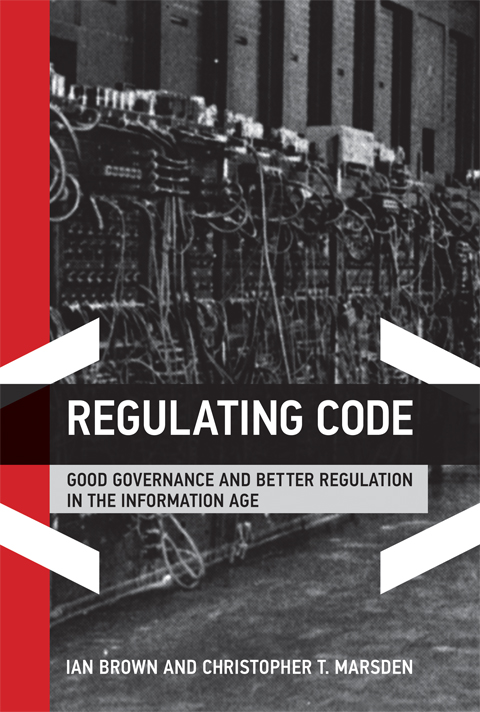
Ian Brown and Christopher T. Marsden’s new book, Regulating Code: Good Governance and Better Regulation in the Information Age, will go down as one of the most important Internet policy books of 2013 for two reasons. First, their book offers an excellent overview of how Internet regulation has unfolded on five different fronts: privacy and data protection; copyright; content censorship; social networks and user-generated content issues; and net neutrality regulation. They craft detailed case studies that incorporate important insights about how countries across the globe are dealing with these issues. Second, the authors endorse a specific normative approach to Net governance that they argue is taking hold across these policy arenas. They call their preferred policy paradigm “prosumer law” and it envisions an active role for governments, which they think should pursue “smarter regulation” of code.
In terms of organization, Brown and Marsden’s book follows the same format found in Milton Mueller’s important 2010 book Networks and States: The Global Politics of Internet Governance; both books feature meaty case studies in the middle bookended by chapters that endorse a specific approach to Internet policymaking. (Incidentally, both books were published by MIT Press.) And, also like Mueller’s book, Brown and Marsden’s Regulating Code does a somewhat better job using case studies to explore the forces shaping Internet policy across the globe than it does making the normative case for their preferred approach to these issues. Continue reading →
Here’s a presentation I delivered on “The War on Vertical Integration in the Digital Economy” at the latest meeting of the Southern Economic Association this weekend. It outlines concerns about vertical integration in the tech economy and specifically addresses regulatory proposals set forth by Tim Wu (arguing for a “separations principle” for the tech economy) & Jonathan Zittrain (arguing for “API neutrality” for social media and digital platforms). This presentation is based on two papers published by the Mercatus Center at George Mason University: “Uncreative Destruction: The Misguided War on Vertical Integration in the Information Economy” (with Brent Skorup) & “The Perils of Classifying Social Media Platforms as Public Utilities.”
[UPDATE 4/30/13: This article was subsequently published in Volume 65, Issues 2 of the Federal Communications Law Journal in April 2013. The links below now point to the final FCLJ version.]
The Mercatus Center at George Mason University has just released a new paper by Brent Skorup and me entitled, “Uncreative Destruction: The War on Vertical Integration in the Information Economy.” Brent, who is the research director for the Information Economy Project at the George Mason University School of Law, and I have been working on this paper since the Spring and we are looking forward to getting it published in a law review shortly. The paper focuses on Tim Wu’s “separations principle” for the digital economy, something I’ve spent some time critiquing here in the past. Here’s the introduction from the 44-page paper that Brent and I just released:
Are information sectors sufficiently different from other sectors of the economy such that more stringent antitrust standards should be applied to them preemptively? Columbia Law School professor Tim Wu responds in the affirmative in his book The Master Switch: The Rise and Fall of Information Empires. Having successfully pushed net-neutrality regulation into the policy spotlight, Wu has turned his attention to what he regards as excessive market concentration and threats to free speech throughout the entire information economy.To support his call for increased antitrust intervention, Wu explains his view of competition in the information economy—a view that deviates substantially from current mainstream antitrust theory.
Continue reading →
Is competition really a problem in the tech industry? That was the question the folks over at WebProNews asked me to come on their show and discuss this week. I offer my thoughts in the following 15-minute clip. Also, down below I have embedded a few of my recent relevant essays on this topic, a few of which I mentioned during the show.
This morning I spoke at a U.S. Chamber of Commerce event on “Responsible Data Uses: Benefits to Consumers, Businesses and the Economy.” In preparing for the event, I dusted off some old working notes for speeches I had delivered at other events about privacy policy and “big data” and expanded them a bit to account for recent policy developments. For what it’s worth, I figured I would post those notes here. (I apologize about the informality but I never write out my speeches, I just work from bullet points.)
—————–
Benefits of “Big Data”
“big data” has numerous micro- and macroeconomic benefits
Micro benefits:
data aggregation of all varieties has powerful social and economic benefits that are sometimes invisible to consumers and citizens but are nonetheless enjoyed by them
big data can positively impact the 3 key micro variables – quality, quantity & price – and benefit consumers / citizens in the process
Macro benefits:
Data is the lifeblood of the information economy and it has an increasing bearing on the global competitiveness of companies and countries
In the old days, when we talked about comparative and competitive advantage, the focus was on natural resources, labor, and capital.
Today, we increasingly talk about another variable: information
Data is increasing one of the most important resources that can benefit economic growth, innovation, and the competitive advantage of firms and nations.
Privacy Concerns
of course, “big data” also raises big privacy concerns for many groups and individuals
this has led to calls for regulatory action and virtually all levels of government – federal, state, local, and international – are considering expanded controls on data collection and aggregation
Federal policy makers, state legislators, and state attorneys general have recently shown interest in regulating commercial advertising and marketing. Several new regulatory initiatives are being proposed, or are already underway, that could severely curtail or restrict advertising or marketing on a variety of platforms. The consequences of these stepped-up regulatory efforts will be profound and will hurt consumer welfare both directly and indirectly.
I go on to note that “advertising can be an easy target for politicians or regulatory activist groups who make a variety of (typically unsubstantiated) claims about its negative impact on society,” but then continue on to explain how “the role of commercial speech in a free-market economy is often misunderstood or taken for granted.” I outline how, despite regulators’ concerns, consumers actually derive three important types of benefits from advertising and marketing: (1) Informational / Educational Benefits; (2) Market Choice / Pro-Competitive Benefits; and (3) Media Promotion / Cross-Subsidization. After discussing each benefit, I conclude that:
For these reasons, a stepped-up regulatory crusade against advertising and marketing will hurt consumer welfare since it will raise prices, restrict choice, and diminish marketplace competition and innovation—both in ad-supported content and service markets, and throughout the economy at large. Simply stated, there is no free lunch.
Read the entire 1,800-word essay here. I have also embedded the document down below in a Scribd reader.
The Technology Liberation Front is the tech policy blog dedicated to keeping politicians' hands off the 'net and everything else related to technology. Learn more about TLF →

 The Technology Liberation Front is the tech policy blog dedicated to keeping politicians' hands off the 'net and everything else related to technology.