My latest Forbes column is a celebration of 47 U.S.C. §230, otherwise known as “Section 230.” Sec. 230 turns 15 years old this year and I argue that this important law has “helped foster the abundance of informational riches that lies at our fingertips today” and has served as “the foundation of our Internet freedoms.” Sadly, however, few people have even heard of it. Worse yet, as I note in my essay, this important law is under attack from various academics and organizations who want it modified to address a variety of online problems. But, as I note:
If the threat of punishing liability is increased, the chilling effect on the free exchange of views and information would likely be quite profound. Many site administrators would immediately start removing massive amounts of content to avoid liability. More simply, they might just shut down any interactive features on their sites or limit service in other ways.
Head over to
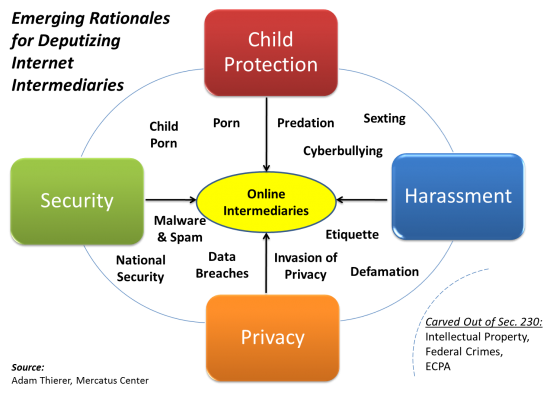
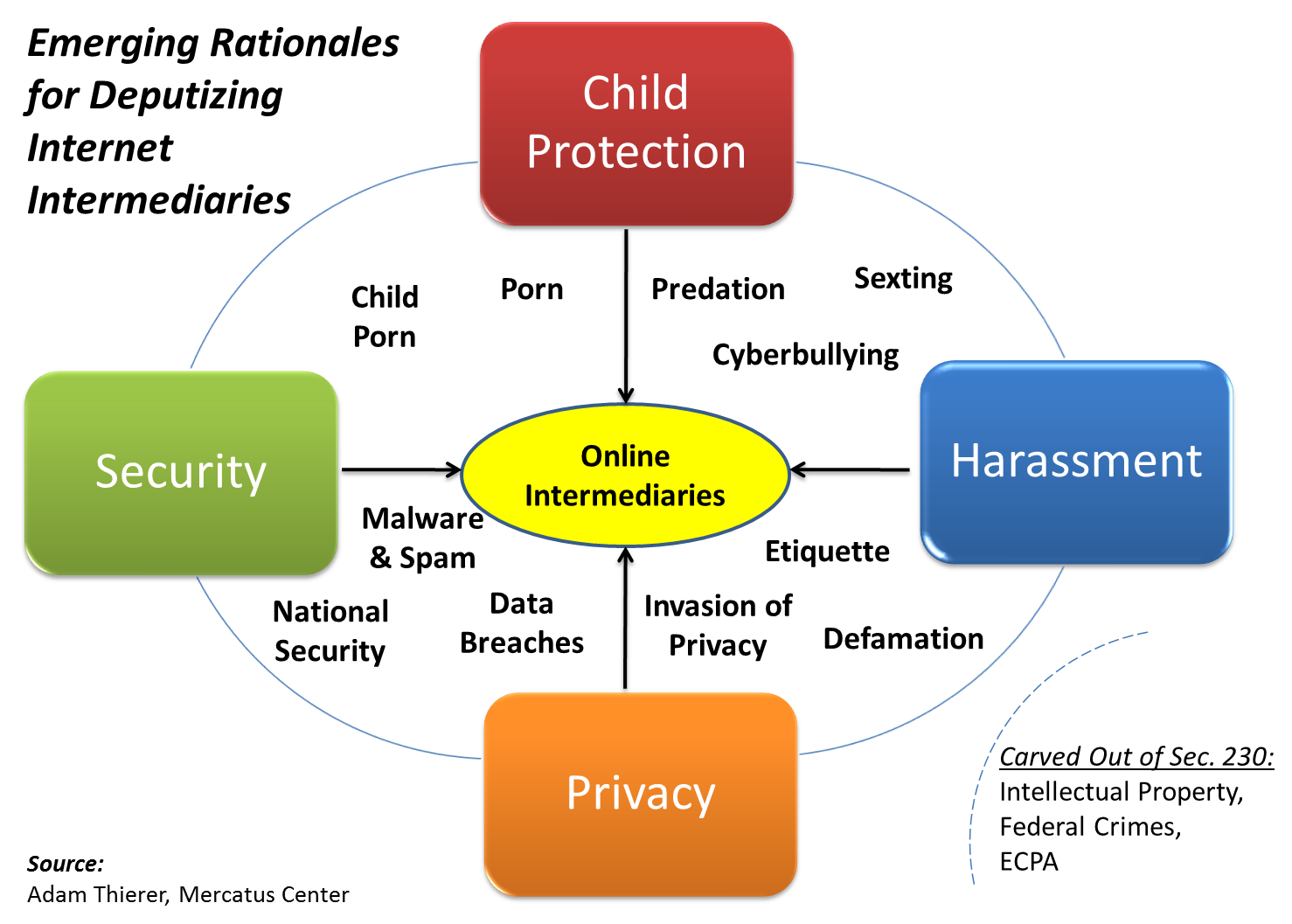
Forbes to read the rest. And here’s a graphic I put together illustrating all the new fault lines in the war against Sec. 230. It will be included in a new paper on the issue that I am wrapping up right now.
By Adam Thierer & Berin Szoka
Short but very important essay here from Santa Clara University Law School Prof. Eric Goldman about calls to alter Sec. 230 of the Communications Decency Act (CDA) to address concerns about online harassment. Generally speaking, Sec. 230 immunizes online intermediaries from punishing liability for the content that travels over their networks / services. Specifically, Sec. 230 stipulates that “No provider or user of an interactive computer service shall be treated as the publisher or speaker of any information provided by another information content provider.” In other words: Don’t shoot the messenger!
As we’ve noted here before, it is probably not an overstatement to think of Sec. 230 as the very cornerstone of Internet Freedom, since it makes possible an online “utopia for utopias,” to borrow a phrase from our favorite modern political philosopher, the late Robert Nozick. Without Sec. 230, intermediaries would likely be forced to shut down many avenues of communication and would have to become deputized conduct and morality police for every cyber-street corner.
Goldman, America’s leading expert on Sec. 230-related jurisprudence, correctly notes that, “Frequently, § 230’s critics do not attack the immunization generally, but instead advocate a new limited exception for their pet concern.” He’s got that right. Indeed, we are increasingly hearing calls from numerous quarters these days to “tweak 230” for one pet concern after another. We’ve illustrated some of those concerns in this exhibit.
Deputization of the Middleman http://d1.scribdassets.com/ScribdViewer.swf
Regulatory advocates can be found for each of these issues who like to see the protections afforded by Sec. 230 scaled back by Congress or he courts. But Goldman rightly warns:
Continue reading →
The Wired article (“Great Wall of Facebook: The Social Network’s Plan to Dominate the Internet — and Keep Google Out“) I discussed yesterday touched on another issue near & dear to my heart (besides the importance of smarter advertising): the future of online anonymity. The article lays out Facebook’s “4-Step Plan for Online Domination,” which involves “colonizing” the web though Facebook’s Connect (launched Dec. 2008) and Open Stream API (launched April 2009) initiatives, which:
don’t just allow users to access their Facebook networks from anywhere online. They also help realize Facebook’s longtime vision of giving users a unique, Web-wide online profile. By linking Web activity to Facebook accounts, they begin to replace the largely anonymous “no one knows you’re a dog” version of online identity with one in which every action is tied to who users really are.
To hear Facebook executives tell it, this will make online interactions more meaningful and more personal.
Imagine, for example, if online comments were written by people using their real names rather than by anonymous trolls. “Up until now all the advancements in technology have said information and data are the most important thing,” says Dave Morin, Facebook’s senior platform manager. “The most important thing to us is that there is a person sitting behind that keyboard. We think the Internet is about people.”
The bolded prediction of what I would call “Online Identity Integration” is already happening. To take one tiny example, readers can now post comments on the TLF by logging into Disqus (our Comment Management System) through their Facebook (or Twitter) account, which will also allow them to automatically share those comments on Facebook (or Twitter). This is purely opt-in: Users are free to continue to post anonymous comments. But as more websites and platforms implement such Identity Integration functionality, a growing percentage of online speech will be tied to profiles offered by major social networks.
Some free speech advocates are sure to bemoan Identity Integration as directly undermining online anonymity. Continue reading →
 Ars Technica has just posted the transcript of a friendly debate I recently engaged in with Harvard University law professor John Palfrey about the future of Section 230 of the Communications Decency Act and online liability more generally. Our debate got started last fall, shortly after I penned a favorable review of John’s excellent new book (with Urs Gasser), Born Digital: Understanding the First Generation of Digital Natives. [Listen to my podcast with John about it here.] Although I enjoyed John’s book, I also raised some concerns about his call in the book to reopen and revise Section 230, specifically to address child safety concerns. At the time, John and I were working together on the Berkman Center’s “Internet Safety Technical Task Force” and we decided to begin an e-mail exchange about the future of 230 and online liability norms more generally. The result was the debate that Ars has just published.
In our exchange, I begin by asking John to more fully develop some statements and proposals he sets forth in
Born Digital. Specifically, he and co-author Urs Gasser argue that: “The scope of the immunity the CDA provides for online service providers is too broad” and that the law “should not preclude parents from bringing a claim of negligence against [a social networking site] for failing to protect the safety of its users.” They also suggest that “There is no reason why a social network should be protected from liability related to the safety of young people simply because its business operates online.” Specifically, the call for “strengthening private causes of action by clarifying that tort claims may be brought against online service providers when safety is at stake,” although they do not define those instances.
Using those proposals as a launching point for our discussion, I challenge John as follows:
I’m troubled by your proposals because I believe Section 230 has been crucial to the success of the Internet and the robust marketplace of online freedom of speech and expression. In many ways — whether intentional or not — Section 230 was the legal cornerstone that gave rise to many of the online freedoms we enjoy today. I fear that the proposal you have set forth could reverse that. It could lead to crushing liability for many online operators-and not just giants like MySpace or Facebook-that might not be able to absorb the litigation costs. Could you elaborate a bit more about your proposal and explain why you think the time has come to alter Section 230 and online liability norms?
And John does and then we go back-and-forth from there. Again, you can read the whole exchange over at Ars.
It was a great pleasure to engage in this exchange with Prof. Palfrey and I look forward to what others have to say in response to our debate. I am working on a longer paper looking broadly at the rising threats to Sec. 230 and the increasing calls for expanded online liability and middleman deputization. I will use whatever feedback I get from this exchange to refine my paper and proposals.

 The Technology Liberation Front is the tech policy blog dedicated to keeping politicians' hands off the 'net and everything else related to technology.