I’ve been floating around in conservative policy circles for 30 years and I have spent much of that time covering media policy and child safety issues. My time in conservative circles began in 1992 with a 9-year stint at the Heritage Foundation, where I launched the organization’s policy efforts on media regulation, the Internet, and digital technology. Meanwhile, my work on child safety has spanned 4 think tanks, multiple blue ribbon child safety commissions, countless essays, dozens of filings and testimonies, and even a multi-edition book.
During this three-decade run, I’ve tried my hardest to find balanced ways of addressing some of the legitimate concerns that many conservatives have about kids, media content, and online safety issues. Raising kids is the hardest job in the world. My daughter and son are now off at college, but the last twenty years of helping them figure out how to navigate the world and all the challenges it poses was filled with difficulties. This was especially true because my daughter and son faced completely different challenges when it came to media content and online interactions. Simply put, there is no one-size-fits-all playbook when it comes to raising kids or addressing concerns about healthy media interactions. Continue reading →
[Cross-posted from Medium.]
In an age of hyper-partisanship, one issue unites the warring tribes of American politics like no other: hatred of “Big Tech.” You know, those evil bastards who gave us instantaneous access to a universe of information at little to no cost. Those treacherous villains! People are quick to forget the benefits of moving from a world of Information Poverty to one of Information Abundance, preferring to take for granted all they’ve been given and then find new things to complain about.
But what mostly unites people against large technology platforms is the feeling that they are just too big or too influential relative to other institutions, including government. I get some of that concern, even if I strongly disagree with many of their proposed solutions, such as the highly dangerous sledgehammer of antitrust breakups or sweeping speech controls. Breaking up large tech companies would not only compromise the many benefits they provide us with, but it would undermine America’s global standing as a leader in information and computational technology. We don’t want that. And speech codes or meddlesome algorithmic regulations are on a collision course with the First Amendment and will just result in endless litigation in the courts.
There’s a better path forward. As President Ronald Reagan rightly said in 1987 when vetoing a bill to reestablish the Fairness Doctrine, “History has shown that the dangers of an overly timid or biased press cannot be averted through bureaucratic regulation, but only through the freedom and competition that the First Amendment sought to guarantee.” In other words, as I wrote in a previous essay about “The Classical Liberal Approach to Digital Media Free Speech Issues,” more innovation and competition are always superior to more regulation when it comes to encouraging speech and speech opportunities.
Continue reading →
After a slight delay, Jurimetrics has finally published my latest law review article, “Soft Law in U.S. ICT Sectors: Four Case Studies.” It is part of a major symposium that Arizona State University (ASU) Law School put together on “Governing Emerging Technologies Through Soft Law: Lessons For Artificial Intelligence” for the journal. I was 1 of 4 scholars invited to pen foundational essays for this symposium. Jurimetrics is a official publication of the American Bar Association’s Section of Science & Technology Law.
This report was a major undertaking that involved dozens of interviews, extensive historic research, several events and presentations, and then numerous revisions before the final product was released. The final PDF version of the journal article is attached.
Here is the abstract: Continue reading →
I have been covering telecom and Internet policy for almost 30 years now. During much of that time – which included a nine year stint at the Heritage Foundation — I have interacted with conservatives on various policy issues and often worked very closely with them to advance certain reforms.
If I divided my time in Tech Policy Land into two big chunks of time, I’d say the biggest tech-related policy issue for conservatives during the first 15 years I was in the business (roughly 1990 – 2005) was preventing the resurrection of the so-called Fairness Doctrine. And the biggest issue during the second 15-year period (roughly 2005 – present) was stopping the imposition of “Net neutrality” mandates on the Internet. In both cases, conservatives vociferously blasted the notion that unelected government bureaucrats should sit in judgment of what constituted “fairness” in media or “neutrality” online.
Many conservatives are suddenly changing their tune, however. President Trump and Sen. Ted Cruz, for example, have been increasingly critical of both traditional media and new tech companies in various public statements and suggested an openness to increased regulation. The President has gone after old and new media outlets alike, while Sen. Cruz (along with others like Sen. Lindsay Graham) has suggested during congressional hearings that increased oversight of social media platforms is needed, including potential antitrust action.
Meanwhile, during his short time in office, Sen. Josh Hawley (R-Mo.) has become one of the most vocal Internet critics on the Right. In a shockingly-worded USA Today editorial in late May, Hawley said, “social media wastes our time and resources” and is “a field of little productive value” that have only “given us an addiction economy.” He even referred to these sites as “parasites” and blamed them for a long list of social problems, leading him to suggest that, “we’d be better off if Facebook disappeared” along with various other sites and services.
Hawley’s moral panic over social media has now bubbled over into a regulatory crusade that would unleash federal bureaucrats on the Internet in an attempt to dictate “fair” speech on the Internet. He has introduced an astonishing piece of legislation aimed at undoing the liability protections that Internet providers rely upon to provide open platforms for speech and commerce. If Hawley’s absurdly misnamed new “Ending Support for Internet Censorship Act” is implemented, it would essentially combine the core elements of the Fairness Doctrine and Net Neutrality to create a massive new regulatory regime for the Internet. Continue reading →
[This essay originally appeared on the AIER blog on May 28, 2019. The USA TODAY also ran a shorter version of this essay as a letter to the editor on June 2, 2019.]
In a hotly-worded USA Today op-ed last week, Senator Josh Hawley (R-Missouri) railed against social media sites Facebook, Instagram, and Twitter. He argued that, “social media wastes our time and resources,” and is “a field of little productive value” that have only “given us an addiction economy.” Sen. Hawley refers to these sites as “parasites” and blames them for a litany of social problems (including an unproven link to increased suicide), leading him to declare that, “we’d be better off if Facebook disappeared.”
As far as moral panics go, Sen. Hawley’s will go down as one for the ages. Politicians have always castigated new technologies, media platforms, and content for supposedly corrupting the youth of their generation. But Sen. Hawley’s inflammatory rhetoric and proposals are something we haven’t seen in quite some time.
He sounds like those fire-breathing politicians and pundits of the past century who vociferously protested everything from comic books to cable television, the waltz to the Walkman, and rock-and-roll to rap music. In order to save the youth of America, many past critics said, we must destroy the media or media platforms they are supposedly addicted to. That is exactly what Sen. Hawley would have us do to today’s leading media platforms because, in his opinion, they “do our country more harm than good.”
We have to hope that Sen. Hawley is no more successful than past critics and politicians who wanted to take these choices away from the public. Paternalistic politicians should not be dictating content choices for the rest of us or destroying technologies and platforms that millions of people benefit from. Continue reading →
A decade ago, a heated debate raged over the benefits of “a la carte” (or “unbundling”) mandates for cable and satellite TV operators. Regulatory advocates said consumers wanted to buy all TV channels individually to lower costs. The FCC under former Republican Chairman Kevin Martin got close to mandating a la carte regulation.
But the math just didn’t add up. A la carte mandates, many economists noted, would actually cost consumers just as much (or even more) once they repurchased all the individual channels they desired. And it wasn’t clear people really wanted a completely atomized one-by-one content shopping experience anyway.
Throughout media history, bundles of all different sorts had been used across many different sectors (books, newspapers, music, etc.). This was because consumers often enjoyed the benefits of getting a package of diverse content delivered to them in an all-in-one package. Bundling also helped media operators create and sustain a diversity of content using creative cross-subsidization schemes. The traditional newspaper format and business is perhaps the greatest example of media bundling. The classifieds and sports sections helped cross-subsidize hard news (especially local reporting). See this 2008 essay by Jeff Eisenach and me for details for more details on the economics of a la carte.
Yet, with the rise of cable and satellite television, some critics protested the use of bundles for delivering content. Even though it was clear that the incredible diversity of 500+ channels on pay TV was directly attributable to strong channels cross-subsidizing weaker ones, many regulatory advocates said we would be better off without bundles. Moreover, they said, online video markets could show us the path forward in the form of radically atomized content options and cheaper prices.
Flash-forward to today. Continue reading →
Congress is considering reforming television laws and solicited comment from the public last month. On Friday, I submitted a letter encouraging the reform effort. I attached the paper Adam and I wrote last year about the current state of video regulations and the need for eliminating the complex rules for television providers.
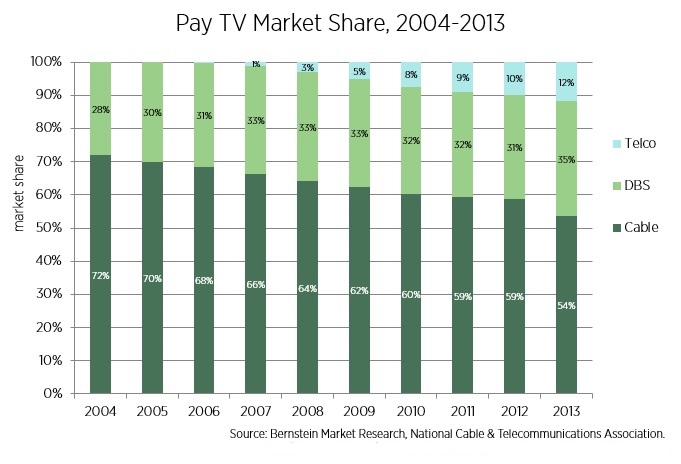
As I say in the letter, excerpted below, pay TV (cable, satellite, and telco-provided) is quite competitive, as this chart of pay TV market share illustrates. In addition to pay TV there is broadcast, Netflix, Sling, and other providers. Consumers have many choices and the old industrial policy for mass media encourages rent-seeking and prevents markets from evolving.
Continue reading →
Aereo’s antenna system is frequently characterized perjoratively as a Rube Goldberg contraption, including in the Supreme Court oral arguments. Funny enough, Preston Padden, a veteran television executive, has characterized the legal system producing over-the-air broadcast television–Aereo’s chief legal opponents–precisely the same way. It’s also ironic that Aereo is in a fight for its life over alleged copyright violations since communications law diminishes the import of copyright law and makes copyright almost incomprehensible. Larry Downes calls the legal arguments for and against Aereo a “tangled mess.” David Post at the Volokh Conspiracy likewise concluded the situation is “pretty bizarre, when you think about it” after briefly exploring how copyright law interacts with communications law.
I agree, but Post actually understates how distorted the copyright law becomes when TV programs pass through a broadcaster’s towers, as opposed to a cable company’s headend. In particular, a broadcaster, which is mostly a passive transmitter of TV programs, gains more control over the programs than the copyright owners. It’s nearly impossible to separate the communications law distortions from the copyright issues, but the Aereo issue could be solved relatively painlessly by the FCC. It’s unfortunate copyright and television law intertwine like this because a ruling adverse to Aereo could potentially–and unnecessarily–upend copyright law.
This week I’ve seen many commentators, even Supreme Court justices, mischaracterize the state of television law when discussing the Aereo case. This is a very complex area and below is my attempt to lay out some of the deeper legal issues driving trends in the television industry that gave rise to the Aereo dispute. Crucially, the law is even more complex than most people realize, which benefits industry insiders and prevents sensible reforms. Continue reading →
 CBS and Time Warner Cable have been embroiled in a heated contractual battle over the past week that has resulted in viewers in some major markets losing access to CBS programming. When disputes like these go nuclear and signal blackouts occur, it is inevitable that some folks will call for policy interventions since nobody likes it when the content they love goes dark.
While some policy responses are warranted in this matter, policymakers should proceed with caution. Heated contractual negotiations are a normal part of any capitalist marketplace. We shouldn’t expect lawmakers to intervene to speed up negotiations or set content prices because that would disrupt the normal allocation of programming by placing a regulatory thumb too heavily on one side of the scale. This is why I am somewhat sympathetic to CBS in this fight. In an age when content creators struggle to protect their copyrighted content and get compensation for it, the last thing we need is government intervention that undermines the few distribution schemes that actually work well.
On the other hand, Time Warner Cable deserves sympathy here, too, since CBS currently enjoys some preexisting regulatory benefits. As I noted in this 2012
Forbes oped, “Toward a True Free Market in Television Programming,” many layers of red tape still encumber America’s video marketplace and prevent a truly free market in video programming from developing. The battle here revolves around the “retransmission consent” rules that were put in place as part of the Cable Act of 1992 and govern how video distributors carry signals from TV broadcasters, which includes CBS.
But those “retrans” rules are not the only part of the regulatory mess here. Continue reading →



 The Technology Liberation Front is the tech policy blog dedicated to keeping politicians' hands off the 'net and everything else related to technology.