 Ian Brown and Christopher T. Marsden’s new book, Regulating Code: Good Governance and Better Regulation in the Information Age, will go down as one of the most important Internet policy books of 2013 for two reasons. First, their book offers an excellent overview of how Internet regulation has unfolded on five different fronts: privacy and data protection; copyright; content censorship; social networks and user-generated content issues; and net neutrality regulation. They craft detailed case studies that incorporate important insights about how countries across the globe are dealing with these issues. Second, the authors endorse a specific normative approach to Net governance that they argue is taking hold across these policy arenas. They call their preferred policy paradigm “prosumer law” and it envisions an active role for governments, which they think should pursue “smarter regulation” of code.
In terms of organization, Brown and Marsden’s book follows the same format found in Milton Mueller’s important 2010 book Networks and States: The Global Politics of Internet Governance; both books feature meaty case studies in the middle bookended by chapters that endorse a specific approach to Internet policymaking. (Incidentally, both books were published by MIT Press.) And, also like Mueller’s book, Brown and Marsden’s Regulating Code does a somewhat better job using case studies to explore the forces shaping Internet policy across the globe than it does making the normative case for their preferred approach to these issues. Continue reading →
My most recent Forbes column is entitled, “We All Hate Advertising, But We Can’t Live Without It.” It’s my attempt to briefly (a) defend the role advertising has traditionally played in sustaining news, entertainment, and online service, and (b) discuss some possible alternatives to advertising that could be tapped if advertising starts failing us a media cross-subsidy.
What got me thinking about this issue again was the controversy over satellite video operator DISH Network offering its customers a new “Auto Hop” capability for its Hopper whole-home HD DVR system. Auto Hop will give viewers the ability to automatically skip over commercials for most recorded prime time programs shown on ABC, CBS, FOX and NBC when viewed the day after airing. It makes the viewing experience feel like the ultimate free lunch. Alas, something still must pay the bills. As innovative as that technology is, we can be certain that it will not make content consumption cost-free. We’ll just pay the price in some other way. The same is true for online services since it’s never been easier to use technology to block ads.
So, what is going to pay the bills for content as ad-skipping becomes increasingly automated and effortless? Stated differently, what are the other possible methods of picking up the tab for content creation? Here’s a rough taxonomy: Continue reading →
 I’ve written two articles on the Protect IP Act of 2011, introduced last week by Sen. Leahy (D-Vt.).
For CNET, I look at some of the key differences, better and worse, between Protect IP and its predecessor last year, known as COICA.
On Forbes this morning, I have a long meditation on what Protect IP says about the current state of the Internet content wars. Copyright, patent, and trademark are under siege from digital technology, and for now at least are clearly losing the arms race.
The new bill isn’t exactly the nuclear option in the fight between the media industries and everyone else, but it does signal increased desperation. Continue reading →
I’ve posted a long article on Forbes.com this morning on the Global Network Initiative. A non-profit group aimed at improving human rights though the agency of information technology companies, GNI has never really gotten off the ground.
Since its formal launch in 2008, following two years of negotiations among tech companies, human rights groups and academics, not a single company has agreed to join beyond the original members–Google, Yahoo and Microsoft.
This despite considerable pressure from supporters of GNI, including Senator Richard Durbin (D-IL), Chair of the Senate Judiciary’s Subcommittee on Human Rights. Indeed, in the wake of uprisings in Tunisia, Egypt, Libya and elsewhere and the seminal role played by social media and other IT, a full-court press has been launched against Facebook and Twitter in particular for failing to sign up. Continue reading →
It seems peculiar to me that some of the same individuals and groups who so vociferously opposed a “broadcast flag” technological mandate in past years are now in a mad rush to have federal policymakers mandate a “Do Not Track” regulatory regime for privacy purposes. The broadcast flag debate, you will recall, centered around the wisdom of mandating a technological fix to the copyright arms race before digitized high-definition broadcast signals were effectively “Napster-ized.” At least that was the fear six or seven years ago. TV broadcasters and some content companies wanted the Federal Communications Commission (FCC) to recognize and enforce a string of code that would have been embedded in digital broadcast program signals such that mass redistribution of video programming could have been prevented.
Flash forward to the present debate about mandating a “Do Not Track” scheme to help protect privacy online. As I noted in my filing last week to the Federal Trade Commission, at root, Do Not Track is just another “information control regime.” Much like the broadcast flag proposal, it’s an attempt to use a technological quick-fix to solve a complex problem. When it comes to such information control efforts, however, there aren’t many good examples of simple fixes or silver-bullet solutions that have worked, at least not for very long. The debates over Wikileaks, online porn, Internet hate speech, and Spam all demonstrate how challenging it can be to put information back into the bottle once it is released into the digital wild.
To be clear, I am not opposed to technological solutions like broadcast flag or Do Not Track,
but I am opposed to forcing them upon the Internet and digital markets in a top-down, centrally-planned fashion. While I am skeptical that either scheme would work well in practice (whether voluntary or mandated), my concern in these debates is that forcing such solutions by law will have many unintended consequences, not the least of which will be the gradual growth of invasive cyberspace controls in these or other contexts. After all, if we can have “broadcast flags” and “Do Not Track” schemes, why not “flag” mandates for objectionable speech or “Do Not Porn” browser mandates? Continue reading →
Today I filed roughly 30 pages worth of comments with the Federal Trade Commission (FTC) in its proceeding on “Protecting Consumer Privacy in an Era of Rapid Change: a Proposed Framework for Businesses and Policy Makers.” [Other comments filed in the proceeding can be found here.] Down below, I’ve attached the Table of Contents from my filing so you can see the major themes I’ve addressed, and I’ve also attached the entire document in a Scribd reader. In coming days and weeks, I’ll be expanding upon some of these themes in follow-up essays.
In my filing, I argue that while it remains impossible to predict with precision the impact a new privacy regulatory regime will have the Internet economy and digital consumers, regulation
will have consequences; of that much we can be certain. As the FTC and other policy makers move forward with proposals to expand regulation in this regard, it is vital that the surreal “something-for-nothing” quality of current privacy debate cease. Those who criticize data collection or online advertising and call for expanded regulation should be required to provide a strict cost-benefit analysis of the restrictions they would impose upon America’s vibrant digital marketplace.
In particular, it should be clear that the debate over Do Not Track and online advertising regulation is fundamentally tied up with the future of online content, culture, and services. Thus, regulatory advocates must explain how the content and services supported currently by advertising and marketing will be sustained if current online data collection and ad targeting techniques are restricted. Continue reading →
In his essay today, “Go On, Opt Out. Just Don’t Come Cryin’ To Me …,” John Battelle has some very sensible thinking on the “Do Not Track” idea and privacy regulation more generally:
Look, if you want to, you can put yourself on a “do not track” list in the Real World. As you walk around in our Real World, where small shopkeepers and Starbucks alike attempt to lure you into their stores, you can simply decide to ignore their come ons. You can refuse to get a grocery card, and forego the discounts they offer. You can forego the countless coupons, come ons, and catalogs that come through your newspaper, browser, or your community mailer, and if you work at it, you can even opt out through some specialized services (with more coming soon, if the FTC gets its way). And you can turn off your television (cause lord knows even the shows are trying to influence you now), and you can ignore your friends when they talk about the latest, coolest promotion that Verizon or ATT has pushed them through their cell phones. If folks insist on talking about stuff that might smack of someone selling you something, heck, you can start to dress like the Unabomber and withdraw entirely from our obviously commercial culture. You might look weird, but at least folks will leave you alone. And if you do, your world will either be better, or it will suck more. Your call.
But don’t come crying to me when you realize that in opting out of our marketing-driven world, you’ve also opted out of, well, a pretty important part of our ongoing cultural conversation, one that, to my mind, is getting more authentic and transparent thanks to digital platforms. And, to my mind, you’ve also opted out of being a thinking person capable of filtering this stuff on your own, using that big ol’ bean which God, or whoever you believe in, gave you in the first place. Life is a conversation, and part of it is commercial. We need to buy stuff, folks. And we need to sell stuff too.
Amen, brother. This is a point Berin Szoka and I have made repeatedly here in the past:
The debate over privacy regulation is fundamentally tied up with the future of online content and culture. The idea of a cost-free opt-out model for the all online data collection / advertising may sound seductive to some, but we must take into account the opportunity costs of regulation. The real world is full of trade-offs and, despite what the Federal Trade Commission seems to think, there is no such thing as a free lunch.
 Today, the U.S. Supreme Court will hear arguments in Schwarzenegger v. EMA, a case that challenges California’s 2005 law banning the sale of “violent” video games to minors. The law has yet to take effect, as rulings by lower federal courts have found the law to be an unconstitutional violation of the First Amendment.
There’s little doubt that banning the sale of nearly any content to adults violates the protections of Free Speech, including, as decided last year, video depictions of cruelty to animals.
But over the years the Court has ruled that minors do not stand equal to adults when it comes to the First Amendment. The Court has upheld restrictions on the speech of students in and out of the classroom, for example, in the interest of preserving order in public schools.
Continue reading →
As a cyber-libertarian, I’ve been lucky enough to work with people of all ideological stripes in pursuit of various public policy objectives. I’ve made selective alliances with people on the Right on economic policy issues (like opposing Net Neutrality regulation, Internet taxes, etc) and also worked closely with folks on the Left on speech and culture issues (content controls, anonymity, online safety concerns, etc).
While engaging with with people on both sides of the political fence, I’m often struck by some of their internal inconsistencies. Conservatives, for example, talk about a big game about personal responsibility on some issues, but quickly abandon that notion when they claim media content or online speech should be regulated by the State (typically “for the children.”) In this essay, I’d like to discuss interesting inconsistencies on the political Left, especially among advocates of strong privacy regulation (most of whom tend to be Left-leaning in their worldview). In particular, here are the two things I find most interesting about modern privacy advocates:
(1)
Most privacy advocates are vociferous First Amendment supporters, yet they abandon their free speech values and corresponding constitutional tests when it comes to privacy regulation. When it comes to proposals to regulate media content or online speech, most folks on the Left have a very principled, clear-cut position: people (or parents) should take responsibility for unwanted information flows in their lives (or the lives of their children). In particular, they rightly argue that the many user empowerment tools on the market (filters, monitoring software, other parental control technologies) constitute a so-called “less-restrictive means” of controlling content when compared to government regulation.
Advocacy groups that I have a great deal of respect for and work with quite closely on these issues–such as EFF, CDT and ACLU—all take this position. Generally speaking, they argue that, when it comes to speech regulation, “household standards” (user-level controls) should trump “community standards” (government regulation). And in Court—where I frequently file joint amicus briefs with them—they repeatedly employ the “less-restrictive means” test to counter government efforts to regulate information flows.
But when it comes to privacy, they throw all this out the window! Continue reading →
The Progress & Freedom Foundation today filed comments in the Federal Communication Commission’s (FCC) “Future of Media” proceeding. Berin Szoka, Ken Ferree, and I urged the FCC to “reject Chicken Little-esque calls for extreme media ‘reform’ solutions,” and counseled policymakers to move cautiously so that media reform can be “organic and bottom-up, not driven by heavy-handed, top-down industrial policies for the press.”
Our 79-page filing covers a wide range of ideas being examined by Washington policymakers to help struggling media outlets and unemployed journalists, or to expand public media / “public interest” content and regulation. Among the major issues explored in our filing:
- First Amendment concerns implicated by government subsidies;
- The pitfalls of imposing new “public interest” obligations on media operators;
- How advertising restrictions could harm the provision of media and news;
- Taxes, fees and other regulations to be avoided;
- The limited role in reform that public media subsidies can play; and
- Positive steps government could take.
We note that as “With many operators struggling to cope with intensifying competition, digitization, declining advertising budgets, and fragmenting audiences, some pundits and policymakers are wondering what the ‘future of media’ entails. The answer: Nobody knows.” While this uncertainty has put concerned policymakers at the ready to “help” the press, we warn that: “There is great danger in rash government intervention.” Instead, policymakers should be “careful to not inhibit potentially advantageous marketplace developments, even if some are highly disruptive.” Marketplace meddling, or government attempts to tinker with private media business models in the hopes that something new and better can be created, are misguided. Moreover, “Our constitutional traditions warn against it, history suggests it would be unwise, and practical impediments render such meddling largely unworkable, anyway.”
Continue reading →
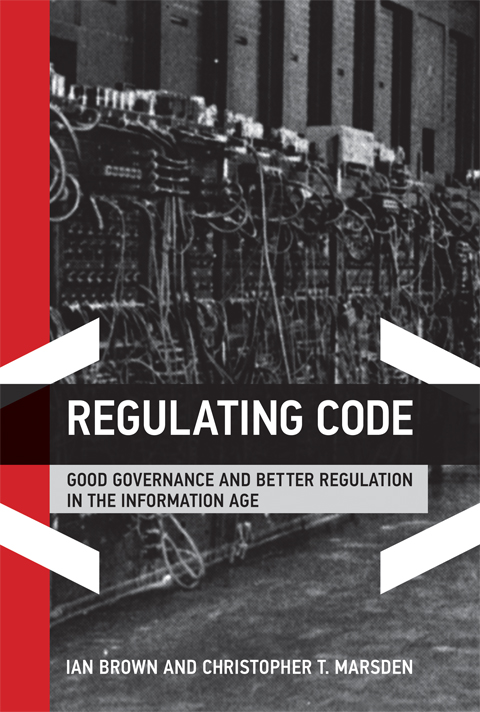 Ian Brown and Christopher T. Marsden’s new book, Regulating Code: Good Governance and Better Regulation in the Information Age, will go down as one of the most important Internet policy books of 2013 for two reasons. First, their book offers an excellent overview of how Internet regulation has unfolded on five different fronts: privacy and data protection; copyright; content censorship; social networks and user-generated content issues; and net neutrality regulation. They craft detailed case studies that incorporate important insights about how countries across the globe are dealing with these issues. Second, the authors endorse a specific normative approach to Net governance that they argue is taking hold across these policy arenas. They call their preferred policy paradigm “prosumer law” and it envisions an active role for governments, which they think should pursue “smarter regulation” of code.

 The Technology Liberation Front is the tech policy blog dedicated to keeping politicians' hands off the 'net and everything else related to technology.