I’ve been floating around in conservative policy circles for 30 years and I have spent much of that time covering media policy and child safety issues. My time in conservative circles began in 1992 with a 9-year stint at the Heritage Foundation, where I launched the organization’s policy efforts on media regulation, the Internet, and digital technology. Meanwhile, my work on child safety has spanned 4 think tanks, multiple blue ribbon child safety commissions, countless essays, dozens of filings and testimonies, and even a multi-edition book.
During this three-decade run, I’ve tried my hardest to find balanced ways of addressing some of the legitimate concerns that many conservatives have about kids, media content, and online safety issues. Raising kids is the hardest job in the world. My daughter and son are now off at college, but the last twenty years of helping them figure out how to navigate the world and all the challenges it poses was filled with difficulties. This was especially true because my daughter and son faced completely different challenges when it came to media content and online interactions. Simply put, there is no one-size-fits-all playbook when it comes to raising kids or addressing concerns about healthy media interactions. Continue reading →
A growing number of conservatives are calling for Big Government censorship of social media speech platforms. Censorship proposals are to conservatives what price controls are to radical leftists: completely outlandish, unworkable, and usually unconstitutional fantasies of controlling things that are ultimately much harder to control than they realize. And the costs of even trying to impose and enforce such extremist controls are always enormous.
I’ll offer a few more thoughts here in addition to what I’ve already said elsewhere. First, here is my response to the Rosen essay. National Review gave me 250 words to respond to her proposal:
While admitting that “law is a blunt instrument for solving complicated social problems,” Christine Rosen (“Keep Them Offline,” June 27) nonetheless downplays the radicalness of her proposal to make all teenagers criminals for accessing the primary media platforms of their generation. She wants us to believe that allowing teens to use social media is the equivalent of letting them operate a vehicle, smoke tobacco, or drink alcohol. This is false equivalence. Being on a social-media site is not the same as operating two tons of steel and glass at speed or using mind-altering substances.
Teens certainly face challenges and risks in any new media environment, but to believe that complex social pathologies did not exist before the Internet is folly. Echoing the same “lost generation” claims made by past critics who panicked over comic books and video games, Rosen asks, “Can we afford to lose another generation of children?” and suggests that only sweeping nanny-state controls can save the day. This cycle is apparently endless: Those “lost generations” grow up fine, only to claim it’s the
next generation that is doomed!
Rosen casually dismisses free-speech concerns associated with mass-media criminalization, saying that her plan “would not require censorship.” Nothing could be further from the truth. Rosen’s prohibitionist proposal would deny teens the many routine and mostly beneficial interactions they have with their peers online every day. While she belittles media literacy and other educational and empowerment-based solutions to online problems, those approaches continue to be a better response than the repressive regulatory regime she would have Big Government impose on society.
I have a few more things to say beyond these brief comments. Continue reading →
This weekend, The Wall Street Journal ran my short letter to the editor entitled, “We Can Protect Children and Keep the Internet Free.” My letter was a response to columnist Peggy Noonan’s April 9 oped, “Can Anyone Tame Big Tech?” in which she proposed banning everyone under 18 from all social-media sites. She specifically singled out TikTok, Youtube, and Instagram and argued “You’re not allowed to drink at 14 or drive at 12; you can’t vote at 15. Isn’t there a public interest here?”
I briefly explained why Noonan’s proposal is neither practical nor sensible, noting how it:
would turn every kid into an instant criminal for seeking access to information and culture on the dominant medium of their generation. I wonder how she would have felt about adults proposing to ban all kids from listening to TV or radio during her youth.
Let’s work to empower parents to help them guide their children’s digital experiences. Better online-safety and media-literacy efforts can prepare kids for a hyperconnected future. We can find workable solutions that wouldn’t usher in unprecedented government control of speech.
Let me elaborate just a bit because this was the focus of much of my writing a decade ago, including my book, Parental Controls & Online Child Protection: A Survey of Tools & Methods, which spanned several editions. Online child safety is a matter I take seriously and the concerns that Noonan raised in her oped have been heard repeatedly since the earliest days of the Internet. Regulatory efforts were immediately tried. They focused on restricting underage access to objectionable online content (as well as video games), but were immediately challenged and struck down as unconstitutionally overbroad restrictions on free speech and a violation of the First Amendment of the U.S. Constitution. Continue reading →
[This essay originally appeared on the AIER blog on May 28, 2019. The USA TODAY also ran a shorter version of this essay as a letter to the editor on June 2, 2019.]
In a hotly-worded USA Today op-ed last week, Senator Josh Hawley (R-Missouri) railed against social media sites Facebook, Instagram, and Twitter. He argued that, “social media wastes our time and resources,” and is “a field of little productive value” that have only “given us an addiction economy.” Sen. Hawley refers to these sites as “parasites” and blames them for a litany of social problems (including an unproven link to increased suicide), leading him to declare that, “we’d be better off if Facebook disappeared.”
As far as moral panics go, Sen. Hawley’s will go down as one for the ages. Politicians have always castigated new technologies, media platforms, and content for supposedly corrupting the youth of their generation. But Sen. Hawley’s inflammatory rhetoric and proposals are something we haven’t seen in quite some time.
He sounds like those fire-breathing politicians and pundits of the past century who vociferously protested everything from comic books to cable television, the waltz to the Walkman, and rock-and-roll to rap music. In order to save the youth of America, many past critics said, we must destroy the media or media platforms they are supposedly addicted to. That is exactly what Sen. Hawley would have us do to today’s leading media platforms because, in his opinion, they “do our country more harm than good.”
We have to hope that Sen. Hawley is no more successful than past critics and politicians who wanted to take these choices away from the public. Paternalistic politicians should not be dictating content choices for the rest of us or destroying technologies and platforms that millions of people benefit from. Continue reading →
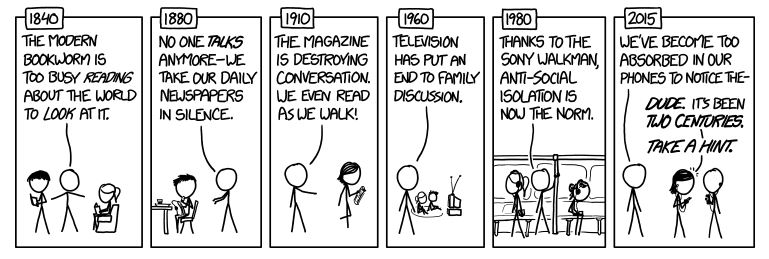
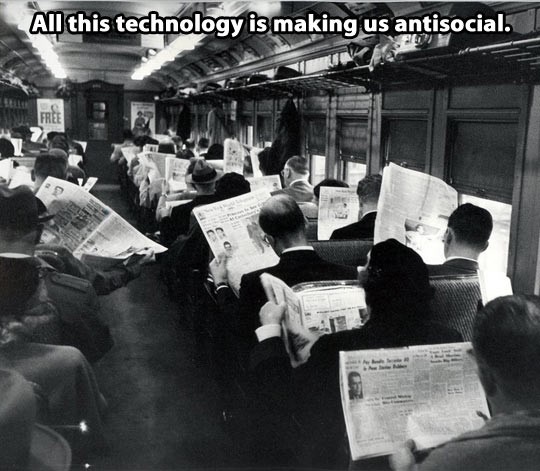
Last week, science writer Michael Shermer tweeted out this old xkcd comic strip that I had somehow missed before. Shermer noted that it represented, “another reply to pessimists bemoaning modern technologies as soul-crushing and isolating.” Similarly, there’s this meme that has been making the rounds on Twitter and which jokes about how newspapers made us as antisocial in the past much as newer technologies supposedly do today.
The sentiments expressed by the comic and that image make it clear how people often tend to romanticize past technologies or fail to remember that many people expressed the same fears about them as critics do today about newer ones. I’ve written dozens of articles about “moral panics” and “techno-panics,” most of which are cataloged here. The common theme of those essays is that, when it comes to fears about innovations, there really is nothing new under the sun. Continue reading →
Yesterday was National Lemonade Day. Over at the Mercatus Bridge blog, Jennifer Skees and I used the opportunity to highlight the increasing regulatory crackdown on kids operating ventures without first seeking the proper permits from local authorities. We ask, “wouldn’t it be better to teach them the value of hard work and entrepreneurial effort instead of threatening them with penalties for not getting costly permits to do basic jobs?” Here’s our answer:
Today is National Lemonade Day. For many Americans a lemonade stand was their first experience in entrepreneurship. But unfortunately, this time honored tradition that teaches the value of hard work, entrepreneurship, and innovation may be under threat from overzealous grown-ups.
Should we really force kids to get licenses to start lemonade stands, sell bottles of water outside a ballpark, or mow lawns for a little extra money? And wouldn’t it be better to teach them the value of hard work and entrepreneurial effort instead of threatening them with penalties for not getting costly permits to do basic jobs?
Recent news stories have highlighted examples of kids being confronted with local regulations that essential tell them not to be entrepreneurial until they’ve gotten someone’s blessing–or else face fines or other penalties for those efforts.
Out in San Francisco, for example, a neighbor threatened to call the police on an eight-year-old girl selling water to raise money for a trip to Disneyland after her mother had lost her job. The neighbor berated the little girl for “illegally selling water without a permit.” Luckily, national outrage seems to have fallen in favor of this rogue entrepreneur instead of “Permit Patty.” But this is far from an isolated case.
Another story went viral earlier this year involving kids and lemonade stands. Country Time lemonade pledged to pay the fines received or the permit cost for children’s lemonade stands. Who thought we’d reach the day when we need a Lemonade Legal Defense Fund? But just prior to the launch, Stapleton, Colorado police were called to shut down the lemonade stand of four and six year-old brothersfor failing to have a business license. Kids who probably can’t read or fill out the necessary forms are expected to obtain a formal license for a tradition that dates back about 120 years. Continue reading →
This afternoon, Berin Szoka asked me to participate in a TechFreedom conference on “COPPA: Past, Present & Future of Children’s Privacy & Media.” [CSPAN video is here.] It was a in-depth, 3-hour, 2-panel discussion of the Federal Trade Commission’s recent revisions to the rules issued under the 1998 Children’s Online Privacy Protection Act (COPPA).
While most of the other panelists were focused on the devilish details about how COPPA works in practice (or at least
should work in practice), I decided to ask a more provocative question to really shake up the discussion: What are we going to do when COPPA fails?
My notes for the event follow down below. I didn’t have time to put them into a smooth narrative, so please pardon the bullet points. Continue reading →
On Wednesday afternoon, it was my great pleasure to make some introductory remarks at a Family Online Safety Institute (FOSI) event that was held at the Yahoo! campus in Sunnyvale, CA. FOSI CEO Stephen Balkam asked me to offer some thoughts on a topic I’ve spent a great deal of time thinking about in recent years: Who needs parental controls? More specifically, what role do parental control tools and methods play in the upbringing of our children? How should we define or classify parental control tools and methods? Which are most important / effective? Finally, what should the role of public policy be toward parental control technologies on both the online safety and privacy fronts?
In past years, I spent much time writing and updating a booklet on these issues called
Parental Controls & Online Child Protection: A Survey of Tools & Methods. It was an enormous undertaking, however, and I have abandoned updating it after I hit version 4.0. But that doesn’t mean I’m not still putting a lot of thought into these issues. My focus has shifted over the past year more toward the privacy-related concerns and away from the online safety issues. Of course, all these issues intersect and many people now (rightly) considered them to largely be the same debate.
Anyway, to kick off the FOSI event, I offered three provocations about parental control technologies and the state of the current debate over them. I buttressed some of my assertions with findings from a recent FOSI survey of parental attitudes about parental controls and online safety. Continue reading →
Today, the U.S. Supreme Court will hear arguments in Schwarzenegger v. EMA, a case that challenges California’s 2005 law banning the sale of “violent” video games to minors. The law has yet to take effect, as rulings by lower federal courts have found the law to be an unconstitutional violation of the First Amendment.
There’s little doubt that banning the sale of nearly any content to adults violates the protections of Free Speech, including, as decided last year, video depictions of cruelty to animals.
But over the years the Court has ruled that minors do not stand equal to adults when it comes to the First Amendment. The Court has upheld restrictions on the speech of students in and out of the classroom, for example, in the interest of preserving order in public schools.
One of the old saws we hear from those who wish to impose more stringent regulations on advertising or product placement is that “it’s for the children.” That is, critics such at the Campaign for a Commercial-Free Childhood and other organzations fear that, because children’s brains are less developed or they have not yet learned to differentiate commercial appeals from other types of information flows, kids may be more susceptible to persuasive commercial messaging. I think there’s some truth to that, but I also believe that (a) kids aren’t quite the sheep we make them out to be, (b) the potential “harm” here is not as great as the critics make it out to be and (c) parental supervision should be the primary the solution to the problem.
But let’s ask a different question entirely: Are we willing to forgo additional, and potentially more diverse, forms of children’s programming simply because we want to keep commercial messaging or product placement away from kids? Consider the case study of The Hub, recently featured in
The New York Times:
With imports of European cartoons, a smattering of Hasbro ads and a rerun of the movie “Garfield,” Hasbro and Discovery Communications unveiled a new television brand for children on Sunday, called The Hub. Over time, the two companies hope to prove that there is room for a fourth player alongside Nickelodeon, the Disney Channel and the Cartoon Network, the three heavyweights of children’s TV, said David M. Zaslav, the chief executive of Discovery Communications. […]
The Technology Liberation Front is the tech policy blog dedicated to keeping politicians' hands off the 'net and everything else related to technology. Learn more about TLF →



 The Technology Liberation Front is the tech policy blog dedicated to keeping politicians' hands off the 'net and everything else related to technology.