Corbin Barthold invited me on Tech Freedom’s “Tech Policy Podcast” to discuss the history of antitrust and competition policy over the past half century. We covered a huge range of cases and controversies, including: the DOJ’s mega cases against IBM & AT&T, Blockbuster and Hollywood Video’s derailed merger, the Sirius-XM deal, the hysteria over the AOL-Time Warner merger, the evolution of competition in mobile markets, and how we finally ended that dreaded old MySpace monopoly!
What does the future hold for Google, Facebook, Amazon, and Netflix? Do antitrust regulators at the DOJ or FTC have enough to mount a case against these firms? Which case is most likely to have legs?
Corbin and I also talked about the of progress more generally and the troubling rise of more and more Luddite thinking on both the left and right. I encourage you to give it a listen:
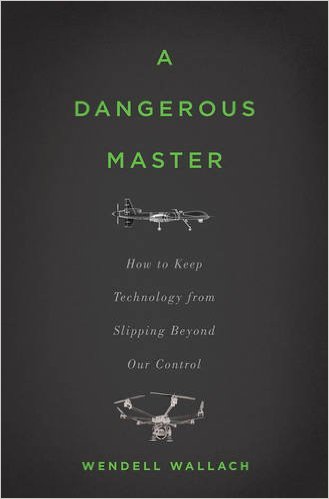
On May 3rd, I’m excited to be participating in a discussion with Yale University bioethicist Wendell Wallach at the Microsoft Innovation & Policy Center in Washington, DC. (RSVP here.) Wallach and I will be discussing issues we write about in our new books, both of which focus on possible governance models for emerging technologies and the question of how much preemptive control society should exercise over new innovations.
Of all the books of technological criticism or skepticism that I’ve read in recent years—and I have read stacks of them!—
A Dangerous Master is by far the most thoughtful and interesting. I have grown accustomed to major works of technological criticism being caustic, angry affairs. Most of them are just dripping with dystopian dread and a sense of utter exasperation and outright disgust at the pace of modern technological change.
Although he is certainly concerned about a wide variety of modern technologies—drones, robotics, nanotech, and more—Wallach isn’t a purveyor of the politics of panic. There are some moments in the book when he resorts to some hyperbolic rhetoric, such as when he frets about an impending “techstorm” and the potential, as the book’s title suggests, for technology to become a “dangerous master” of humanity. For the most part, however, his approach is deeper and more dispassionate than what is found in the leading tracts of other modern techno-critics.
I wanted to draw your attention to this important address on online platform regulation by Alex Chisholm, the head of UK’s Competition and Markets Authority. That’s the non-ministerial department in the UK responsible for competition policy issues. Chisholm delivered the address on October 27th at the Bundesnetzagentur conference in Bonn. It’s a terrific speech that other policymakers would be wise to read and mimic to ensure that antitrust and competition policy decisions don’t derail the many benefits of the Information Revolution.
“Today, as regulators, we have the responsibility but also the great historical privilege of playing an influential role in the deployment throughout the economy of the latest of these defining technological eras,” Chisholm began. “As regulators, we must try to minimise the inevitable mismatch between how we’ve done things before and the opportunities and risks of the new,” he argued.
He continued on to specify three recommendations for those crafting policy on this front: Continue reading →
I recently finishedLearning by Doing: The Real Connection between Innovation, Wages, and Wealth, by James Bessen of the Boston University Law School. It’s a good book to check out if you are worried about whether workers will be able to weather this latest wave of technological innovation. One of the key insights of Bessen’s book is that, as with previous periods of turbulent technological change, today’s workers and businesses will obviously need find ways to adapt to rapidly-changing marketplace realities brought on by the Information Revolution, robotics, and automated systems.
That sort of adaptation takes time, but for technological revolutions to take hold and have meaningful impact on economic growth and worker conditions, it requires that large numbers of ordinary workers acquire new knowledge and skills, Bessen notes. But, “that is a slow and difficult process, and history suggests that it often requires social changes supported by accommodating institutions and culture.” (p 223) That is not a reason to resist disruptive forms of technological change, however. To the contrary, Bessen says, it is crucial to allow ongoing trial-and-error experimentation and innovation to continue precisely because it represents a learning process which helps people (and workers in particular) adapt to changing circumstances and acquire new skills to deal with them. That, in a nutshell, is “learning by doing.” As he elaborates elsewhere in the book:
Major new technologies become ‘revolutionary’ only after a long process of learning by doing and incremental improvement. Having the breakthrough idea is not enough. But learning through experience and experimentation is expensive and slow. Experimentation involves a search for productive techniques: testing and eliminating bad techniques in order to find good ones. This means that workers and equipment typically operate for extended periods at low levels of productivity using poor techniques and are able to eliminate those poor practices only when they find something better. (p. 50)
Luckily, however, history also suggests that, time and time again, that process has happened and the standard of living for workers and average citizens alike improved at the same time. Continue reading →
In this new paper, Koopman, Mitchell, and I discuss how the sharing economy has changed the way many Americans commute, shop, vacation, borrow, and so on. Of course, the sharing economy “has also disrupted long-established industries, from taxis to hotels, and has confounded policymakers,” we note. “In particular, regulators are trying to determine how to apply many of the traditional ‘consumer protection’ regulations to these new and innovative firms.” This has led to a major debate over the public policies that should govern the sharing economy.
We argue that, coupled with the Internet and various new informational resources, the rapid growth of the sharing economy alleviates the need for much traditional top-down regulation. These recent innovations are likely doing a much better job of serving consumer needs by offering new innovations, more choices, more service differentiation, better prices, and higher-quality services. In particular, the sharing economy and the various feedback mechanism it relies upon helps solve the tradition economic problem of “asymmetrical information,” which is often cited as a rationale for regulation. We conclude, therefore, that “the key contribution of the sharing economy is that it has overcome market imperfections without recourse to traditional forms of regulation. Continued application of these outmoded regulatory regimes is likely to harm consumers.” Continue reading →
What works well as anethical directive might not work equally well as a policy prescription. Stated differently, what one ought to do it certain situations should not always be synonymous with what they must do by force of law.
I’m going to relate this lesson to tech policy debates in a moment, but let’s first think of an example of how this lesson applies more generally. Consider the Ten Commandments. Some of them make excellent ethical guidelines (especially the stuff about not coveting neighbor’s house, wife, or possessions). But most of us would agree that, in a free and tolerant society, only two of the Ten Commandments make good law:
Thou shalt not kill and Thou shalt not steal.
In other words, not every sin should be a crime. Perhaps
some should be; but most should not. Taking this out of the realm of religion and into the world of moral philosophy, we can apply the lesson more generally as: Not every wise ethical principle makes for wise public policy. Continue reading →
I enjoyed this Wall Street Journal essay by Daniel H. Wilson on “The Terrifying Truth About New Technology.” It touches on many of the themes I’ve discussed here in my essays on techno-panics, fears about information overload, and the broader battle throughout history between technology optimists and pessimists regarding the impact of new technologies on culture, life, and learning. Wilson correctly notes that:
The fear of the never-ending onslaught of gizmos and gadgets is nothing new. The radio, the telephone, Facebook — each of these inventions changed the world. Each of them scared the heck out of an older generation. And each of them was invented by people who were in their 20s.
He continues:
Young people adapt quickly to the most absurd things. Consider the social network Foursquare, in which people not only willingly broadcast their location to the world but earn goofy virtual badges for doing so. My first impulse was to ignore Foursquare—for the rest of my life, if I have to.
And that’s the problem. As we get older, the process of adaptation slows way down. Unfortunately, we depend on alternating waves of assimilation and accommodation to adapt to a constantly changing world. For [developmental psychologist Jean] Piaget, this balance between what’s in the mind and what’s in the environment is called equilibrium. It’s pretty obvious when equilibrium breaks down. For example, my grandmother has phone numbers taped to her cellphone. Having grown up with the Rolodex (a collection of numbers stored next to the phone), she doesn’t quite grasp the concept of putting the numbers in the phone.
Why are we so nostalgic about the technology we grew up with? Old people say things like: “This new technology is stupid. I liked (new, digital) technology X better when it was called (old, analog) technology Y. Why, back in my day….” Which leads inexorably to, “I just don’t get it.”
There’s a simple explanation for this phenomenon: “adventure window.” At a certain age, that which is familiar and feels safe becomes more important to you than that which is new, different, and exciting. Think of it as “set-in-your-ways syndrome.”
Over at the Brain Pickings blog, Maria Popova has posted an amazing 1972 documentary based on Alvin Toffler’s famous 1970 book, Future Shock. The documentary, like the book, focuses on many of the themes we hear Internet optimists and pessimists debating all the time today: “information overload,” excessive consumerism, artificial intelligence and robotics, biotechnology, cryonics, the nature of humanity and how technology impacts it, etc, etc. Again, all the same stuff people are still fighting about today.
Popova correctly notes that “The film, darkly dystopian and oozing techno-paranoia, is a valuable reminder that… societies have always feared new technology but ultimately adapted to it.” Indeed, at one point in the film we hear, “The future has burst upon us… [but] is technology always desirable?” And that’s just in reference to the (now-obsolete) supersonic jet transport, or Concorde! “Changes bombard our nervous systems, clamoring for decisions. New values, new technologies, flood into our lives… Escape from change in today’s society become more and more impossible. But change itself is out of control.” Geez.. how did we make it past 1972!
The documentary is narrated by Orson Welles, which makes it even more fun. Welles had a presence that just made everything seem larger than life, and his voice-of-God narration here really added a nice touch to this film.
It’s an absolutely great find. Here’s the first 10-minute segment from the documentary. Watch all five segments over at
Brain Pickings.
I really enjoyed this editorial in today’s Wall Street Journal by sci-fi novelist Orson Scott Card, author of Ender’s Game, among many other books. Card engages in some interesting soul searching about the impact of the Net and digital technology on our lives, economy, and culture. He concludes his essay by noting that:
We’re still the same human beings we always were. Consumers still act like consumers; people still search for love and friendship. But the Internet has freed us from the boundaries of distance and many of the risks of embarrassment in social interactions. This re-sorted geography has brought its own pitfalls and forced us to create new rules of etiquette.
But just as I have no desire to give up cars, trains and planes to return to the hay-eating, vet-needing, poop-generating, one-horsepower horse, I don’t want to go back to pre-Google research, pre-Amazon shopping, pre-blog newsmedia, or the loneliness of villages limited by geography.
Quite right. Card is expressing the sort of “pragmatic optimism” I’ve written about here before in my essays about the ongoing battle between Internet optimists and pessimists. I’ve tried to articulate a sort of middle ground position in this debate that embraces the amazing technological changes at work in today’s Information Age but does so with a healthy dose of humility and appreciation for the disruptive impact and pace of that change. As I’ve noted before, we need to think about how to mitigate the negative impacts associated with technological change without adopting the paranoid tone or Luddite-ish recommendations of the pessimists. Read Card’s entire essay to get a better feel for how we can begin to think in that way.
There’s been plenty written about the death spiral that America’s newspaper industry finds itself stuck in — here’s an amazing summary of the recent online debates — and I’ve spent a lot of time writing on this issue here in the past, too. Ben Compaine, one of America’s sharpest media analysts and the co-author of the classic study Who Owns the Media?, has added his own two cents in his latest essay over at the Rebuilding Media blog. Like everything Ben writes, it is well worth reading:
If newspapers have essentially been able to thrive on the revenue from advertisers alone (again, with cost of printing more or less covered by circulation revenue), why are they having so much trouble today? The answer is not one single factor, but a major contributor is that newspapers – whether print or digital—are just worth less to advertisers than they were 20 years ago. Back then, local advertisers did not have many options for reaching the mass local audience. What was the alternative for auto dealers? For real estate agents? Supermarkets or department stores? For some, direct mail was one possible option. But that was about it. Using pre-prints instead of ROP became attractive for some large display advertisers, leaving the publishers with a piece of the cash flow. Advertisers were hit with regular rate increases. And they pretty much had to pay, The publishers made good money.
But then a double whammy. Just about the time the Internet became a real alternative for classified listings—think Craigslist, Monster.com, eBay, Autotrader.com—and for retailers—think DoubleClick, Google, et al—the boys at the cable operators had perfected the insertion of highly local spots into their feeds. Between 1989 and 2007 local cable advertising increased from $500 million to $4.3 billion—or from 0.4% of all advertising to 1.6%. Advertising in newspapers fell from 26% to 15% in this period. Although some of the highly local advertisers going to cable may have taken some of their funds from budgets for radio or other local media, it is probable that a significant share came from the hides of newspapers. I estimate perhaps up to 20% of the decline in local newspaper advertising share can be attributed to local cable spots.
The other whammy, the gorilla in the room, is Internet advertising. No need to elaborate. But its impact on newspapers is not just that it has siphoned off dollars per se. Much more importantly is that
the Internet has given most advertisers greater market power against newspaper publishers. Many big advertisers—like car dealers, real estate offices and big box retailers—don’t need the newspapers as much.
Ben’s got it exactly right. The decline of newspapers comes down to the death of “protectable scarcity” (thanks to Canadian media expert Ken Goldstein for that phrase). There’s just too much other competition out there online already for our eyes and ears. We’re witnessing substitution effects on a scale never seen in the media world, with disruptive digital technologies and networks splintering our attention spans. That de-massification of media means that high fixed cost endeavors like daily newspapers are not going to be able to sustain the cross-subsidies they’ve long gotten from advertisers.
If you want to boil the newspaper death spiral down to an equation, it would look something like this:
The Technology Liberation Front is the tech policy blog dedicated to keeping politicians' hands off the 'net and everything else related to technology. Learn more about TLF →




 The Technology Liberation Front is the tech policy blog dedicated to keeping politicians' hands off the 'net and everything else related to technology.