A growing number of conservatives are calling for Big Government censorship of social media speech platforms. Censorship proposals are to conservatives what price controls are to radical leftists: completely outlandish, unworkable, and usually unconstitutional fantasies of controlling things that are ultimately much harder to control than they realize. And the costs of even trying to impose and enforce such extremist controls are always enormous.
Earlier this year,
The Wall Street Journal ran a response I wrote to a proposal set forth by columnist Peggy Noonan in which she proposed banning everyone under 18 from all social-media sites (“We Can Protect Children and Keep the Internet Free,” Apr. 15). I expanded upon that letter in an essay here entitled, “Should All Kids Under 18 Be Banned from Social Media?” National Review also recently published an article penned by Christine Rosen in which she also proposes to “Ban Kids from Social Media.” And just this week, Zach Whiting of the Texas Public Policy Foundation published an essay on “Why Texas Should Ban Social Media for Minors.”
I’ll offer a few more thoughts here in addition to what I’ve already said elsewhere. First, here is my response to the Rosen essay. National Review gave me 250 words to respond to her proposal:
While admitting that “law is a blunt instrument for solving complicated social problems,” Christine Rosen (“Keep Them Offline,” June 27) nonetheless downplays the radicalness of her proposal to make all teenagers criminals for accessing the primary media platforms of their generation. She wants us to believe that allowing teens to use social media is the equivalent of letting them operate a vehicle, smoke tobacco, or drink alcohol. This is false equivalence. Being on a social-media site is not the same as operating two tons of steel and glass at speed or using mind-altering substances.
Teens certainly face challenges and risks in any new media environment, but to believe that complex social pathologies did not exist before the Internet is folly. Echoing the same “lost generation” claims made by past critics who panicked over comic books and video games, Rosen asks, “Can we afford to lose another generation of children?” and suggests that only sweeping nanny-state controls can save the day. This cycle is apparently endless: Those “lost generations” grow up fine, only to claim it’s the
next generation that is doomed!
Rosen casually dismisses free-speech concerns associated with mass-media criminalization, saying that her plan “would not require censorship.” Nothing could be further from the truth. Rosen’s prohibitionist proposal would deny teens the many routine and mostly beneficial interactions they have with their peers online every day. While she belittles media literacy and other educational and empowerment-based solutions to online problems, those approaches continue to be a better response than the repressive regulatory regime she would have Big Government impose on society.
I have a few more things to say beyond these brief comments. Continue reading →
Slate recently published an astonishing piece of revisionist history under the title, “Bring Back the Golden Age of Broadcast Regulation,” which suggested that the old media regulatory model of the past would be appropriate for modern digital media providers and platforms. In the essay, April Glaser suggests that policymakers should resurrect the Fairness Doctrine and a host of old Analog Era content controls to let regulatory bureaucrats address Digital Age content moderation concerns.
In a tweetstorm, I highlighted a few examples of why the so-called Golden Era wasn’t so golden in practice. I began by noting that the piece ignores the troubling history of FCC speech controls and unintended consequences of regulation. That regime gave us limited, bland choices–and a whole host of First Amendment violations. We moved away from that regulatory model for very good reasons.
For those glorifying the Fairness Doctrine, I encourage them to read the great Nat Hentoff’s excellent essay, “The History & Possible Revival of the Fairness Doctrine,” about the real-world experience of life under the FCC’s threatening eye. Hentoff notes: Continue reading →
Via Twitter, Andrew Grossman brought to my attention this terrifically interesting interview with a Kuwaiti censor that appeared in the Kuwait Times (“Read No Evil – Senior Censor Defends Work, Denies Playing Big Brother“). In the interview, the censor, Dalal Al-Mutairi, head of the Foreign Books Department at the Ministry of Information, speaks in a remarkably candid fashion and casual tone about the job she and other Kuwaiti censors do every day. My favorite line comes when Dalal tells the reporter how working as a censor is so very interesting and enlightening: “I like this work. It gives us experience, information and we always learn something new.” I bet! But what a shame that others in her society will be denied the same pleasure of always learning something new. Of course, like all censors, Dalal probably believes that she is doing a great public service by screening all culture and content to make sure the masses do not consume offensive, objectionable, or harmful content.
But here’s where the reporter missed a golden opportunity to ask Dalal the one question that you must always ask a censor if you get to meet one:
If the content you are censoring is so destructive to the human soul or psyche, how then is it that you are such a well-adjusted person? And Dalal certainly seems like a well-adjusted person. Although the reporter doesn’t tell us much about her personal life or circumstances, Dalal volunteers this much about herself and her fellow censors: “Many people consider the censor to be a fanatic and uneducated person, but this isn’t true. We are the most literate people as we have read much, almost every day. We receive a lot of information from different fields. We read books for children, religious books, political, philosophical, scientific ones and many others.” Well of course you do… because you are lucky enough to have access to all that content! But you are also taking steps to make sure the rest of your society doesn’t consume it on the theory that it would harm them or harm public morals in some fashion. But, again, how is it that you have not been utterly corrupted by it all, Ms. Dalal? After all, you get to consume all that impure, sacrilegious, and salacious stuff! Shouldn’t you be some kind of monster by now?
How can this inconsistency be explained? The answer to this riddle can be found in the “Third-Person Effect Hypothesis.” Continue reading →
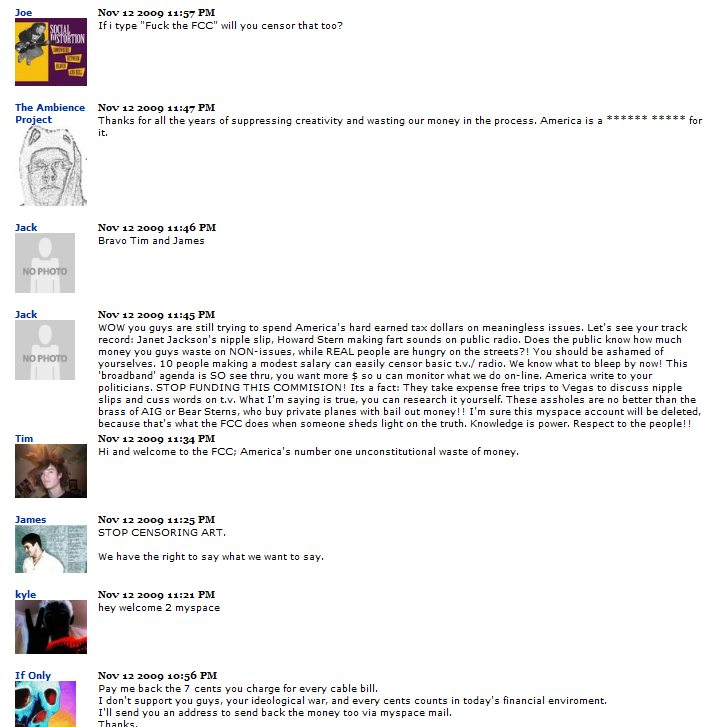
Oh my. So today, as part of its ongoing effort to look like the hip new regulatory agency on the block, the Federal Communications Commission decided to launch a MySpace page. Really. Big. Mistake.
I mean, shouldn’t someone over there have known it would take about 2 milliseconds for various cranks to launch into profanity-laced rants that would make George Carlin blush? Sure enough, the page is already littered with some of the most colorful language you’ll ever lay your eyes on, mixed in with some 9/11 conspiracy theories, a plug for the Marijuana Policy Posse, and something about the FCC “build[ing] a cone of terror in [our] homes.”
Go check it out, but avert the children’s eyes first. It ain’t pretty. Which begs the question: Will the FCC apply its Pacifica indecency standard to its own MySpace page? Seems like their site is pretty “pervasive” to me, and there could be “children in the viewing audience.” Time to censor these “fleeting expletives” on the FCC’s MySpace page!
The Parents Television Council (PTC) released a new report today entitled Women in Peril: A Look at TV’s Disturbing New Storyline Trend. The report argues that “by depicting violence against women with increasing frequency, or as a trivial, even humorous matter, the broadcast networks may ultimately be contributing to a desensitized atmosphere in which people view aggression and violence directed at women as normative, even acceptable,” said PTC President Tim Winter. As evidence the report cites… Nicole Kidman. OK, it cites more than Nicole Kidman, but the 7-page report and accompanying press release does seem to place a lot of stock in the fact that, while being questioning by a House Foreign Affairs subcommittee hearing about violence against women overseas, “Ms. Kidman conceded that Hollywood has probably contributed to violence against women by portraying them as weak sex objects, according to the Associated Press.” I’m not sure what Ms. Kidman was doing testifying before Congress on the matter of violence against women overseas — dare I suggest some congressmen were out for another photo-op with a Hollywood celeb? — but the better question is whether Ms. Kidman’s opinion has any bearing on the question of what relationship, if any, there is between televised violence and real-world violence against women. (Incidentally, if she really feels passionately about all this, is she prepared to go back and recut some of her old scenes in “Dead Calm,” “To Die For,” and “Eyes Wide Shut“?)
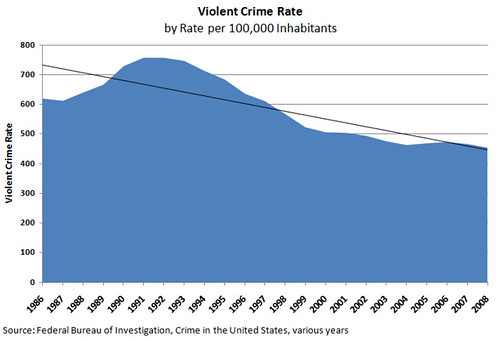
But let’s not nitpick about the credentials Ms. Kidman brings to the table or whether it makes any sense for PTC to elevate her opinions to proof of theory when it comes to a supposed connection between depictions of violence against women in film or television and real world acts of violence against women. PTC, however, suggests that’s exactly what is going on today. They allude to a few lab studies which are of the “monkey see, monkey do” variety — where the results of artificial lab experiments are used to claim that watching depictions of violence will turn us all into killing machines, rapists, robbers, or just plain ol’ desensitized thugs.
There’s just one problem with such studies, and the PTC report: Reality. Continue reading →
What Unites Advocates of Speech Controls & Privacy Regulation? [pdf]
by Adam Thierer & Berin Szoka
The Progress & Freedom Foundation,
Progress on Point No. 16.19
Anyone who has spent time following debates about speech and privacy regulation comes to recognize the striking parallels between these two policy arenas. In this paper we will highlight the common rhetoric, proposals, and tactics that unite these regulatory movements. Moreover, we will argue that, at root, what often animates calls for regulation of both speech and privacy are two remarkably elitist beliefs:
- People are too ignorant (or simply too busy) to be trusted to make wise decisions for themselves (or their children); and/or,
- All or most people share essentially the same values or concerns and, therefore, “community standards” should trump household (or individual) standards.
While our use of the term “elitism” may unduly offend some understandably sensitive to populist demagoguery, our aim here is not to launch a broadside against elitism as
Time magazine culture critic William H. Henry once defined it: “The willingness to assert unyieldingly that one idea, contribution or attainment is better than another.”[1] Rather, our aim here is to critique that elitism which rises to the level of political condescension and legal sanction. We attack not so much the beliefs of some leaders, activists, or intellectuals that they have a better idea of what it in the public’s best interest than the public itself does, but rather the imposition of those beliefs through coercive, top-down mandates.
That sort of elitism—elitism enforced by law—is often the objective of speech and privacy regulatory advocates. Our goal is to identify the common themes that unite these regulatory movements, explain why such political elitism is unwarranted, and make it clear how it threatens individual liberty as well as the future of free and open Internet. As an alternative to this elitist vision, we advocate an empowerment agenda: fostering an environment in which users have the tools and information they need to make decisions for themselves and their families. Continue reading →
Rebecca MacKinnon has an important piece in the Wall Street Journal today about China’s “Green Dam Youth Escort” filtering mandate and the danger of this model catching on with other governments. “More and more governments — including democracies like Britain, Australia and Germany — are trying to control public behavior online, especially by exerting pressure on Internet service providers,” she notes. “Green Dam has only exposed the next frontier in these efforts: the personal computer.”
She’s right, and that’s cause for serious concern. Moreover, there’s the question of how corporations doing business in China should respond to demands and threats related to installing such filters. She notes:
In a world that includes child pornographers and violent hate groups, it is probably not reasonable to oppose all censorship in all situations. But if technical censorship systems are to be put in place, they must be sufficiently transparent and accountable so that they do not become opaque extensions of incumbent power — or get hijacked by politically influential interest groups without the public knowing exactly what is going on.
Which brings us back to companies: the ones that build and run Internet and telecoms networks, host and publish speech, and that now make devices via which citizens can go online and create more speech. Companies have a duty as global citizens to do all they can to protect users’ universally recognized right to free expression, and to avoid becoming opaque extensions of incumbent power — be it in China or Britain.
I generally agree with all that but this is a difficult issue and one that I have struggled with personally. (See this “Friendly Conversation about Corporate High-Tech Engagement with China” that Jim Harper and I had three years ago). But I do hope that more companies take a hard line with the Chinese as well as there own governemnts when it comes to filtering mandates or even restricitve parental control defaults and settings [an issue I wrote more about in this paper: “The Perils of Mandatory Parental Controls and Restrictive Defaults.”] On that note, kudos to the business groups that already signed on to a joint letter oppossing China’s new filtering mandate.
 Chairman Mao–er… Martin–has canceled (WSJ) the FCC’s December 18 meeting, when the Commission was set to vote on Martin’s proposal to rig an auction to give away a valuable piece of spectrum (“AWS-3”) to M2Z networks. In exchange for a sweetheart deal on the spectrum, the company would have been required to use a quarter of it to provide a free (but very slow) wireless broadband service. Martin had initially proposed to require that the service be made porn-free, but eventually suggested that users over 18 would be able to opt-out of network-level filtering.
Two weeks ago, when it became clear that Martin would attempt to ram this proposal through while he still could, I asked how the ascendant Left would respond:
Will the defenders of free expression triumph over those who see ensuring free broadband as a social justice issue? Or will those on the Left who usually joining us in opposing censorship simply remain silent as the government extends the architecture of censoring the “public airways” onto the Net (where the underlying rationale of traditional broadcast regulation–that parents are powerless–does not apply)?
I’m glad to see that the deathblow to this unconstitutional proposal did indeed come from the political Left–specifically, from Sen. John Rockefeller, (D-W.Va.) and Rep. Henry Waxman, (D-Calif.), who will be responsible for overseeing the FCC in the new Congress. (The Bush administration had already opposed the proposal, as with so many of Martin’s abuses, had failed to stop it.)
With President-elect Obama having declared that, “Here in the country that invented the Internet, every child should have the chance to get online,” it seems almost certain that the Administration will press ahead with some kind of universal broadband proposal of its own. But what would such a proposal look like? If it’s another public broadband utility, would it include network-level filtration like Martin’s proposal? If so, will the Democratic opponents of government censorship stick by their principles and fight that, too?
I suspect we may find that what’s constitutional is politically impossible (unfiltered free Internet) and what’s politically possible (filtered free Internet) is unconstitutional. Continue reading →

 The Technology Liberation Front is the tech policy blog dedicated to keeping politicians' hands off the 'net and everything else related to technology.