Posts tagged as:

In my latest R Street Institute report, I discuss the importance of “Getting AI Innovation Culture Right.” This is the first of a trilogy of major reports on what sort of policy vision and set of governance principles should guide the development of  artificial intelligence (AI), algorithmic systems, machine learning (ML), robotics, and computational science and engineering more generally. More specifically, these reports seek to answer the question, Can we achieve AI safety without innovation-crushing top-down mandates and massive new regulatory bureaucracies? 

These questions are particular pertinent as we just made it through a week in which we’ve seen a major open letter issued that calls for a 6-month freeze on the deployment of AI technologies, while a prominent AI ethicist argued that governments should go further and consider airstrikes data processing centers even if the exchange of nuclear weapons needed to be considered! On top of that, Italy became the first major nation to ban ChatGPT, the popular AI-enabled chatbot created by U.S.-based OpenAI.

My report begins from a different presumption: AI, ML and algorithmic technologies present society with enormously benefits and, while real risks are there, we can find better ways of addressing them. Continue reading →

A growing number of conservatives are calling for Big Government censorship of social media speech platforms. Censorship proposals are to conservatives what price controls are to radical leftists: completely outlandish, unworkable, and usually unconstitutional fantasies of controlling things that are ultimately much harder to control than they realize. And the costs of even trying to impose and enforce such extremist controls are always enormous.

Earlier this year, The Wall Street Journal ran a response I wrote to a proposal set forth by columnist Peggy Noonan in which she proposed banning everyone under 18 from all social-media sites (“We Can Protect Children and Keep the Internet Free,” Apr. 15). I expanded upon that letter in an essay here entitled, “Should All Kids Under 18 Be Banned from Social Media?” National Review also recently published an article penned by Christine Rosen in which she also proposes to “Ban Kids from Social Media.” And just this week, Zach Whiting of the Texas Public Policy Foundation published an essay on “Why Texas Should Ban Social Media for Minors.”

I’ll offer a few more thoughts here in addition to what I’ve already said elsewhere. First, here is my response to the Rosen essay. National Review gave me 250 words to respond to her proposal:

While admitting that “law is a blunt instrument for solving complicated social problems,” Christine Rosen (“Keep Them Offline,” June 27) nonetheless downplays the radicalness of her proposal to make all teenagers criminals for accessing the primary media platforms of their generation. She wants us to believe that allowing teens to use social media is the equivalent of letting them operate a vehicle, smoke tobacco, or drink alcohol. This is false equivalence. Being on a social-media site is not the same as operating two tons of steel and glass at speed or using mind-altering substances. Teens certainly face challenges and risks in any new media environment, but to believe that complex social pathologies did not exist before the Internet is folly. Echoing the same “lost generation” claims made by past critics who panicked over comic books and video games, Rosen asks, “Can we afford to lose another generation of children?” and suggests that only sweeping nanny-state controls can save the day. This cycle is apparently endless: Those “lost generations” grow up fine, only to claim it’s the  next generation that is doomed! Rosen casually dismisses free-speech concerns associated with mass-media criminalization, saying that her plan “would not require censorship.” Nothing could be further from the truth. Rosen’s prohibitionist proposal would deny teens the many routine and mostly beneficial interactions they have with their peers online every day. While she belittles media literacy and other educational and empowerment-based solutions to online problems, those approaches continue to be a better response than the repressive regulatory regime she would have Big Government impose on society.

I have a few more things to say beyond these brief comments. Continue reading →

I suppose it was inevitable that the DRM wars would come to the world of drones. Reporting for the Wall Street Journal today, Jack Nicas notes that:

In response to the drone crash at the White House this week, the Chinese maker of the device that crashed said it is updating its drones to disable them from flying over much of Washington, D.C.SZ DJI Technology Co. of Shenzhen, China, plans to send a firmware update in the next week that, if downloaded, would prevent DJI drones from taking off within the restricted flight zone that covers much of the U.S. capital, company spokesman Michael Perry said.

Washington Post reporter Brian Fung explains what this means technologically:

The [DJI firmware] update will add a list of GPS coordinates to the drone’s computer telling it where it can and can’t go. Here’s how that system works generally: When a drone comes within five miles of an airport, Perry explained, an altitude restriction gets applied to the drone so that it doesn’t interfere with manned aircraft. Within 1.5 miles, the drone will be automatically grounded and won’t be able to fly at all, requiring the user to either pull away from the no-fly zone or personally retrieve the device from where it landed. The concept of triggering certain actions when reaching a specific geographic area is called “geofencing,” and it’s a common technology in smartphones. Since 2011, iPhone owners have been able to create reminders that alert them when they arrive at specific locations, such as the office.

This is complete overkill and it almost certainly will not work in practice. First, this is just DRM for drones, and just as DRM has failed in most other cases, it will fail here as well. If you sell somebody a drone that doesn’t work within a 15-mile radius of a major metropolitan area, they’ll be online minutes later looking for a hack to get it working properly. And you better believe they will find one. Continue reading →

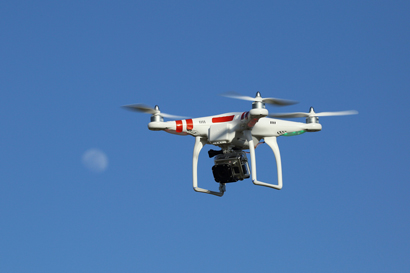
DroneThe use of unmanned aircraft systems, or “drones,” for private and commercial uses remains the subject of much debate. The issue has been heating up lately after Congress ordered the Federal Aviation Administration (FAA) to integrate UASs into the nation’s airspace system by 2015 as part of the FAA Modernization and Reform Act of 2012.

The debate has thus far centered mostly around the safety and privacy-related concerns associated with private use of drones. The FAA continues to move slowly on this front based on a fear that private drones could jeopardize air safety or the safety of others on the ground. Meanwhile, some privacy advocates are worried that private drones might be used in ways that invade private spaces or even public areas where citizens have a reasonable expectation of privacy. For these and other reasons, the FAA’s current ban on private operation of drones in the nation’s airspace remains in place.

But what about the speech-related implications of this debate? After all, private and commercial UASs can have many peaceful, speech-related uses. Indeed, to borrow Ithiel de Sola Pool’s term, private drones can be thought of as “technologies or freedom” that expand and enhance the ability of humans to gather and share information, thus in turn expanding the range of human knowledge and freedom.

A new Mercatus Center at George Mason University working paper, “News from Above: First Amendment Implications of the Federal Aviation Administration Ban on Commercial Drones,” deals with these questions.  This 59-page working paper was authored by Cynthia Love, Sean T. Lawson, and Avery Holton. (Love is currently a Law Clerk for Judge Carolyn B. McHugh in 10th Circuit U.S. Court of Appeals. Lawson and Holton are affliated with the Department of Communication at the University of Utah.)

“To date, little attention has been paid to the First Amendment implications of the [FAA] ban,” note Love, Lawson, and Holton. Their article argues that “aerial photography with UASs, whether commercial or not, is protected First Amendment activity, particularly for news-gathering purposes. The FAA must take First Amendment-protected uses of this technology into account as it proceeds with meeting its congressional mandate to promulgate rules for domestic UASs.” They conclude by noting that “The dangers of [the FAA’s] regulatory approach are no mere matter of esoteric administrative law. Rather, as we have demonstrated, use of threats to enforce illegally promulgated rules, in particular a ban on journalistic use of UASs, infringes upon perhaps our most cherished constitutional right, that of free speech and a free press.” Continue reading →

Psychologists Daniel Simons and Christopher Chabris had an interesting editorial in The Wall Street Journal this weekend asking, “Do Our Gadgets Really Threaten Planes?” They conducted an online survey of 492 American adults who have flown in the past year and found that “40% said they did not turn their phones off completely during takeoff and landing on their most recent flight; more than 7% left their phones on, with the Wi-Fi and cellular communications functions active. And 2% pulled a full Baldwin, actively using their phones when they weren’t supposed to.”

Despite the widespread prevalence of such law-breaking activity, planes aren’t falling from the sky and yet the Federal Aviation Administration continues to enforce the rule prohibiting the use of digital gadgets during certain times during flight. “Why has the regulation remained in force for so long despite the lack of solid evidence to support it?” Simons and Chabris ask. They note:

Human minds are notoriously overzealous “cause detectors.” When two events occur close in time, and one plausibly might have caused the other, we tend to assume it did. There is no reason to doubt the anecdotes told by airline personnel about glitches that have occurred on flights when they also have discovered someone illicitly using a device. But when thinking about these anecdotes, we don’t consider that glitches also occur in the absence of illicit gadget use. More important, we don’t consider how often gadgets have been in use when flights have been completed without a hitch. Our survey strongly suggests that there are multiple gadget violators on almost every flight.

That’s all certain true, but what actually motivated this ban — and has ensured its continuation despite a lack of evidence it is needed to diminish technological risk — is the precautionary principle. As the authors correct note: Continue reading →

Adam Thierer noted in mid-December that the FCC was considering allowing the experimental use of cellphone jammers in prison.  The FCC just issued (PDF) a Special Temporary Authorization to allow the DC Department of Corrections to test a cell phone jamming technology.

This technology sounds like an excellent solution to a serious problem:  The illicit use of cell phones inside correctional facilities by prisoners across the country.  In particular, the technology appears to be “directional,” meaning that unlike traditional jammers, which simply block signals within a certain radius around the jammer, this technology appears to be capable of blocking signals inside the confines of a particular room or building.  In fact, I’m sure millions of Americans would love to see such technologies implemented in cinemas, theatres, and other performing arts venues across the country.  I, for one, am tired of having the exquisite acoustic delicacies of Bach interrupted by annoying ring tones, such as  the (painfully) immortal “Who Let the Dogs Out?”

So Much for The Rule of Law

But there’s one important problem: The FCC isn’t waiving a rule here against cell phone jammer. unless I’m missing some subtle statutory quirk, they’re essentially “waiving” a statute—specifically 47 U.S.C. 333:

No person shall willfully or maliciously interfere with or cause interference to any radio communications of any station licensed or authorized by or under this chapter or operated by the United States Government.

You don’t need to be an administrative lawyer to know that agencies can’t just ignore acts of Congress—no matter how good the policy reason for the waiver is. That’s a big part of what the “rule of law” means.  Period.  Do not pass ‘Go’.  Do not collect $3,101.09 (today’s equivalent of $200 in 1935, when Monopoly debuted).

Fortunately, as noted in the WSJ article Adam cited, at least one legislator realizes this and thinks it’s worth fixing:  U.S. Rep. Kevin Brady (R., Texas) told the Journal that his office is “drafting the necessary legislation to remove this outdated FCC roadblock.”  The FCC, of course, sped right past that particular roadblock.  But then, what should we expect from an agency that has, under its outgoing (and none-too-soon!) chairman Kevin Martin, simply disregarded statutory limits on its authority when it found Comcast in violation of the agency’s non-binding net neutrality principles this summer?  (My PFF colleague Barbara Esbin has eloquently condemned this violation of the rule of law in, “The Law is Whatever the Nobles Do: Undue Process at the FCC” (PDF).)

Now, when Congress considers this question, let us hope that they draw the right lesson from this episode:   Whatever the wisdom of outright bans on particular technologies, writing such bans into statutes is a really bad idea.  At least if such decisions were left up to regulatory agencies, they would have the flexibility to decide when to depart from a general ban.  Thus, the best approach would be to repeal the ban altogether.   Continue reading →

When I was growing up in Illinois and Indiana, my friends and family used to make fun of me for always having my nose in a book. Everywhere I went I carried a book–first comics then novels–and was constantly reading while I walked about the neighborhood. [I still do so today, except it’s more like nerdy law review articles and government filings these days.] My dad used to always say that if I didn’t cut it out that one day I was going fall on my face or, worse yet, get hit by a car.

Luckily that never happened. But I thought of this again today when reading about this new law from my old birth state of Illinois that would ban texting and talking on mobile devices while walking through roadways. The penalty isn’t all that steep (just a $25 misdemeanor) and the law certainly is well-intentioned (trying to deter pedestrian injuries / fatalities or traffic accidents), but one wonders if such a law is really needed or if it will accomplish the goal of improving public safety.

As a general matter, I think it’s unwise for governments to pass laws protecting people from their own stupidity. But proponents might respond that the measure is equally as important in protecting others from your stupidity. That is, a distracted pedestrian could cause accidents. Therefore, it should be a crime for them to text or talk while crossing a roadway. Continue reading →