What Unites Advocates of Speech Controls & Privacy Regulation? [pdf]
by Adam Thierer & Berin Szoka
The Progress & Freedom Foundation,
Progress on Point No. 16.19
Anyone who has spent time following debates about speech and privacy regulation comes to recognize the striking parallels between these two policy arenas. In this paper we will highlight the common rhetoric, proposals, and tactics that unite these regulatory movements. Moreover, we will argue that, at root, what often animates calls for regulation of both speech and privacy are two remarkably elitist beliefs:
- People are too ignorant (or simply too busy) to be trusted to make wise decisions for themselves (or their children); and/or,
- All or most people share essentially the same values or concerns and, therefore, “community standards” should trump household (or individual) standards.
While our use of the term “elitism” may unduly offend some understandably sensitive to populist demagoguery, our aim here is not to launch a broadside against elitism as
Time magazine culture critic William H. Henry once defined it: “The willingness to assert unyieldingly that one idea, contribution or attainment is better than another.”[1] Rather, our aim here is to critique that elitism which rises to the level of political condescension and legal sanction. We attack not so much the beliefs of some leaders, activists, or intellectuals that they have a better idea of what it in the public’s best interest than the public itself does, but rather the imposition of those beliefs through coercive, top-down mandates.
That sort of elitism—elitism enforced by law—is often the objective of speech and privacy regulatory advocates. Our goal is to identify the common themes that unite these regulatory movements, explain why such political elitism is unwarranted, and make it clear how it threatens individual liberty as well as the future of free and open Internet. As an alternative to this elitist vision, we advocate an empowerment agenda: fostering an environment in which users have the tools and information they need to make decisions for themselves and their families. Continue reading →
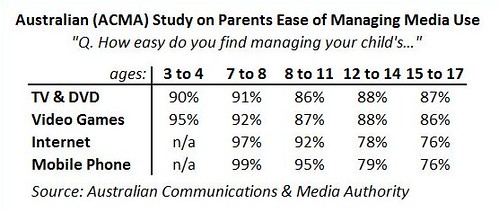
An interesting new survey has just been released by the Australian Communications and Media Authority (ACMA), which is the rough equivalent of the Federal Communications Commission here in the U.S., but with somewhat broader authority. ACMA’a latest report is entitled Use of Electronic Media and Communications: Early Childhood to Teenage Years and it takes a look at media technology usage among Australian youngsters in 5 age groupings (3 to 4 years of age, 7 to 8, 8 to 11, 12 to 14, and 15 to 17).
The survey also asked Australian parents “How easy do you find managing your child’s ___ use.” They asked that question for four different media or communications technologies: TV & DVD; video games; Internet; and mobile devices. They results, summarized in the table below, were quite interesting and seem to indicate that Australian parents find it much easier to manage their children’s media use than some of their elected leaders imagine.
Continue reading →

 Do we have any Australian TLF readers out there? If so, I’d be interested in their input about how well video game censorship works down under.
I follow Australian content regulation via the wonderful “Somebody Think of the Children!” blog, operated by Michael Meloni of Brisbane, Australia. (Mike, if you’re listening, you have at least one big fan here in the U.S. and thank you for keeping the rest of us up-to-speed about censorship developments on the other side of the globe!) This week, Mike reports that another video game (“F.E.A.R. 2”) was refused classification by the Australian government’s Classification Board. Apparently, the “refused classification” designation is the equivalent of a ban in Australia. And F.E.A.R. 2 is the fifth game to receive that designation in 2008. (Other games that have been censored, or subject to some sort of political investigation or pressure, are inventoried at the “Refused Classification.com” website.)
First, let me just say that this again reminds me how lucky we are to have strong free speech protections here in the United States thanks to the First Amendment of our Constitution. I do so much bitching about efforts to regulate speech and media content (especially video games) that I sometimes fail to step back and appreciate how fortunate we are here in the U.S. to not have to worry about an official government ratings body overseeing all game releases. This really hit home for me when I read that “Fallout 3” was one of the 5 games banned this year. It’s a brilliant game and I just can believe it would be censored such that the Australian public could not play the same version of it that I can.
Second, I’m wondering how well these bans work in Australia. A big part of my research on speech regulation is focused on the
practicality of censorship in the modern Information Age. [See my “End of Censorship” essay.] Thus — taking off my advocate hat and putting on my academic hat — I would be very interested in hearing from Australians about how effective these regulatory schemes are in practice. Can you still get games from overseas and play them on consoles and PCs in Australia? Do you download uncensored versions (either legally or illegally)? Does the government take steps to stem the flow of unregulated content? Or, are most citizens willing to just played the censored version of games that the Australian government eventually authorizes? Have there been academic studies done on the practical side of content censorship in Australia?
You get the idea. Any input would be greatly appreciated.
[Note: I have also been following the Australian government’s big recent push for centralized Internet filtering. Would be interested in input as that as well from Australians citizens.]
The Australian government has been running a trial of ISP-level filtering products to determine whether network-based filtering could be implemented by the government to censor certain forms of online content without a major degradation of overall network performance. The government’s report on the issue was released today: Closed-Environment Testing of ISP-Level Internet Content Filtering. It was produced by the Australian Communications & Media Authority (ACMA), which is the rough equivalent of the Federal Communications Commission here in the U.S., but with somewhat broader authority.
The Australian government has been investigating Internet filtering techniques for many years now and even gone so far to offered subsidized, government-approved PC-based filters through the Protecting Australian Families Online program. That experiment did not end well, however, as a 16-year old Australian youth cracked the filter within a half hour of its release. The Australian government next turned its attention to ISP-level filtering as a possible solution and began a test of 6 different network-based filters in Tasmania.
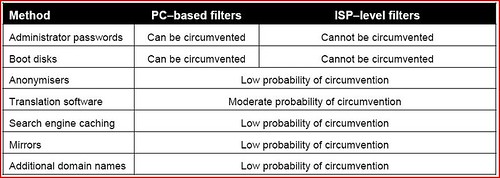
What makes ISP-level (network-based) filtering an attractive approach for many policymakers is that, at least in theory, it could solve the problem the Australian government faced with PC-based (client-side) filters: ISP-level filters are more difficult, if not impossible, to circumvent. That is, if you can somehow filter content and communications at the source–or within the network–then you have a much greater probability of stopping that content from getting through. Here’s a chart from the ACMA’s new report that illustrates what they see as the advantage of ISP-level filters:
 Continue reading →

 The Technology Liberation Front is the tech policy blog dedicated to keeping politicians' hands off the 'net and everything else related to technology.