In the latest PFF TechCast, I discuss the issues considered in the second essay in our ongoing series, “The Wrong Way to Reinvent Media.” In this 6-minute podcast, PFF’s press director Mike Wendy chats with me about proposals to impose taxes on broadcast spectrum licenses to funnel money to public media or “public interest” content. In my paper and this podcast, I make the case again socially engineering media choices and outcomes through the tax code.
MP3 file: PFF TechCast #2 – Saving the Media Through Broadcast Spectrum Taxes (4/5/2010)
As mentioned last week, in a new series of essays, PFF scholars will be examining proposals that would have the government play a greater role in sustaining struggling media enterprises, “saving journalism,” or promoting more “public interest” content. With many traditional media operators struggling, and questions being raised about how journalism in particular will be supported in the future, Washington policymakers are currently considering what role government can and should play in helping media providers reinvent themselves in the face of tumultuous technological change wrought by the Digital Revolution. We will be releasing 6 or 7 essays on this topic leading up to our big filing in the FCC’s “Future of Media” proceeding (deadline is May 7th). And here’s a podcast Berin Szoka and I did providing an overview of the series.
In the first installment of the series, Berin and I critiqued an old idea that’s suddenly gained new currency: taxing media devices or distribution systems to fund media content. In the second installment, “The Wrong Way to Reinvent Media, Part 2: Broadcast Spectrum Taxes to Subsidize Public Media,” I discuss proposals to impose a tax on broadcast spectrum licenses to funnel money to public media projects or other “public interest” content or objectives. Such a tax would be fundamentally unfair to broadcasters, who are struggling for their very survival in the midst of unprecedented marketplace turmoil. Moreover, such a tax is unnecessary in light of the many other sources of “public interest” programming available today. Finally, even if the government creates or subsidizes wonderful, civic- and culturally-enriching content, there’s no way to force people to consume it. Nor should government force such media choices upon the public. There’s no good reason for government to be socially-engineering media choices through taxes.
I’ve attached the entire essay down below.
Continue reading →
By Adam Thierer & Berin Szoka
In a series of upcoming essays, we will be examining proposals being put forward today that would have the government play a greater role in sustaining struggling media enterprises, “saving journalism,” or promoting more “public interest” content. The reason we’re working up this multi-part series is because, with many traditional media operators struggling, and questions being raised about how journalism in particular will be supported in the future, Washington policymakers are currently considering what role government can and should play in helping media providers reinvent themselves in the face of tumultuous technological change wrought by the Digital Revolution.
For example, the Federal Communications Commission (FCC) recently kicked off a new “Future of Media” effort with a workshop on “Serving the Public Interest in the Digital Era.” (The filing deadline for the FCC’s “Future of Media” proceeding is May 7th). Likewise, the Federal Trade Commission (FTC) has hosted two workshops asking “How Will Journalism Survive the Internet Age?” Meanwhile, the Senate has already held hearings about “the future of journalism,” and Senator Benjamin L. Cardin (D-MD) recently introduced the “Newspaper Revitalization Act,” which would allow newspapers to become tax-exempt non-profits in an effort to help them stay afloat.
Thus, in light of Washington’s sudden interest in the future of media and journalism, we will be taking a hard look at several issues and proposals that are being floated today, including:
- Taxes on media devices, mobile phones, or broadband bills to channel money to media enterprises / content;
- Taxes / fees on broadcasters to funnel support to their public sector competitors or to public interest programs;
- “News vouchers” or “public interest vouchers” that would encourage citizens to channel support to media providers;
- Taxes on private advertising to subsidize non-commercial / public media content;
- Expanded postal subsidies for media mail; and
- Targeted welfare programs for out-of-work journalists or corporate welfare in the form of bailouts for failing media enterprises.
You won’t be surprised to hear that we are generally quite skeptical of most of these ideas, but we promise to give each one serious consideration. We’ll kick things off tomorrow with our essay on why taxing media devices or distribution systems to fund media content is not a particularly good idea.
I somehow missed this excellent ITIF paper by Robert D. Atkinson and George Ou when it came out at this point last year, but George has just dusted it off, made a couple of updates, and re-posted it over at the Digital Society blog. Worth reading. It touches on a lot of the same case studies I have been documenting in my ongoing series, “Problems in Public Utility Paradise.” In particular, it focuses on the UTOPIA and iProvo fiascos out in Utah. Here’s a key takeaway from those case studies:
The lessons learned in Utah is that projected uptake models and deployment plans don’t always come to fruition, and when that happens the consequence is failure. For UTOPIA, the project was projected to reach 35% uptake rates by February 2008 but the reality was less than 17% uptake. UTOPIA had also hoped for 17% uptake from lucrative business customers but the reality was only 2 to 3 percent. Provo County’s iProvo was hoping for 10,000 subscribers by July 2006 with the assumption that 75% of those customers would subscribe to lucrative triple play services, but the reality was 10,000 customers in late 2007 with only 17% of those customers subscribing to triple play. Many consumers were quite happy to subscribe to existing broadband cable or telecom providers. The consistent theme in Utah was an overestimation of the uptake rates and the underestimation of competition from incumbent cable operator Comcast and telecom operator Qwest which led to consistent underperformance.
Ouch. For more details, see this old essay of mine about UTOPIA from 2008, and this piece from last Sept about iProvo. Not a pretty picture. As I say every time I pen a piece about the latest muni failure du jour, these case studies should serve as a cautionary tale about the dangers of grandiose, centrally planned broadband schemes. There is no such thing as a free lunch. Network-building is hard, and politicians usually aren’t that good at doing it.
The Parents Television Council (PTC) released a new report today entitled Women in Peril: A Look at TV’s Disturbing New Storyline Trend. The report argues that “by depicting violence against women with increasing frequency, or as a trivial, even humorous matter, the broadcast networks may ultimately be contributing to a desensitized atmosphere in which people view aggression and violence directed at women as normative, even acceptable,” said PTC President Tim Winter. As evidence the report cites… Nicole Kidman. OK, it cites more than Nicole Kidman, but the 7-page report and accompanying press release does seem to place a lot of stock in the fact that, while being questioning by a House Foreign Affairs subcommittee hearing about violence against women overseas, “Ms. Kidman conceded that Hollywood has probably contributed to violence against women by portraying them as weak sex objects, according to the Associated Press.” I’m not sure what Ms. Kidman was doing testifying before Congress on the matter of violence against women overseas — dare I suggest some congressmen were out for another photo-op with a Hollywood celeb? — but the better question is whether Ms. Kidman’s opinion has any bearing on the question of what relationship, if any, there is between televised violence and real-world violence against women. (Incidentally, if she really feels passionately about all this, is she prepared to go back and recut some of her old scenes in “Dead Calm,” “To Die For,” and “Eyes Wide Shut“?)
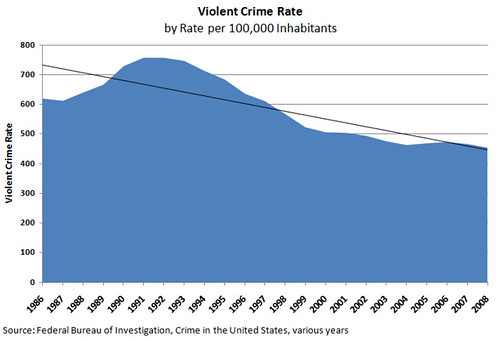
But let’s not nitpick about the credentials Ms. Kidman brings to the table or whether it makes any sense for PTC to elevate her opinions to proof of theory when it comes to a supposed connection between depictions of violence against women in film or television and real world acts of violence against women. PTC, however, suggests that’s exactly what is going on today. They allude to a few lab studies which are of the “monkey see, monkey do” variety — where the results of artificial lab experiments are used to claim that watching depictions of violence will turn us all into killing machines, rapists, robbers, or just plain ol’ desensitized thugs.
There’s just one problem with such studies, and the PTC report: Reality. Continue reading →
For some time now here at the TLF, we have been documenting the track record of various government-owned or subsidized utility projects — municipal wi-fi projects, locally-owned telecom ventures, city or state fiber projects, and so on. We’ve attempted to see if the rhetoric matches the reality when it comes to the grandiose promises made about government investment or ownership of communications or broadband networks being our ticket to high-tech paradise.
The results? Well, the record speaks for itself. It’s been one miserable failure after another. And yet the high-tech pork barrel rolls on and taxpayers are all too often stuck picking up the tab.
I just wanted to make everyone aware of the fact that I finally got around to collecting most of our essays on the subject here into an “Ongoing Series” page that will be permanently housed here. (As far as I can tell, we’re up to about 18 or 19 installments). I encourage my TLF contributors to help me contribute entries to the series and I also invite our readers to continue to submit examples of these experiments so we can continue to document their failure. Of course, if there are success stories, we’d like to hear about those too. But that will likely be a much shorter series!
Like many others, I have long been troubled by the fact that the Supreme Court does not allow TV cameras or live audio coverage of the cases it hears. I know all the arguments against live video or audio coverage and I find them all quite unconvincing when weighed against the public’s right to hear the oral arguments and decisions that will have such a direct bearing on their lives and liberty. We should be allowed to see, or at least hear, these arguments and decisions as they happen.
Anyway, as I was reading through an article today in
Broadcasting & Cable about how “C-SPAN Seeks Oral Argument Tapes in Fox Swearing Case,” I couldn’t help but think about how particularly ironic it was that our nation’s highest court would be considering one of the most important free speech cases in decades — FCC v. Fox — and it yet wouldn’t be allowing any of us to listen in live when it takes place on November 4th! If we are lucky, the Court might grant C-SPAN expedited access to the tapes of the arguments, but it may be that we have to wait many weeks to hear what was said.
Seems silly to me. Worse yet, it means I will have to camp out in front of the Supreme Court the night before and freeze my butt off in the hope of getting a seat in the courtroom to hear the live argument! Which brings up the final bit of irony I always like to point out about restricting cameras and microphones from courtrooms: Why are they letting
anyone in the courtroom at all if they so fear instantaneous public access to the arguments?

 The Technology Liberation Front is the tech policy blog dedicated to keeping politicians' hands off the 'net and everything else related to technology.