by Berin Szoka & Adam Thierer
This morning, the House Energy & Commerce Committee will hold a hearing on “Behavioral Advertising: Industry Practices And Consumers’ Expectations.” If nothing else, it promises to be quite entertaining: With full-time Google bashers Jeff Chester and Scott Cleland on the agenda, the likelihood that top Google officials will be burned in effigy appears high!
Chester, self-appointed spokesman for what one might call the People for the Ethical Treatment of Data (PETD) movement, is sure to rant and rave about the impending techno-apocalypse that will, like all his other Chicken-Little scenarios, befall us all if online advertisers were permitted to better tailor ads to consumers’ liking. After all, can you imagine the nightmare of less annoying ads that might actually convey more useful information to consumers? Isn’t serving up “untargeted” dumb banner ads for Viagra to young women and Victoria’s Secret ads to Catholic school kids the pinnacle of modern online advertising? Gods forbid we actually make advertising more relevant and interest-based! (Those Catholic school boys may appreciate the lingerie ads, but few will likely buy bras.)
Anyway, according to National Journal’s Tech Daily Dose, the hearing lineup also includes:
- Charles Curran, Executive Director, Network Advertising Initiative
- Christopher Kelly, Chief Privacy Officer, Facebook
- Edward Felten, Director, Center for IT Policy, Princeton University
- Anne Toth, Chief Privacy Officer & Vice President, Policy, Yahoo!
- Nicole Wong, Deputy General Counsel, Google
That’s an interesting group and we’re sure that they will say interesting things about the issue. Nonetheless, because four of them have a corporate affiliation that fact will inevitably be used by some critics to dismiss what they have to say about the sensibility of more targeted or interest-based forms of online advertising. So, we’d like to offer a few thoughts and pose a few questions to make sure that Committee members understand why, regardless of what it means for any particular online operator,
targeting online advertising is very pro-consumer and essential to the future of online content, culture, and competition. As Wall Street Journal technology columnist Walt Mossberg has noted, “Advertising is the mother’s milk of all the mass media.” Much of the “free speech” we all cherish isn’t really free, but ad-supported!
Continue reading →
The Gawker offers a fascinating discussion of the legal right to anonymity:
“There is clearly a moral case that some people should be able to join the public debate and retain their anonymity,” Tench told Gawker. “And I think this will have a chilling effect. Blogs like this can only exist anonymously, and I imagine that anyone who wanted to set one up is thinking about this case.”
As well they should. But the notion that anonymous publishers have a right, in perpetuity, to keep their identities a secret—or that people who learn their identities are honor-bound not to reveal them—is nonsense.
Amen! One can resist, fiercely, government efforts to reduce online anonymity through age verification or identity authentication mandates, as Adam Thierer have argued most recently in our work about efforts to expand COPPA to cover adolescents (“COPPA 2.0,” which would indirectly mandate age verification for large numbers of adults for the first time). One might even argue that there are moral reasons to resist the urge to out pseudonymous/anonymous bloggers (just as one might avoid outing closeted gays out of respect for their privacy). But one need not accept the pernicious idea that the government should punish the outing of peusodonymous/anonymous writers, which is simply a restraint on legitimate free speech.
This exchange, cited by the Gawker article, is particularly interesting, and demonstrates how one can distinguish the question of whether outing is “right” or “appropriate” from the question of whether it should be punished by law:
When the National Review‘s Ed Whelan revealed Publius, who writes for Obsidian Wings, to be a professor of law at the South Texas College of Law named John F. Blevins earlier this month, the palpable online outrage forced Whelan to apologize.
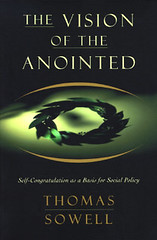 Berin recently encouraged me to re-read Thomas Sowell’s The Vision of the Anointed: Self-Congratulation as a Basis for Social Policy, which I hadn’t looked at since I first read it back in 1995 or 96. I’m glad I did since Sowell’s work has always been profoundly influential on my thinking (especially his masterpiece, A Conflict of Visions) and I had forgotten how useful The Vision of the Anointed was in helping me understand the reoccurring model that drives ideological crusades to expand government power over our lives and economy.
“The great ideological crusades of the twentieth-century intellectuals have ranged across the most disparate fields,” Sowell noted in the book. But what they all had in common, he argued, was “their moral exaltation of the anointed above others, who are to have their different views nullified and superseded by the views of the anointed, imposed via the power of government.” (p. 5) These elitist, government-expanding crusades shared several key elements, which Sowell identified as follows:
- Assertion of a great danger to the whole society, a danger to which the masses of people are oblivious.
- An urgent need for government action to avert impending catastrophe.
- A need for government to drastically curtail the dangerous behavior of the many, in response to the prescient conclusions of the few.
- A disdainful dismissal of arguments to the contrary as either uninformed, irresponsible, or motivated by unworthy purposes.
You can see this model at work on a daily basis today with our government’s various efforts to reshape our economy, but I think this model is equally applicable to debates over social policy and speech control. In particular, the various “technopanics” I have been writing about recently fit this model. (See 1, 2, 3, 4, 5). For example, consider how this plays out in the debate over online social networking:
Continue reading →
As Berin mentioned last week, we have a new paper out on proposals to expand the Children’s Online Privacy Protection Act (COPPA) of 1998. We generically refer to those COPPA-expansion efforts as “COPPA 2.0.” Hence, the title of our paper: “COPPA 2.0: The New Battle over Privacy, Age Verification, Online Safety & Free Speech.” To recap what Berin already noted, in the name of improving online child safety, some legislators and state attorneys general (AGs) are advocating the expansion of COPPA’s “verifiable parental consent” model of age verification before certain sites or services may collect, or enable the sharing of, personal information for children.
Unlike “COPPA 1.0,” however, which only applied to children under the age of 13, “COPPA 2.0” would apply to all minors up to age 17. Moreover, the range of sites covered by the new law would generally be expanded to include just about any site or service with social networking functionality.
Since Berin has already summarized our general concerns with efforts to expand COPPA’s “verifiable parental consent” online age verification system to cover more online users and sites, I thought I would focus here on what I believe will be the most controversial (and important) part of our paper — our discussion about how COPPA 2.0 affects the speech rights of both adults
and adolescents.
Continue reading →
Recall a couple of years ago when I lauded Google – and also picked on them – for making customer data “more anonymous”?
“‘Anonymous’ is correctly regarded as an absolute condition,” I wrote. “Like pregnancy, anonymity is either there or it’s not. Modifying the word with a relative adjective like ‘more’ is a curious use of language.”
The challenge of these concepts – “anonymized” or “de-identified” data – is still around, and it’s still a difficult one.
Here’s a sophisticated take on the question:
Information is increasingly difficult to classify as “identified” or “de-identified,” particularly as it is copied, exchanged, or recombined with other information. With rapidly evolving technologies and databases, it is more appropriate to describe a spectrum of “identifiability,” rather than a binary classification of information as identifiable or not. The question could then become not whether deidentified information might be made re-identifiable, but rather which entities would be able to re-identify the information, how much effort they would have to expend, and what limits are placed on their doing so.
And here’s an advocacy group apparently lacking that sophistication. They treat information as flatly “de-identified” in a legal filing about a New Hampshire law that bans the sale of prescription drug data for marketing purposes:
[T]he Prescription Information Law does not implicate patient privacy. While it purports to protect privacy interests, the statute regulates patient de-identified information.
Here’s the thing: Both quotes were issued by the Center for Democracy and Technology. Continue reading →
I’m reading a couple of interesting books right now [see my Shelfari list here] including Guarding Life’s Dark Secrets: Legal and Social Controls over Reputation, Propriety, and Privacy by Lawrence Friedman of the Stanford School of Law. The book examines the legal and social norms governing privacy, reputation, sex, and morals over the past two centuries. It’s worth putting on your reading list. [Here’s a detailed review by Neil Richards.] I might pen a full review later but for now I thought I would just snip this passage from the concluding chapter:
In an important sense, privacy is a modern invention. Medieval people had no concept of privacy. They also had no actual privacy. Nobody was ever alone. No ordinary person had private space. Houses were tiny and crowded. Everyone was embedded in a face-to-face community. Privacy, as idea and reality, is the creation of a modern bourgeois society. Above all, it is a creation of the nineteenth century. In the twentieth century it became even more of a reality. [p. 258]
In a time when amorphous “rights” to privacy seem to be multiplying like wildflowers, this is an important insight from Friedman. In my opinion, many of the creative privacy theories being concocted today are often based on false nostalgia about some forgotten time in the past when we supposedly all had our own little quiet spaces that were completely free from privacy intrusions. But as Friedman makes clear, this is largely a myth. It’s not to say that there aren’t legitimate issues out there today. But it’s important that we place modern privacy issues in a larger historical context and understand how many of today’s concerns pale in comparison to the problems of the past.
[Note: If you’re interested in this topic, you’ll also want to read Daniel Solove’s The Future of Reputation: Gossip, Rumor, and Privacy on the Internet. Also, here’s Jim Harper’s review of it.]
Adam Thierer & I have just released a detailed examination (PDF) of brewing efforts to expand the Children’s Online Privacy Protection Act of 1998 to cover adolescents and potentially all social networking sites—an approach we call “COPPA 2.0.”
As Adam explained on Larry Magid’s CNET podcast, COPPA mandates certain online privacy protections for children under 13, most importantly that websites obtain the “verifiable consent” of a child’s parent before collecting personal information about that child or giving that child access to interactive functionality that might allow the child to share their personal information with others. The law was intended primarily to “enhance parental involvement in a child’s online activities” as a means of protecting the online privacy and safety of children.
Yet advocates of expanding COPPA—or “COPPA 2.0″—see COPPA’s verifiable parental consent framework as a means for imposing broad regulatory mandates in the name of online child safety and concerns about social networking, cyber-harassment,
etc. Two COPPA 2.0 bills are currently pending in New Jersey and Illinois. The accelerated review of COPPA to be conducted by the FTC next year (five years ahead of schedule) is likely to bring to Washington serious talk of expanding COPPA—even though Congress clearly rejected covering adolescents age 13-16 when COPPA was first proposed back in 1998.
We’ll discuss some of the key points of our paper in a series of blog posts, but here are the top nine reasons for rejecting COPPA 2.0, in that such an approach would:
- Burden the free speech rights of adults by imposing age verification mandates on many sites used by adults, thus restricting anonymous speech and essentially converging—in terms of practical consequences—with the unconstitutional Children’s Online Protection Act (COPA), another 1998 law sometimes confused with COPPA;
- Burden the free speech rights of adolescents to speak freely on—or gather information from—legal and socially beneficial websites;
- Hamper routine and socially beneficial communication between adolescents and adults;
- Reduce, rather than enhance, the privacy of adolescents, parents and other adults because of the massive volume of personal information that would have to be collected about users for authentication purposes (likely including credit card data);
Continue reading →
Lee Gomes writes on Fobes.com with a clear-eyed reminder that privacy regulation has been costly, yet failed to deliver. Lovers of government intervention will, of course, take this as an argument to double-down.
Google has announced that it will soon begin allowing U.S. advertisers to use trademarked keywords in limited circumstances in text ads, much as Yahoo! already does. Google currently allow advertisers to bid on trademarked terms as keywords that could cause an ad to appear, either next to Google search results or on a third-party publisher’s website. That policy will not change, and is discussed here by my PFF colleague Sid Rosenzweig. The new policy is focused on the text seen by users in ads themselves and applies only if the “landing page” (to which the ad links) is used by a reseller, aggregator or parts supplier to sell only products that are relevant to the mark in question, or if the page is used to provide impartial reviews or other information about the trademarked product. The new policy does not apply to sites/pages that (a) facilitate the sale of counterfeit goods, (b) allow the sale of a competitor’s goods, (c) criticize the trademarked good, or (d) do not provide substantial information or a purchase option. Despite these limitations and other safeguards, Google has been sharply criticized by some trademark holders and might even be sued (e.g., for contributory infringement).
I’ll defer to the real trademark lawyers to figure out whether Google is correct that its new policy falls within the bounds of trademark law (particularly the “nominative fair use” doctrine). But since Adam Thierer and I have been involved in an ongoing defense of online advertising against those who would squelch it through regulation in the name of privacy concerns (not at play here), I think it’s important to highlight the potential benefits to users from this seemingly arcane policy change-and to consider what this episode says about online advertising generally. I see three main benefits to consumers from the policy change that should be considered alongside the vitally important role that trademarks play in our economy in communicating reputational information.
First, Google’s new policy will allow consumers to
find products more easily because advertisers will be able to offer more descriptive and therefore informative ads, mentioning what they sell by name. Continue reading →
Facebook has been at the center of a controversy involving its moderation policies and The Pirate Bay, a popular Bittorrent tracker that was found guilty of copyright infringement by a Swedish court last month. Since early April, Facebook has enforced a “site-wide” ban on links to The Pirate Bay – including those in private messages.
This practice may run afoul of federal wiretapping statutes that bar service providers from “intercepting” private messages, according to an article that appeared on Wired Threat Level last week. Wired quotes Kevin Bankston, a senior attorney for the Electronic Frontier Foundation, who explains that Facebook’s filtering raises “serious questions about whether Facebook is in compliance with federal wiretapping law.”
It’s important to draw a distinction between the traditional notion of “wiretapping” and Facebook’s “interception” of user messages, which doesn’t involve any human intervention. Regardless of how the courts may interpret ancient laws like the 1986 Electronic Communications Privacy Act, an automated computer system flagging and deleting certain strings from user messages simply isn’t comparable to a third party secretly listening in on a private phone conversation.
Besides, Facebook makes clear to its users from the get-go that their messages and postings are subject to a set of rules (which Facebook lays out in plain English). If Facebook believes a message or posting is against the rules, it can block or remove it. This is not an unreasonable rule; many online discussion forums have enforced similar policies since the Web’s early days. Such filtering is possible only if sites can “examine” messages to identify misconduct.
Continue reading →

 The Technology Liberation Front is the tech policy blog dedicated to keeping politicians' hands off the 'net and everything else related to technology.