The Federal Trade Commission (FTC) has just released its final privacy framework proposal, “Protecting Consumer Privacy in an Era of Rapid Change.” The agency released a draft report with the same title back in late 2010 and then asked for comments. [Here were my comments to the agency.] The FTC’s final report comes just a month after the Obama Administration released its 50-page privacy framework, Consumer Data Privacy in a Networked World, which included a privacy “bill of rights.” That report was primarily driven by the Department of Commerce. [I penned a Forbes column about that report the day it was released.] The new FTC report is fairly consistent with the earlier Commerce Department report. Here are some of the key themes or recommendations from the final FTC report:
- rooted in a set of baseline privacy principles with a strong push for “privacy by design,” more consumer choice, and better transparency.
- along with Dept of Commerce, the agency will work with industry to develop privacy codes of conduct and then give them teeth with possibility of FTC enforcement.
- pushes for industry to pursue voluntary “Do Not Track” mechanism, which to the agency apparently means “do not collect” any info.
- calls on Congress to pass data security legislation and legislation “to provide greater transparency for, and control over, the practices of information brokers.” Also, “to further increase transparency, the Commission calls on data brokers that compile data for marketing purposes to explore creating a centralized website where data brokers could (1) identify themselves to consumers and describe how they collect and use consumer data and (2) detail the access rights and other choices they provide with respect to the consumer data they maintain.”
- the agency will host a workshop later this year to discuss privacy withing “large platform providers.” The report notes: “To the extent that large platforms, such as Internet Service Providers, operating systems, browsers, and social media, seek to comprehensively track consumers’ online activities, it raises heightened privacy concerns.”
- the agency is also stepping up oversight on mobile privacy issues.
- the agency says it “generally supports the exploration of efforts to develop additional mechanisms, such as the ‘eraser button’ for social media,” but stops short of saying it should be mandated at this time.
Some of my initial random thoughts about the FTC report: Continue reading →
Over at Forbes I have posted some thoughts on the new privacy framework (Consumer Data Privacy in a Networked World) that the Obama Administration released today. In my essay, “The Problem with Obama’s “Let’s Be More Like Europe” Privacy Plan,” I hammer home the same point I’ve made here before many times: Regulation is not a costless exercise. No matter how well-intentioned regulatory proposals may be, they can often have unforeseen, unintended consequences. This is equally true for privacy controls. I discuss how a new privacy regulatory regime could drive up prices for services that currently are free or inexpensive, limit new digital services and innovations, create barriers to entry for new entrants and entrepreneurs, negatively impact the competitiveness of existing U.S. Internet operators, and, more generally, increase the horizons of government power over the Internet.
For a more detailed analysis of these issues, I encourage you to check out my big Mercatus Center filing to the FTC last year on privacy and Do Not Track regulation. Also, here are few TLF essays that summarize my skepticism about expanded privacy controls:
You wouldn’t think that policymakers need to be reminded that technological progress raises living standards and creates new (and better) employment opportunities. Alas, some comments President Obama made in a speech last week seemed to link technology to job losses. “There are some structural issues with our economy where a lot of businesses have learned to become much more efficient with a lot fewer workers,” he said. “You see it when you go to a bank and you use an ATM, you don’t go to a bank teller, or you go to the airport and you’re using a kiosk instead of checking in at the gate.”
In an essay in today’s
Wall Street Journal, one of my Mercatus Center colleagues Russ Roberts, a professor of economics at George Mason University, brilliantly deconstructs this logic and points out why technology doesn’t destroy jobs:
Somehow, new jobs get created to replace the old ones. Despite losing millions of jobs to technology and to trade, even in a recession we have more total jobs than we did when the steel and auto and telephone and food industries had a lot more workers and a lot fewer machines.
Why do new jobs get created? When it gets cheaper to make food and clothing, there are more resources and people available to create new products that didn’t exist before. Fifty years ago, the computer industry was tiny. It was able to expand because we no longer had to have so many workers connecting telephone calls. So many job descriptions exist today that didn’t even exist 15 or 20 years ago. That’s only possible when technology makes workers more productive.
Read the whole thing. Great stuff.
Over at MediaFreedom.org, a new site devoted to fighting the fanaticism of radical anti-media freedom groups like Free Press and other “media reformistas,” I’ve started rolling out a 5-part series of essays about “The Battle for Media Freedom.” In Part 1 of the series, I defined what real media freedom is all about, and in Part 2 I discussed the rising “cyber-collectivist” threat to media freedom. In my latest installment, I offer an analytical framework that better explains the major differences between the antagonists in the battle over media freedom.
Understanding the Origins of Political Struggles
 In his many enlightening books, Thomas Sowell, a great economist and an even better political scientist, often warns of the triumph of good intentions over good economics. It’s a theme that F.A. Hayek and Milton Friedman both developed extensively before him. But Sowell has taken this analysis to an entirely differently level in books like A Conflict of Visions: Ideological Origins of Political Struggles, and
The Vision of the Anointed: Self-Congratulation as a Basis for Social Policy
. Sowell teaches us that no matter how noble one’s intentions might be, it does not mean that those ideas will translate into sound public policy. Nonetheless, since “the anointed” believe their own intentions are pure and their methods are sound, they see nothing wrong with substituting their will for the will of millions of individuals interacting spontaneously and voluntarily in the marketplace. The result is an expansion of the scope of public decision-making and a contraction of the scope of private, voluntary action. As a result, mandates replace markets, and freedom gives way central planning.
In his many enlightening books, Thomas Sowell, a great economist and an even better political scientist, often warns of the triumph of good intentions over good economics. It’s a theme that F.A. Hayek and Milton Friedman both developed extensively before him. But Sowell has taken this analysis to an entirely differently level in books like A Conflict of Visions: Ideological Origins of Political Struggles, and
The Vision of the Anointed: Self-Congratulation as a Basis for Social Policy
. Sowell teaches us that no matter how noble one’s intentions might be, it does not mean that those ideas will translate into sound public policy. Nonetheless, since “the anointed” believe their own intentions are pure and their methods are sound, they see nothing wrong with substituting their will for the will of millions of individuals interacting spontaneously and voluntarily in the marketplace. The result is an expansion of the scope of public decision-making and a contraction of the scope of private, voluntary action. As a result, mandates replace markets, and freedom gives way central planning.
Sowell developed two useful paradigms to help us better understand “the origins of political struggles.” He refers to the “constrained” versus “unconstrained” vision and separates these two camps according to how they view the nature of man, society, economy, and politics:
| “Constrained Vision” |
“Unconstrained Vision” |
| Man is inherently constrained; highly fallible and imperfect |
Man is inherently unconstrained; just a matter of trying hard enough; man & society are perfectible |
| Social and economic order develops in bottom-up, spontaneous fashion. Top down planning is hard because planners aren’t omnipotent. |
Order derives from smart planning, often from top-down. Elites can be trusted to make smart social & economic interventions. |
| Trade-offs & incentives matter most; wary of unintended consequences |
Solutions & intentions matter most; less concern about costs or consequences of action |
| Opportunities count more than end results; procedural fairness is key; Liberty trumps |
Outcomes matter most; distributive or “patterned” justice is key; Equality trumps liberty |
| Prudence and patience are virtues. There are limits to human reason. |
Passion for, and pursuit of, high ideals trumps all. Human reason has boundless potential. |
| Law evolves and is based on the experience of ages. |
Law is made by trusted elites. |
| Markets offer benefit of experience & experimentation and help develop knowledge over time. |
Markets cannot ensure desired results; must be superseded by planning & patterned justice |
| Exponents: Aristotle, Adam Smith, Edmund Burke, James Madison, Lord Acton, F.A. Hayek, Ludwig von Mises, Milton Friedman, James Buchanan, Robert Nozick |
Exponents: Plato, Rousseau, William Godwin, Voltaire, Robert Owen, John Kenneth Galbraith, John Dewey, Earl Warren, Bertrand Russell, John Rawls |
Last Thursday I shared my thoughts in two short (<5 min) RussiaToday interviews on on President Obama's big speech about NASA and his long-overdue cancellation of NASA’s white elephant known as “Ares I” rocket. (See Jeff Foust’s analysis here and here.) I was sorry to see the Administration decide to preserve the Orion capsule as a lifeboat for the International Space Station, but as I indicate below, I can’t really blame them for feeling they had to “throw a bone” to the Congressional lions defending that program and the jobs it created (using tax dollars that killed far more jobs, of course—a classic “seen v. unseen” problem).
But as I note below, the far more important
good news is that, if Obama gets his way, NASA would finally buy crew launch services to ISS and for future deep space missions from the private sector (expanding its limited COTS program) instead of building its own rockets and capsule for this purpose. This decision is easily single best thing the Administration has done thus far. They have a tough fight ahead with the few members of Congress who actually care about this—who just so happen to be the ones whose districts will face job cuts when dead-end, wasteful make-work programs are canceled. The irony here is just too thick: Many of the same kinds of folks who’ve been decrying Obama as a socialist (not unjustly, in my opinion) now attack him on nationalist grounds for trying to turn part of our ultra-socialist space program over to the private sector.
http://www.youtube.com/v/-0Da2fyzBus&hl=en_US&fs=1&
Here’s another clip: Continue reading →
As mentioned last week, in a new series of essays, PFF scholars will be examining proposals that would have the government play a greater role in sustaining struggling media enterprises, “saving journalism,” or promoting more “public interest” content. With many traditional media operators struggling, and questions being raised about how journalism in particular will be supported in the future, Washington policymakers are currently considering what role government can and should play in helping media providers reinvent themselves in the face of tumultuous technological change wrought by the Digital Revolution. We will be releasing 6 or 7 essays on this topic leading up to our big filing in the FCC’s “Future of Media” proceeding (deadline is May 7th). And here’s a podcast Berin Szoka and I did providing an overview of the series.
In the first installment of the series, Berin and I critiqued an old idea that’s suddenly gained new currency: taxing media devices or distribution systems to fund media content. In the second installment, “The Wrong Way to Reinvent Media, Part 2: Broadcast Spectrum Taxes to Subsidize Public Media,” I discuss proposals to impose a tax on broadcast spectrum licenses to funnel money to public media projects or other “public interest” content or objectives. Such a tax would be fundamentally unfair to broadcasters, who are struggling for their very survival in the midst of unprecedented marketplace turmoil. Moreover, such a tax is unnecessary in light of the many other sources of “public interest” programming available today. Finally, even if the government creates or subsidizes wonderful, civic- and culturally-enriching content, there’s no way to force people to consume it. Nor should government force such media choices upon the public. There’s no good reason for government to be socially-engineering media choices through taxes.
I’ve attached the entire essay down below.
Continue reading →
 This morning at the Newseum in Washington, DC, U.S. Secretary of State Hillary Rodham Clinton delivered remarks on Internet freedom and the future of global free speech and expression. [Transcript is here + video.] It will go down as a historic speech in the field of Internet policy since she drew a bold line in the cyber-sand regarding exactly where the United States stands on global online freedom. Clinton’s answer was unequivocal: “Both the American people and nations that censor the Internet should understand that our government is committed to helping promote Internet freedom.” “The Internet can serve as a great equalizer,” she argued. “By providing people with access to knowledge and potential markets, networks can create opportunities where none exist.”
Unfortunately, however, “the same networks that help organize movements for freedom… can also be hijacked by governments to crush dissent and deny human rights.” Echoing Winston Churchill’s famous “iron curtain” speech, Sec. Clinton argued that “With the spread of these restrictive practices, a new information curtain is descending across much of the world.” She noted that virtual walls are replacing traditional walls in many nations as repressive regimes seek to squash the liberties of their citizenry. That’s why the Administration’s bold stand in favor of online freedom is so essential.
Importantly, Sec. Clinton made it clear that the Obama Administration is ready to commit significant resources to this effort. She said that, over the next year, the State Department plans to work with others to establish a standing effort to promote technology and will invite technologists to help advance the cause through a new “innovation competition” that will promote circumvention technologies and other technologies of freedom. Sec. Clinton also challenged private companies to stand up to censorship globally and challenge foreign governments when they demand controls on the free flow of information or digital technology.
That is particularly important because Secretary Clinton’s speech comes on the heels of the recent news that Google and at least 30 other Internet companies were the victims of cyberattacks in China, which raises profound questions about the future of online freedom and cybersecurity. Sec. Clinton’s remarks will make it clear to online operators that the U.S. government stands prepared to back them up when they challenge the censorial policies of repressive foreign regimes.
Continue reading →
In a letter to the editor of the Washington Post last week, former FTC Commissioner Thomas Leary responded to a Post article describing the FTC’s suit against Intel as a “major step for President Obama,” consistent with his campaign promise to “reinvigorate antitrust enforcement.” Leary responded indignantly to this characterization by declaring:
People seem to forget that the FTC is a bipartisan independent agency.
As a Republican FTC commissioner appointed by a Democratic president, I can vouch for the agency’s independence. During my service from 1999 to 2005 in the administrations of presidents Bill Clinton and George Bush, I never received a direct or indirect policy recommendation on a pending matter from anyone in the White House or from any of the people in Congress who had actively supported me.
Leary’s leeriness about political encroachment on the FTC illustrates the depth of abiding faith in independent regulatory agencies as standing truly apart from the day-to-day politics of Washington—especially when the might of the regulatory state is being wielded against a particular company in quasi-judicial prosecutions, such as antitrust enforcement actions. But if the independence of the FTC is this important, what about the independence of the Federal Communications Commission, with its broad jurisdiction over the media and tools of free speech?
Leary would probably be appalled at the politicization of the FCC in recent years. Bush’s second FCC chairman, Kevin Martin, was infamous for his political Machiavellianism and widely despised by the communications law bar. By contrast, when it became clear that Obama’s high-tech advisor Julius Genachowski would succeed Martin as FCC Chairman shortly before Obama’s inauguration, he received a chorus of applause from a wide range of philosophical perspectives, including from our former president at PFF, Ken Ferree:
Julius Genachowski is an outstanding choice to chair the Commission. He is knowledgeable, experienced, and presumably will have the ear of the most influential people within the Administration.
While no one would compare the eminently likable Genachowski to Martin, his relationship to the Obama administration appears unprecedented in its closeness, and one must ask whether that’s a good thing for the head of a supposedly “independent” regulatory agency or integrity of that agency’s decision-making. Continue reading →
by Adam Thierer & Berin Szoka
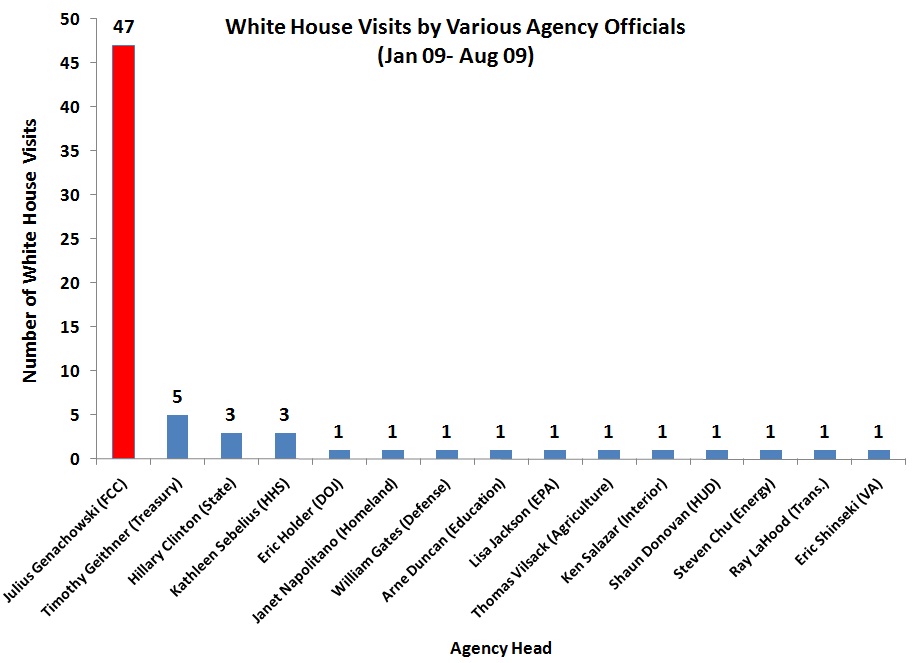
Move over, health care reform, climate change, and the economy. Judging by White House visits by various government agency heads, the Obama administration instead appears preoccupied with the re-regulation of communications, media, and the Internet. The Administration has just released logs of all visitors to the White House and Executive Office Buildings from Obama’s inauguration through August—including a staggering 47 visits by Federal Communications Commission (FCC) Chairman Julius Genachowski. By contrast, no other major agency head logged more than five visits. Chairman Genachowski obviously has an audience with those at the highest levels of power, including the President himself, but this raises questions about just how “independent” this particular regulator and his agency really are.
Unprecedented Transparency by White House
The Administration deserves credit for releasing these visitor logs, which offer unprecedented transparency into the White House’s workings. Unfortunately, the logs lack visitors’ affiliation and title, making it difficult to discern subtle patterns. Furthermore, each entry indicates only one “visitee” and the total number of people involved. Full disclosure requires identifying all meeting participants. Nonetheless, President Obama’s gesture is a great first step toward improved government accountability.
This openness allows us to ask questions we couldn’t pose for previous administrations—such as why the FCC head seems to have unparalleled access to the White House. Lacking data from previous administrations, it’s difficult to make direct comparisons with previous FCC Chairmen, but the sheer number of visits by Chairman Genachowski leaves no doubt about his uniquely close involvement with the White House. Continue reading →
FOXNews.com has just published an editorial that I penned about Monday’s net neutrality announcement from the FCC.
by Ryan Radia
The federal government may gain broad new powers to regulate Internet providers next month if Federal Communications Commission Chairman Julius Genachowski gets his way. In a milestone speech on Monday, Genachowski proposed sweeping new regulations that would give the FCC the formal authority to dictate application and network management practices to companies that offer Internet access, including wireless carriers like AT&T and Verizon Wireless.
Genachowski’s proposed rules would make good on a pledge that President Obama made in his campaign to enshrine net neutrality as law. The announcement was met with cheers by a small but vocal crowd of activists and academics who have been pushing hard for net neutrality for years. But if bureaucrats and politicians truly care about neutrality, they would be wise to resist calls to expand the government’s power over private networks. Instead, policymakers should recognize that it is far more important for government to remain neutral to competing business models — open, closed, or any combination thereof.
Continue reading →

 The Technology Liberation Front is the tech policy blog dedicated to keeping politicians' hands off the 'net and everything else related to technology.