
- Ceci c’est un meme.
On
Forbes today, I look at the phenomenon of memes in the legal and economic context, using my now notorious “Best Buy” post as an example. Along the way, I talk antitrust, copyright, trademark, network effects, Robert Metcalfe and Ronald Coase.
It’s now been a month and a half since I wrote that electronics retailer Best Buy was going out of business…gradually. The post, a preview of an article and future book that I’ve been researching on-and-off for the last year, continues to have a life of its own.
Commentary about the post has appeared in online and offline publications, including The Financial Times, The Wall Street Journal, The New York Times, TechCrunch, Slashdot, MetaFilter, Reddit, The Huffington Post, The Motley Fool, and CNN. Some of these articles generated hundreds of user comments, in addition to those that appeared here at Forbes.
Continue reading →
 Vivek Wadhwa, who is affiliated with Harvard Law School and is director of research at Duke University’s Center for Entrepreneurship, has a terrific column in today’s Washington Post warning of the dangers of government trying to micromanage high-tech innovation and the Digital Economy from above.
For reasons I have never been able to understand, the
Washington Post uses different headlines for its online opeds versus its print edition. That’s a shame, because while I like the online title of Wadhwa’s essay, “Uncle Sam’s Choke-Hold on Innovation,” the title in the print edition is better: “Google, Twitter and the Best Regulator.” By “best regulator” Wadhwa means the marketplace, and this is a point we have hammered on here at the TLF relentlessly: Contrary to what some critics suggest, the best regulator of “market power” is the market itself because of the way it punishes firms that get lethargic, anti-innovative, or just plain cocky. Wadhwa notes:
The technology sector moves so quickly that when a company becomes obsessed with defending and abusing its dominant market position, countervailing forces cause it to get left behind. Consider: The FTC spent years investigating IBM and Microsoft’s anti-competitive practices, yet it wasn’t government that saved the day; their monopolies became irrelevant because both companies could not keep pace with rapid changes in technology — changes the rest of the industry embraced. The personal-computer revolution did IBM in; Microsoft’s Waterloo was the Internet. This — not punishment from Uncle Sam — is the real threat to Google and Twitter if they behave as IBM and Microsoft did in their heydays.
Continue reading →
 In my work critiquing the Lessig-Zittrain-Wu school of thinking–which fears the decline and fall of online “openness” and digital “generativity”–I have argued that, while there is no such thing as perfect “openness,” things are actually getting more open and generative all the time. All that really counts from my perspective is that we are witnessing healthy innovation across the generativity continuum.
Will some devices and platforms continue to be “closed”? Sure. Think Apple and cable set-top boxes. But (a) there’s a ton of innovation taking place on top of those supposedly “closed” platforms and (b) there are other options consumers can exercise if they don’t like those content /information delivery methods. [See this chapter from the Next Digital Decade book for my fuller critique.]
And, even if one adopts a rigid Zittrainian view of openness and generativity, each day seems to bring more good news. From that perspective it’s hard to find a better headline than this one: ”
Smartphone Makers Bow to Demands for More Openness.” That’s from ArsTechnica today and it refers to the fact that smartphone giant HTC just announced it would no longer attempt to lock the bootloader on its smartphones, meaning geeks like me can root and hack their devices to their heart’s content. As the Ars story notes:
Continue reading →
Jack Shafer brought to my attention this terrific new Politico column by Michael Kinsley entitled, “How Microsoft Learned ABCs of D.C.” In the editorial, Kinsley touches on some of the same themes I addressed in my recent piece here “On Facebook ‘Normalizing Relations’ with Washington” as well as in my Cato Institute essay from last year on”The Sad State of Cyber-Politics.” Kinsley notes how Microsoft was originally bashed by many for not getting into the D.C. lobbying game early enough:
there even was a feeling that, in refusing to play the Washington game, Microsoft was being downright unpatriotic. Look, buddy, there is an American way of doing things, and that American way includes hiring lobbyists, paying lawyers vast sums by the hour, throwing lavish parties for politicians, aides, journalists and so on. So get with the program.
But after doing exactly that, Kinsley notes, the company got blasted for for being too aggressive in D.C.!
So that’s what Microsoft did. It moved its “government affairs” office out of distant Chevy Chase and into the downtown K Street corridor. It bulked up on lawyers and hired the best-connected lobbyists. Soon, Microsoft was coming under criticism for being heavy-handed in its attempts to buy influence.
“But the sad thing is that it seems to have worked. Microsoft is no longer Public Enemy No. 1,” Kinsley notes, and he continues on to reiterate a point I made in my last two essays: Google is the Great Satan now!
Continue reading →
The English language is public domain (the language itself, not everything said with it). So it’s worthless, right? No dollars change hands when people use it. Perhaps it could be made worth something if someone were to own it. The owner could charge a license fee to people who use English, making substantial revenue on this suddenly valuable language.
Congress can take works in the public domain and make intellectual property of them according to the Tenth Circuit Court of Appeals in a case that approved Congress “restoring” public domain works to copyrighted status. (The case is Golan v. Holder, and the Supreme Court has granted certiorari.)
But would we really be better off if the English language were given a dollar value through the mechanism of ownership and licensing? No. What is now a costless positive-externality machine would turn into a profit-center for one lucky owner. The society would not be better off, just that owner. If we had to pay for a language, we would regard that as a cost.
In a similar vein, Mike Masnick at TechDirt indulges the somewhat tongue-in-cheek observation that Microsoft costs the world economy $500 billion by accumulating to itself that would have gone to other things. It’s a sort of Broken Window fallacy for intellectual property: the idea that creating ownership of intellectual goods creates value. What is not seen when intellectual property is withheld from the public domain is the unpaid uses that might have been made of it.
Now, Microsoft has reaped wonderful benefits from its intellectual creations because it has bestowed wonderful benefits on societies across the globe. But might it have provided all these benefits for slightly less reward, leaving more money with consumers for their preferred uses?
This is all a way of challenging the mental habit of assuming that dollars are equal to value. In the area of intellectual property (whether or not protected by federal statutes), things that have no effect on the economy (because they’re in the public domain) may have huge value. Things privately owned because of intellectual property law may have less value than they should, even though their owners collect lots of money.
I’ve posted a long article on Forbes.com this morning on the Global Network Initiative. A non-profit group aimed at improving human rights though the agency of information technology companies, GNI has never really gotten off the ground.
Since its formal launch in 2008, following two years of negotiations among tech companies, human rights groups and academics, not a single company has agreed to join beyond the original members–Google, Yahoo and Microsoft.
This despite considerable pressure from supporters of GNI, including Senator Richard Durbin (D-IL), Chair of the Senate Judiciary’s Subcommittee on Human Rights. Indeed, in the wake of uprisings in Tunisia, Egypt, Libya and elsewhere and the seminal role played by social media and other IT, a full-court press has been launched against Facebook and Twitter in particular for failing to sign up. Continue reading →
The New York Times
reports that, “Facebook is hoping to do something better and faster than any other technology start-up-turned-Internet superpower. Befriend Washington. Facebook has layered its executive, legal, policy and communications ranks with high-powered politicos from both parties, beefing up its firepower for future battles in Washington and beyond.” The article goes on to cite a variety of recent hires by Facebook, its new DC office, and its increased political giving.
This isn’t at all surprising and, in one sense, it’s almost impossible to argue with the logic of Facebook deciding to beef up its lobbying presence inside the Beltway. In fact, later in the
Times story we hear the same two traditional arguments trotted out for why Facebook must do so: (1) Because everyone’s doing it! and (2) You don’t want be Microsoft, do you? But I’m not so sure whether “normalizing relations” with Washington is such a good idea for Facebook or other major tech companies, and I’m certainly not persuaded by the logic of those two common refrains regarding why every tech company must rush to Washington.
Continue reading →
Venture capitalist Bill Gurley asked a good question in a Tweet late last night when he was “wondering if Apple’s 30% rake isn’t a foolish act of hubris. Why drive Amazon, Facebook, and others to different platforms?” As most of you know, Gurley is referring to Apple’s announcement in February that it would require a 30% cut of app developers’ revenues if they wanted a place in the Apple App Store.
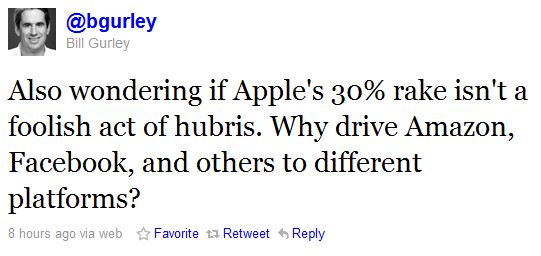 Indeed, why would Apple be so foolish? Of course, some critics will cry “monopoly!” and claim that Apple’s “act of hubris” was simply a logical move by a platform monopolist to exploit its supposedly dominant position in the mobile OS / app store marketplace. But what then are we to make of Amazon’s big announcement yesterday that it was jumping in the ring with its new app store for Android? And what are we to make of the fact that Google immediately responded to Apple’s 30% announcement by offering publishers a more reasonable 10%-of-the-cut deal? And, as Gurley notes, you can’t forget about Facebook. Who knows what they have up their sleeve next. They’ve denied any interest in marketing their own phone and, at least so far, have not announced any intention to offer a competing app store, but why would they need to? Their platform can integrate apps directly into it! Oh, and don’t forget that there’s a little company called Microsoft out there still trying to stake its claim to a patch of land in the mobile OS landscape. Oh, and have you visited the HP-Palm development center lately? Some very interesting things going on there that we shouldn’t ignore.
What these developments illustrate is a point that I have constantly reiterated here: Continue reading →
The Technology Policy Institute has released an interesting new study from Robert Crandall and Charles Jackson on “Antitrust in High-Tech Industries,” which takes a close look at the impact of antitrust law in the three most high-profile technology cases of the last half century: IBM, AT&T and Microsoft. Crandall and Jackson conclude:
In each of our three cases, the ultimate source of major changes in the competitive landscape appears to have been innovation and new technology — technology that was apparently not unleashed by the antitrust litigation. In each case, the government did not and probably could not see how technology would develop over time. Therefore, it was difficult for the government to design remedies that would accelerate competition when this competition developed from new technologies.
I enjoyed the paper and encourage others to read the entire thing. It’s very much in line with what we’ve written here in the past on the antitrust and high-tech markets. See, for example, my review of Gary Reback’s recent book on antitrust and high-tech markets. As I noted there, the crucial, ‘conflict of visions‘ issue comes down to an appreciation for dynamic competition and technological evolution over the sort of static competition, fixed-pie mindset that so many antitrust defenders espouse. Those of us who believe in dynamic competition see markets in a constant state of flux and expect that sub-optimal market developments or configurations are exactly the spark that incentivizes new form of market entry, innovation, technological disruption, price competition, and so on. But the static competition crowd looks at the same situation and imagines that the only hope is to wheel in the wrecking ball of antitrust regulation since they have little faith that things might change for the better. Moreover, they ignore the profound costs associated with such regulation and litigation. Crandall and Jackson’s paper explains why patience is the better policy.


 The Technology Liberation Front is the tech policy blog dedicated to keeping politicians' hands off the 'net and everything else related to technology.