Posts tagged as:

When the smoke cleared and I found myself half caught-up on sleep, the information and sensory overload that was CES 2013 had ended.

There was a kind of split-personality to how I approached the event this year. Monday through Wednesday was spent in conference tracks, most of all the excellent Innovation Policy Summit put together by the Consumer Electronics Association. (Kudos again to Gary Shapiro, Michael Petricone and their team of logistics judo masters.)

The Summit has become an important annual event bringing together legislators, regulators, industry and advocates to help solidify the technology policy agenda for the coming year and, in this case, a new Congress.

I spent Thursday and Friday on the show floor, looking in particular for technologies that satisfy what I coined the The Law of Disruption: social, political, and economic systems change incrementally, but technology changes exponentially.

What I found, as I wrote in a long post-mortem for Forbes, is that such technologies are well-represented at CES, but are mostly found at the edges of the show–literally. Continue reading →

Unfortunately, most consumers won’t realize that Netflix is trying to impose its costs on all Internet consumers to gain an anticompetitive price advantage against its over-the-top competitors.

At the Consumer Electronic Show two weeks ago, Netflix announced that it would block consumer access to high definition and 3D movies (HD) for customers of Internet service providers (ISPs) that Netflix disfavors. Netflix’s goal is to coerce ISPs into paying for a free Internet fast lane for Netflix content. If Netflix succeeds, it would harm Internet consumers and competition among video streaming providers. It would also fundamentally alter the economics and openness of the Internet, “where consumers make their own choices about what applications and services to use and are free to decide what content they want to access, create, or share with others.”

Ironically, Netflix’s strategy is a variant of the doomsday narrative spun by net neutrality activists over the last decade. Their narrative assumes ISPs will use their gatekeeper control to block their customers from accessing Internet content distributed by competitors. Of course, ISPs have never blocked consumer access to competitive Internet content. Now that the FCC has distorted the Internet marketplace through the adoption of asymmetric net neutrality rules, Netflix, the dominant streaming video provider, has decided to block consumer access to its content.

This may not seem like a big deal given the relatively limited HD content currently available on Netflix. But that’s about to change in a very big way. Netflix recently announced a new multi-year licensing agreement that makes it the “ exclusive American subscription TV service for first run live-action and animated features from the Walt Disney Studios.” In addition to Disney-branded content (e.g., The Lion King), the deal includes content produced by Pixar (e.g., Brave), Lucasfilm (e.g., Star Wars), and Marvel (e.g., The Avengers). Netflix also announced a multi-year deal with Turner Broadcasting and Warner Bros. that includes the Cartoon Network and exclusive distribution rights to TNT’s television series Dallas. As an analyst recently told Ars Technica, “These movies, if you’ve got young kids—you’ve got to have Netflix.”

Netflix has decided to use this new market power to force ISPs to pay for its own Internet fast lane. In classic double-speak, Netflix calls its fast lane the “Netflix Open Connect” content delivery network (CDN). Though Netflix uses the word “open” to describe its CDN, it is not part of the open Internet. It is only “open” to Netflix for the delivery of its content, and it is only “open” to ISPs who connect to it on terms dictated by Netflix. Continue reading →

Daniel Lyons, assistant professor at Boston College Law School, discusses his new Mercatus Center Working Paper, “The Impact of Data Caps and Other Forms of Usage-Based Pricing for Broadband Access.” Describing the system most of us are used to as an all-you-can-eat version of internet access, Lyons explains why it might make more sense for Internet Service Providers (ISPs) to transition to usage-based pricing, a type of metered model for broadband.

According to Lyons, the fixed costs of building up a broadband network are so great that any attempt to create an equitable cost distribution that can recoup these costs forces lighter users to subsidize heavier users. These types of flat rate payment programs often can be a barrier to low-income users. Instead, Lyons advocates for a usage-based system. In response to concerns about possible anti-competitive behavior by ISPs, Lyons further proposes that enforcement of policy transparency among ISPs might be an appropriate role for government.

Download

Related Links

Gabriella Coleman, the Wolfe Chair in Scientific and Technological Literacy in the Art History and Communication Studies Department at McGill University, discusses her new book, “Coding Freedom: The Ethics and Aesthetics of Hacking,” which has been released under a Creative Commons license.

Coleman, whose background is in anthropology, shares the results of her cultural survey of free and open source software (F/OSS) developers, the majority of whom, she found, shared similar backgrounds and world views. Among these similarities were an early introduction to technology and a passion for civil liberties, specifically free speech.

Coleman explains the ethics behind hackers’ devotion to F/OSS, the social codes that guide its production, and the political struggles through which hackers question the scope and direction of copyright and patent law. She also discusses the tension between the overtly political free software movement and the “politically agnostic” open source movement, as well as what the future of the hacker movement may look like.

Download

Related Links

Three rings for the broadcast-kings filling the sky,
Seven for the cable-lords in their head-end halls,
Nine for the telco-men doomed to die,
One for the White House to make its calls
On Capitol Hill where the powers lie,
One ring to rule them all, one ring to find them,
One ring to bring them all and without the Court bind them,
On Capitol Hill where the powers lie.

Myths resonate because they illustrate existential truths. In J.R.R. Tolkien’s mythical tale, the Lord of the Rings, the evil Lord Sauron imbued an otherwise very ordinary ring – the “One Ring”– with an extraordinary power: It could influence thought. When Sauron wore the One Ring, he could control the lords of the free peoples of Middle Earth through lesser “rings of power” he helped create. The extraordinary power of the One Ring was also its weakness: It eventually corrupted all who wore it, even those with good intentions. This duality is the central truth in Tolkien’s tale.

It is also central to current debates about freedom of expression and the Internet.

Since the invention of the printing press, those who control the means of mass communication have had the ability to influence thought. The printing press enabled the rapid and widespread circulation of ideas and information for the first time in history, including ideas that challenged the status quo (e.g., sedition and heresy). Governments viewed this new technology as a threat and responded by establishing control over the machinery of the printing press through state monopolies, press licenses, and special taxation.

The right to think is the beginning of freedom, and speech must be protected from the government because speech is the beginning of thought.”

The Framers knew that freedom of expression is the foundation of freedom. They also recognized that governments could control thought by controlling the printing press, and included a clause in the First Amendment prohibiting government interference with the “freedom of the press.” Though this clause was aimed at the printing press, its protection is not limited to the mass communications media of the Eighteenth Century. The courts have held that the First Amendment encompasses new mass media technologies, including broadcast television and cable.

Several public interest groups, academics, and pundits across the political spectrum nevertheless argue that the latest mass communications technology – the Internet – does not merit protection from government interference on First Amendment grounds. They assert that neither the dissemination of speech by Internet service providers (ISPs) nor the results of Internet search engines (e.g., Google) are entitled to First Amendment protection. They fear that Internet companies will use the First Amendment to justify the exercise of editorial control over the free expression of their consumers.

Others (including the Competitive Enterprise Institute) argue that the First Amendment applies to bothISPs and search engines. They believe a government with unrestrained control over the means of mass communications has the incentive and the ability to use that power to control the thoughts of its people, which inevitably leads to authoritarianism. They point to Internet censorship by ChinaSyria, and other authoritarian governments as current proof of this principle.

Both sides in the Internet debate raise legitimate concerns. I suspect many consumers do not want ISPs and search engines to exercise unfettered control over the Internet. I suspect that just as many consumers do not want government to exercise unfettered control over the Internet either. How can we resolve these dual concerns?

The free peoples of Middle Earth struggled with a similar duality at the Council of Elrond, where they decided what should be done with the One Ring. “Why not use this ring?” wondered Boromir, a bold hero who had long fought the forces of Sauron and believed the ring could save his people. Aragorn, a cautious but no less valiant hero, abruptly answered that no one on the Council could safely wield it. When Elrond suggested that the ring must be destroyed, mutual distrust drove the Council to chaos. Order was restored only when Frodo, a hobbit with no armies to command and no physical power, volunteered for the dangerous task of destroying the ring.

The judicial branch is our Frodo. It has no armies to command and no physical power. It must rely on the willingness of others to abide by its decisions and their strength to enforce them. Like the peoples of Middle Earth who relied on Frodo, we rely on the courts to protect us from abuse of government power because the judicial branch is the least threatening to our liberty.

This is as true today as it was when the Constitution was signed. Changes in technology do not change the balance of power among our branches of government. As we have in the earlier eras of the printing press, broadcast television, and cable, we must trust the courts to apply the First Amendment to mass communications in the Internet era.

Providing ISPs and search engines with First Amendment rights would prevent dangerous and unnecessary government interference with the Internet while permitting the government to protect Internet consumers within Constitutional bounds. Although some advocates imply otherwise, application of the First Amendment to Internet companies would not preclude the government from regulating the Internet. The courts uphold regulations that limit freedom of expression so long as they are narrowly tailored to advance a compelling or substantial government interest.

We have always trusted the courts to balance the right to freedom of expression with other rights and governmental interests, and there is no reason to believe they cannot appropriately balance competing concerns involving the Internet. If the courts cannot be trusted with this task, no one can.

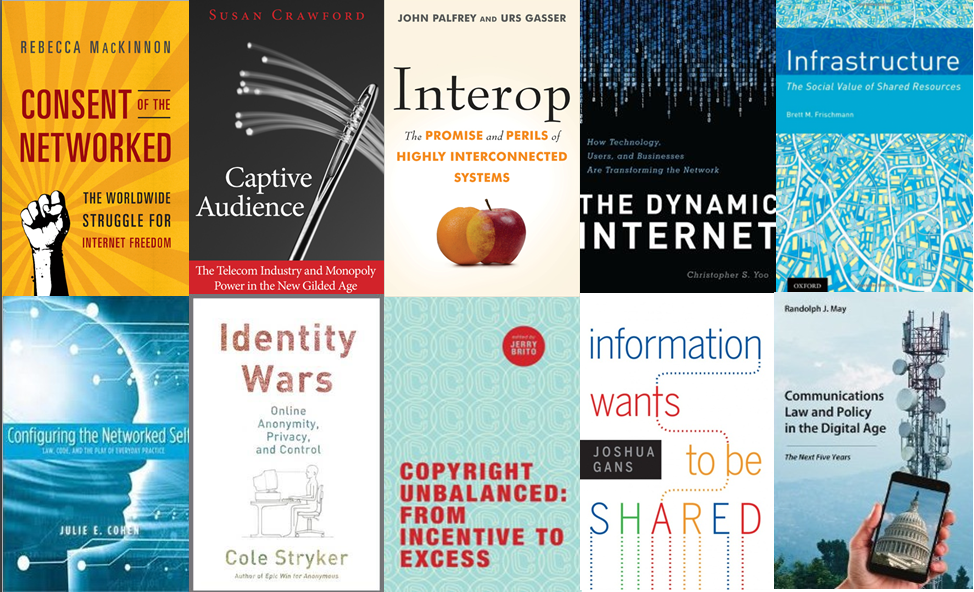
The number of major cyberlaw and information tech policy books being published annually continues to grow at an astonishing pace, so much so that I have lost the ability to read and review all of them. In past years, I put together end-of-year lists of important info-tech policy books (here are the lists for 2008, 2009, 2010, and 2011) and I was fairly confident I had read just about everything of importance that was out there (at least that was available in the U.S.). But last year that became a real struggle for me and this year it became an impossibility. A decade ago, there was merely a trickle of Internet policy books coming out each year. Then the trickle turned into a steady stream. Now it has turned into a flood. Thus, I’ve had to become far more selective about what is on my reading list. (This is also because the volume of journal articles about info-tech policy matters has increased exponentially at the same time.)

So, here’s what I’m going to do. I’m going to discuss what I regard to be the five most important titles of 2012, briefly summarize a half dozen others that I’ve read, and then I’m just going to list the rest of the books out there. I’ve read most of them but I have placed an asterisk next to the ones I haven’t.  Please let me know what titles I have missed so that I can add them to the list. (Incidentally, here’s my compendium of all the major tech policy books from the 2000s and here’s the running list of all my book reviews.)

Continue reading →

When CLECs say “packet mode,” don’t let the doublespeak fool you. They are asking for heavy-handed economic regulation of the Internet itself, just like many countries at the ITU.

Last week, I wrote about the failure of the CLECs to provide consumers with the additional choices in communications services Congress had envisioned in 1996. I noted that, now that the antiquated telephone network is about to sunset, CLECs must bear responsibility for their own decisions to forgo investment in their own infrastructure and rely on lines leased with temporary government subsidies. The desperation of CLECs to avoid this reality is apparent in their use of doublespeak to conceal their true intent: convincing the FCC to regulate the Internet like plain old telephone service. Continue reading →

[Updated 7/10/14: See new addendum at bottom. Updated 4/28/13: Included links to several things + started list of additional resources at end.]

Each year I am contacted by dozens of people who are looking to break into the field of information technology policy as a think tank analyst, a research fellow at an academic institution, or even as an activist. Some of the people who contact me I already know; most of them I don’t. Some are free-marketeers, but a surprising number of them are independent analysts or even activist-minded Lefties. Some of them are students; others are current professionals looking to change fields (usually because they are stuck in boring job that doesn’t let them channel their intellectual energies in a positive way). Some are lawyers; others are economists, and a growing number are computer science or engineering grads. In sum, it’s a crazy assortment of inquiries I get from people, unified only by their shared desire to move into this exciting field of public policy.

I always do my best to answer their emails, calls, and requests for meetings. Unfortunately, there’s only so much time in the day and I am sometimes not able to get back to all of them. I always feel bad about that, so, this essay is an effort to gather my thoughts and advice and put it all one place so that I will at least have something to send these folks. Perhaps I’ll try to update it over time.

#1) Understand that Specialization Matters

I don’t want to bury the lede here, so let me start with the most important piece of advice I share with everyone who contacts me: specialization matters. When I got started in the sleepy field of information technology policy back in 1991, it was possible to be a jack-of-all-trades. There were only a few issues that really mattered, and most of them were tied up with traditional communications and media policy. If you knew a little something about telephony, universal service subsidies, spectrum policy, and broadcast regulation, then you could be an analyst in this field. There were only a handful of people in the think tank world back then who even cared about such issues. Continue reading →

With each passing year, Washington’s appetite for Internet regulation grows. While “Hands Off the Net!” was a popular rallying cry just a decade ago—and was even a shared sentiment among many policymakers—today’s zeitgeist seems to instead be “Hands All Over the Net.” Countless interests and regulatory advocates have pet Internet policy issues they want Washington to address, including copyright, privacy, cybersecurity, online taxation, broadband regulation, among many others.

Rep. Darrell Issa (R-CA) wants to do something to slow down this legislative locomotive. He has proposed the “Internet American Moratorium Act (IAMA), which would impose a two-year moratorium on “any new laws, rules or regulations governing the Internet.” The prohibition would apply to both Congress and the Executive Branch but makes an exception to any rules dealing with national security.

Will Rep. Issa’s proposal make any difference if implemented? Any congressionally imposed legislative moratorium is a symbolic gesture and not a binding constraint since Congress is always free to pass another law later to get around an earlier prohibition. So, in that sense, a moratorium might not change much. Nonetheless, such symbolic gestures are often important and Issa is to be commended for at least trying to raise awareness about the dangers of creeping regulation of online life and the digital economy.

If policymakers really want to take a more substantive step to slow the flow of red tape, they should consider a different approach. Instead of (or, perhaps, in addition to) a two-year legislative moratorium, they should impose a variant of “Moore’s Law” for information technology laws and regulations. “Moore’s Law,” as most of you know, is the principle named after Intel co-founder Gordon E. Moore who first observed that, generally speaking, the processing power of computers doubles roughly every 18 months while prices remain fairly constant.

As I argued in a Forbes column earlier this year, we should apply this same principle to high-tech policy. Continue reading →

In a New York Times op-ed this weekend entitled “You Can’t Say That on the Internet,” Evgeny Morozov, author of The Net Delusion, worries that Silicon Valley is imposing a “deeply conservative” “new prudishness” on modern society. The cause, he says, are “dour, one-dimensional algorithms, the mathematical constructs that automatically determine the limits of what is culturally acceptable.” He proposes that some form of external algorithmic auditing be undertaken to counter this supposed problem. Here’s how he puts it in the conclusion of his essay:

Quaint prudishness, excessive enforcement of copyright, unneeded damage to our reputations: algorithmic gatekeeping is exacting a high toll on our public life. Instead of treating algorithms as a natural, objective reflection of reality, we must take them apart and closely examine each line of code. Can we do it without hurting Silicon Valley’s business model? The world of finance, facing a similar problem, offers a clue. After several disasters caused by algorithmic trading earlier this year, authorities in Hong Kong and Australia drafted proposals to establish regular independent audits of the design, development and modifications of computer systems used in such trades. Why couldn’t auditors do the same to Google? Silicon Valley wouldn’t have to disclose its proprietary algorithms, only share them with the auditors. A drastic measure? Perhaps. But it’s one that is proportional to the growing clout technology companies have in reshaping not only our economy but also our culture.

It should be noted that in a Slate essay this past January, Morozov had also proposed that steps be taken to root out lies, deceptions, and conspiracy theories on the Internet.  Morozov was particularly worried about “denialists of global warming or benefits of vaccination,” but he also wondered how we might deal with 9/11 conspiracy theorists, the anti-Darwinian intelligent design movement, and those that refuse to accept the link between HIV and AIDS.

To deal with that supposed problem, he recommended that Google “come up with a database of disputed claims” or “exercise a heavier curatorial control in presenting search results,” to weed out such things. He suggested that the other option “is to nudge search engines to take more responsibility for their index and exercise a heavier curatorial control in presenting search results for issues” that someone (he never says who) determines to be conspiratorial or anti-scientific in nature.

Taken together, these essays can be viewed as a preliminary sketch of what could become a comprehensive information control apparatus instituted at the code layer of the Internet. Continue reading →