The Tennis Channel and ESPN have teamed up to offer live coverage of the US Open online. Not only is this a wonderful thing for consumers, but it also demonstrates just how easily content creators (including traditional television programming networks) can completely bypass cable companies, who once supposedly used their “bottleneck” power to act as “gatekeepers” over the content Americans could receive. If this was ever true, it certainly isn’t true in the era of Internet video!
The venture will, of course, be ad-supported. But just how much content such a model can support will depend heavily on whether Internet video programming distributors like this venture (or Hulu.com) will be able to personalize the ads shown on their videos based on the likely interests of users. Ad industry observer David Hallerman has predicted that spending on behavioral advertising:
is projected to reach $1.1 billion in 2009 and $4.4 billion in 2012 [a quarter of U.S. display advertising].The prime mover behind this rapid increase will be the mainstream adoption of online video advertising, which will increasingly require targeting to make it cost-effective.
The problem isn’t just the expense involved in streaming online video, it’s that contextually targeting advertising (based on keywords) is easy when the content is text but far more difficult when the content is video.
So if you’re hoping to cut the cord to cable and save the expense of a monthly cable subscription, you’d better hope the privacy zealots don’t wipe out advertising model necessary to make Internet video a true substitute for traditional subscription video sources!
 In a post earlier this week, I discussed Randy Cohen’s “guideline” for anonymous blogging. Specifically, Cohen argued in a recent New York Times piece that, “The effects of anonymous posting have become so baleful that it should be forsworn unless there is a reasonable fear of retribution. By posting openly, we support the conditions in which honest conversation can flourish.” While sympathetic to that guideline, I noted I agreed with it as an ethical principle, not a legal matter. In others words, what might make sense as a “best practice” for the Internet and its users would not make sense as a regulatory standard. I prefer using social norms and public pressure to drive these standards, not regulation that could have an unintended chilling effect on beneficial forms of anonymous online speech.
Dan Gillmor of the Center for Citizen Media of the Harvard Berkman Center has a new column up at the UK Guardian in which he takes a slightly different cut at a new standard or social norm for dealing with some of the more caustic anonymous speech out there:
One of the norms we’d be wise to establish is this: People who don’t stand behind their words deserve, in almost every case, no respect for what they say. In many cases, anonymity is a hiding place that harbours cowardice, not honour. The more we can encourage people to use their real names, the better. But if we try to force this, we’ll create more trouble than we fix. But we don’t want, in the end, to turn everything over to the lawyers. The rest of us — the audience, if you will — need to establish some new norms as well.
Specifically, Gillmor argues that, ” We need to readjust our internal BS meters in a media-saturated age,” because “We are far too prone to accepting what we see and hear.” I think Gillmor has too little faith in most digital denizens; most of us take anonymous comments with a grain of salt and assume that the ugliest of those comments are often untrue. And that’s generally the “principle” he recommends each of us adopt going forward: Continue reading →
 Randy Cohen, who pens “The Ethicist” column for The New York Times Magazine, wrote this week about the “skank case,” or the controversy surrounding the recent legal outing for an anonymous blogger who called fashion model Liskula Cohen a “psychotic, lying, whoring … skank.” Thanks to a recent court decision, we now know that the blogger who uttered those words is Rosemary Port, a 29-year-old Fashion Institute of Technology student. And she now apparently plans to sue Google for revealing her identity to the court. [As a shameful aside, can I just say that there has never been a nerdy Internet legal battle that involved two more smokin’ hot women than this! Sorry, I couldn’t resist pointing out the obvious.]
 Reflecting on this catfight in his NY Times Magazine editorial, “Is It O.K. to Blog About This Woman Anonymously?” Randy Cohen asks:
Has anonymous posting, though generally protected by law, become so toxic that it should be discouraged? It has. To promote the social good of lively conversation and the exchange of ideas, transparency should be the default mode. […]
Here is a guideline. The effects of anonymous posting have become so baleful that it should be forsworn unless there is a reasonable fear of retribution. By posting openly, we support the conditions in which honest conversation can flourish.
But Mr. Cohen never specifies whether he is talking about an
ethical guideline or a legal guideline. There is a world of difference, of course. As a matter of social or personal ethics, I think many of us would agree that anonymity “should be forsworn” and we should encourage people to “post openly.” I always live by that rule myself when blogging or posting comments on other sites, whether they are blogs, discussion boards, or even shopping sites. But that is my choice. I would not want that choice forced by law upon others. Continue reading →
 My friends Anne Collier and Larry Magid, two of America’s leading experts on Internet safety matters, have just released a terrific new “Online Safety 3.0” manifesto. Anne is the editor of Net Family News, Larry pens the “Safe and Secure” blog for CNet News, and together they run ConnectSafely.org. Everything they do is must-reading for those of us who cover and care about the intersection of online child safety and free speech issues. [Disclosure: I am currently serving along with Anne and Larry on the new, government-appointed Online Safety Technology Working Group.]
In their new “Online Safety 3.0” essay, Anne and Larry argue that:
Both the Internet and the way young people use technology are constantly changing, but Internet safety messages change very slowly if at all. A few years ago, some of us in the Net safety community started talking about how to adjust our messaging for the much more interactive “Web 2.0.” And we did so, based on the latest research as it emerged. But even those messages are starting to get a bit stale.
 Their “Version 3.0” for online safety refocuses the discussion on “the positive reasons for safe use of social technology.” They want to”enable[] youth enrichment and empowerment. Its main components — new media literacy and digital citizenship – are both protective and enabling.” They argue that “promoting critical thinking, mindful producing, and the ethics, responsibilities and rights of citizenship” is “empowering because it’s protective. This is protection that lasts a lifetime.” Amen to that.
What I like best about Anne and Larry’s approach is that is fundamentally optimistic. Whereas so many supposed child safety experts talk down to both parents and kids and seem to suggest that both are completely oblivious to the world around them, Anne and Larry have a very different worldview and approach. They are positive about the potential of both parents and kids to take on new challenges and make the best of the new technologies they have at their disposal, even if there are some bumps along the way. The other thing I love about Anne and Larry is that they have done more than any two journalists I know to debunk the “technopanic” hysteria that others in the media world have propagated over the past 15 years.
Anyway, make sure to read their “Online Safety 3.0” manifesto. Best thing I’ve seen on the subject in a long time.
 I recently finished Tyler Cowen’s latest book, Create Your Own Economy: The Path to Prosperity in a Disordered World. Like everything he writes, this book is worth reading and it will be of interest to those who follow technology policy debates since Cowen makes a passionate case for “Internet optimism” in the face of recent criticisms of the Internet and the Information Age in general.
Cowen is a Professor of Economics at George Mason University and the co-author, along with Alex Tabarrok, of the wonderful MarginalRevolution.com blog. And if you haven’t read Cowen’s
In Praise of Commercial Culture, stop what you’re doing and go get yourself a copy right now. Brilliant book. Compared to that book, Create Your Own Economy is a difficult book to summarize. Seriously, this book is all over the place… but in a good way. Even though it sometimes feels like “Tyler’s Miscellaneous Ramblings,” those ramblings will keep you engaged and entertained. Cord Blomquist did a pretty good job of summarizing the general themes of the book in this post two months ago when he noted that, “despite cultural reflexes that would have us do otherwise, we should embrace… new technologies as means to be more selective about what information we absorb and therefore welcome the increased volume of bytes into our lives. In his new book, [Cowen] explores technology as a vehicle to help you determine what you really value, not a series of a email-powered torture devices.” That’s a pretty good summation, but the book is about much more than that.
Instead of a full-blown review, I want to focus on some of passages from Cowen’s book about coping with information overload, which I think readers here might find of interest. In doing so, I will contrast Cowen’s views with those of John Freeman, who just penned “A Manifesto for Slow Communication” in The Wall Street Journal. As we will see, Cowen and Freeman’s differences exemplify the heated ongoing debate taking place among “Internet optimists & pessimists,” which I have discussed here many times before. Continue reading →
I like this new document about guarding your online reputation that has just been jointly published by Reputation Defender and the Internet Keep Safe Coalition (iKeepSafe). They list these “3 Key Tips for Parents” for how to deal with concerns about their children’s online safety, privacy, and reputation:
1. Keep Current with Technology: Talk to teachers about what forms of Internet safety tools they implement in computer labs and technology classes, consider these safety tools for home use, and stay up-to-date on the capabilities of any mobile devices your child may have.
2. Keep Communicating with Your Kids: Find out who your child talks to online, educate your kids about the permanence of any “digital footprints” they leave behind, limit the use of social networks, and make it a habit to engage your kids in critical conversation—the more you talk to your kids about their online usage, the more they will learn to use digital products in a safe and healthy manner.
3. Keep Checking Your Kid’s Internet Activity: Keep computers in a central public location, check your child’s browsing histories, and limit your child’s computer time—there’s a whole world of outdoor and offline activities where they should be involved!
All good advice. I especially like their focus on getting parents to communicate early and often with their kids. It’s something I have beat the drum about quite a bit in my own work on the subject. Continue reading →
On July 27th, The Progress & Freedom Foundation hosted a Capitol Hill panel discussion entitled “Online Child Safety, Privacy, and Free Speech: An Overview of Challenges in Congress & the States.” The event featured remarks from:
- Parry Aftab, Executive Director, WiredSafety.org
- Todd Haiken, Senior Manager of Policy, Common Sense Media
- Jim Halpert, Partner, DLA Piper
- Berin Szoka, Senior Fellow, The Progress & Freedom Foundation
We’ve just released the transcript of the event, which I have also pasted down below the fold in a Scribd document reader. Also, the audio for this event can be heard by clicking below:
Download mp3
Here is the full event description: Continue reading →
 by Adam Thierer & Berin Szoka — (Ver. 1.0 — Summer 2009)
We are attempting to articulate the core principles of cyber-libertarianism to provide the public and policymakers with a better understanding of this alternative vision for ordering the affairs of cyberspace. We invite comments and suggestions regarding how we should refine and build-out this outline. We hope this outline serves as the foundation of a book we eventually want to pen defending what we regard as “Real Internet Freedom.” [Note: Here’s a printer-friendly version, which we also have embedded down below as a Scribd document.]
I. What is Cyber-Libertarianism?
Cyber-libertarianism refers to the belief that individuals—acting in whatever capacity they choose (as citizens, consumers, companies, or collectives)—should be at liberty to pursue their own tastes and interests online.
Generally speaking, the cyber-libertarian’s motto is “Live & Let Live” and “Hands Off the Internet!” The cyber-libertarian aims to minimize the scope of state coercion in solving social and economic problems and looks instead to voluntary solutions and mutual consent-based arrangements.
Cyber-libertarians believe true “Internet freedom” is freedom
from state action; not freedom for the State to reorder our affairs to supposedly make certain people or groups better off or to improve some amorphous “public interest”—an all-to convenient facade behind which unaccountable elites can impose their will on the rest of us.
Continue reading →
What Unites Advocates of Speech Controls & Privacy Regulation? [pdf]
by Adam Thierer & Berin Szoka
The Progress & Freedom Foundation,
Progress on Point No. 16.19
Anyone who has spent time following debates about speech and privacy regulation comes to recognize the striking parallels between these two policy arenas. In this paper we will highlight the common rhetoric, proposals, and tactics that unite these regulatory movements. Moreover, we will argue that, at root, what often animates calls for regulation of both speech and privacy are two remarkably elitist beliefs:
- People are too ignorant (or simply too busy) to be trusted to make wise decisions for themselves (or their children); and/or,
- All or most people share essentially the same values or concerns and, therefore, “community standards” should trump household (or individual) standards.
While our use of the term “elitism” may unduly offend some understandably sensitive to populist demagoguery, our aim here is not to launch a broadside against elitism as
Time magazine culture critic William H. Henry once defined it: “The willingness to assert unyieldingly that one idea, contribution or attainment is better than another.”[1] Rather, our aim here is to critique that elitism which rises to the level of political condescension and legal sanction. We attack not so much the beliefs of some leaders, activists, or intellectuals that they have a better idea of what it in the public’s best interest than the public itself does, but rather the imposition of those beliefs through coercive, top-down mandates.
That sort of elitism—elitism enforced by law—is often the objective of speech and privacy regulatory advocates. Our goal is to identify the common themes that unite these regulatory movements, explain why such political elitism is unwarranted, and make it clear how it threatens individual liberty as well as the future of free and open Internet. As an alternative to this elitist vision, we advocate an empowerment agenda: fostering an environment in which users have the tools and information they need to make decisions for themselves and their families. Continue reading →
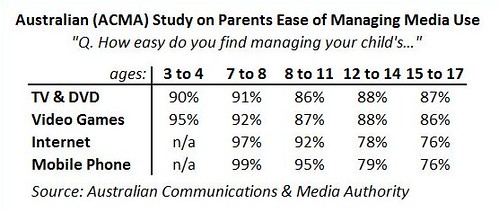
An interesting new survey has just been released by the Australian Communications and Media Authority (ACMA), which is the rough equivalent of the Federal Communications Commission here in the U.S., but with somewhat broader authority. ACMA’a latest report is entitled Use of Electronic Media and Communications: Early Childhood to Teenage Years and it takes a look at media technology usage among Australian youngsters in 5 age groupings (3 to 4 years of age, 7 to 8, 8 to 11, 12 to 14, and 15 to 17).
The survey also asked Australian parents “How easy do you find managing your child’s ___ use.” They asked that question for four different media or communications technologies: TV & DVD; video games; Internet; and mobile devices. They results, summarized in the table below, were quite interesting and seem to indicate that Australian parents find it much easier to manage their children’s media use than some of their elected leaders imagine.
Continue reading →


 The Technology Liberation Front is the tech policy blog dedicated to keeping politicians' hands off the 'net and everything else related to technology.