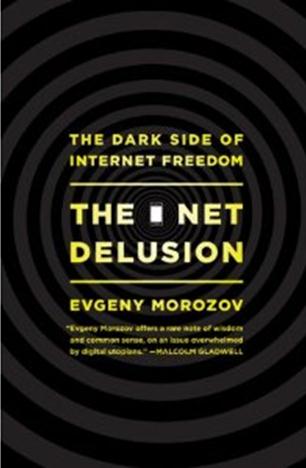
 In his new book, The Net Delusion: The Dark Side of Internet Freedom, Evgeny Morozov aims to prick the bubble of hyper-optimism that surrounds debates about the Internet’s role in advancing human freedom or civic causes. Morozov, a native of Belarus, is a tremendously gifted young cyber-policy scholar affiliated with Stanford University and the New America Foundation. He’s an expert on the interaction of digital technology and democracy and writes frequently on that topic for a variety of respected media outlets.
In
Net Delusion, as with many of his previous columns and essays, Morozov positions himself the ultimate Net “realist,” aiming to bring a dose of realpolitik to discussions about how much of a difference the Net and digital technologies make to advancing democracy and freedom. His depressing answer: Not much. Indeed, Morozov’s book is one big wet blanket on the theory that “technologies of freedom” can help liberate humanity from the yoke of repressive government.
Morozov clearly relishes his skunk at the garden party role, missing few opportunities to belittle those who subscribe to such theories. If you’re one of those who tinted your Twitter avatar green as an expression of solidarity with Iranian “Green Movement” dissidents, Morozov’s view is that, at best, you’re wasting your time and, at worst, you’re aiding and abetting tyrants by engaging in a form of “slacktivism” that has little hope of advancing real regime change. The portrait he paints of technology and democracy is a dismal one in which cyber-utopian ideals of information as liberator are not just rejected but inverted. He regards such “cyber-utopian” dreams as counter-productive, even dangerous, to the advance of democracy and human freedom. Continue reading →
 In my previous post on the FCC’s Open Internet Report and Order, I looked at the weak justification given for the new rules the Commission approved on Dec. 21, 2010
In this post, an aside on the likely costs of the rules, and in particular the costs of enforcement.
Last week was the 100th birthday of Nobel prize-winning economist Ronald Coase, a remarkable man I have had the great fortune to know personally. Among his many contributions to the field, Coase has always advocated for more empirical research and other data collection to help lead the field out of its theoretical quagmire. To that end, Coase co-founded the International Society for New Institutional Economics, and served as its first President in 1996.
Unfortunately, the FCC, which owes a great debt to Coase for his early championing of auctions for radio spectrum, does not seem to have learned much else from his work. In a section optimistically captioned, “The Benefits of Protecting the Internet’s Openness Exceed the Costs” (¶¶ 38-42), the Commission makes no effort to calculate either with any hint of rigor. Wishing away serious economic analysis, the Report simply states that “By comparison to the benefits of these prophylactic measures, the costs associated with the open Internet rules adopted here are likely small.”
Continue reading →
 At the last possible moment before the Christmas holiday, the FCC published its Report and Order on “Preserving the Open Internet,” capping off years of largely content-free “debate” on the subject of whether or not the agency needed to step in to save the Internet.
In the end, only FCC Chairman Julius Genachowski fully supported the final solution. His two Democratic colleagues concurred in the vote (one approved in part and concurred in part), and issued separate opinions indicating their belief that stronger measures and a sounder legal foundation were required to withstand likely court challenges. The two Republican Commissioners vigorously dissented, which is not the norm in this kind of regulatory action. Independent regulatory agencies, like the U.S. Courts of Appeal, strive for and generally achieve consensus in their decisions. Continue reading →
I’m always entertained by the talk among the Twitterati — especially those who seem to permanently reside in the #NetNeutrality and #FCC hashtags — about how the Internet’s “openness” is at risk, and that steps must be taken to preserve it. Regulatory regimes are often birthed by myths, and this one is no different. Contrary to what the regulation-happy worry-warts suggest, the Internet has never been more “open” than it is today. After all, as Geert Lovink reminded us in his 2008 critique of Jonathan Zittrain’s thinking about the decline of online openness:
[In] [t]he first decades[,] the Internet was a closed world, only accessible to (Western) academics and the U.S. military. In order to access the Internet one had to be an academic computer scientist or a physicist. Until the early nineties it was not possible for ordinary citizens, artists, business[es] or activists, in the USA or elsewhere, to obtain an email address and make use of the rudimentary UNIX-based applications. … It was a network of networks—but still a closed one.
And even though it will probably make the folks at Free Press and Public Knowledge have an aneurysm, it’s abundantly clear what shook-up this sleepy, closed model:
commercialization. That’s right, those evil folks who had the audacity to want to make a dollar online were the ones who brought us the “open” Internet we know and love today! Continue reading →
 I really enjoyed this editorial in today’s Wall Street Journal by sci-fi novelist Orson Scott Card, author of Ender’s Game, among many other books. Card engages in some interesting soul searching about the impact of the Net and digital technology on our lives, economy, and culture. He concludes his essay by noting that:
We’re still the same human beings we always were. Consumers still act like consumers; people still search for love and friendship. But the Internet has freed us from the boundaries of distance and many of the risks of embarrassment in social interactions. This re-sorted geography has brought its own pitfalls and forced us to create new rules of etiquette.
But just as I have no desire to give up cars, trains and planes to return to the hay-eating, vet-needing, poop-generating, one-horsepower horse, I don’t want to go back to pre-Google research, pre-Amazon shopping, pre-blog newsmedia, or the loneliness of villages limited by geography.
Quite right. Card is expressing the sort of “pragmatic optimism” I’ve written about here before in my essays about the ongoing battle between Internet optimists and pessimists. I’ve tried to articulate a sort of middle ground position in this debate that embraces the amazing technological changes at work in today’s Information Age but does so with a healthy dose of humility and appreciation for the disruptive impact and pace of that change. As I’ve noted before, we need to think about how to mitigate the negative impacts associated with technological change without adopting the paranoid tone or Luddite-ish recommendations of the pessimists. Read Card’s entire essay to get a better feel for how we can begin to think in that way.
Wow, what a year for cyberlaw and information technology policy books! Both in terms of number of titles and the gravity of the books released, 2010 was one of the biggest years of the past decade (perhaps matched only by 2006 or 2008 in terms of significance). So, here’s my annual list of the Most Important Info-Tech Policy Books of 2010.
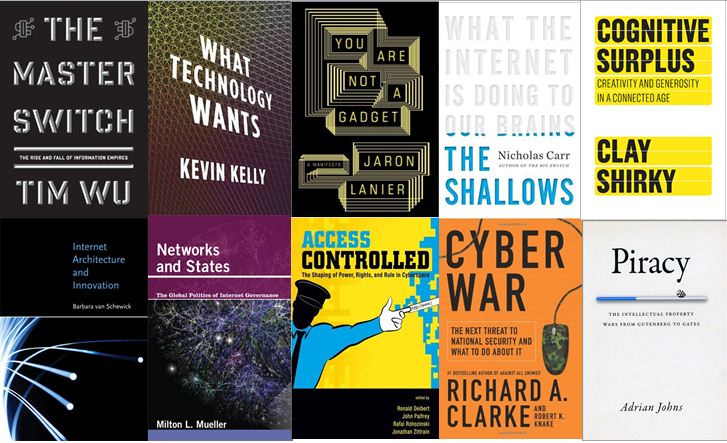 First, however, as is the case each year [see my 2008 & 2009 lists], I need to repeat a few disclaimers. First, what qualifies as an “important” info-tech policy book is highly subjective, but I would define it as a title that many people — especially scholars in the field — are currently discussing and that we will likely be referencing for many years to come. But I “weight” books in the sense that narrowly-focused titles lose a few points. For example, books that deal mostly with privacy issues, copyright law, or antitrust policy do not exactly qualify as the same sort of “info-tech policy book” as other titles that offer a broader exploration of policy issues / concerns. For that reason, “big picture” info-tech policy books tend to rank higher on my lists.
The second caveat: Merely because a book appears on my list
it does not necessarily mean I agree with everything in it. In fact, as was the case in previous years, I found much with which to disagree in my picks for the most important books of 2010 and I find that the cyber-libertarianism I subscribe to has very few fans out there.
With those caveats in mind, here are my choices for the Most Important Info-Tech Policy Books of 2010. Continue reading →
 When the only tool you have is a hammer, as the old cliché goes, everything looks like a nail.
Net neutrality, as I first wrote in 2006, is a complicated issue at the accident-prone intersection of technology and policy. But some of its most determined—one might say desperate—proponents are increasingly anxious to simplify the problem into political slogans with no melody and sound bites with no nutritional value. Even as—perhaps precisely because—a “win-win-win” compromise seems imminent, the rhetorical excess is being amplified. The feedback is deafening.
In one of the most bizarre efforts yet to make everything be about net neutrality, Public Knowledge issued several statements this week “condemning” Fox’s decision to prohibit access to its online programming from Cablevision internet users. In doing so, the organization claims, Fox has committed “the grossest violations of the open Internet committed by a U.S. company.”
This despite the fact that the open Internet rules (pick whatever version you like) apply only to Internet access providers. Indeed, the rules are understood principally as a protection for content providers. You know, like Fox. Continue reading →
In a post here last month on “Two Paradoxes of Privacy Regulation,” I discussed some of the interesting — and to me, troubling — similarities between rising calls for online privacy regulation and ongoing attempts to enact various types of controls on online speech or expression. In that essay, I argued that while most privacy advocates are First Amendment supporters as it pertains to content regulation, they abandon their free speech values and corresponding constitutional tests when it comes to privacy regulation. When the topic of debate shifts from concerns about potentially objectionable content to the free movement of personal information, personal responsibility and self-regulation become the last option, not the first. Privacy advocates typically ignore, downplay, or denigrate user-empowerment tools, even though many of those same advocates endorse “self-help” efforts as the superior method of dealing with objectionable speech or media content. In essence, therefore, they are claiming self-help is the right answer in one context, but not the other. Ironically, therefore, privacy advocates and moral conservatives actually share much in common in that they are using the same playbook to advance their goals: They are rejecting personal responsibility and user-empowerment tools and techniques in favor or government control for their respective issues.
Keeping that insight in mind, I want to take this comparison a step further and suggest that what really unites these two movements is a general conservatism about how our online lives and online business should be governed. For the moral conservatives, that instinct is well-understood. They want hold the line against what they believe is a decaying moral order by restricting access to potentially objectionable speech or content — dirty words, violent video games, online porn, or whatever else. The conservatism of the modern privacy movement is less obvious at first blush. I suspect that many privacy conservatives would not consider themselves “conservative” at all, and they might even be highly offended at being grouped in with moral conservatives who seek to wield government power to control online speech and expression. Nonetheless, the two groups share a common trait —
an innate hostility to the impact of technological / social change within the realm of “rights” or values they care about. In their respective arenas, they both rejected the evolutionary dynamism of the free marketplace and they long for a return to a simpler and supposedly better time. Continue reading →
 My article for CNET News.com this morning analyzes the “leaked” net neutrality bill from Rep. Henry Waxman, chair of the House Energy and Commerce Committee. I put leaked in quotes because so many sources came up with this document yesterday that its escape from the secrecy of the legislative process hardly seems dramatic. Reporters with sources inside Waxman’s office, including The Hill and The Washington Post, expect Waxman to introduce the bill sometime this week.
The CNET article goes through the bill in some detail, and I won’t duplicate the analysis here. It is a relatively short piece of legislation that makes limited changes to Title I of the Communications Act, giving the FCC only the authority it needs to implement “core” regulations that would allow the agency to enforce violations of the open Internet principles. Continue reading →
 I encourage tech policy wonks in Washington to attend next week’s (Oct. 5th) Information Technology and Innovation Foundation event on “A Guide to the Internet Political Landscape,” which will feature the release of Rob Atkinson’s new report, “Who’s Who in Internet Politics: A Taxonomy of Information Technology Policy Perspectives
.” The report identifies nine distinct groupings shaping Internet policy and how these groups view key Internet policy issues, including net neutrality, copyright, and privacy.
I encourage tech policy wonks in Washington to attend next week’s (Oct. 5th) Information Technology and Innovation Foundation event on “A Guide to the Internet Political Landscape,” which will feature the release of Rob Atkinson’s new report, “Who’s Who in Internet Politics: A Taxonomy of Information Technology Policy Perspectives
.” The report identifies nine distinct groupings shaping Internet policy and how these groups view key Internet policy issues, including net neutrality, copyright, and privacy.
Rob is one of my very favorite people in Washington and I always look forward to everything he does–even when I disagree with him! I remember a great debate we had a decade ago when he invited me to critique his paper on “The Failure of Cyber-Libertarianism: The Case for a National E-Commerce Strategy.” And at the end of the debate he conceded that I was correct and he immediately converted to the libertarian movement. No, not really! But it was a hell of a fun time.
I hope for a repeat for some of that fun as Rob was kind enough to ask me to comment on his new “Who’s Who in Internet Politics” paper as next week’s event along with Morgan Reed of the Association for Competitive Technology. Rob asked me to peer review an early draft of the study and I can assure you it will make a splash. Come on over to ITIF next Tuesday, October 5th at 9:30am to hear us discuss it. You can
RSVP here. Location is 1101 K Street NW, Suite 610.


 The Technology Liberation Front is the tech policy blog dedicated to keeping politicians' hands off the 'net and everything else related to technology.