The Mercatus Center at George Mason University has just released my new white paper, “The Perils of Classifying Social Media Platforms as Public Utilities.” [PDF] I first presented a draft of this paper last November at a Michigan State University conference on “The Governance of Social Media.” [Video of my panel here.]
In this paper, I note that to the extent public utility-style regulation has been debated within the Internet policy arena over the past decade, the focus has been almost entirely on the physical layer of the Internet. The question has been whether Internet service providers should be considered “essential facilities” or “natural monopolies” and regulated as public utilities. The debate over “net neutrality” regulation has been animated by such concerns.
While that debate still rages, the rhetoric of public utilities and essential facilities is increasingly creeping into policy discussions about other layers of the Internet, such as the search layer. More recently, there have been rumblings within academic and public policy circles regarding whether social media platforms, especially social networking sites, might also possess public utility characteristics. Presumably, such a classification would entail greater regulation of those sites’ structures and business practices.
Proponents of treating social media platforms as public utilities offer a variety of justifications for regulation. Amorphous “fairness” concerns animate many of these calls, but privacy and reputational concerns are also frequently mentioned as rationales for regulation. Proponents of regulation also sometimes invoke “social utility” or “social commons” arguments in defense of increased government oversight, even though these notions lack clear definition.
Social media platforms do not resemble traditional public utilities, however, and there are good reasons why policymakers should avoid a rush to regulate them as such. Continue reading →
[UPDATE: 2/14/2013: As noted here, this paper was published by the Minnesota Journal of Law, Science & Technology in their Winter 2013 edition. Please refer to that post for more details and cite this final version of the paper going forward.]
I’m pleased to report that the Mercatus Center at George Mason University has just released my huge new white paper, “Technopanics, Threat Inflation, and the Danger of an Information Technology Precautionary Principle.” I’ve been working on this paper for a long time and look forward to finding it a home in a law journal some time soon. Here’s the summary of this 80-page paper:
Fear is an extremely powerful motivating force, especially in public policy debates where it is used in an attempt to sway opinion or bolster the case for action. Often, this action involves preemptive regulation based on false assumptions and evidence. Such fears are frequently on display in the Internet policy arena and take the form of full-blown “technopanic,” or real-world manifestations of this illogical fear. While it’s true that cyberspace has its fair share of troublemakers, there is no evidence that the Internet is leading to greater problems for society.
This paper considers the structure of fear appeal arguments in technology policy debates and then outlines how those arguments can be deconstructed and refuted in both cultural and economic contexts. Several examples of fear appeal arguments are offered with a particular focus on online child safety, digital privacy, and cybersecurity. The various factors contributing to “fear cycles” in these policy areas are documented.
To the extent that these concerns are valid, they are best addressed by ongoing societal learning, experimentation, resiliency, and coping strategies rather than by regulation. If steps must be taken to address these concerns, education and empowerment-based solutions represent superior approaches to dealing with them compared to a precautionary principle approach, which would limit beneficial learning opportunities and retard technological progress.
The complete paper can be found on the Mercatus site here, on SSRN, or on Scribd. I’ve also embedded it below in a Scribd reader. Continue reading →
Over at Forbes I have posted some thoughts on the new privacy framework (Consumer Data Privacy in a Networked World) that the Obama Administration released today. In my essay, “The Problem with Obama’s “Let’s Be More Like Europe” Privacy Plan,” I hammer home the same point I’ve made here before many times: Regulation is not a costless exercise. No matter how well-intentioned regulatory proposals may be, they can often have unforeseen, unintended consequences. This is equally true for privacy controls. I discuss how a new privacy regulatory regime could drive up prices for services that currently are free or inexpensive, limit new digital services and innovations, create barriers to entry for new entrants and entrepreneurs, negatively impact the competitiveness of existing U.S. Internet operators, and, more generally, increase the horizons of government power over the Internet.
For a more detailed analysis of these issues, I encourage you to check out my big Mercatus Center filing to the FTC last year on privacy and Do Not Track regulation. Also, here are few TLF essays that summarize my skepticism about expanded privacy controls:
Friends of Internet freedom, I need your assistance. I think we need to develop a principled, pro-liberty blueprint for Internet policy going forward. Can you help me draw up five solid principles to guide that effort?
No, wait, don’t worry about it… it has has already been done!
As I noted in my latest weekly Forbes column, “Fifteen years ago, the Clinton Administration proposed a paradigm for how cyberspace should be governed that remains the most succinct articulation of a pro-liberty, market-oriented vision for cyberspace ever penned. It recommended that we rely on civil society, contractual negotiations, voluntary agreements, and ongoing marketplace experiments to solve information age problems. In essence, they were recommending a high-tech Hippocratic oath: First, do no harm (to the Internet).”
That was the vision articulated by President Clinton’s chief policy counsel Ira Magaziner, who was in charge of crafting the administration’s Framework for Global Electronic Commerce
in July 1997. I was blown away by the document then and continue to genuflect before it today. Let’s recall the five principles at the heart of this beautiful Framework: Continue reading →
On Forbes yesterday, I posted a detailed analysis of the successful (so far) fight to block quick passage of the Protect-IP Act (PIPA) and the Stop Online Piracy Act (SOPA). (See “Who Really Stopped SOPA, and Why?“) I’m delighted that the article, despite its length, has gotten such positive response.
As regular readers know, I’ve been following these bills closely from the beginning, and made several trips to Capitol Hill to urge lawmakers to think more carefully about some of the more half-baked provisions.
But beyond traditional advocacy–of which there was a great deal–something remarkable happened in the last several months. A new, self-organizing protest movement emerged on the Internet, using social news and social networking tools including Reddit, Tumblr, Facebook and Twitter to stage virtual teach-ins, sit-ins, boycotts, and other protests. Continue reading →
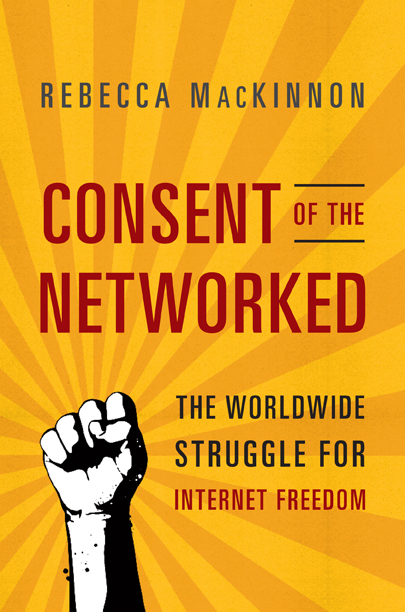 Rebecca MacKinnon’s new book, Consent of the Networked: The Worldwide Struggle for Internet Freedom, is well-researched exploration of the forces driving Internet developments and policy across the globe today. She serves up an outstanding history of recent global protest movements and social revolutions and explores the role that Internet technologies and digital networks played in those efforts. She also surveys some of the recent policy fights here and abroad over issues such as online privacy, Net neutrality regulation, free speech matters, and the copyright wars. The Consent of the Networked is certainly worth reading and will go down as one of the most important Internet policy books of 2012.
A Call to Action
Of course, it’s not just a history lesson. MacKinnon has also issued a call-to-arms here. As a well-known web activist, MacKinnon has emerged as a leading force in the broad-based, if loosely-defined, “Net freedom” movement. The term “Net freedom,” she notes, means very different things to different people. It’s “like a Rorschach inkblot test: different people look at the same ink splotch and see very different things.” (p. 188) Nonetheless, on the global stage, the Internet freedom movement is fundamentally tied up with efforts to hold both governments and corporate actors more accountable for their actions toward the Netizens, digital networks, and online speech and expression. Continue reading →
In the wake of last week’s big SOPA showdown, a lot of people are talking about the expanded presence and power of the Internet, online operators, and digital Netizens in Washington policy debates. I certainly don’t mean to diminish the importance of this particular episode. It certainly is historic, regardless of how you feel about the specifics of SOPA. What does concern me, however, is the way this episode is prompting questions about how much more “engagement” Internet companies need to consider inside the Beltway. For example, today’s Wall Street Journal features an article on “The Web’s Growing Muscle” and notes:
The Internet industry has found a rare sweet spot in Washington. With Google in the lead, the companies have begun building a strong traditional lobbying force in Washington. And, to complement that inside game, websites’ millions of users have become a powerful outside weight on Congress. What’s more, in a rare Washington double play, the concerns of Internet companies have found a sympathetic ear both in the Democratic White House and among Republican presidential candidates who otherwise can’t agree with Barack Obama on anything.
The piece concludes with a quote from an anonymous media executive saying “People are looking at what Google spent on lobbying and wondering, ‘Can we match that?’ It has to be a big spend.”
I cannot possibly think of anything more demoralizing than that. Continue reading →
 After three years of politicking, it now looks like Congress may actually give the FCC authority to conduct incentive auctions for mobile spectrum, and soon. That, at least, is what the FCC seems to think.
At CES last week, FCC Chairman Julius Genachowski largely repeated the speech he has now given three years in a row. But there was a subtle twist this time, one echoed by comments from Wireless Bureau Chief Rick Kaplan at a separate panel.
Instead of simply warning of a spectrum crunch and touting the benefits of the incentive auction idea, the Chairman took aim at a House Republican bill that would authorize the auctions but limit the agency’s “flexibility” in designing and conducting them. “My message on incentive auctions today is simple,” he said, “we need to get it done now, and we need to get it done right.” Continue reading →
 In an provocative oped in today’s New York Times, Vint Cerf, one of the pioneers of the Net who now holds the position “chief Internet evangelist” at Google, makes the argument for why “Internet Access Is Not a Human Right.” He argues:
technology is an enabler of rights, not a right itself. There is a high bar for something to be considered a human right. Loosely put, it must be among the things we as humans need in order to lead healthy, meaningful lives, like freedom from torture or freedom of conscience. It is a mistake to place any particular technology in this exalted category, since over time we will end up valuing the wrong things. For example, at one time if you didn’t have a horse it was hard to make a living. But the important right in that case was the right to make a living, not the right to a horse. Today, if I were granted a right to have a horse, I’m not sure where I would put it.
The best way to characterize human rights is to identify the outcomes that we are trying to ensure. These include critical freedoms like freedom of speech and freedom of access to information — and those are not necessarily bound to any particular technology at any particular time. Indeed, even the United Nations report, which was widely hailed as declaring Internet access a human right, acknowledged that the Internet was valuable as a means to an end, not as an end in itself.
You won’t be surprised to hear that I generally agree. But there are two other issues Cerf fails to address. First, who or what pays the bill for classifying the Internet or broadband as a birthright entitlement? Second, what are the potential downsides for competition and innovation from such a move? Continue reading →
 I’ve written several articles in the last few weeks critical of the dangerously unprincipled turn at the Federal Communications Commission toward a quixotic, political agenda. But as I reflect more broadly on the agency’s behavior over the last few years, I find something deeper and even more disturbing is at work. The agency’s unreconstructed view of communications, embedded deep in the Communications Act and codified in every one of hundreds of color changes on the spectrum map, has become dangerously anachronistic.
The FCC is required by law to see separate communications technologies delivering specific kinds of content over incompatible channels requiring distinct bands of protected spectrum. But that world ceased to exist, and it’s not coming back. It is as if regulators from the Victorian Age were deciding the future of communications in the 21
st century. The FCC is moving from rogue to steampunk.
With the unprecedented release of the staff’s draft report on the AT&T/T-Mobile merger, a turning point seems to have been reached. I wrote on
CNET (see “FCC: Ready for Reform Yet?”) that the clumsy decision to release the draft report without the Commissioners having reviewed or voted on it, for a deal that had been withdrawn, was at the very least ill-timed, coming in the midst of Congressional debate on reforming the agency. Pending bills in the House and Senate, for example, are especially critical of how the agency has recently handled its reports, records, and merger reviews. And each new draft of a spectrum auction bill expresses increased concern about giving the agency “flexibility” to define conditions and terms for the auctions.
The release of the draft report, which edges the independent agency that much closer to doing the unconstitutional bidding not of Congress but the White House, won’t help the agency convince anyone that it can be trusted with any new powers. Let alone the novel authority to hold voluntary incentive auctions to free up underutilized broadcast spectrum.
 Continue reading →

 The Technology Liberation Front is the tech policy blog dedicated to keeping politicians' hands off the 'net and everything else related to technology.