Posts tagged as:

A key point that Berin and I try to get across in our Forbes editorial today about the Yahoo!-Microsoft deal is that the high-tech marketplace evolves too rapidly for creaky Analog Era antitrust laws to keep up. We wanted to say more on that point in our piece, but we had a tight deadline (and a strict word limit!)  Well, turns out that we really don’t need to do so now because Farhad Manjoo of Slate has done a better job than we ever could have making that point in this essay today entitled, “The Case Against the Case Against Google“:

But if the government was right on the facts [in the Microsoft case], it was wrong on the big picture. The theory behind the prosecution was that Microsoft’s mobster tactics would raise the price of software and slow down innovation. But that didn’t happen. In 2002, Microsoft settled the antitrust case with the Bush administration; it faced no substantial penalties for its years of bad behavior. At that point, it still looked unbeatable—it had the same OS monopoly, office-software monopoly, and Web-browser monopoly. And you know what happened? It got beat anyway. Many of Microsoft’s assets turned out not to matter, because upstarts like Google and old foes like Apple found ways to innovate around them.


Continue reading →

We’ve just published an op-ed over at Forbes.com about today’s big Yahoo!-Microsoft deal.


Searching For Success: Web 1.0 Titans Struggle to Reinvent Themselves by Berin Szoka & Adam Thierer

Yahoo! and Microsoft on Wednesday announced a partnership in which Microsoft’s Bing search engine technology will power search for both companies, but Yahoo! will manage advertising sales and content creation.

This should be cause for celebration as a good thing for consumers. By providing a strong competitor with a combined 28% market share, the deal should also be a source of relief at Google, which has come under increasing attack for its supposed market dominance. But if recent concerns about online search, advertising, competition and privacy are any guide, many will fail to appreciate why the deal is pro-consumer, or what it says about the rapid evolution of the Internet.

It’s easy to forget that just a decade ago most of us still hadn’t done our first Google search, Microsoft was still focused on the desktop and Yahoo! was still serving up the online equivalent of the Yellow Pages. AltaVista, AOL, CompuServe and Geocities still ruled the roost.

Today, as we enjoy the fruits of a true cyber-renaissance, cyberspace circa 1999 increasingly looks like the Digital Dark Ages: The old online walled gardens have crumbled, desktop applications have migrated to the cloud and search has redefined our experience of the Web.

Oh, and did we mention just about all of it is “free“? Sounds like exactly the sort of vigorous innovation, expanding consumer choice, falling prices and cut-throat competition that policymakers should want, right?

Alas, regulators seem stuck in the past. European officials in particular seem hell-bent on continuing the antitrust crusade of the ’90s against Microsoft, myopically focused on fading paradigms (desktop operating systems and Web browsers). But instead of narrowly defining high-tech markets based on yesterday’s technologies or market structures, policymakers should embrace the one constant of the Internet economy: dynamic, disruptive and irrepressible change.

Continue reading →

Great piece in Wired by Fred Vogelstein asking “Why Is Obama’s Top Antitrust Cop Gunning for Google?” It paints a pretty good picture of the coming antitrust ordeal that Google is likely to be subjected to by the Obama Administration. And, as usual, I couldn’t agree more with the skepticism that Eric Goldman of Santa Clara University Law School articulates when he notes: “The problem for antitrust in high tech is that the environment changes so rapidly. Someone who looks strong today won’t necessarily be strong tomorrow.”  More importantly, as Vogelstein’s article notes, we’ve been down this path before with less than stellar results when you look at the IBM investigation in the 70s and the Microsoft case from the 90s (a fiasco that is still going on today):

After the government initiated its case against IBM, the company spent two decades scrupulously avoiding even the appearance of impropriety. By the time the suit was dropped in the early 1980s, company lawyers were weighing in on practically every meeting and scrutinizing every innovation, guarding against anything that could be seen as anticompetitive behavior. A decade later, innovation at Big Blue had all but ceased, and it had no choice but to shrink its mainframe business. (It has since reinvented itself as a services company.) Microsoft took the opposite approach. Gates and company were defiant, to the point of stonewalling regulators and refusing to take the charges seriously. “Once we accept even self-imposed regulation, the culture of the company will change in bad ways,” one former Microsoft executive told Wired at the time. “It would crush our competitive spirit.” Gates put it even more directly: “The minute we start worrying too much about antitrust, we become IBM.” Microsoft’s hostility to the very idea of regulation resulted in several avoidable missteps—including remarkably antagonistic deposition testimony from Gates—that ultimately helped the DOJ rally support for its ongoing antitrust suit against the company. Although Microsoft ultimately settled, the public beating appears to have taken a toll on the company, which has been unable to maintain its reputation for innovation and industry leadership.

Read the whole article for all the gory details.  This is going to be the biggest antitrust case of all-time once it is finally launched and I feel confident predicting that it will make many lawyers and consultants very, very rich while doing absolutely nothing to help consumer welfare.  But perhaps those DOJ lawyers can at least get Google to lower the prices for all those services they offer. Oh, wait, they’re all free.  But don’t worry, I’m sure Beltway bureaucrats will do a great job of running something as complex as search algorithms and online advertising markets.  Right.

Well, here we go again. Harvard’s Jonathan Zittrain has penned another gloomy essay about how “freedom is at risk in the cloud” and the future of the Internet is in peril because nefarious digital schemers like Apple, Facebook, and Google are supposedly out to lock you into their services and take away your digital rights.  And so, as I have done here many times before (see 1, 2, 3, 4, 5 + video!), I will offer a response arguing that Jonathan’s cyber-Chicken Little-ism is largely unwarranted.

Zittrain’s latest piece is entitled “Lost in the Cloud” and it appears in today’s New York Times.  It closely tracks the arguments he has set forth in his book The Future of the Internet–And How to Stop It, which I named the most important technology policy book of 2008, but not because I agreed with its central thesis.  Zittrain’s book and his new NYT essay are the ultimate exposition of Lessigite technological pessimism.  I don’t know what they put in the water up at the Berkman Center to make these guys so remarkably cranky and despondent about the future of of the Internet, but starting with Lawrence Lessig’s Code in 1999 and running through to Zittrain’s Future of the Internet we have been forced to endure endless Tales of the Coming Techno-Apocalypse from these guys.  Back in the late 90s, Prof. Lessig warned us that AOL and some other companies would soon take over the new digital frontier since “Left to itself, cyberspace will become a perfect tool of control.”  Ah yes, how was it that we threw off the chains of our techno-oppressors and freed ourselves from that wicked walled garden hell?  Oh yeah, we clicked our mouses and left! And that was pretty much the end of AOL’s “perfect control” fantasies. [See my recent debate with Prof. Lessig over at Cato Unbound for more about this “illusion of perfect control,” as I have labeled it.]

But Zittrain is the equivalent of the St. Peter upon which the Church of Lessigism has been built and, like any good disciple, he’s still vociferously preaching to the unconverted and using fire and brimstone sermons to warn of our impending digital damnation. In fact, he’s taken it to all new extremes. In Future of the Internet, Jonathan argues that we run the risk of seeing the glorious days of the generative, open Net and digital devices give way to more “sterile, tethered devices” and closed networks. The future that he hopes to “stop” is one in which Apple, TiVo, Facebook, and Google — the central villains in his drama — are supposedly ceded too much authority over our daily lives because of a combination of (a) their wicked ways and (b) our ignorant ones.

Continue reading →

Wired Magazine editor Chris Anderson has an important new book out, “Free: The Future of a Radical Price.” He focuses on the economics of free services, building on the excellent analysis of thinkers like Mike Masnick (whose 2007 essay, “The Grand Unified Theory on The Economics of Free,” succinctly sums up the concept).free-chris-anderson

Following up on his book, Anderson has a new op-ed up on CNN.com in which he explores how the emergence of free services in the digital age has raised new challenges for antitrust regulators:

Now Google has Microsoft-like dominance in search and search advertising. What should it not be allowed to do? That question may come to define this era of antitrust law. When [Christine] Varney was confirmed, she withdrew the Bush administration’s report setting relatively conservative standards of antitrust enforcement and declared, “The Antitrust Division will be aggressively pursuing cases where monopolists try to use their dominance in the marketplace to stifle competition and harm consumers…

Varney and her team of economists and lawyers are no doubt tangling with the question of how to enforce antitrust laws in a way that ensures an “even” playing field for competition without causing consumers to lose access to free services that are growing more abundant by the day.

But there’s a more important question that Varney should be asking: what actually constitutes market dominance in the age of free? Is the fact that a firm has a substantial share of a distinct marketplace a reliable indicator of dominance? And if the result of firms achieving high market share is an explosion of free goods and services, is it even in consumers’ interests for government to go after “dominant” firms?

Continue reading →

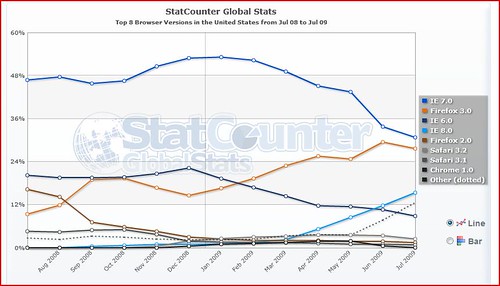
Really, what would we do without European antitrust regulators protecting us from the evils of browser innovation? If Microsoft was allowed to actually bundle its Internet Explorer browser alongside its operating system we might actually do something really crazy… like perhaps try it! After all, the latest browser stats make it pretty clear most of us have a choice and that fewer and fewer of us rely on IE. As Erick Schonfeld noted on Tech Crunch today:

The new browser wars on on. More than a decade after Microsoft killed off Netscape with Internet Explorer, competition in the browser market has never been stronger. Just last week, Mozilla released Firefox 3.5, which has now been downloaded nearly 14 million times. Earlier in June, Apple released Safari 4. In March, Microsoft introduced Internet Explorer 8, and Google came out with a speedier beta of its Chrome browser. Some early data is coming in showing relative market share and how fast people are upgrading. If you look at the chart above from Statcounter, it indicates that since March Internet Explorer has lost 11.4 percent market share to other browsers. [..] Where did that go? It went to Firefox, Safari, and Chrome. Nearly 5 percent of that, or about half, went to Firefox 3.0, which currently has 27.6 percent market share. That doesn’t count last week’s upgrade.

08-09 browser stats

Alas, as I pointed out in my essay a few weeks ago (“European Regulators Think Consumers Too Stupid to Know How to Download a Different Browser“), some Euro-crats still seem to believe that changing browsers requires great detective skills to unearth alternatives.  It’s just pure poppycock and yet another sad example of how antitrust law is usually hopelessly behind the times and has absolutely nothing to do with protecting consumers or fostering innovation.

Now, please excuse me while I get back to surfing the Net via Firefox and Chrome (and Opera on my mobile phone). My God, how did I ever find these browser alternatives!

Fred Vogelstein’s essay in Wired, “Great Wall of Facebook: The Social Network’s Plan to Dominate the Internet — and Keep Google Out” describes the intensifying clash between Google and Facebook—a clash that focuses on the ability to target advertising:

Like typical trash-talking youngsters, Facebook sources argue that their competition is old and out of touch. “Google is not representative of the future of technology in any way,” one Facebook veteran says. “Facebook is an advanced communications network enabling myriad communication forms. It almost doesn’t make sense to compare them.”

Apart from noting that Facebook directs users to Microsoft’s Bing as its default search engine for the Internet at large, the most interesting part of the article is Facebook’s “4-Step Plan for Online Domination”:

1. Build critical mass. In the eight months ending in April, Facebook has doubled in size to 200 million members, who contribute 4 billion pieces of info, 850 million photos, and 8 million videos every month. The result: a second Internet, one that includes users’ most personal data and resides entirely on Facebook’s servers. 2. Redefine search. Facebook thinks its members will turn to their friends—rather than Google’s algorithms—to navigate the Web. It already drives an eyebrow-raising amount of traffic to outside sites, and that will only increase once Facebook Search allows users to easily explore one another’s feeds. 3. Colonize the Web. Thanks to a pair of new initiatives—dubbed Facebook Connect and Open Stream—users don’t have to log in to Facebook to communicate with their friends. Now they can access their network from any of 10,000 partner sites or apps, contributing even more valuable data to Facebook’s servers every time they do it. 4. Sell targeted ads, everywhere. Facebook hopes to one day sell advertising across all of its partner sites and apps, not just on its own site. The company will be able to draw on the immense volume of personal data it owns to create extremely targeted messages. The challenge: not freaking out its users in the process.

Facebook can’t keep losing money forever.  Indeed, investors are willing to keep sinking money into Facebook during Phases 1-3 because they think it will pay off in Phase 4—when Facebook really threatens to be a fGoogle-killer.  But rather the fact that investors are willing to subsidize the creation of a wonderful platform now used by 200 million people (one fifth of all Internet users worldwide), or that Facebook might finally provide a counter-weight to the fearsome Google, the People for the Ethical Treatment of Data (PETD) are appalled.  One commenter on the Wired story put it best: Continue reading →

chris soghoianIn episode #44 of “Tech Policy Weekly,” Berin Szoka and Adam Thierer engage in a debate with Internet security expert Chris Soghoian, who is a student fellow at the Berkman Center for Internet & Society at Harvard University. He is also a Ph.D. candidate at Indiana University’s School of Informatics.

Chris is an up-and-coming star in the field of cyberlaw and technology policy as he has quickly made a name for himself in debates over privacy policy, data security, and government surveillance.  He straddles the line between academic and activist, and the role he often plays in many tech policy debates is somewhat akin to what Ralph Nader has done in many other fields through the years. Except, in this case, instead of “Unsafe at Any Speed” it’s more like “Unsafe at Any Setting,” since Chris is often raising a stink about what he regards as unjust or unreasonable privacy or security settings that various online websites or service providers use.

On the show, Chris talks about two of his recent crusades to get certain online providers to change their default settings to improve user security or privacy: (1) His effort this week to get major email providers—and Google in particular—to change their default security settings on their email offerings; and (2) his earlier crusade to create permanent opt-out cookies to stop behavioral advertising by advertising networks.

There are several ways to listen to today’s TLF Podcast. You can press play on the player below to listen right now, or download the MP3 file. You can also subscribe to the podcast by clicking on the button for your preferred service. (And do us a favor, Digg this podcast!)

[display_podcast]

Continue reading →

by Berin Szoka & Adam Thierer

This morning, the House Energy & Commerce Committee will hold a hearing on “Behavioral Advertising: Industry Practices And Consumers’ Expectations.” If nothing else, it promises to be quite entertaining:  With full-time Google bashers Jeff Chester and Scott Cleland on the agenda, the likelihood that top Google officials will be burned in effigy appears high!

Chester, self-appointed spokesman for what one might call the People for the Ethical Treatment of Data (PETD) movement, is sure to rant and rave about the impending techno-apocalypse that will, like all his other Chicken-Little scenarios, befall us all if online advertisers were permitted to better tailor ads to consumers’ liking. After all, can you imagine the nightmare of less annoying ads that might actually convey more useful information to consumers? Isn’t serving up “untargeted” dumb banner ads for Viagra to young women and Victoria’s Secret ads to Catholic school kids the pinnacle of modern online advertising?  Gods forbid we actually make advertising more relevant and interest-based!  (Those Catholic school boys may appreciate the lingerie ads, but few will likely buy bras.)

Anyway, according to National Journal’s Tech Daily Dose, the hearing lineup also includes:

  • Charles Curran, Executive Director, Network Advertising Initiative
  • Christopher Kelly, Chief Privacy Officer, Facebook
  • Edward Felten, Director, Center for IT Policy, Princeton University
  • Anne Toth, Chief Privacy Officer & Vice President, Policy, Yahoo!
  • Nicole Wong, Deputy General Counsel, Google

That’s an interesting group and we’re sure that they will say interesting things about the issue. Nonetheless, because four of them have a corporate affiliation that fact will inevitably be used by some critics to dismiss what they have to say about the sensibility of more targeted or interest-based forms of online advertising. So, we’d like to offer a few thoughts and pose a few questions to make sure that Committee members understand why, regardless of what it means for any particular online operator, targeting online advertising is very pro-consumer and essential to the future of online content, culture, and competition.  As Wall Street Journal technology columnist Walt Mossberg has noted, “Advertising is the mother’s milk of all the mass media.”  Much of the “free speech” we all cherish isn’t really free, but ad-supported!

Continue reading →