The debate over the imposition of sales tax collection obligations on interstate vendors is heating up again at the federal level with the introduction of S. 1452, “The Main Street Fairness Act.” [pdf] The measure would give congressional blessing to a multistate compact that would let states impose sales taxes on interstate commerce, something usually blocked by the Commerce Clause of the U.S. Constitution. Senator Dick Durbin (D-IL) introduced the bill in the Senate along with Tim Johnson (D-SD) and Jack Reed (D-RI). The measure is being sponsored in the House of Representatives by John Conyers (D-MI) and Peter Welch (D-VT). At this time, there are no Republican co-sponsors even though Sen. Mike Enzi was rumored to be a considered co-sponsoring the measure before introduction.
Without any Republicans on board the effort, the measure may not advance very far in Congress. Nonetheless, to the extent the measure gets any traction, it is worth itemizing a few of the problems with this approach. My Mercatus Center colleague Veronique de Rugy and I have done some work on this issue together in the past and we are planning a short new paper on the topic. It will build on this lengthy Cato Institute paper we authored together in 2003, “The Internet Tax Solution: Tax Competition, Not Tax Collusion.” The key principle we set forth was this: “Congress must.. take an affirmative stand against efforts by state and local governments to create a collusive multistate tax compact to tax interstate sales.” “It would be wrong,” we argued, “for members of Congress to abdicate their responsibility to safeguard the national marketplace by giving the states carte blanche to tax interstate commercial activities through a tax compact. The guiding ethic of this debate must remain tax competition, not tax collusion.” Continue reading →
Two data points in the news over the past 24 hours to consider:
- A new report on “Smartphone Adoption & Usage” by the Pew Internet Project finds that “one third of American adults – 35% – own smartphones” and that of that group “some 87% of smartphone owners access the Internet or email on their handheld” and “25% of smartphone owners say that they mostly go online using their phone, rather than with a computer.”
- According to the Wall Street Journal, the “Average iPhone Owner Will Download 83 Apps This Year.” That’s up from an average of 51 apps downloaded in 2010. (At first I was astonished when I read that, but then realized that I’ve probably downloaded an equal number of apps myself, albeit on an Android-based device.)
As I explain in my latest
Forbes column, facts like these help us understand “How iPhones And Androids Ushered In A Smartphone Pricing Revolution.” That is, major wireless carriers are in the process of migrating from flat-rate, “all-you-can-eat” wireless data plans to usage-based plans. The reason is simple economics: data demand is exploding faster than data supply can keep up.
“It’s been four years since the introduction of the iPhone and rival devices that run Google’s Android software,” notes Cecilia Kang of The Washington Post. “In that time, the devices have turned much of America into an always-on, Internet-on-the-go society.” Indeed, but it’s not just the iPhone and Android smartphones. It’s all those tablets that have just come online over the past year, too. We are witnessing a tectonic shift in how humans consume media and information, and we are witnessing this revolution unfold over a very short time frame. Continue reading →
My latest Forbes column notes how “Taxes On Talking Are On the Rise Across the U.S.” with levies on mobile phones and devices skyrocketing. I build my argument around data and arguments found in Dan Rothschild’s excellent recent Mercatus Center paper, which makes “The Case Against Taxing Cell Phone Subscribers,” as well as an important recent study by Scott Mackey, an economist and partner at KSE Partners LLP, which documents the growing burden of these wireless taxes and fees.
“Wireless users now face a combined federal, state, and local tax and fee burden of 16.3%, a rate two times higher than the average retail sales tax rate and the highest wireless rate since 2005,” Mackey finds. Mobile tax rates range from a high of 23.7% in Nebraska to a low of 6.9% in Oregon. 48 states have an average combined wireless tax rate above 11%. These burdensome taxes on talking just don’t make any sense, argues Rothschild. “There is no economic justification for these high tax rates: reducing cell phone ownership is not a public policy goal, cell phone use by one customer does not affect other customers or other people, and these taxes fall disproportionately on lower-income households.”
You can read my entire essay here, but also make sure to re-read Dan Rothschild’s guest post here at the TLF on the issue. It’s much better than my own treatment. For me, the key point is this: If the primary policy goal in this arena is to build out a first-class communications and data infrastructure and make sure all Americans have access to it, discriminatory taxes on wireless services and networks are highly counter-productive. Policymakers should hang up on the Talking Tax.
My latest Forbes column is a celebration of 47 U.S.C. §230, otherwise known as “Section 230.” Sec. 230 turns 15 years old this year and I argue that this important law has “helped foster the abundance of informational riches that lies at our fingertips today” and has served as “the foundation of our Internet freedoms.” Sadly, however, few people have even heard of it. Worse yet, as I note in my essay, this important law is under attack from various academics and organizations who want it modified to address a variety of online problems. But, as I note:
If the threat of punishing liability is increased, the chilling effect on the free exchange of views and information would likely be quite profound. Many site administrators would immediately start removing massive amounts of content to avoid liability. More simply, they might just shut down any interactive features on their sites or limit service in other ways.
Head over to
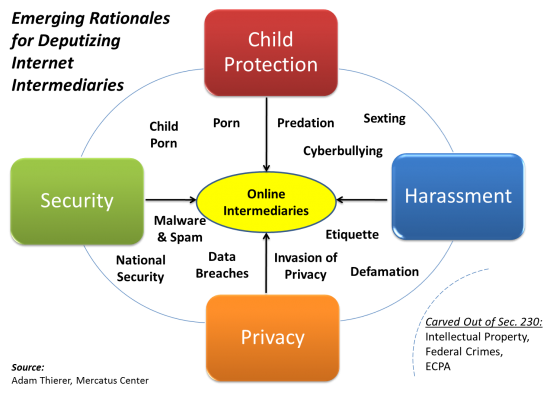
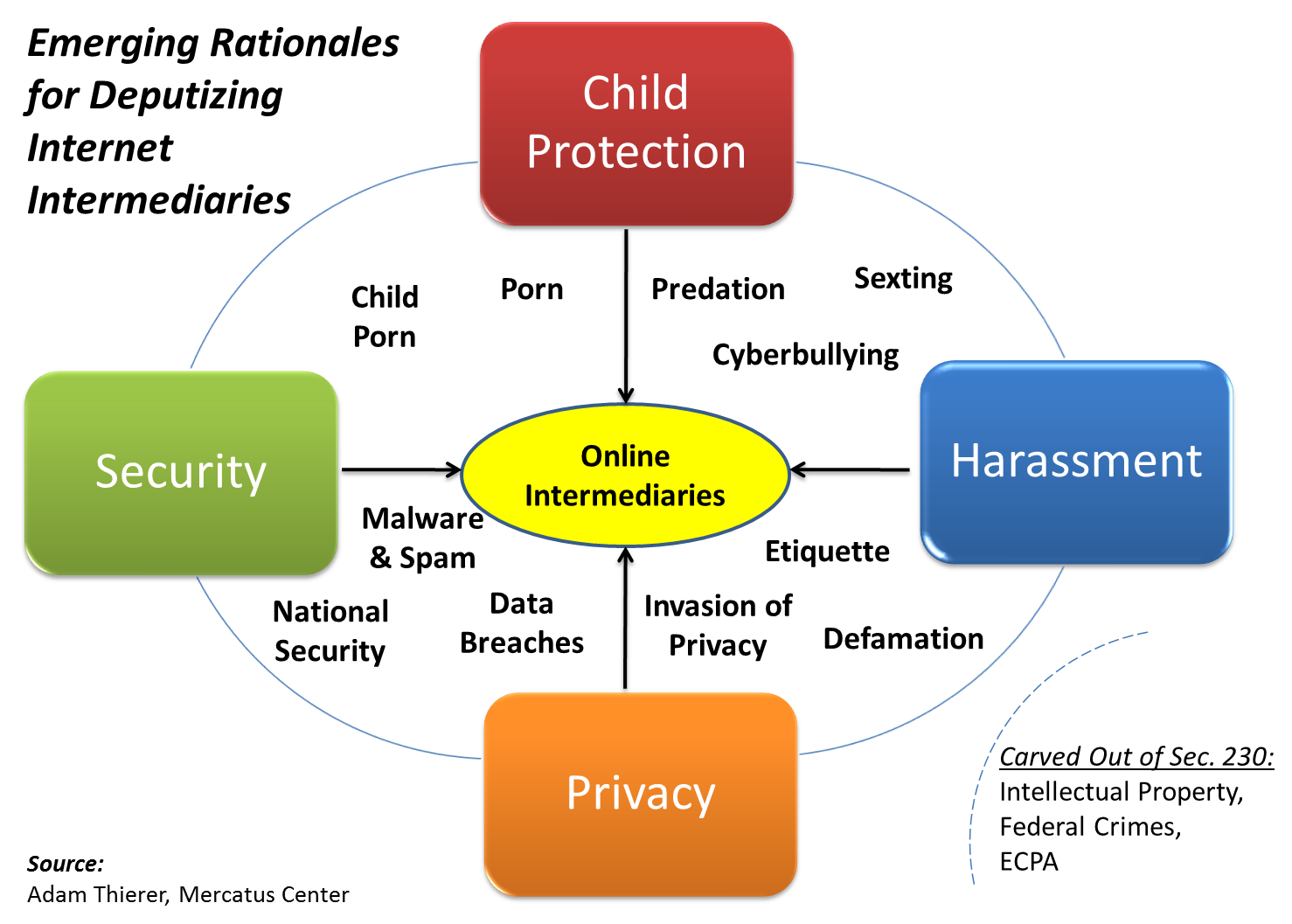
Forbes to read the rest. And here’s a graphic I put together illustrating all the new fault lines in the war against Sec. 230. It will be included in a new paper on the issue that I am wrapping up right now.
Reps. Edward Markey (D-Mass.) and Joe Barton (R-Texas) have released a discussion draft of their forthcoming “Do Not Track Kids Act of 2011.” I’ve only had a chance to give it a quick read, but the bill, which is intended to help safeguard kids’ privacy online, has two major regulatory provisions of interest:
(1) New regulations aimed at limiting data collection about children and teens, including (a)
expansion of the Children’s Online Privacy Protection Act (COPPA) of 1998, which would build upon COPPA’s “verifiable parental consent” model; and (b) a new “Digital Marketing Bill of Rights for Teens;” and (c) limits on collection of geolocation information about both children and teens.
(2)
An Internet “Eraser Button” for Kids to help kids wipe out embarrassing facts they have place online but later come to regret. Specifically, the bill would require online operators “to the extent technologically feasible, to implement mechanisms that permit users of the website, service, or application of the operator to erase or otherwise eliminate content that is publicly available through the website, service, or application and contains or displays personal information of children or minors.” This is loosely modeled on a similar idea currently being considered in the European Union, a so-called “right to be forgotten” online.
Both of these proposals were originally floated by the child safety group Common Sense Media (CSM) in a report released last December. It’s understandable why some policymakers and child safety advocates like CSM would favor such steps. They fear that there is simply too much information about kids online today or that kids are voluntarily placing far too much personal information online that could come back to haunt them in the future. These are valid concerns, but there are both practical and principled reasons to be worried about the regulatory approach embodied in the Markey-Barton “Do Not Track Kids Act”: Continue reading →
I spaced out and completely forget to post a link here to my latest Forbes column which came out over the weekend. It’s a look at back at last week’s hullabaloo over “Apple, The iPhone, and a Locational Privacy Techno-Panic.” In it, I argue:
Some of the concerns raised about the retention of locational data are valid. But panic, prohibition and a “privacy precautionary principle” that would preemptively block technological innovation until government regulators give their blessings are not valid answers to these concerns. The struggle to conceptualize and protect privacy rights should be an evolutionary and experimental process, not one micro-managed at every turn by regulation.
I conclude the piece by noting that:
Public pressure and market norms also encourage companies to correct bone-headed mistakes like the locational info retained by Apple. But we shouldn’t expect less data collection or less “tracking” any time soon. Information powers the digital economy, and we must learn to assimilate new technology into our lives.
Read the rest here. And if you missed essay Larry Downes posted here on the same subject last week, make sure to check it out.
 In my latest “Technologies of Freedom” column for Forbes, I take a closer look at the idea of an “Internet eraser button” as one method of protecting privacy or safeguarding reputation online. The child safety group Common Sense Media has suggested it is needed to help kids and others wipe out embarrassing facts we’ve place online but later come to regret. The Eraser Button idea is similar to “the right to be forgotten” proposal currently being hotly debated in Europe.
In my column, I argue that “it is unlikely that such a mechanism could be implemented, and even if it could, it would have troubling ramifications for freedom of speech, digital commerce, and Internet governance more generally.” I dwell a bit on the free speech issues and note that “What we are talking about here is the destruction of history, otherwise known as censorship. Few would have suggested that burning books was a smart way to protect privacy in the past. Is burning binary bits of information any wiser?” But the point seems moot in light of the significant enforcement challenges the notion faces, including the question: Who actually owns the data collected by online sites and services?
Anyway, read the rest of the essay over at Forbes. And here are a few other pieces we’ve run here at the TLF on the issue: 1, 2, 3.
 I’m very excited to announce that I now have a regular Forbes column that will fly under the banner, “Technologies of Freedom.” My first essay for them is already live and it addresses a topic I’ve dealt with here extensively through the years: Irrational fears about tech monopolies and “information empires.” Jump over to Forbes to read the whole thing.
Regular readers of this blog will understand why I chose “Technologies of Freedom” as the title for my column, but I thought it was worth reiterating. No book has had a more formative impact on my thinking about technology policy than Ithiel de Sola Pool’s 1983 masterpiece,
Technologies of Freedom: On Free Speech in an Electronic Age. As I noted in my short Amazon.com review, Pool’s technological tour de force is simply breathtaking in its polemical power and predictive capabilities. Reading this book almost three decades after it was published, one comes to believe that Pool must have possessed a crystal ball or had a Nostradamus-like ability to foresee the future.
For example, long before anyone else had envisioned what we now refer to as “cyberspace,” Pool was describing it in this book. “Networked computers will be the printing presses of the twenty-first century,” he argued in his remarkably prescient chapter on electronic publishing. “Soon most published information will disseminated electronically,” and “there will be networks on networks on networks,” he predicted. “A panoply of electronic devices puts at everyone’s hands capacities far beyond anything that the printing press could offer.” Few probably believed his prophecies in 1983, but no one doubts him now! Continue reading →
Writing over at Forbes, Bret Swanson notes that the progression of information technology history isn’t going so well for those Net pessimists who, not so long ago, predicted that the sky was set to fall on consumers and that digital innovation was dying. Specifically, Swanson addresses the theories set forth by cyberlaw professors Lessig, Zittrain, and Wu (among others), whose theories about “perfect control,” the death of “generativity,” and the rise of the “master switch,” I have addressed here many time before. [See this compendium of TLF essays discussing “Problems with the Lessig-Zittrain-Wu Thesis.”] Swanson summarizes what went wrong with their gloomy Chicken Little theories and their predictions of the coming cyber end-times:
As the cloud wars roar, the cyber lawyers simmer. This wasn’t how it was supposed to be. The technology law triad of Harvard’s Lawrence Lessig and Jonathan Zittrain and Columbia’s Tim Wu had a vision. They saw an arts and crafts commune of cyber-togetherness. Homemade Web pages with flashing sirens and tacky text were more authentic. “Generativity” was Zittrain’s watchword, a vague aesthetic whose only definition came from its opposition to the ominous “perfect control” imposed by corporations dictating “code” and throwing the “master switch.”
In their straw world of “open” heros and “closed” monsters, AOL’s “walled garden” of the 1990s was the first sign of trouble. Microsoft was an obvious villain. The broadband service providers were
of course dangerous gatekeepers, the iPhone was too sleek and integrated, and now even Facebook threatens their ideal of uncurated chaos. These were just a few of the many companies that were supposed to kill the Internet. The triad’s perfect world would be mostly broke organic farmers and struggling artists. Instead, we got Apple’s beautifully beveled apps and Google’s intergalactic ubiquity. Worst of all, the Web started making money.
Swanson goes on to argue that, despite all the hang-wringing we’re heard from this triumvirate and their many, many disciples in the academic and regulatory activist world, things just keep getting more innovative, more generative, and yes, even more “open.” Continue reading →
Forbes.com has just published an editorial that Berin Szoka and I penned about yesterday’s net neutrality announcement from the FCC.
by Adam Thierer & Berin Szoka
There was a time, not so long ago, when the term “Internet Freedom” actually meant what it implied: a cyberspace free from over-zealous legislators and bureaucrats. For a few brief, beautiful moments in the Internet’s history (from the mid-90s to the early 2000s), a majority of Netizens and cyber-policy pundits alike all rallied around the flag of “Hands Off the Net!” From censorship efforts, encryption controls, online taxes, privacy mandates and infrastructure regulations, there was a general consensus as to how much authority government should have over cyber-life and our cyber-liberties. Simply put, there was a “presumption of liberty” in all cyber-matters.
Those days are now gone; the presumption of online liberty is giving way to a presumption of regulation. A massive assault on real Internet freedom has been gathering steam for years and has finally come to a head. Ironically, victory for those who carry the banner of “Internet Freedom” would mean nothing less than the death of that freedom.
We refer to the gradual but certain movement to have the federal government impose “neutrality” regulation for all Internet actors and activities—and in particular, to yesterday’s announcement by Federal Communications Commission (FCC) Chairman Julius Genachowski that new rules will be floated shortly. “But wait,” you say, “You’re mixing things up! All that’s being talked about right now is the application of ‘simple net neutrality,’ regulations for the infrastructure layer of the net.” You might even claim regulations are not really regulation but pro-freedom principles to keep the net “free and open.”
Such thinking is terribly short-sighted. Here is the reality: Because of the steps being taken in Washington right now, real Internet Freedom—for all Internet operators and consumers, and for economic and speech rights alike—is about to start dying a death by a thousand regulatory cuts. Policymakers and activists groups are ramping up the FCC’s regulatory machine for a massive assault on cyber-liberty. This assault rests on the supposed superiority of common carriage regulation and “public interest” mandates over not just free markets and property rights, but over general individual liberties and freedom of speech in particular. Stated differently, cyber-collectivism is back in vogue—and it’s coming very soon to a computer near you! Continue reading →


 The Technology Liberation Front is the tech policy blog dedicated to keeping politicians' hands off the 'net and everything else related to technology.