 Today, PFF has released my latest book: Parental Controls and Online Child Protection: A Survey of Tools and Methods. The entire publication is online and can be downloaded at http://www.pff.org/parentalcontrols (Note: I will be making constant updates to the book in coming months and will post them to that site).
As the title implies, the report provides a broad survey of everything on the market today that can help parents better manage media content, whether it be broadcast television, cable or satellite TV, music devices, mobile phones, video game consoles, the Internet, or social networking websites. I put this report together to show policymakers, the press and the public that many constructive options exist that can help parents control media in their homes and in the lives of their children.
While it can be a formidable challenge to be a parent in an “always-on,” interactive, multimedia world, luckily, there has never been a time in our nation’s history when parents have had more tools and methods at their disposal to help them determine and enforce what is acceptable in their homes and in the lives of their children. And that conclusion is equally applicable to all major media platforms. In the past, the OFF button was the only technical control at a parent’s disposal. Today, by contrast, parents (like me!) have myriad tools and methods to restrict or tailor media content to their own household tastes and values. Those restrictive tools include: the V-Chip and TV ratings; cable and satellite set-top box screening tools; DVD blocking controls; cell phone blocking tools; video game console controls; Internet filtering and monitoring tools, instant messaging monitoring tools; operating system controls; web browser controls; search engine “safe search” tools; media time management devices, and so on. You will find an exhaustive discussion of all these tools and many others in my book.
Continue reading →
Legislation is expected to be introduced in Congress very soon that would regulate television programming deemed to be “excessively violent.” This follows the release of the FCC’s recent report calling on Congress to act and to give the agency the power to regulate such programming on broadcast television and potentially even cable and satellite TV.
In response to these proposals, I wanted to draw your attention to an event that I will be hosting this week as well as a new study (and a few old ones) that PFF has published on this issue:
(1) EVENT THIS FRIDAY: PFF will be hosting a congressional seminar this Friday, May 18 from Noon-1:30 on “The Complexities of Regulating TV Violence.” The event will take place in Rayburn House Office Building , Room B354. Panelists will include:
-
Henry Geller, Former General Counsel, Federal Communications Commission
-
Robin Bronk, Executive Director, The Creative Coalition
-
Robert Corn-Revere, Partner, Davis Wright Tremaine LLP
-
Jonathan L. Freedman, Professor of Psychology, University of Toronto and Author, Media Violence and its Effect on Aggression
If you are interested in attending this free seminar, please RSVP here: http://www.pff.org/events/upcomingevents/051807complexitytvviolence.asp
(2) NEW STUDY: PFF has just released a new study, “The Right Way to Regulate Violent TV,” which outlines the many ways parents have to deal with potentially objectionable media content, including violent programming. The 23-page study highlights the many technical and non-technical parental control tools and methods that families can use to tailor video programming to their own needs and values. In the report, I argue that:
Continue reading →
In late March, I hosted a congressional seminar entitled “Age Verification for Social Networking Sites: Is It Possible? And Desirable?” I brought together 5 experts in the field to debate the issue, including:
- John Cardillo, President & CEO, Sentinel
- Jay Chaudhuri, Special Counsel to North Carolina Attorney General Roy Cooper
- Raye Croghan, Vice President, IDology, Inc.
- Tim Lordan, Executive Director, Internet Education Foundation
- Jeff Schmidt, CEO, Authis
It was an outstanding discussion and I’m happy to report that the transcript is now available online here. Also, you can listen to the audio from the event here. Also, you can find the big study of mine that we discussed that day here.
http://documents.scribd.com/ScribdViewer.swf?document_id=2887394&access_key=key-18jii1mp0o9wovvaijjs&page=&version=1&auto_size=true
Jennifer Medina of the New York Times penned an article yesterday on the debate over social networking fears leading to calls for age verification mandates. She noted that measures are moving in several states that would require social networking sites to age-verify users before they are allowed to visit the sites or create profiles there. But Medina also noted that there are many difficult questions about how age verification would work and how “social networking” would even be defined. (I summarize these questions in my recent PFF report, “Social Networking and Age Verification: Many Hard Questions; No Easy Solutions.”)
Ms. Medina was also kind enough to interview me for the story and she summarizes some of what I had to say in her piece. In a nutshell, I stressed that the most effective way to deal with this problem is to get serious about dealing with sex offenders instead of trying to regulate law-abiding citizens. We need to be locking up convicted sex offenders for a lot longer in this country to make sure they behind bars instead of behind keyboards seeking to prey on our children.
I also stressed the importance of online safety education as part of the strategy here. But my comments on that didn’t make the cut in the story. But you can read my big recent paper on this issue for additional details.
Some lawmakers at the federal, state and local level have advocated video game industry regulation in the name of protecting children from potentially objectionable content, usually of a violent nature. In my opinion, the better approach–and one that doesn’t involve government censorship or regulation of games–is to empower parents to better make these decisions for their own families. And the key to that effort is an effective rating / labeling system for game content that parents understand and use.
Luckily, there are good signs that the video game industry’s voluntary ratings system–the ESRB (the Entertainment Software Rating Board)–is doing exactly that. The game industry established the ESRB in 1994 and it has rated thousands of games since then. (The ESRB estimates it rates over 1,000 games per year). Virtually every title produced by major game developers for retail sale today carries an ESRB rating and content descriptors. Generally speaking, the only games that do not carry ESRB ratings today are those developed by web amateurs that are freely traded or downloaded via the Internet.
The ESRB applies seven different rating symbols and over 30 different content “descriptors” that it uses to give consumers highly detailed information about games. Thus, by simply glancing at the back of each game container, parents can quickly gauge the appropriateness of the title for their children.
So, how effective is this system, as measured by parental awareness and usage of the ESRB ratings and labels? Since 1999, the ESRB has asked Peter D. Hart Research Associates to study that question and conduct polls asking parents if they are aware of the ESRB ratings and if they use them. As this chart illustrates, the results are impressive with both awareness and use growing rapidly since 1999:
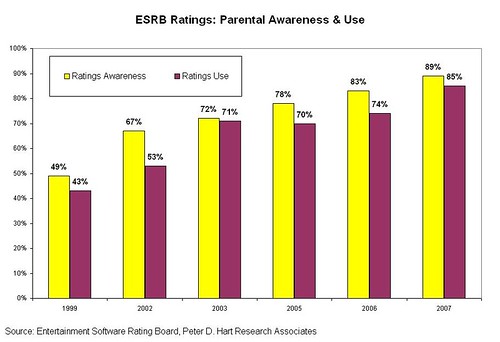
Better yet, all gaming platforms and most PCs can read these ratings and labels and allow parents to block games rated above a certain level they find unacceptable. But the real strength of the ESRB’s ratings system lies in the content descriptors, which give parents plenty of warning about what they will see or hear in each title. That way, parents can talk to their kids about those games or just not buy them for their kids until they think they are ready.
The game industry deserves credit not only for creating such an excellent content rating / labeling system, but also putting significant resources into public education / awareness efforts to ensure parents know how to take advantage of it. So then, why are lawmakers continuing to waste millions of taxpayer dollars litigating unneeded regulatory efforts?
Over at National Review Online today, Peter Suderman has a good discussion of the current state of video game politics. As usual, a lot of politicians are playing games; political games, that is. Suderman notes that:
…attacking the video-game industry has long been a favored sport amongst politicians eager to shore up their credibility with the concerned parent crowd. At the state level, at least ten laws banning the sale of certain video games to minors have been brought to life. In California, Governor Arnold Schwarzenegger, a guy who made his name hacking and slashing his enemies to a bloody pulp on the big screen, apparently didn’t want high schoolers doing digital imitations: He tried to ban the sale of violent games to minors back in 2005. Oregon is currently considering a similar law, and New York Governor Eliot Spitzer recently stated that he intends to pursue one as well. But these laws go down like a final level boss once they hit the courts. To date, not one of the dubious proposals has stood up to a court challenge.
Some lawmakers can’t even be bothered to worry about anything so insignificant as considering whether a law is constitutional. Regarding one video-game ban, Minnesota state legislator Sandy Poppas shrugged off any such responsibility, saying, “Legislators don’t worry too much about what’s constitutional. We just try to do what’s right, and we let the courts figure that out.” The recurrent bashing of the game industry tends to resemble a major league team taking on a troop of t-ballers: Politicians get to knock a couple of balls out of the park in front of parents, but the whole thing is just a show.
Indeed it is. I made a similar argument in a piece for NRO last year as well as my big PFF study, “Fact and Fiction in the Debate over Video Game Regulation.”
The FCC has just issued its long-awaited report on Violent Television Programming and Its Impact on Children. Unsurprisingly, it recommends that the government should assume a great role in regulating the video content that comes into our homes. The agency concludes that: “We believe that further action to enable viewer-initiated blocking of violent television content would serve the government’s interests in protecting the well-being of children and facilitating parental supervision and would be reasonably likely to be upheld as constitutional.” (p. 15)
Ambiguity Defined
Ironically, however, the FCC’s report goes on to undercut its own argument for regulation again and again because of the stunning level of ambiguity surrounding everything they propose. For example, in the second paragraph of the report, the FCC notes that “A broad range of television programming aired today contains [violent] content, including, for example, cartoons, dramatic series, professional sports such as boxing, news coverage, and nature programs.” Is the agency saying such things could be regulated? They never tell us.
Or consider the endless number of questions raised by this paragraph on pages 20-21:
We believe that developing an appropriate definition of excessively violent programming would be possible, but such language needs to be narrowly tailored and in conformance with judicial precedent. Any definition would need to be clear enough to provide fair warning of the conduct required. A definition sufficient to give notice of upcoming violent programming content to parents and potential viewers could make use of, or be a refinement of, existing voluntary rating system definitions or could make use of definitions used in the research community when studying the consequences of violent programming. For more restrictive time channeling rules, a definition based on the scientific literature discussed above, which recognizes the factors most important to determining the likely impact of violence on the child audience, could be developed. For example, such a definition might cover depictions of physical force against an animate being that, in context, are patently offensive. In determining whether such depictions are patently offensive, the Government could consider among other factors the presence of weapons, whether the violence is extensive or graphic, and whether the violence is realistic. (p. 20-21)
Let’s try to unpack some of this because defining “excessive violence” is really the core of this debate.
Continue reading →
Lisa Lerer of Forbes was nice enough to do a feature story this week about my views on the panic over social networking and the push for age verification of such sites. Her piece is entitled “Why MySpace is a Safe Space,” and begins as follows: “Adam Thierer doesn’t look like much of a revolutionary. But last month he challenged both Washington and conventional wisdom with a fairly radical proposition: Perhaps MySpace and the Internet aren’t so scary for kids, after all.”
I don’t really regard what I’ve been saying in my recent essays or big new PFF study as “revolutionary.” Rather, if you spend any time studying this issue and these sites in a dispassionate, educated way, I think the conclusions I draw seem quite reasonable. Unfortunately, I don’t think many policy makers or critics have spent any serious time on these sites or seriously explored the relative danger of online social networking sites relative to offline social networking places. A classic “moral panic” has developed because of this: An older generation fears a new medium that it does not use or understand.
Anyway, read my discussion with Lisa for more details.
The Parents Television Council (PTC), a media activist group that routinely petitions Congress and the FCC for greater content regulation, recently released a new poll which they say proves that the V-Chip and parental control technologies have been a failure.
Their poll finds that only 11% of those surveyed said they used the V-chip or their cable box parental controls to block unwanted content from their television during the past week. And that result is virtually unchanged from a poll they took last September asking the same question. Therefore, the PTC concludes that recent efforts by broadcasters and cable companies to spend hundreds of millions of dollars educating families about these parental control tools have been a failure. And, unsurprisingly, the PTC feels that this again shows the need for government regulators need to step in and do more national nannying for us.
As I’ll make clear in a moment, the V-Chip and current television ratings are certainly not perfect. And I have no doubt that household usage of these tools is quite low for reasons I’ll get into. But let me first address what appears to be a rather glaring methodological deficiency of this PTC poll which makes it difficult to take seriously.
Continue reading →
I’m putting the wraps on a big paper on the dangers of mandating age verification for social networking websites. One of the questions I ask in the study is exactly how broadly “social networking sites” will be defined for purposes of regulation? Will chat rooms, hobbyist sites, listservs, instant messaging, video sharing sites, online marketplaces or online multiplayer gaming sites qualify? If so, how will they be policed and how burdensome will age-verification mandates become for smaller sites? Finally, does the government currently have the resources to engage in such policing activities since almost all websites now have a social networking component? I explore these and other questions in my paper.
But now I have another type of site to add to list, and not one that I originally gave much consideration to: online newspapers. Over the weekend, the
USA Today relaunched its website, not only to freshen up its look, but also to fundamentally change the ways the site works. According to the editors, the new features of the site will give readers the ability to:
Continue reading →

 The Technology Liberation Front is the tech policy blog dedicated to keeping politicians' hands off the 'net and everything else related to technology.