Posts tagged as:

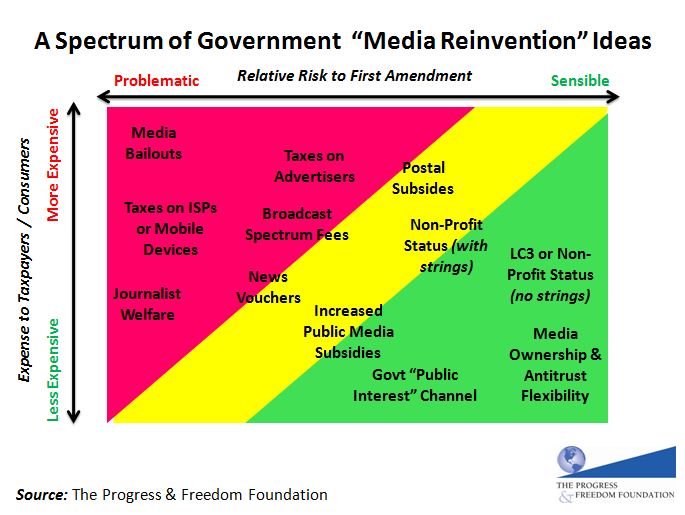
As I’ve noted here before, the Federal Trade Commission (FTC) has an ongoing proceeding asking “How Will Journalism Survive the Internet Age?” The agency has hosted two workshops on the issue and a third is scheduled for June 15th at the National Press Club. Recently, the FTC released a 47-page staff discussion draft entitled “Potential Policy Recommendations to Support the Reinvention of Journalism,” which outlines dozens of proposals that have been set forth in recent years to “save journalism,” “reinvent media,” or support various forms of so-called “public interest programming.”  [I’ve embedded the document down below.] Although the FTC makes it very clear on the first page of the discussion draft that it “does not represent final conclusions or recommendations by the Commission or FTC staff [and] it is solely for purposes of discussion,” the document is drawing scrutiny and raising concern since it might foreshadow where the FTC (and Obama Administration) could be heading on this front.

Some of those raising a stink about the FTC draft include: Jeff Jarvis (“FTC Protects Journalism’s Past“); Rob Port (“Federal Government Considering “iPad Tax” To Subsidize Journalism“); Mark Tapscott: “(Will Journalists Wake up in Time to Save Journalism from Obama’s FTC?”); and Andrew Malcolm of the Los Angeles Times (“Obama’s FTC Plan to Reinvent America’s News Media“), who says, “this FTC study is rated R for anyone who thinks the federal government, the object of copious news coverage itself, has no business deciding which sectors of the private media business survive and thrive through its support, subsidies and encouragement with things like tax incentives. Yet that’s what this Obama administration paper is suggesting as another of the ex-community organizer’s galactic reform plans.”   Ouch!

Continue reading →

We all pay “universal service” assessments on our phone bills.  It’s even broken out separately; go look. It’s probably just a matter of time before the Federal Communications Commission proposes to slap universal service assessments on broadband service to help pay for universal service subsidies for broadband service. The national broadband plan, after all, calls for “broadening” the universal service funding base.

If the commission reclassifies broadband as a “Title II” telecommunications service, this will be virtually automatic because the Telecommunications Act of 1996 says telecommunications providers must contribute toward the FCC’s universal service fund. If the commission doesn’t reclassify broadband, it could still require contributions — just like it imposed universal service assessments on VOIP without classifying VOIP as telecommunications.

After the FCC starts using universal service funds to subsidize broadband for poor people and rural households, the logic will be seductively compelling: “Broadband receives subsidies, so it’s only fair that broadband pays into the fund.”

Forget the ensuing howls about “taxing the Internet.”  I want to talk about another aspect of this.  Would imposing universal service assessments on broadband actually further the FCC’s goals in its national broadband plan?

Irish Setter Chasing Tail

Photo by nawtydawg.

The FCC wants to make broadband available to all Americans, regardless of where they live. Ideally, the FCC would like us all to subscribe, regardless of our income or where we live. The problem with imposing universal service assessments on broadband is that this would increase the price, leading subscribership to be lower than it would otherwise be.

This effect might be big or it might be little. But before making a decision about imposing universal service assessments on broadband, the FCC ought to know the size of the effect and how it compares to the increase in subscribership that would result from the subsidies.

To figure out how universal service assessments might affect broadband subscribership, we need to know how responsive broadband subscription is to changes in price. Economists call this the “price elasticity of demand.” The most recent study I’ve seen — and the only one cited in the FCC’s technical paper underlying the national broadband plan — estimates the elasticity of broadband demand was about -0.69 in 2008. That means a 1 percent increase in price would lead to a 0.69 percent decrease in subscribership. Other, earlier studies find much higher demand elasticities. But to be conservative, let’s use -0.69.

Current universal service assessments on interstate telecommunications are about 15 percent.  About 66.6 million households had broadband in 2008. A 15 percent increase in the price of broadband would reduce subscribership by about 6.9 million households (15% times -0.69 times 66.6 million.)

If the FCC imposed universal service assessments on broadband, it might be able to lower the rate since it would be collecting assessments from a broader base than just telephone service. Suppose the FCC could lower the assessment to 10 percent, more in line with the historical norm.  A 10 percent increase in the price of broadband would reduce subscribership by 4.6 million households (10% times -0.69 times 66.6 million).

So we’re going to reduce broadband subscribership by 4.6-6.9 million households in order to provide subsidies to increase broadband subscribership.  If the funds currently spent to subsidize phone service in rural areas were spent on broadband, that would be enough money to close the “funding gap” and make broadband available to the 7 million homes the FCC  says currently are unserved or under-served. 

Not all of them will susbcribe, so we can’t assume these subsidies will increase subscribership by 7 million.  About 65 percent of Americans currently have broadband at home.  If 65 percent of unserved or underserved households choose to subscribe once broadband becomes available, that would be  4.55 million new subscribers.

In short, it looks like subjecting all broadband to universal service assessments to pay for rural broadband subsidies would either be a wash or reduce subscribership on net. Paying for universal broadband service with assessments on broadband service will give the FCC a lot to do, but it won’t advance the subscribership goals of the national broadband plan. 

There are other ways to raise the money without this perverse effect. Historically, local telephone subscription has been very insensitive to price, so one option would be for the FCC to simply impose a universal service charge per phone number instead of the current percentage fee.  (Low-income households who have “Lifeline” service or use low-cost prepaid wireless plans could be charged a lower fee without sacrificing much revenue.)

Another option would be for Congress to earmark some revenues from upcoming spectrum auctions to fund universal broadband service, and reduce the universal service assessments on our phone bills accordingly.

Reasonable people can differ on whether, or by how much, the federal government should subsidize broadband where it is not currently available. But if we’re gonna do it, there’s no sense in funding it with a mechanism that reduces broadband subscription elsewhere.

There’s an inherent paradox in the Federal Communications Commission’s (FCC) media ownership regulations and the new Notice of Inquiry that the agency has just launched looking into those rules. Like everything else the FCC has been doing lately, this NOI poses hundreds of questions about the topic at hand. In this case, the agency is interested in knowing what the impact of its byzantine regulatory regime for media ownership has been. Complicating matters even more is that fact that the FCC wants people to provide detailed answers about the impact of these rules on amorphous values like “diversity” and “localism.” So, the agency asks, what has been the impact of the local TV ownership rule, the local radio ownership rule, the newspaper/broadcast cross-ownership rule, the radio/TV cross-ownership rule, the dual network rule, and so on, on the marketplace, competition, diversity, localism, etc.

But therein lies the fundamental paradox of the FCC’s inquiry and the media ownership regulations in general: So long as the rules are preemptive and prophylactic in character, we will never get clear answers to the questions the agency poses. By definition, the agency’s media ownership rules make experimentation with new business models illegal. It is per se criminal to enter into combinations that the agency has presumptively divined to be counter to “the public interest,” whatever that means.   Thus, we can never get definitive answers to the questions the agency poses when “the marketplace” isn’t a truly free marketplace at all.  It is a regulatory construct artificially constrained in countless ways.

So, what’s the answer here? In a word: Antitrust. While I’m no fan of over-zealous antitrust regulation, it has one huge advantage over the media ownership regime that the FCC enforces: It doesn’t preemptively seek to determine supposedly sensible market structures or ownership patterns. The threat of antitrust intervention can be a very dangerous thing, and wrecking-ball style antitrust interventions are rarely sensible, but at least the DOJ and FTC aren’t turning the regulatory dials on a massive media marketplace industrial policy the way the Federal Communications Commission does with its media ownership regulations. Continue reading →

The announcement yesterday from key Congressional Democrats of an effort to reform the Communications Act put me in a nostalgic mood. Here follows one of my longest efforts yet to bury the lede.

One of my favorite courses in law school was Abner Mikva’s “Legislative Process” course, which he taught while serving on the D.C. Circuit Court of Appeals and before his tenure as White House counsel to President Clinton. Mikva had previously served in Congress; indeed, one of the first votes I ever cast was for Mikva while an undergraduate at Northwestern University.

(It was a remarkable period at the law school. The year Mikva signed on as a lecturer was also the first year on the faculty for three professors just starting their academic careers: Larry Lessig, Elena Kagan, and Barack Obama. I took two classes with Lessig, including an independent study on the impact of technology on the practice of law, but regrettably none from the other two.) Continue reading →

I’ve been wading through the FCC’s latest Mobile Wireless Competition Report, and articles about it trying to make sense of what the the agency might be up to on this front.  It’s hard to get a read on where the agency may be going here. As my PFF colleague Mike Wendy suggested in his post on the FCC’s report, “far from press reports which state the FCC clearly determined the market is not ‘effectively competitive,’ well, that’s wrong. In fact, the FCC fails to make any such determination whatsoever.”  Moreover, just flipping through the charts and tables of the 237-page report, one is struck by how dynamic this marketplace is, and how crazy it would be for the FCC to declare it anything other than effectively competitive and highly innovative.

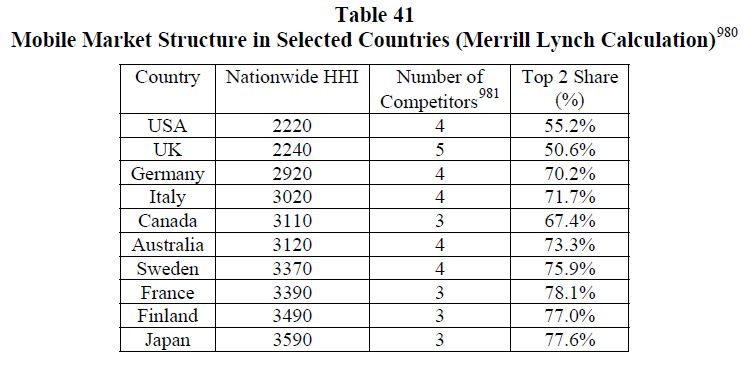
Yet, the FCC and many others seem hung up on industry structure. In particular, there seems to be a lot of hand-wringing about increasing consolidation among the sector’s top players.  But the data the FCC reproduces in the report seem to undermine that concern. For example, here’s a snapshot of the “Mobile Market Structure in Selected Countries,” which appears on pg. 197 of the FCC report.  It shows how much more consolidated foreign mobile markets are relative to the U.S., which is true of wireline markets too.  And you can find much more evidence of how competitive the marketplace is in these two reports.

Continue reading →

Mike Wendy and I have just released a new PFF white paper, “The Constructive Alternative to Net Neutrality Regulation and Title II Reclassification Wars.” In it, we discuss the Federal Communications Commission’s (FCC) misguided effort to pigeonhole the Internet and broadband networks into the regulatory regime of a bygone era. Specifically, the agency’s recent efforts to impose “Net neutrality” regulations on broadband networks, or reclassify them as Title II services under the Communications Act, raises the likelihood of delayed or foregone investment, will discourage innovation at both the core and edge of networks, and increases the likely politicization and bureaucratization of high-technology policy more generally.

We believe there are constructive alternatives to such a destructive regulatory path.  The better alternative would be based on (1) a new legislative framework centered on an FTC-like enforcement model of ex post adjudication grounded in antitrust law; (2) increased industry self-regulation, technical collaboration, and alternative dispute resolution mechanisms; and (3) greater reliance on community policing and expert third-party oversight.

For more details, you can read our entire paper down below the fold: Continue reading →

Back on St. Paddy’s Day, I offered a few comments on the “funding gap” identified in the FCC’s just-released national broadband plan. Since then, the FCC has put out a notice of proposed rulemaking and notice of inquiry seeking public comment on reforms that would allow its universal service fund to subsidize broadband. The FCC has also released a 137-page technical paper that details how the staff calculated the broadband “availability gap” and funding gap.

So, now there’s more to chew on, and another round of online mastication would be timely given the open FCC proceeding.  Here are three big issues:

  1. Definition of broadband

The plan announced a goal of making broadband with actual download speeds of 4 mbps available to all Americans.  In the plan, this goal appeared to be based on the actual average speed of broadband service (4 mbps), even though the median speed is just 3.1 mbps (p. 21). The technical paper, however, also projects that, based on past growth rates in broadband speed, “the median will likely be higher than 4 mbps by the end of 2010.” (p. 43)  Contrary to what I thought back in March, it appears the FCC is justifying the 4 mbps goal based on the median speed, not the average. 

The technical report also argues that 4 mbps is necessary to run high-speed video, which a “growing portion of subscribers” (not including me) apparently use. (p. 43) So, if the broadband plan achieves its goals, every Amercian will have the opportunity to subscribe to Internet access capable of delivering high-quality porn! Fortunately, the technical report uses a different and more productive example — streamed classroom lectures. 

Reasonable people could still question whether the median is the appropriate benchmark to guide government actions intended to equalize broadband access opportunities.  The technical report includes a helpful graphic that shows the most common broadband speed users actually buy is 2 mbps, and 38 percent of all subscribers have speeds of 2 mbps or less. (p. 43) The FCC staff’s model calculates that if the goal were set at 1.5 mbps, the number of “unserved” households would fall from 7 million to 6.3 million, and the required subsidy would fall from $18.6 billion to $15.3 billion. (p. 45) 

If almost half of broadband subscribers have decided that something less than 4 mbps is perfectly adequate, that suggests 4 mbps may go far beyond what is necessary to ensure that all Americans have access to basic broadband service. So, that 4 mbps goal is still questionable.

  1. Omission of 3G wireless

The 4 mbps goal allowed the FCC to ignore third generation wireless when it estimated the “availability gap.” The technical paper shows that 95 percent of households have 4 mbps broadband available. About 3 percent of households have no broadband available, while 2 percent have broadband available at speeds ranging from 384 kbps – 3 mbps. (p. 17)  That 2 percent probably includes households with slow DSL and 3G wireless.

The technical paper also revealed that it did not include service from fixed Wireless Internet Service Providers due to data availability. (p. 25) These serve 2 million subscribers in rural areas (p. 66), so the omission potentially accounts for a large chunk of the households considered “unserved.” No telling how many, since apparently the data aren’t available.

Back in March, I guesstimated that the 7 million household “availability gap” might overstate the size of the problem by more than half, simply because 3G wireless is available to 98 percent of American households. Looks like my guesstimate is pretty much in line with the more detailed figures in the FCC technical paper.

 3. Role of satellite

The broadband plan did not count satellite broadband when assessing availability. The technical paper (pp. 89-94)provides a much more detailed explanation of the capacity constraints the FCC staff believes will prevent satellite broadband from serving more than a couple million subscribers.   (The current satellite subscriber base is approximately 900,000.)

The technical paper pointed out that satellites are expensive and take three years to build. (p. 92) To put the time frame in perspective, that’s about as long as the FCC and the Federal-State Joint Board on Universal Service have been discussing universal service subsidies for broadband. Lord knows we shouldn’t make consumers wait that long!

There is, however, something a little asymmetrical about the way the FCC staff treated satellite and other forms of broadband. The point of estimating the broadband availability gap was to determine how much of a subsidy would be required to induce the private sector to build the infrastructure to close the gap. But while the study assumed that the subsidies would call forth the requisite cable, DSL, and wireless infrastructure within some unnamed but acceptable time frame, it decided that three years is just too long to wait for satellite infrastructure to expand. So, satellite plays a minimal role in the FCC’s plan.

Yet even this minimal role has a big impact. To its credit, the technical paper calculated how satellite broadband could dramatically slash the cost of serving the most expensive 250,000 homes. It estimated (pp. 91-92) that the net present value of subsidies required to serve these homes with satellite would range between $800 million and $2 billion — compared to a $13.4 billion subsidy required to serve these homes with terrestrial broadband. (This implies an annual subsidy of $105-255 million, which is pretty close to my March 17 guesstimate of $100-200 million.)

So, satellite broadband could help prevent costs from skyrocketing, even assuming it plays only the limited role envisioned in the FCC staff’s analysis.
I’ve complained mightily (here and here) about the agonizing technological awfulness that was, at least until recently the website of the FCC (you know, one of the two federal agencies—besides the FTC—that thinks it has the expertise necessary to regulate the Internet). My point wasn’t just that the FCC’s website made it very difficult to find and access data, but that this was a serious problem for transparency in government. I have to give the agency credit for improving many aspects of its site, though much work still remains to be done.

But then there are all the other agencies of our sprawling regulatory Leviathan! And in particular, the Securities and Exchange Commission (SEC), which processes—crudely—huge amounts of financial data. A new report from House Oversight and Government Reform Committee Ranking Member Darrell Issa released today describes just how severe the SEC’s problems are:

The Commission’s securities disclosure processes are technologically backward.  It reviews corporate filings manually, using printouts, pencils, and calculators.  It has never developed the ability to perform large-scale quantitative analysis to find fraud.  Commission staff use Google Finance, Yahoo! Finance, and other commercially-available resources to analyze corporate filings.  If the Commission had a robust database of the financial information filed by its registrants, it could automatically prioritize the thousands of tips and complaints it receives.  But no such database has ever been constructed.

Hence the biting title of the report: The SEC: Designed for Failure. Ouch! It’s really amazing how, when regulators fail to protect consumers, the default response by most in Congress is to assume that only sweeping new powers will fix the problem (which is what “financial reform” legislation would do) instead of, say, bringing the agency into the 21st century.

Similarly, there’s a move afoot to give the FTC vast new powers across the board or to protect our privacy online (from evil companies that don’t respect the privacy promises they made to consumers) with little thought given to data-driven technological  through user empowerment. Continue reading →

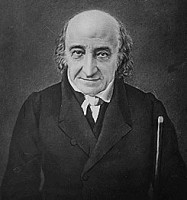
Over the weekend, I published an op-ed in The Des Moines Register encouraging the FCC to heed the lessons of the first national broadband plan, the one Secretary of the Treasury Albert Gallatin sent to Congress in 1808.

Gallatin was a remarkable figure in the early history of the federal government, and his accomplishments include being the longest-serving Treasury secretary (1801-1812) to date. His report on the Subject of Public Roads and Canals, completed at the request of Congress, remains one of the seminal documents in the history of American infrastructure. It is a masterpiece of dispassionate policy-making and clear-headed writing.

Alas, the document is available nowhere online, and the only in-print copy I can find is published by the aptly-named Dodo Press. This is indeed unfortunate given the renewed interest in network infrastructure as a form of national technology. The NBP published in March by the FCC, despite its nearly 400 pages and thousands of footnotes, makes no reference to Gallatin or his plan. Continue reading →

I’m keeping tabs on who filed “major” comments (more than a 10-15 pages) in the Federal Communications Commission’s “Future of Media” proceeding (GN Docket No. 10-25).  As I noted last week, The Progress & Freedom Foundation submitted almost 80 pages of comments (single-spaced!) in the matter, so it’s something I care deeply about and will be tracking closely going forward.

Incidentally, the general consensus of those who filed (especially if you count “minor” comments) is fairly overwhelming: Bring on Big Government! Seriously, I only found a handful of comments that object strenuously to government meddling in media markets or that raised concerns about the potential for the State’s increasing involvement in the journalism profession. Even many of the affected industries appear to be suffering from a bit of Stockholm syndrome here.  Most of them just play up the good things they are doing but barely utter a peep about the dangers of federal encroachment into the affairs of the Press.

Anyway, for those of you who care to track the gradual federalization of media and journalism, I think what you see below is a fairly comprehensive listing of the major filings submitted thus far in the FCC’s “Future of Media” proceeding. I’ll try to add more as I find them. You might also want to track what was filed in the Federal Trade Commission’s workshops on “How Will Journalism Survive the Internet Age.”  Finally, if you care to learn more of this issue, I’m hosting an event on the morning of May 20th to discuss these issues in more detail.

Continue reading →