Over at Ars, Ben Kuchera has a review of Ask.com’s redesign of its web portal for kids, AskKids.com. It’s a great new addition to the growing list of safe seach tools and web portals geared toward younger surfers.

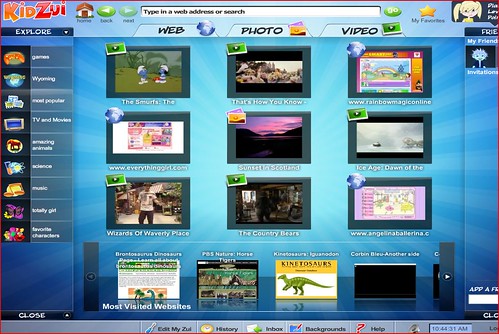
I’m also a big fan of KidZui, the new browser for kids that provides access to over 800,000 kid-friendly websites, videos, and pictures that have been pre-screened by over 200 trained teachers and parents. The company employs a rigorous 5-step “content selection process” to determine if it is acceptable for kids between 3-12 years of age. My kids, both under the age of 7, just love it, but I can’t see many kids older than 10 enjoying it because it is mostly geared toward the youngest web surfers.
Last year, as part of my 10-part series coinciding with “Internet Safety Month,” I wrote about the market for safe search tools and web portals for kids. I generally divide these sites and services into two groups:
(1)
“Safe Search” Tools and Portals for Kids
(2)
Child- and Teen-Oriented Websites
Below I will describe each group and list the many sites and services currently available. I encourage readers to offer additional suggestions for sites that belong on the list. (I keep a running list of these sites and services in my book, “Parental Controls and Online Child Protection: A Survey of Tools & Methods.”)
Continue reading →
I have just released a new PFF white paper on “The Perils of Mandatory Parental Controls and Restrictive Defaults.” It points out the dangers of government mandating that parental controls be defaulted to their most restrictive position. I’ve gone ahead and just pasted the entire text below (but without the footnotes):
During ongoing debates about parental controls, ratings, and online child safety, there have occasionally been rumblings about the possibility of requiring that media, computing and communications devices: (1) be shipped to market with parental controls embedded, and possibly, (2) those controls being defaulted to their most restrictive position, forcing users to opt out of the controls later if they wanted to consume media rated above a certain threshold.
Imagine, for example, a law requiring that every television, TV set-top box, and video game console be shipped with on-board screening technologies that were set to block any content rated above “G” for movies, “TV-Y” for television, or “E” for video games, which are the most restrictive rating designations for each type of media. Similarly, all personal computers or portable media devices sold to the public could be forced to have filters embedded that were set to block all “objectionable” content, however defined.
If “default” requirements such as this were mandated by law, parents would be forced to opt out of the restrictions by granting their children selective permission to media content or online services. In theory, this might help limit underage access to objectionable media or online content. Such a mandate might be viewed as less intrusive than direct government censorship and, therefore, less likely to run afoul of the constitution.
For these reasons, such a proposal would likely have great appeal among some policymakers, “family” groups, child safety advocates, and parents. But mandating parental controls and restrictive defaults is a dangerous and elitist idea that must be rejected because it will have many unintended consequences and not likely achieve the goal of better protecting our kids.
Continue reading →
The long-awaited final report of the UK’s Byron Review on Children and New Technology is finally out. It is called Safer Children in a Digital World. It focuses on the benefits and risks associated with the Internet and video games. I will be posting more about the specifics in coming days, but the general thrust of the report–at least from the executive summary–looks quite good. Here’s a few key quotes:
* Technology offers extraordinary opportunities for all of society including children and young people. The internet allows for global exploration which can also bring risks, often
paralleling the offline world.
* “New media are often met by public concern about their impact on society and anxiety and polarisation of the debate can lead to emotive calls for action.” … “Debates and research in this area can be highly polarised and charged with emotion.”
* “I propose that we seek to achieve gains in these three areas by having a national strategy for child internet safety which involves better self-regulation and better provision of information and education for children and families.”
* “We need to take into account children’s individual strengths and vulnerabilities, because the factors that can discriminate a ‘beneficial’ from a ‘harmful’ experience online and in video games will often be individual factors in the child. The very same content can be useful to a child at a certain point in their life and development and may be equally damaging to another child.”
I like the focus on education and parental oversight that I see in the report. Here’s a particular good recommendation that closely parallels what I have called for in my own work:
Continue reading →

 The Technology Liberation Front is the tech policy blog dedicated to keeping politicians' hands off the 'net and everything else related to technology.