Posts tagged as:

Aereo’s antenna system is frequently characterized perjoratively as a Rube Goldberg contraption, including in the Supreme Court oral arguments. Funny enough, Preston Padden, a veteran television executive, has characterized the legal system producing over-the-air broadcast television–Aereo’s chief legal opponents–precisely the same way. It’s also ironic that Aereo is in a fight for its life over alleged copyright violations since communications law diminishes the import of copyright law and makes copyright almost incomprehensible. Larry Downes calls the legal arguments for and against Aereo a “tangled mess.” David Post at the Volokh Conspiracy likewise concluded the situation is “pretty bizarre, when you think about it” after briefly exploring how copyright law interacts with communications law.

I agree, but Post actually understates how distorted the copyright law becomes when TV programs pass through a broadcaster’s towers, as opposed to a cable company’s headend. In particular, a broadcaster, which is mostly a passive transmitter of TV programs, gains more control over the programs than the copyright owners. It’s nearly impossible to separate the communications law distortions from the copyright issues, but the Aereo issue could be solved relatively painlessly by the FCC. It’s unfortunate copyright and television law intertwine like this because a ruling adverse to Aereo could potentially–and unnecessarily–upend copyright law.

This week I’ve seen many commentators, even Supreme Court justices, mischaracterize the state of television law when discussing the Aereo case. This is a very complex area and below is my attempt to lay out some of the deeper legal issues driving trends in the television industry that gave rise to the Aereo dispute. Crucially, the law is even more complex than most people realize, which benefits industry insiders and prevents sensible reforms. Continue reading →

After yesterday’s FCC meeting, it appears that Chairman Wheeler has a finely tuned microscope trained on broadcasters and a proportionately large blind spot for the cable television industry.

Yesterday’s FCC meeting was unabashedly pro-cable and anti-broadcaster. The agency decided to prohibit television broadcasters from engaging in the same industry behavior as cable, satellite, and telco television distributors and programmers. The resulting disparity in regulatory treatment highlights the inherent dangers in addressing regulatory reform piecemeal rather than comprehensively as contemplated by the #CommActUpdate. Congress should lead the FCC by example and adopt a “clean” approach to STELA reauthorization that avoids the agency’s regulatory mistakes.

The FCC meeting offered a study in the way policymakers pick winners and losers in the marketplace without acknowledging unfair regulatory treatment. It’s a three-step process.

  • First, the policymaker obfuscates similarities among issues by referring to substantively similar economic activity across multiple industry segments using different terminology.
  • Second, it artificially narrows the issues by limiting any regulatory inquiry to the disfavored industry segment only.
  • Third, it adopts disparate regulations applicable to the disfavored industry segment only while claiming the unfair regulatory treatment benefits consumers.

The broadcast items adopted by the FCC yesterday hit all three points. Continue reading →

Some recent tech news provides insight into the trajectory of broadband and television markets. These stories also indicate a poor prognosis for a net neutrality. Political and ISP opposition to new rules aside (which is substantial), even net neutrality proponents point out that “neutrality” is difficult to define and even harder to implement. Now that the line between “Internet video” and “television” delivered via Internet Protocol (IP) is increasingly blurring, net neutrality goals are suffering from mission creep.

First, there was the announcement that Netflix, like many large content companies, was entering into a paid peering agreement with Comcast, prompting a complaint from Netflix CEO Reed Hastings who argued that ISPs have too much leverage in negotiating these interconnection deals.

Second, Comcast and Apple discussed a possible partnership whereby Comcast customers would receive prioritized access to Apple’s new video service. Apple’s TV offering would be a “managed service” exempt from net neutrality obligations.

Interconnection and managed services are generally not considered net neutrality issues. They are not “loopholes.” They were expressly exempted from the FCC’s 2010 (now-defunct) rules. However, net neutrality proponents are attempting to bring interconnection and managed services to the FCC’s attention as the FCC crafts new net neutrality rules. Net neutrality proponents have an uphill battle already, and the following trends won’t help. Continue reading →

Most conservatives and many prominent thinkers on the left agree that the Communications Act should be updated based on the insight provided by the wireless and Internet protocol revolutions. The fundamental problem with the current legislation is its disparate treatment of competitive communications services. A comprehensive legislative update offers an opportunity to adopt a technologically neutral, consumer focused approach to communications regulation that would maximize competition, investment and innovation.

Though the Federal Communications Commission (FCC) must continue implementing the existing Act while Congress deliberates legislative changes, the agency should avoid creating  new regulatory disparities on its own. Yet that is where the agency appears to be heading at its meeting next Monday. Continue reading →

My response to Free State Foundation’s blog post, “Understanding the Un-Free Market for Retrans Consent Is the First Step for Reforming It

The Free State Foundation (FSF) questioned my most recent blog post at RedState, which noted that the American Television Alliance’s (ATVA) arguments supporting FCC price regulation of broadcast television content are inconsistent with the arguments its largest members make against government intervention proposed by net neutrality supporters. FSF claimed that my post created a “false equivalency” between efforts to modify an existing regulatory regime and efforts to impose new regulations in a previously free market.

FSF’s “false equivalence” theory is a red herring that is apparently intended to distract from the substantive issues I raised. The validity of the economic arguments related to two-sided markets discussed in my blog doesn’t depend on the regulatory status of the two-sided markets those arguments address. The notion that the existence of regulation in the video marketplace gives ATVA a free pass to say anything it wants without heed for intellectual consistency is absurd.

I suspect FSF knows this. Its blog post does not dispute that ATVA’s arguments at the FCC are inconsistent with the arguments its largest members make against net neutrality; in fact, FSF failed to address the ATVA petition at all. Though the FSF blog was ostensibly prompted by my post at RedState, FSF decided to “leave the merits of ATVA’s various proposals to others” (except me, apparently).

FSF’s decision to avoid the merits of ATVA’s arguments at the FCC (the subject of my blog post), begs the question: What was the FSF blog actually about? It appears FSF wrote the blog to (1) reiterate its previous (and misleading) analyses of the video programing market, and (2) argue that the Next Generation Television Marketplace Act “represents the proper direction” for reforming it.

To be clear, I haven’t previously addressed either issue. But, in the spirit of collegial dialogue initiated by FSF, I discuss them briefly in this blog. Continue reading →

The decision to forgo distribution is referred to as a “blackout” in the cable context and “blocking” in the Internet context, but the economic considerations affecting such negotiations are substantially the same.

The American Television Alliance (ATVA), a coalition comprised primarily of cable and satellite TV operators, is using the playbook of net neutrality proponents in abid to convince the Federal Communications Commission (FCC) to regulate prices for broadcast television content. The goal of ATVA’s cable and satellite members is to increase their profit margins by convincing the government to artificially lower the cost of programming they resell to consumers. I suspect the goal of ATVA’s non-profit memberse.g.Public Knowledge and New America Foundation, is to solidify the FCC’s flawed rationale for adopting net neutrality rules in 2010, which imposed restrictions on market arrangements between Internet Service Providers (ISPs) and Internet content providers without finding a market failure.

Many of ATVA’s cable members are also ISPs that have routinely argued against the imposition of net neutrality regulations in the market for Internet services. By supporting ATVA, these same companies appear to have abandoned the intellectual foundation for opposition to net neutrality. Are they now signaling their intent to embrace net neutrality regulation of the Internet? Continue reading →

Last week, the House held a hearing about the so-called IP Transition. The IP Transition refers to the telephone industry practice of carrying all wire-based consumer services–voice, Internet, and television–via faster, better fiber networks and not on the traditional copper wires that had fewer capabilities. Most consumers have not and will not notice the change. The completed IP Transition, however, has enormous implications for how the FCC regulates. As one telecom watcher said, “What’s at stake? Everything in telecom policy.”

For 100 years or so, phone service has had a special place in regulatory law given its importance in connecting the public. Phone service was almost exclusively over copper wires, a service affectionately called “plain old telephone service” (POTS). AT&T became the government-approved POTS national monopolist in 1913 (which ended with the AT&T antitrust breakup in the 1980s). The deal was: AT&T got to be a protected monopolist while the government got to require AT&T provide various public benefits. The most significant of these is universal service–AT&T had to serve virtually every US household and charge reasonable rates even to remote (that is, expensive) customers.

To create more phone competitors to the Baby Bells–the phone companies spun off from the AT&T break-up in the 1980s–the Congress passed the 1996 Telecom Act and the FCC put burdens on the Baby Bells to allow new phone companies to lease the Baby Bells’ AT&T-created copper wires at regulated rates. The market changed in ways never envisioned in the 1990s however. Today, phone companies face competition–not from the new phone companies leasing the old monopoly infrastructure but from entirely different technologies. You can receive voice service from your cable company (“digital voice”), your “phone” company (POTS), your wireless company, and even Internet-based providers like Vonage and Skype. Increasingly, households are leaving POTS behind in favor of voice service from cable or wireless providers. Yet POTS providers–like Verizon and AT&T (which also offer wireless service)–must abide by monopoly-era regulations that their cable and wireless competitors–Comcast, Sprint, and others–don’t have to abide by.

Understanding the significance of the IP Transition requires (unfortunately) knowing a little bit about Title I and Title II of the Communications Act. “Telecommunications services,” which are the phone companies with copper networks, are heavily regulated by the FCC under Title II. On the other hand, “information services,” which includes Internet service, are lightly regulated under Title I. This division made some sense in the 1990s. It is increasingly under stress now because burdened “telecommunications” companies like AT&T and Verizon are offering “information services” like Internet via DSL, FiOS, and U-Verse. Conversely, lightly-regulated “information services” companies like Comcast, Charter, and Time-Warner Cable are entering the regulated telephone market but face few of the regulatory burdens.

Which brings us to the IP Transition. As Title II phone companies replace their copper wires with fiber and deploy broadband networks to compete with cable companies, their customers’ phone service is being carried via IP packets. Functionally, these new networks act like a heavily-regulated Title II service since they carry voice, but they also act like the Title I broadband networks that cable providers built. So should these new fiber networks be burdened like Title II services or deregulated like Title I services? Or is it possible to achieve some middle ground using existing law? Those are the questions before the FCC and policymakers. Billions of dollars of investment will be accelerated or slowed and many firms will live or die depending on how the FCC and Congress act. Stay tuned.

over-the-topCBS and Time Warner Cable have been embroiled in a heated contractual battle over the past week that has resulted in viewers in some major markets losing access to CBS programming. When disputes like these go nuclear and signal blackouts occur, it is inevitable that some folks will call for policy interventions since nobody likes it when the content they love goes dark.

While some policy responses are warranted in this matter, policymakers should proceed with caution. Heated contractual negotiations are a normal part of any capitalist marketplace. We shouldn’t expect lawmakers to intervene to speed up negotiations or set content prices because that would disrupt the normal allocation of programming by placing a regulatory thumb too heavily on one side of the scale. This is why I am somewhat sympathetic to CBS in this fight. In an age when content creators struggle to protect their copyrighted content and get compensation for it, the last thing we need is government intervention that undermines the few distribution schemes that actually work well.

On the other hand, Time Warner Cable deserves sympathy here, too, since CBS currently enjoys some preexisting regulatory benefits. As I noted in this 2012 Forbes oped, “Toward a True Free Market in Television Programming,” many layers of red tape still encumber America’s video marketplace and prevent a truly free market in video programming from developing. The battle here revolves around the “retransmission consent” rules that were put in place as part of the Cable Act of 1992 and govern how video distributors carry signals from TV broadcasters, which includes CBS.

But those “retrans” rules are not the only part of the regulatory mess here. Continue reading →

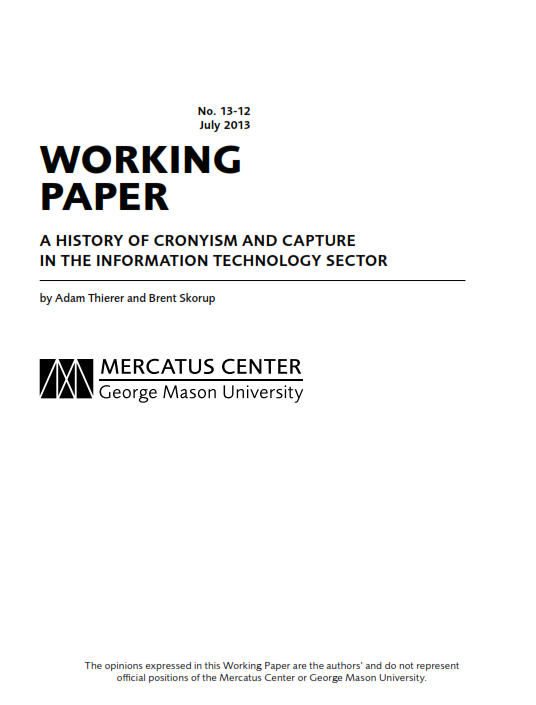
WP coverThe Mercatus Center at George Mason University has just released a new paper by Brent Skorup and me entitled, “A History of Cronyism and Capture in the Information Technology Sector.” In this 73-page working paper, which we hope to place in a law review or political science journal shortly, we document the evolution of government-granted privileges, or “cronyism,” in the information and communications technology marketplace and in the media-producing sectors. Specifically, we offer detailed histories of rent-seeking and regulatory capture in: the early history of the telephony and spectrum licensing in the United States; local cable TV franchising; the universal service system; the digital TV transition in the 1990s; and modern video marketplace regulation (i.e., must-carry and retransmission consent rules, among others.

Our paper also shows how cronyism is slowly creeping into new high-technology sectors.We document how Internet companies and other high-tech giants are among the fastest-growing lobbying shops in Washington these days. According to the Center for Responsive Politics, lobbying spending by information technology sectors has almost doubled since the turn of the century, from roughly $200 million in 2000 to $390 million in 2012.  The computing and Internet sector has been responsible for most of that growth in recent years. Worse yet, we document how many of these high-tech firms are increasingly seeking and receiving government favors, mostly in the form of targeted tax breaks or incentives. Continue reading →

Gina Keating, author of Netflixed: The Epic Battle for America’s Eyeballs, discusses the startup of Netflix and their competition with Blockbuster.

Keating begins with the history of the company and their innovative improvements to the movie rental experience. She discusses their use of new technology and marketing strategies in DVD rental, which inspired Blockbuster to adapt to the changing market.

Keating goes on to describe Netflix’s transition to internet streaming and Blockbuster’s attempts to retain their market share.

Download

Related Links