Posts tagged as:

DM cover
On May 3rd, I’m excited to be participating in a discussion with Yale University bioethicist Wendell Wallach at the Microsoft Innovation & Policy Center in Washington, DC. (RSVP here.) Wallach and I will be discussing issues we write about in our new books, both of which focus on possible governance models for emerging technologies and the question of how much preemptive control society should exercise over new innovations.

Wallach’s latest book is entitled, A Dangerous Master: How to Keep Technology from Slipping beyond Our Control. And, as I’ve noted here recently, the greatly expanded second edition of my latest book, Permissionless Innovation: The Continuing Case for Comprehensive Technological Freedom, has just been released.

Of all the books of technological criticism or skepticism that I’ve read in recent years—and I have read stacks of them!— A Dangerous Master is by far the most thoughtful and interesting. I have grown accustomed to major works of technological criticism being caustic, angry affairs. Most of them are just dripping with dystopian dread and a sense of utter exasperation and outright disgust at the pace of modern technological change.

Although he is certainly concerned about a wide variety of modern technologies—drones, robotics, nanotech, and more—Wallach isn’t a purveyor of the politics of panic. There are some moments in the book when he resorts to some hyperbolic rhetoric, such as when he frets about an impending “techstorm” and the potential, as the book’s title suggests, for technology to become a “dangerous master” of humanity. For the most part, however, his approach is deeper and more dispassionate than what is found in the leading tracts of other modern techno-critics.

Permissionless Innovation 2nd edition book cover -1
I am pleased to announce the release of the second edition of my book, Permissionless Innovation: The Continuing Case for Comprehensive Technological Freedom. As with the first edition, the book represents a short manifesto that condenses — and attempts to make more accessible — arguments that I have developed in various law review articles, working papers, and blog posts over the past few years. The book attempts to accomplish two major goals.

First, I attempt to show how the central fault line in almost all modern technology policy debates revolves around “the permission question,” which asks: Must the creators of new technologies seek the blessing of public officials before they develop and deploy their innovations? How that question is answered depends on the disposition one adopts toward new inventions. Two conflicting attitudes are evident.

One disposition is known as the “precautionary principle.” Generally speaking, it refers to the belief that new innovations should be curtailed or disallowed until their developers can prove that they will not cause any harms to individuals, groups, specific entities, cultural norms, or various existing laws, norms, or traditions.

The other vision can be labeled “permissionless innovation.” It refers to the notion that experimentation with new technologies and business models should generally be permitted by default. Unless a compelling case can be made that a new invention will bring serious harm to society, innovation should be allowed to continue unabated and problems, if they develop at all, can be addressed later.

I argue that we are witnessing a grand clash of visions between these two mindsets today in almost all major technology policy discussions today. Continue reading →

Few people have been more tireless in their defense of the notion of “permissionless innovation” than Wall Street Journal columnist L. Gordon Crovitz. In his weekly “Information Age” column for the Journal (which appears each Monday), Crovitz has consistently sounded the alarm regarding new threats to Internet freedom, technological freedom, and individual liberties. It was, therefore, a great honor for me to wake up Monday morning and read his latest post, “The End of the Permissionless Web,” which discussed my new book “Permissionless Innovation: The Continuing Case for Comprehensive Technological Freedom.”

“The first generation of the Internet did not go well for regulators,” Crovitz begins his column. “Despite early proposals to register websites and require government approval for business practices, the Internet in the U.S. developed largely without bureaucratic control and became an unstoppable engine of innovation and economic growth.” Unfortunately, he correctly notes:

Regulators don’t plan to make the same mistake with the next generation of innovations. Bureaucrats and prosecutors are moving in to undermine services that use the Internet in new ways to offer everything from getting a taxi to using self-driving cars to finding a place to stay.

This is exactly why I penned my little manifesto. As Crovitz continues on to note in his essay, new regulatory threats to both existing and emerging technologies are popping up on almost a daily basis. He highlights currently battles over Uber, Airbnb, 23andme, commercial drones, and more. And his previous columns have discussed many other efforts to “permission” innovation and force heavy-handed top-down regulatory schemes on fast-paced and rapidly-evolving sectors and technologies. Continue reading →

In his latest weekly Wall Street Journal column, Gordon Crovitz has penned a review of the new Jeff Jarvis book, Public Parts: How Sharing in the Digital Age Improves the Way We Work and Live . Gordon’s review closely tracks my own thoughts on the book, which I laid out last week in my Forbes essay, “Is Privacy Overrated?”  Gordon’s essay is entitled “Are We Too Hung Up on Privacy” and he finds, like I do, that Jarvis makes compelling case for understanding the benefits of publicness as the flip-side of privacy. Instead of repeating all the arguments we make in our reviews here, I’ll just ask people go check out both of our essays if they are interested.

I did, however, want to elaborate on one thing I didn’t have time to discuss in my review of the Jarvis book. While I like the approach he used in the book, I thought Jarvis could have spent a bit more time exploring some the thorny legal issues in play when advocates of privacy regulation look to enshrine into law quite expansive views of privacy “rights.”

One of the things that both Crovitz and I appreciated about the Jarvis book was the way he tries to get us to think about privacy in the context of ethics instead of law. “Privacy is an ethic governing the choices made by the recipient of someone else’s information,” Jarvis argues, while “publicness is an ethic governing the choices made by the creator of one’s own information,” he says. In my review, I explained why this was so important: Continue reading →

Tim Wu’s new book, The Master Switch: The Rise and Fall of Information Empires, will be released next week and it promises to make quite a splash in cyberlaw circles.  It will almost certainly go down as one of the most important info-tech policy books of 2010 and will probably win the top slot in my next end-of-year list.

Of course, that doesn’t mean I agree with everything in it.  In fact, I disagree vehemently with Wu’s general worldview and recommendations, and even much of his retelling of the history of information sectors and policy.  Nonetheless, for reasons I will discuss in this first of many critiques, the book’s impact will be significant because Wu is a rock star in this academic arena as well as a committed activist in his role as chair of the radical regulatory activist group, Free Press. Through his work at Free Press as well as the New America Foundation, Professor Wu is attempting to craft a plan of action to reshape the Internet and cyberspace.

I stand in opposition to almost everything that Wu and those groups stand for, thus, I will be spending quite a bit of time addressing his perspectives and proposals here in coming months, just as I did when Jonathan Zittrain’s hugely important The Future of the Internet & How to Stop It was released two years ago (my first review is here and my latest critique is here).  In today’s essay, I’ll provide a general overview and foreshadow my critiques to come.  (Note: Tim was kind enough to have his publisher send me an advance uncorrected proof of the book a few months ago, so I’ll be using that version to construct these critiques. Please consult the final version for cited material and page numbers.) Continue reading →

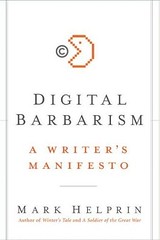
Last month, Digital Barbarism book cover National Review magazine published a review that I penned of Mark Helprin’s new book, Digital Barbarism: A Writer’s Manifesto.  Helprin’s book is both a passionate defense of copyright law as well as a mini-autobiography.  Helprin is one of the great novelists and essayists of the past half-century, and his book A Soldier of a Great War is one of my all-time favorite novels.  I cannot in strong enough words encourage you to read that book; it is profoundly moving. (I almost named my son after the lead character in the book!)

Thus, I was quite excited when I learned that Helprin had penned a defense of copyright and I jumped at the chance to review it when the folks at National Review asked me to do so.  Alas, as you will see in my review, I was terribly disappointed.  I wish Helprin would have stuck with the very reasonable tone he adopted in this excellent podcast interview he did recently with John J. Miller of National Review Online. Unfortunately, he went a different direction in the book, as I make clear in my review:


National Review July 20, 2009

“Man, Machine, and Copyright” a review of Digital Barbarism: A Writer’s Manifesto, by Mark Helprin by Adam Thierer

It would be difficult to think of anyone more ideally suited to pen a passionate defense of copyright law than novelist Mark Helprin.  Helprin has written several of the finest works of modern literature, including his masterpiece, A Soldier of the Great War, a narrative of transcendent beauty. In Digital Barbarism, Helprin sets out to use his formidable gift for the written word to repel the “cyber mob” that has attacked copyright law and called for its curtailment, or even abolition.

Unfortunately, while Helprin occasionally rises to great heights in his defense of copyright, he too often sinks to lamentable lows — by resorting to the same unbecoming rhetorical tactics used by the mob he seeks to condemn. Indeed, his book is filled with gratuitous vitriol and neo-Luddite ramblings about the Internet and Information Age that severely detract from his defense of copyright. This is a shame, because, in places, Digital Barbarism makes a fine case against those critics who wrongly view copyright as an impediment to the creation and diffusion of content. “The availability of information is not and will not be restrained by the copyright system any more than it is or will be restrained by the delivery systems that make it possible,” Helprin argues. Why, he asks, “must ‘content’ be free” when everything else — access to the Internet, digital devices, etc. — costs good money? He notes that the movement that advocates “free,” universal access to all copyrighted material in the name of “openness” and “the public good” would, ironically, “destroy the dream it advocates”: Continue reading →

Vision of the Anointed book coverBerin recently encouraged me to re-read Thomas Sowell’s The Vision of the Anointed: Self-Congratulation as a Basis for Social Policy, which I hadn’t looked at since I first read it back in 1995 or 96.   I’m glad I did since Sowell’s work has always been profoundly influential on my thinking (especially his masterpiece, A Conflict of Visions) and I had forgotten how useful The Vision of the Anointed was in helping me understand the reoccurring model that drives ideological crusades to expand government power over our lives and economy.

“The great ideological crusades of the twentieth-century intellectuals have ranged across the most disparate fields,” Sowell noted in the book.  But what they all had in common, he argued, was “their moral exaltation of the anointed above others, who are to have their different views nullified and superseded by the views of the anointed, imposed via the power of government.” (p. 5)  These elitist, government-expanding crusades shared several key elements, which Sowell identified as follows:

  1. Assertion of a great danger to the whole society, a danger to which the masses of people are oblivious.
  2. An urgent need for government action to avert impending catastrophe.
  3. A need for government to drastically curtail the dangerous behavior of the many, in response to the prescient conclusions of the few.
  4. A disdainful dismissal of arguments to the contrary as either uninformed, irresponsible, or motivated by unworthy purposes.

You can see this model at work on a daily basis today with our government’s various efforts to reshape our economy, but I think this model is equally applicable to debates over social policy and speech control.  In particular, the various “technopanics” I have been writing about recently fit this model. (See 1, 2, 3, 4, 5).  For example, consider how this plays out in the debate over online social networking:

Continue reading →

I was over at the Federal Communications Commission (FCC) the other day chatting with someone about various regulatory issues and Rush Limbaugh’s WSJ editorial came up.  The person I was speaking with made a comment about how conservatives have really been energized and unified in opposition to the re-imposition to the Doctrine.  I reminded them, however, that it wasn’t always the case that conservatives stood together in the fight over the Fairness Doctrine.  In fact, when I first came to town almost 20 years ago, there were still plenty of conservatives who actually favored it.  I was reminded of that fact when reading a new piece in Engage about “Broadcast ‘Fairness’ in the Twenty-First Century” by my friend Robert Corn-Revere.  Bob is one America’s great First Amendment defenders and his new essay offers an excellent history of efforts to micro-manage speech on the broadcast airwaves over the years.  In it, he reminds us that:

Given the recent vocal opposition to the Fairness Doctrine in the interest of preserving conservative talk radio, it is easy to forget that many prominent conservatives championed the doctrine before its demise. Phyllis Schlafly was a vocal proponent of the Fairness Doctrine because of what she described as “the outrageous and blatant anti-Reagan bias of the TV network newscasts,” and she testified at the FCC in the 1980s in support of the policy “to serve as a small restraint on the monopoly power wielded by Big TV Media.” Senator Jesse Helms was another long-time advocate of the Fairness Doctrine, and conservative groups Accuracy in Media and the American Legal Foundation actively pursued fairness complaints at the FCC against network newscasts.

Likewise, in our book, A Manifesto for Media Freedom, Brian Anderson and I note that some other prominent right-leaning politicians, such as Sen. Trent Lott, favored the Fairness Doctrine.  Moreover, even though most of those conservative individuals and groups have now turned against the Fairness Doctrine, some Republicans still defend (or even seek to expand) the same underlying regulatory concepts that served as the foundation of the Fairness Doctrine.  As Corn-Revere notes: Continue reading →

This afternoon at the New America Foundation, Jonathan Zittrain and I engaged in a spirited debate about his provocative new book, The Future of the Internet and How to Stop It. As always, Jonathan gave an us an interesting and highly entertaining show, and it was a great honor for me to be given the opportunity to provide some feedback about his book. I’ve been quite critical of the thesis that Jonathan sets forth in his book, and I have discussed my reservations in a lengthy book review and a series of follow-up essays here and elsewhere. (Part 1, 2, 3, 4, 5).

Jonathan opens with about 45 minutes of remarks and I come into the conversation around the 49 mark of the video. Michael Calabrese of NAF also has some comments about Jonathan’s book after I speak and then there is some interaction with the audience.

http://www.youtube.com/v/KDgxGN6cqTA&hl=en&fs=1

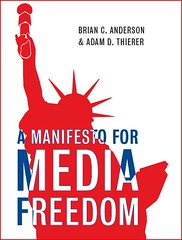
Manifesto for Media Freedom book coverI’m pleased to announce the publication of A Manifesto for Media Freedom, which I co-authored with Brian C. Anderson of the Manhattan Institute. Brian serves as editor of Manhattan Institute’s excellent City Journal and he is the author of best-selling books like South Park Conservatives and Democratic Capitalism and Its Discontents.

In this little manifesto, we highlight one of the central ironies of the Information Age.  Namely, that despite “the breathtaking abundance of new and old media outlets for obtaining news, information, and entertainment…”

many people hate this profusion, and never more than when it involves political speech. The current media market, they charge, doesn’t represent true diversity, or isn’t fair, or is subject to manipulation by a small and shrinking group of media barons. They want the government to regulate it into better shape, which just happens to be a shape that benefits them. Doing so… would be a disaster, a kind of soft or not-so-soft tyranny that would wipe out whole sectors of media, curtailing free speech and impoverishing our democracy.

In other words, instead of celebrating the unprecedented cornucopia of media choices at our collective disposal, many policymakers and media critics are calling for just as much media regulation as ever. We itemize these threats in our chapters and they include: efforts to revive the “Fairness Doctrine”, media ownership regulations, “localism” requirements, Net neutrality mandates, a la carte regulations, cable and satellite censorship, video game censorship, regulation of social networking sites, campaign finance-related speech restrictions, and so on.

In each case, we advance a pro-freedom paradigm to counter the advocates of media control. What do we mean by the “media freedom” that we advocate as the alternative to these new regulatory crusades? Here’s how we put it in the book:

Continue reading →