Posts tagged as:

Venture capitalist Bill Gurley asked a good question in a Tweet late last night when he was “wondering if Apple’s 30% rake isn’t a foolish act of hubris. Why drive Amazon, Facebook, and others to different platforms?” As most of you know, Gurley is referring to Apple’s announcement in February that it would require a 30% cut of app developers’ revenues if they wanted a place in the Apple App Store.
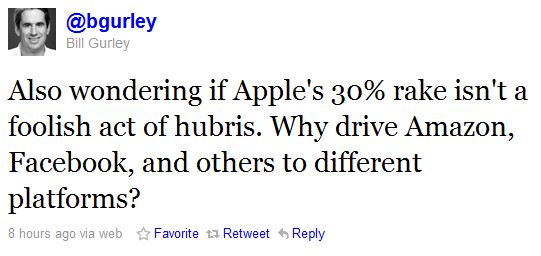
Indeed, why would Apple be so foolish? Of course, some critics will cry “monopoly!” and claim that Apple’s “act of hubris” was simply a logical move by a platform monopolist to exploit its supposedly dominant position in the mobile OS / app store marketplace.  But what then are we to make of Amazon’s big announcement yesterday that it was jumping in the ring with its new app store for Android? And what are we to make of the fact that Google immediately responded to Apple’s 30% announcement by offering publishers a more reasonable 10%-of-the-cut deal?  And, as Gurley notes, you can’t forget about Facebook. Who knows what they have up their sleeve next.  They’ve denied any interest in marketing their own phone and, at least so far, have not announced any intention to offer a competing app store, but why would they need to? Their platform can integrate apps directly into it!  Oh, and don’t forget that there’s a little company called Microsoft out there still trying to stake its claim to a patch of land in the mobile OS landscape. Oh, and have you visited the HP-Palm development center lately?  Some very interesting things going on there that we shouldn’t ignore.

What these developments illustrate is a point that I have constantly reiterated here: Continue reading →


[Cross-posted at Truth on the Market]

[UPDATE:  Josh links to a WSJ article telling us that EU antitrust enforcers raided several (unnamed) e-book publishers as part of an apparent antitrust investigation into the agency model and whether it is “improperly restrictive.”  Whatever that means.  Key grafs:

At issue for antitrust regulators is whether agency models are improperly restrictive. Europe, in particular, has strong anticollusion laws that limit the extent to which companies can agree on the prices consumers will eventually be charged. Amazon, in particular, has vociferously opposed the agency practice, saying it would like to set prices as it sees fit. Publishers, by contrast, resist the notion of online retailers’ deep discounting.

It is unclear whether the animating question is whether the publishers might have agreed to a particular pricing  model, or to particular prices within that model.  As a legal matter that distinction probably doesn’t matter at all; as an economic matter it would seem to be more complicated–to be explored further another day . . . .]

A year ago I wrote about the economics of the e-book publishing market in the context of the dispute between Amazon and some publishers (notably Macmillan) over pricing.  At the time I suggested a few things about how the future might pan out (never a good idea . . . ):

And that’s really the twist.  Amazon is not ready to be a platform in this business.  The economic conditions are not yet right and it is clearly making a lot of money selling physical books directly to its users.  The Kindle is not ubiquitous and demand for electronic versions of books is not very significant–and thus Amazon does not want to take on the full platform development and distribution risk.  Where seller control over price usually entails a distribution of inventory risk away from suppliers and toward sellers, supplier control over price correspondingly distributes platform development risk toward sellers.  Under the old system Amazon was able to encourage the distribution of the platform (the Kindle) through loss-leader pricing on e-books, ensuring that publishers shared somewhat in the costs of platform distribution (from selling correspondingly fewer physical books) and allowing Amazon to subsidize Kindle sales in a way that helped to encourage consumer familiarity with e-books.  Under the new system it does not have that ability and can only subsidize Kindle use by reducing the price of Kindles–which impedes Amazon from engaging in effective price discrimination for the Kindle, does not tie the subsidy to increased use, and will make widespread distribution of the device more expensive and more risky for Amazon.

This “agency model,” if you recall, is one where, essentially, publishers, rather than Amazon, determine the price for electronic versions of their books sold via Amazon and pay Amazon a percentage.  The problem from Amazon’s point of view, as I mention in the quote above, is that without the ability to control the price of the books it sells, Amazon is limited essentially to fiddling with the price of the reader–the platform–itself in order to encourage more participation on the reader side of the market.  But I surmised (again in the quote above), that fiddling with the price of the platform would be far more blunt and potentially costly than controlling the price of the books themselves, mainly because the latter correlates almost perfectly with usage, and the former does not–and in the end Amazon may end up subsidizing lots of Kindle purchases from which it is then never able to recoup its losses because it accidentally subsidized lots of Kindle purchases by people who had no interest in actually using the devices very much (either because they’re sticking with paper or because Apple has leapfrogged the competition).

It appears, nevertheless, that Amazon has indeed been pursuing this pricing strategy.  According to this post from Kevin Kelly,

John Walkenbach noticed that the price of the Kindle was falling at a consistent rate, lowering almost on a schedule. By June 2010, the rate was so unwavering that he could easily forecast the date at which the Kindle would be free: November 2011.

Continue reading →

Competition and patience

by on February 22, 2010 · 2 comments

Until recently, Amazon and its Kindle were the only real e-reader game in town. This allowed them to force on publishers an arguably arbitrary (and low) price of $9.99 for bestsellers. With the introduction of Apple’s iPad, however, publishers now have a viable competitor to which they can defect. The result will likely be higher e-book prices in the near term, and this has prompted some point out that this is a case where more competition resulted in higher prices for consumers.

The key phrase in the previous paragraph, however, is “near term.” It’s interesting to see that five years after it began offering video in the iTunes store, Apple is apparently pushing TV producers to lower their prices by half from $1.99 an episode to 99¢. Market processes–especially those surrounding new technology and distribution channels–can be less than instantaneous, but they have a way of ultimately conforming to economic reality.

Reporting on the ongoing negotiations with Apple, the New York Times says, “Television production is expensive, and the networks are wary of selling shows for less.” But the economic reality they’re missing is that TV production is a fixed cost, and as my friend Tim Lee has pointed out many times, the marginal cost of digital distribution is basically zero. As a result, I wouldn’t be surprised if five years from now, we’ll see Apple badgering book publishers to cut their prices in half.

Over at Silicon Alley Insider, Gregory Galant has a wonderful post about “18 Awesome Tech Things We Didn’t Have 10 Years Ago.” It serves as another great example of the amazing technological progress we have witnessed over the past decade.  He’s asking people for suggestions for what else should be on the list, so head over there and let him know. Seems like wi-fi technologies should be on there somehow. FiOS deserves a shout-out, too. And where’s Firefox & Chrome? Also, I’ll put in a special word for some amazing new home theater technologies: high-def flat-screens and projectors; media servers & Windows Media Center; BluRay; and 3 incredible gaming / media consoles (Wii, PS3, & XBox). Anyway, here’s Galant’s list:

Wikipedia Gmail Facebook YouTube Twitter AdWords Amazon AWS RSS (started in ‘99 but didn’t catch on till the ’00s) Meetup iPod Google Maps Podcasts Mint Skype/VOIP iPhone Google Docs Creative Commons Flickr

Business Insider reports that, sometime next year, Scribd will launch a “seamless” interface that allows users to access Scribd docs on their Kindles.  That’s a major step forward for the startup, which aims to be the “YouTube for print”—and which Adam and I use to make all our PFF papers available online in an embeddable Flash viewer that’s much quicker to load than the full PDFs.  But it also represents a serious potential long-term challenge to Amazon, since Scribd is “quietly developing a strong e-book storefront to match its hoard of user generated content,” as Business Insider notes, and because:

If Scribd can put its books on the Kindle, this number should only grow, especially since it offers publishers a better business deal than Amazon.  Amazon reportedly offers a 50/50 sales split. Scribd only keeps 20% and allows publishers to set their own price.

So much for “The coming Kindle monopoly” the cranks over at Oligopoly Watch warn us about!

kindle-vs-nookIt would be more accurate to say that Scribd will be “Kindling” e-book competition within the base of Kindle users, and of course, competing devices like  Barnes & Noble’s Nook offer cross-platform competition, just as satellite television competes with cable.   In both cases, the platform operator has a strong incentive to compete for users by offering as much content (books/video programming) as possible at attractive prices.

On the one hand, one might say that inter-platform competition is stronger in the case of video delivery platforms, because users generally lease equipment on a month-to-month basis, while e-book users must buy their $250+ device up-front (making it therefore harder to switch from Amazon to Barnes & Noble, if one decides one doesn’t like the offerings or prices for e-books on the Kindle).  But on the other hand, if Scribd can compete head-to-head with Amazon in offering e-books on Amazon’s Kindle (and perhaps on the Note, too, someday soon), users don’t need to switch devices at all: They can just switch e-book providers. Furthermore since e-books are bought on an à la carte basis, users don’t have to switch completely, they can just switch for any particular book—meaning that Amazon needs to compete for every additional purchase they can get, which means lower prices and more choices for consumers.

Continue reading →

The disabled have much to give thanks for this year—but contrary to common assumptions, it’s not for paternalistic government accessibility mandates, regulations or subsidies (see, for example, the FCC’s November 6 Broadband Accessibility workshop), but for the good ol’ fashioned private sector ingenuity that has made America great. Five broad categories of examples suggest how constantly-improving computing power and innovation can make life easier for many, if not all, disabled users—and how market forces empower the disabled along with everyone else.

Video transcription. Last week, Google announced “the preliminary roll-out of automatic captioning in YouTube, an innovation that takes advantage of our speech recognition technology to turn the spoken word into text captions.” Google uses the same speech recognition technology it refined with its free Goog-411 and Google Voice services to automatically transcribe video dialog (which can also be automatically translated using Google’s translation engine). Why? Not because of any government mandate, but because of some combination of three factors: (i) it’s an easy way for Google to invest in its “reputational capital,” (ii) the underlying technologies of transcribing videos make videos easier to use for all users, not just the hearing-impaired, and (iii) those technologies also make it possible to contextually target advertising to the verbal content of videos.

http://www.youtube.com/v/kTvHIDKLFqc&hl=en_US&fs=1&

It’s worth noting that Hulu currently offers closed captioning for some of its television programming but notes that “closed-captioning data that’s used for broadcast TV isn’t easily translated for online use.” The online television clearinghouse promises to offer more closed-captioning soon. Perhaps they ought to license Google’s algorithmic transcription?

Voice recognition for direct consumer use—most notably, Dragon NaturallySpeaking 10, the latest version of the leading voice recognition software, which was released in summer 2008 but only recently seems to have really hit critical mass. Continue reading →

The Internet is massive. That’s the ‘no-duh’ statement of the year, right?  But seriously, the sheer volume of transactions (both economic and non-economic) is simply staggering.  Consider a few factoids to give you a flavor of just how much is going on out there:

  • In 2006, Internet users in the United States viewed an average of 120.5 Web pages each day.
  • There are over 1.4 million new blog posts every day.
  • Social networking giant Facebook reports that each month, its over 300 million users upload more than 2 billion photos, 14 million videos, and create over 3 million events. More than 2 billion pieces of content (web links, news stories, blog posts, notes, photos, etc.) are shared each week. There are also roughly 45 million active user groups on the site.
  • YouTube reports that 20 hours of video are uploaded to the site every minute.
  • Amazon reported that on December 15, 2008, 6.3 million items were ordered worldwide, a rate of 72.9 items per second.
  • Every six weeks, there are 10 million edits made to Wikipedia.

Now, let’s think about how some of our lawmakers and media personalities talk about the Internet.  If we were to judge the Internet based upon the daily headlines in various media outlets or from the titles of various Congressional or regulatory agency hearings, then we’d be led to believe that the Internet is a scary, dangerous place. That ‘s especially the case when it comes to concerns about online privacy and child safety. Everywhere you turn there’s a bogeyman story about the supposed dangers of cyberspace.

But let’s go back to the numbers. While I certainly understand the concerns many folks have about their personal privacy or their child’s safety online, the fact is the vast majority of online transactions that take place online each and every second of the day are of an entirely harmless, even socially beneficial nature.  I refer to this disconnect as the “problem of proportionality” in debates about online safety and privacy. People are not just making mountains out of molehills, in many cases they are just making the molehills up or blowing them massively out of proportion. Continue reading →

A recent article by Lisa Carley in the New York Wine Examiner reports that Amazon is suspending plans that would have allowed wine producers to sell direct to consumers.  The culprit? State regulations:

One of the main reasons why this program has been put on hold is the complexity of wine-shipping laws within the United States, and that fact that the major wholesalers spend millions of dollars on the state level to keep it difficult for the consumer to have access to wine they want at good prices.

About 35 states permit some form of direct shipment to consumers, but laws vary greatly. In Virginia, consumers can order wine from any winery or retailer licensed in any state, as long as the seller registers with the state of Virginia and collects taxes. In Maryland, direct shipment of wine to consumers is still a felony. Montana limits the total amount of wine any consumer can order to 12 cases per year, which means most wineries won’t ship there because an individual winery has no way of knowing how much wine the consumer has ordered from other sellers. I’m not making this stuff up; check the Wine Institute’s compendium of state laws.

In several studies, Alan Wiseman and I found that consumers can enjoy significant savings on higher-priced wines if they order online.  (The savings disappear for wines priced under $20 per bottle because of shipping costs.) The Internet also gives consumers access to wines that they might not find by simply walking into a store.   

It would be a shame to see Amazon’s idea die. Currently, a winery or retailer that wants to ship directly to consumers has to figure out and comply with each state’s laws. It makes a lot of sense that a single retail sales portal could consolidate and continuously update this information, then set up a system that lets any seller market its wine direct to consumers in states where that’s legal, in compliance with all state laws.

by Berin Szoka & Adam Thierer, Progress Snapshot 5.11 (PDF)

Ten years ago, Nobel Prize-winning economist Milton Friedman lamented the “Business Community’s Suicidal Impulse:” the persistent propensity to persecute one’s competitors through regulation or the threat thereof. Friedman asked: “Is it really in the self-interest of Silicon Valley to set the government on Microsoft?” After yesterday’s FCC vote’s to open a formal “Net Neutrality” rule-making, we must ask whether the high-tech industry—or consumers—will benefit from inviting government regulation of the Internet under the mantra of “neutrality.”

The hatred directed at Microsoft in the 1990s has more recently been focused on the industry that has brought broadband to Americans’ homes (Internet Service Providers) and the company that has done more than any other to make the web useful (Google). Both have been attacked for exercising supposed “gatekeeper” control over the Internet in one fashion or another. They are now turning their guns on each other—the first strikes in what threatens to become an all-out, thermonuclear war in the tech industry over increasingly broad neutrality mandates. Unless we find a way to achieve “Digital Détente,” the consequences of this increasing regulatory brinkmanship will be “mutually assured destruction” (MAD) for industry and consumers.

New Fronts in the Neutrality Wars

The FCC’s proposed rules would apply to all broadband providers, including wireless, but not to Google or many other players operating in other layers of the Net who favor such broadband-specific rules. With this rulemaking looming, AT&T came after Google with letters to the FCC in late September and then another last week accusing the company of violating neutrality principles in their business practices and arguing that any neutrality rules that apply to ISPs should apply equally to Google’s panoply of popular services. In particular, AT&T accused Google of “search engine bias,” suggesting that only government-enforced neutrality mandates could protect consumers from Google’s supposed “monopolist” control.

The promise made yesterday by the FCC—to only apply neutrality principles to the infrastructure layer of the Net—is hollow and will ultimately prove unenforceable. Continue reading →

Some of the most prominent Internet companies sent a letter yesterday asking for protection from market forces. Among them: Facebook, Google, Amazon, and Twitter.

A Washington Post story summarizes their concerns: “[W]ithout a strong anti-discrimination policy, companies like theirs may not get a fair shot on the Internet because carriers could decide to block them from ever reaching consumers.”

No ISP could block access to these popular services and survive, of course. What they could do is try to charge the most popular services a higher tarriff to get their services through. Thus, weep the helpless, multi-billion-dollar Internet behemoths, we need a “fair shot”!

Plain and simple, these companies want regulation to ensure that ISPs can’t capture a larger share of the profits that the Internet generates. They want it all for themselves. Phrased another way, the goal is to create a subsidy for content creators by blocking ISPs from getting a piece of the action.

It’s all very reminiscent of disputes between coal mines and railroads. The coal mines “produced the coal” and believed that the profitability of the coal-energy ecosystem should accrue only to themselves, with railroads earning the barest minimum. But where is it written that digging coal out of the ground is what creates the value, and getting it were it’s used creates none? Transport may be as valuable as “production” of both commodities and content. The market should decide, not the industry with the best lobbyists.

What happens if ISPs can’t capture the value of providing transport? Of course, less investment flows to transport and we have less of it. Consumers will have to pay more of their dollars out of pocket for broadband, while Facebook’s boy CEO draws an excessive salary from atop a pile of overpriced stock holdings. The irony is thick when opponents of high executive compensation support “net neutrality” regulation.

Another reason why these Internet companies’ concerns are bogus is their size and popularity. They have a direct line to consumers and more than enough capability to convince consumers that any given ISP is wrongly degrading access to their services. As Tim Lee pointed out in his excellent paper, The Durable Internet, ownership of a network service does not equate to control. ISPs can be quickly reined in by the public, as has already happened.

A “net neutrality” subsidy for small start-up services is also unnecessary: They have no profits to share with ISPs. What about mid-size services—heading to profitability, but not there yet? Can ISPs choke them off? Absolutely not.

Large, established companies are not known for being ahead of trends, for one thing, and the anti-authoritarian culture of the Internet is the perfect place to play “beleagured upstart” against the giant, evil ISP. There could be no greater PR gift than for a small service to have access to it degraded by an ISP.

The Internet companies’ plea for regulation is bogus, and these companies are losing their way. The leadership of these companies should fire their government relations staffs, disband their contrived advocacy organization, and get back to innovating and competing.