Wow, I am really blown away by CancelCable.com. Earlier today, I mentioned how I discovered it thanks to Mike Musgrove’s Washington Post story about how more and more people are canceling their cable and satellite subscriptions altogether and using alternative video platforms — Hulu, iTunes, Netflix, XBox, etc. — to watch their favorite shows. Anyway, if you go to CancelCable.com’s “Show Finder” site, you will find a complete inventory of all the major television programs you can find online right now. Go to the site to see the complete list, but down below I cut just the first 15 shows listed to give you a feel for how it works. And that list just continues to grow and grow in both directions — in terms of the number of shows and the number of platforms where you can get them.
OK, so why again do we need to mandate a la carte regulation for cable and satellite?
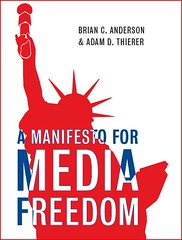 I’m pleased to announce the publication of A Manifesto for Media Freedom, which I co-authored with Brian C. Anderson of the Manhattan Institute. Brian serves as editor of Manhattan Institute’s excellent City Journal and he is the author of best-selling books like South Park Conservatives and Democratic Capitalism and Its Discontents.
In this little manifesto, we highlight one of the central ironies of the Information Age. Namely, that despite “the breathtaking abundance of new and old media outlets for obtaining news, information, and entertainment…”
many people hate this profusion, and never more than when it involves political speech. The current media market, they charge, doesn’t represent true diversity, or isn’t fair, or is subject to manipulation by a small and shrinking group of media barons. They want the government to regulate it into better shape, which just happens to be a shape that benefits them. Doing so… would be a disaster, a kind of soft or not-so-soft tyranny that would wipe out whole sectors of media, curtailing free speech and impoverishing our democracy.
In other words, instead of celebrating the unprecedented cornucopia of media choices at our collective disposal, many policymakers and media critics are calling for just as much media regulation as ever. We itemize these threats in our chapters and they include: efforts to revive the “Fairness Doctrine”, media ownership regulations, “localism” requirements, Net neutrality mandates, a la carte regulations, cable and satellite censorship, video game censorship, regulation of social networking sites, campaign finance-related speech restrictions, and so on.
In each case, we advance a pro-freedom paradigm to counter the advocates of media control. What do we mean by the “media freedom” that we advocate as the alternative to these new regulatory crusades? Here’s how we put it in the book:
Continue reading →
Jeff Eisenach, Chairman of Criterion Economics, and I have just released a new article about the perils of a la carte regulation in the Federalist Society’s journal Engage. In “A La Carte Regulation of Pay TV: Good Intentions vs. Good Economics,” we argue that: “From a policy perspective, a la carte regulation is worse than a solution in search of a problem; it is a problem waiting to happen.” We show that the pay TV marketplace is functioning quite efficiently and that consumers have more choices and content diversity at their disposal than ever. A la carte mandates, we argue, would destroy that diversity and likely put pressure on prices to go up, contrary to the goals of the backers of a la carte.
We also discuss how a la carte is being proposed a tool of social regulation / speech control, with backers labeling it a way of “cleaning up cable.” We explain why that is not going to work and why, even if it did, it would be a betrayal of the First Amendment.
This new article can be found online here.
Bruce Owen, America’s preeminent media economist–with apologies to Harold Vogel, who at least deserves an honorable mention–has written another splendid piece for Cato’s Regulation magazine, this one entitled, “The Temptation of Media Regulation.”
This latest essay deals primarily with the many fallacies surrounding so-called “a la carte” regulation of the video marketplace, and I encourage you to read it to see Owen’s powerful refutation of the twisted logic behind that regulatory crusade. But I wanted to highlight a different point that Bruce makes right up front in his essay because it is something I am always stressing in my work too.
In some of my past work on free speech and media marketplace regulation, I have argued that there is very little difference between Republicans and Democrats when it comes to these issues. They are birds of feather who often work closely together to regulate speech and media. Whether it is broadcast ‘indecency’ controls; proposals to extend those controls to cable & satellite TV; campaign finance laws; efforts to limit or rollback ownership regulations; or even must carry and a la carte, the story is always the same: It’s one big bipartisan regulatory love fest. [And the same goes for regulation of the Internet, social networking sites, and video games.]
Owen explains why that is the case:
Continue reading →
As I mentioned yesterday, James Gattuso and I penned an editorial for National Review this week about the growth of FCC regulation and spending in recent years. In the op-ed, we also noted that, “For whatever reason, a disproportionate number of these [new regulatory proposals] have been aimed at cable television, so much so that press and industry analysts now speak of Chairman Martin’s ongoing ‘war on cable.'”
Today, the editors at
National Review have chimed in with an editorial of their own on the issue entitled, “Pulling the Cable on Martin’s Crusade.” Specifically, the editors address what most pundits believe really motivates the Chairman’s crusade against cable: His desire to force cable companies to offer consumers channels on “a la carte” basis in an effort to “clean up” cable TV. “Martin should abandon this particular crusade,” the NR editors argue. “While we are sympathetic to parents’ desire to get the channels they want without having to buy access to racier fare, using economic regulation to restructure an industry is the wrong approach.” They continue:
Continue reading →
With the release last month of its report on Violent Television Programming and Its Impact on Children, the FCC teed up the issue of regulating televised violence and tossed it over to Congress with a recommendation that lawmakers go ahead and swing for the fences. And Congress appears ready to oblige, although not necessarily in the way some at the FCC had originally envisioned.
You will recall that FCC Chairman Kevin Martin used the FCC’s violence report as another opportunity to engage in his monomaniacal, Moby Dick-like quest to impose a la carte regulation on cable and satellite operators. Martin argued that “Requiring cable and satellite television providers to offer programming in a more a la carte manner would be a more content neutral means for Congress to regulate violent programming and therefore would raise fewer constitutional issues.” But it doesn’t appear that the chairman is going to get his whale this time around.
Continue reading →

 The Technology Liberation Front is the tech policy blog dedicated to keeping politicians' hands off the 'net and everything else related to technology.