Posts tagged as:

Vision of the Anointed book coverBerin recently encouraged me to re-read Thomas Sowell’s The Vision of the Anointed: Self-Congratulation as a Basis for Social Policy, which I hadn’t looked at since I first read it back in 1995 or 96.   I’m glad I did since Sowell’s work has always been profoundly influential on my thinking (especially his masterpiece, A Conflict of Visions) and I had forgotten how useful The Vision of the Anointed was in helping me understand the reoccurring model that drives ideological crusades to expand government power over our lives and economy.

“The great ideological crusades of the twentieth-century intellectuals have ranged across the most disparate fields,” Sowell noted in the book.  But what they all had in common, he argued, was “their moral exaltation of the anointed above others, who are to have their different views nullified and superseded by the views of the anointed, imposed via the power of government.” (p. 5)  These elitist, government-expanding crusades shared several key elements, which Sowell identified as follows:

  1. Assertion of a great danger to the whole society, a danger to which the masses of people are oblivious.
  2. An urgent need for government action to avert impending catastrophe.
  3. A need for government to drastically curtail the dangerous behavior of the many, in response to the prescient conclusions of the few.
  4. A disdainful dismissal of arguments to the contrary as either uninformed, irresponsible, or motivated by unworthy purposes.

You can see this model at work on a daily basis today with our government’s various efforts to reshape our economy, but I think this model is equally applicable to debates over social policy and speech control.  In particular, the various “technopanics” I have been writing about recently fit this model. (See 1, 2, 3, 4, 5).  For example, consider how this plays out in the debate over online social networking:

Continue reading →

As Berin mentioned last week, we have a new paper out on proposals to expand the Children’s Online Privacy Protection Act (COPPA) of 1998.   We generically refer to those COPPA-expansion efforts as “COPPA 2.0.” Hence, the title of our paper: “COPPA 2.0: The New Battle over Privacy, Age Verification, Online Safety & Free Speech.”  To recap what Berin already noted, in the name of improving online child safety, some legislators and state attorneys general (AGs) are advocating the expansion of COPPA’s “verifiable parental consent” model of age verification before certain sites or services may collect, or enable the sharing of, personal information for children.

Unlike “COPPA 1.0,” however, which only applied to children under the age of 13, “COPPA 2.0” would apply to all minors up to age 17.  Moreover, the range of sites covered by the new law would generally be expanded to include just about any site or service with social networking functionality.

Since Berin has already summarized our general concerns with efforts to expand COPPA’s “verifiable parental consent” online age verification system to cover more online users and sites, I thought I would focus here on what I believe will be the most controversial (and important) part of our paper — our discussion about how COPPA 2.0 affects the speech rights of both adults and adolescents.

Continue reading →

Adam Thierer & I have just released a detailed examination (PDF) of brewing efforts to expand the Children’s Online Privacy Protection Act of 1998 to cover adolescents and potentially all social networking sites—an approach we call “COPPA 2.0.”

As Adam explained on Larry Magid’s CNET podcast, COPPA mandates certain online privacy protections for children under 13, most importantly that websites obtain the “verifiable consent” of a child’s parent before collecting personal information about that child or giving that child access to interactive functionality that might allow the child to share their personal information with others. The law was intended primarily to “enhance parental involvement in a child’s online activities” as a means of protecting the online privacy and safety of children.

Yet advocates of expanding COPPA—or “COPPA 2.0″—see COPPA’s verifiable parental consent framework as a means for imposing broad regulatory mandates in the name of online child safety and concerns about social networking, cyber-harassment, etc. Two COPPA 2.0 bills are currently pending in New Jersey and Illinois. The accelerated review of COPPA to be conducted by the FTC next year (five years ahead of schedule) is likely to bring to Washington serious talk of expanding COPPA—even though Congress clearly rejected covering adolescents age 13-16 when COPPA was first proposed back in 1998.

We’ll discuss some of the key points of our paper in a series of blog posts, but here are the top nine reasons for rejecting COPPA 2.0, in that such an approach would:

  • Burden the free speech rights of adults by imposing age verification mandates on many sites used by adults, thus restricting anonymous speech and essentially converging—in terms of practical consequences—with the unconstitutional Children’s Online Protection Act (COPA), another 1998 law sometimes confused with COPPA;
  • Burden the free speech rights of adolescents to speak freely on—or gather information from—legal and socially beneficial websites;
  • Hamper routine and socially beneficial communication between adolescents and adults;
  • Reduce, rather than enhance, the privacy of adolescents, parents and other adults because of the massive volume of personal information that would have to be collected about users for authentication purposes (likely including credit card data);

Continue reading →

As anyone who has spent time searching for comments on the FCC’s website can tell you, the agency doesn’t exactly have the most user-friendly website.  In the interest of making it easier for others to read the comments that came in last week in the agency’s “Child Safe Viewing Act” Notice of Inquiry, I have compiled all the major comments (those over 3 or 4 pages) and provided links to them below the fold.

Again, this proceeding was required under the “Child Safe Viewing Act of 2007,” which Congress passed last year and President Bush signed last December. The goal of the bill and the FCC’s proceeding (MB 09-26) is to study “advanced blocking technologies” that “may be appropriate across a wide variety of distribution platforms, including wired, wireless, and Internet platforms.”  I filed 150+ pages worth of comments in this matter last week, and here’s my analysis of why this bill and the FCC’s proceeding are worth monitoring closely.

Continue reading →

Today I filed comments with the Federal Communications Commission (FCC) in its proceeding examining the marketplace for “advanced blocking technologies.”  This proceeding was required under the “Child Safe Viewing Act of 2007,” which Congress passed last year and President Bush signed last December. The goal of the bill and the FCC’s proceeding (MB 09-26) is to study “advanced blocking technologies” that “may be appropriate across a wide variety of distribution platforms, including wired, wireless, and Internet platforms.”  My colleagues will no doubt laugh about the fact that I have dropped an absurd 150 pages worth of comments on the FCC in this matter, but I had a lot to say on this topic!  Parental controls, child safety, and free speech issues have been the focus of much of my research agenda over the past 10 years.

In my filing, I argue that the FCC should tread carefully in this matter since the agency has no authority over most of the media platforms and technologies described in the Commission’s recent Notice of Inquiry.  Moreover, any related mandates or regulatory actions in in this area could diminish future innovation in this field and would violate the First Amendment rights of media creators and consumers alike.  The other major conclusions of my filing are as follows:

  • There exists an unprecedented abundance of parental control tools to help parents decide what constitutes acceptable media content in their homes and in the lives of their children.
  • There is a trade-off between complexity and convenience for both tools and ratings, and no parental control tool is completely foolproof.
  • Most homes have no need for parental control technologies because parents rely on other methods or there are no children in the home.
  • The role of household media rules and methods is underappreciated and those rules have an important bearing on this debate.
  • Parental control technologies work best in combination with educational efforts and parental involvement.
  • The search for technological silver-bullets and “universal” solutions represent a quixotic, Holy Grail-like quest and it will destroy innovation in this marketplace.
  • Enforcement of “household standards” made possible through use of parental controls and other methods negates the need for “community standards”-based content regulation.

My entire filing can be found here and down below in a Scribd reader.  All comments in the matter are due tomorrow and then reply comments are due on May 18th.

Continue reading →

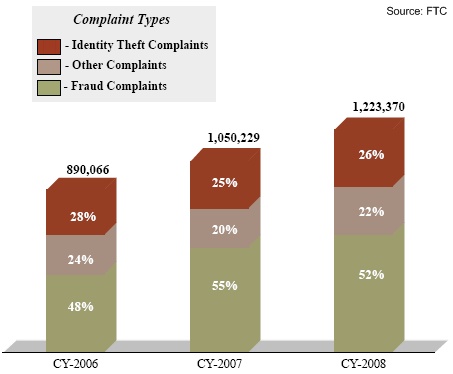
Whenever I pen anything about the dangers of age verification mandates for the Internet and social networking sites, I always point to Federal Trade Commission (FTC) reports about rising identity theft complaints. For the ninth year in a row, identity theft was the number one consumer complaint to the agency.

Now, imagine how much worse this problem could get if government mandated that everyone had to be “verified” before they were allowed to visit a social networking site, however that ends up being defined. Such a mandate would exponentially increase the amount of personal information — especially credit card information — that was available to identity thieves.  Age verification advocates often ignore this problem when making the case for regulation.

Worse yet, much of the information that would be made available via such mandates would be personal information about children, which makes for a very attractive target for identity thieves since those records are rarely checked until the kids get much older and start applying for things. At least most adults typically learn they have been the victim of ID theft shortly after it occurs, allowing them to take steps to deal with the situation. With kids, their records could be milked for years by bad guys without them or their parents ever knowing it.

ID theft FTC

gavelIt appears that the long legal saga of the Child Online Protection Act of 1998 (COPA) has finally come to a close. This morning, according to AP, the U.S. Supreme Court rejected the government’s latest request to revive the law, which was stuck down as an unconstitutional violation of the First Amendment by lower courts and never went into effect.

COPA was an effort by Congress to modify the Communications Decency Act of 1996 (CDA) in response to the Supreme Court’s decision in Reno v. ACLU finding that the CDA was unconstitutionally over-broad. COPA sought to narrow the scope of regulation and protect minors from sexual material on the Internet by making it a crime for someone to “knowingly” place materials online that were “harmful to minors.” The law provided an affirmative defense from prosecution, however, to those parties who made a “good faith” effort to “restrict[ ] access by minors to material that is harmful to minors” using credit cards or age verification schemes. Although narrower than the CDA, COPA was immediately challenged and also blocked by lower courts because it was still too sweeping in effect. Moreover, the courts found there were other “less restrictive means” that parents could use to deal with objectionable content — such as Internet filters.

Following the initial challenge, COPA then became the subject of an epic, decade-long legal battle that finally concluded today when the U.S. Supreme Court refused to revisit the law. COPA had already been reviewed by the Supreme Court twice before — in 2002 and 2004.  Thus, a third visit to the Supreme Court by COPA would have been something of a historical development in the world of First Amendment jurisprudence. But with the Supreme Court’s rejection of the government’s appeal today, lower court rulings stand and COPA will remain unconstitutional and unenforceable.

The key recent legal battle occurred in the Third Circuit Court of Appeals, which upheld a lower court ruling striking down COPA. The Third Circuit’s full decision is here. And I penned a 3-part series on the lower court ruling by Judge Lowell Reed Jr., senior judge of the U.S. District Court for the Eastern District of Pennsylvania, here, here, and here. Also make sure to check out this summary of COPA’s legal journey that Alex Harris penned last November.

While COPA is now dead and buried, it would be foolish to think this is the end of efforts to legislate on this front. Although it remains unclear what the legislative response will look like during a time of Democratic rule, I am certain that legislation will be floated in short order (i.e., “Son of COPA”) to try to get around the constitutional issues and regulate objectionable online content. If legislators were smart, they’d avoid legally risky solutions like more centralized filtering mandates or age verification requirements. They’d be on safer ground to consider going the subsidy route and finding a way to get parental control tools in the hands of more families and institutions. I’m not saying that I favor such subsidies, merely that such an approach would almostly certainly pass legal muster and probably wouldn’t even be challenged in court. They might also consider more public education / PSA-driven approached to online safety. Those approaches may end up finding more support in a Democratic Congress and administration anyway.

[More coverage at NYT, Reuters, CNet and Ars.]

ISTTF coverThe Internet Safety Technical Task Force (ISTTF), which was formed a year ago to study online safety concerns and technologies, today issued its final report to the U.S. Attorneys General who authorized its creation. It was a great honor for me to serve as a member of the ISTTF and I believe this Task Force and its report represent a major step forward in the discussion about online child safety in this country.

The ISTTF was very ably chaired by John Palfrey, co-director of Harvard University’s Berkman Center for Internet & Society, and I just want to express my profound thanks here to John and his team at Harvard for doing a great job herding cats and overseeing a very challenging process. I encourage everyone to examine the full ISTTF report and all the submissions, presentations, and academic literature that we collected. [It’s all here.] It was a comprehensive undertaking that left no stone unturned.

Importantly, the ISTTF convened (1) a Research Advisory Board (RAB),which brought together some of the best and brightest academic researchers in the field of child safety and child development and (2) a Technical Advisory Board (TAB), which included some of America’s leading technologists, who reviewed child safety technologies submitted to the ISTTF. I strongly recommend you closely examine the RAB literature review and TAB assessment of technologies because those reports provide very detailed assessments of the issues. They both represent amazing achievements in their respective arenas.

There are a couple of key takeaways from the ISTTF’s research and final 278-page report that I want to highlight here. Most importantly, like past blue-ribbon commissions that have studied this issue, the ISTTF has generally concluded there is no silver-bullet technical solution to online child safety concerns. The better way forward is a “layered approach” to online child protection. Here’s how we put it on page 6 of the final report:

The Task Force remains optimistic about the development of technologies to enhance protections for minors online and to support institutions and individuals involved in protecting minors, but cautions against overreliance on technology in isolation or on a single technological approach. Technology can play a helpful role, but there is no one technological solution or specific combination of technological solutions to the problem of online safety for minors. Instead, a combination of technologies, in concert with parental oversight, education, social services, law enforcement, and sound policies by social network sites and service providers may assist in addressing specific problems that minors face online. All stakeholders must continue to work in a cooperative and collaborative manner, sharing information and ideas to achieve the common goal of making the Internet as safe as possible for minors.

Continue reading →

I was about post something more regarding why Kevin Martin’s AWS-3 spectrum filtering plan will fail, but I can’t say it any better than Steve Schultze does here:

Martin also recently leaked the fact that he is proposing that adults can verify their identity to avoid the porn filter initially mandated for all users of of the no-fee service. I helped author some comments to the FCC explaining why this filter was a bad idea, so an opt-out mechanism could theoretically be a good development… if age verification were viable, and if you thought that adults were eager to identify themselves as possible porn-lovers, and if we assumed that all adults had credit cards. In short, filtering is not a great option even with those caveats.

Exactly. Also, don’t forget about that little thing called the First Amendment! This plan would almost certainly be challenged on 1A grounds. (Also, here’s a filing I signed on to that critiques the filtering plan).

Blown to Bits coverI’ve just finished reading Blown to Bits: Your Life, Liberty, and Happiness After the Digital Explosion, by Hal Abelson, Ken Ledeen, and Harry Lewis, and it’s another title worth adding to your tech policy reading list. The authors survey a broad swath of tech policy territory — privacy, search, encryption, free speech, copyright, spectrum policy — and provide the reader with a wonderful history and technology primer on each topic.

I like the approach and tone they use throughout the book. It is certainly something more than “Internet Policy for Dummies.” It’s more like “Internet Policy for the Educated Layman”: a nice mix of background, policy, and advice. I think Ray Lodato’s Slashdot review gets it generally right in noting that, “Each chapter will alternatively interest you and leave you appalled (and perhaps a little frightened). You will be given the insight to protect yourself a little better, and it provides background for intelligent discussions about the legalities that impact our use of technology.”

Abelson, Ledeen, and Lewis aren’t really seeking to be polemical in this book by advancing a single thesis or worldview. To the extent the book’s chapters are guided by any central theme, it comes in the form of the “two basic morals about technology” they outline in Chapter 1:

The first is that information technology is inherently neither good nor bad — it can be used for good or ill, to free us or to shackle us. Second, new technology brings social change, and change comes with both risks and opportunities. All of us, and all of our public agencies and private institutions, have a say in whether technology will be used for good or ill and whether we will fall prey to its risks or prosper from the opportunities it creates. (p. 14)

Mostly, what they aim to show is that digital technology is reshaping society and, whether we like or it not, we better get used to it — and quick!  “The digital explosion is changing the world as much as printing once did — and some of the changes are catching us unaware, blowing to bits our assumptions about the way the world works… The explosion, and the social disruption that it will create, have barely begun.” (p 3)

In that sense, most chapters discuss how technology and technological change can be both a blessing and a curse, but the authors are generally more optimistic than pessimistic about the impact of the Net and digital technology on our society. What follows is a quick summary of some of the major issues covered in Blown to Bits.

Continue reading →