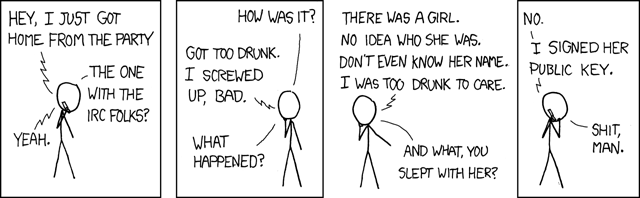
That bewildering title is my entire contribution to the discussion of the Australian government’s plan to filter the Internet. The 463 has a good write-up of this bad idea. The picture they’ve illustrated the post with alone makes it worth a visit.
That bewildering title is my entire contribution to the discussion of the Australian government’s plan to filter the Internet. The 463 has a good write-up of this bad idea. The picture they’ve illustrated the post with alone makes it worth a visit.
Over the slow holiday season, the Internet has been alight with outrage over the Recording Industry of America’s argument in a file-sharing case that, per the Washington Post, “it is illegal for someone who has legally purchased a CD to transfer that music into his computer.”
But as copyright expert William Paltry explains, it simply ain’t so:
[T]he RIAA is being unfairly maligned. I have read the brief (and you can too here). On page 15 of the brief, we find the flashpoint: “Once Defendant converted Plaintiffs’ recordings into the compressed .mp3 format AND they are in his shared folder, they are no longer the authorized copies distributed by Plaintiffs.” I have capitalized the word “and” because it is here that the RIAA is making the point that placing the mp3 files into the share folder is what makes the copy unauthorized. The RIAA is not saying that the mere format copying of a CD to an mp3 file that resides only on one’s hard drive and is never shared is infringement. This is a huge distinction…
An interesting point from Joel Johnson:
That it seems possible that the RIAA would go after people for ripped CDs says a lot about the way most people—including the Washington Post, apparently—view the organization…
This is true, but is any other course imaginable? CD sales, and record company profits, seem to be in free-fall, and it’s beyond credulity at this point to argue that online file-sharing isn’t, at least to a significant extent, to blame. Why would an industry fade without a struggle?
As the recording industry grasps desperately for revenues, it is perhaps inevitable that it will increasingly clash with record buyers, musicians, and the public. So expect more alarmism, more yellow journalism, and greater vitriol from the “copyfighters” and their allies and expect (probably) for all this to be used as further leverage to push “open culture” policies, however tenuous their connection to the source of conflict, the collateral damage of an industry’s slow collapse–which itself is no new or unique thing.
In other words, expect a lot more of these kind of stories in 2008. John Tierney’s article yesterday on the sociology climate change is a better explanation than most as to why.
I’ve been trying to keep tabs on the status of various municipal wi-fi experiments going on across the nation by posting local news reports about them whenever I see them. The results so far have not been encouraging, but this hasn’t been that surprising since those of us who study these issues know that most wireline muni experiments failed too.
And speaking of failed wireline experiments, it appears there’s another one that might soon be added to the list. The Utah Telecommunications Open Infrastructure Agency–or “UTOPIA” as it is known–was created in 2002 by local Utah officials who wanted to bring high-speed Internet access to their communities. Eleven communities pledged roughly $200 million over 20 years to back the bonds needed to finance the construction of advanced fiber-optic facilities. Utilimately, the goal was to ensure inexpensive broadband for the masses at minimal cost to taxpayers.
But there are problems in paradise. According to this recent article by Steve Oberbeck of The Salt Lake Tribune:
[F]our years after 11 Utah cities… pledged to financially back the UTOPIA system, its finances are in shambles. Construction is behind schedule. Its top promoters have quit, and its newest chairman has uttered the unthinkable – that despite promises to the contrary, the cities that pledged their support eventually may have to pony up hundreds of millions in taxpayer dollars to prop up the system.
What went wrong?
Each year, the Edge Foundation surveys a score (~160 this year) of prominent scientists and other notables for brief-essay answers to a big-picture question. This year: “What have you changed your mind about?”
Some elaboration:
When thinking changes your mind, that’s philosophy. When God changes your mind, that’s faith. When facts change your mind, that’s science. WHAT HAVE YOU CHANGED YOUR MIND ABOUT? WHY? Science is based on evidence. What happens when the data change? How have scientific findings or arguments changed your mind?”
With Richard Dawkins, Aubrey de Grey (less repetitive than usual), various Dysons, Denis Dutton, and Brian Eno among the respondents, there’s plenty of interest to read and consider.
And much to mock. On the existence of god as a signal of one’s above-it-all elitism, compare the trite Alan Alda (yes, him) with an unusually shrill Clay Shirky.
Did you know that you have only 412 days left of analog-TV viewing pleasure?
Yes, it’s true (unless lawmakers change their minds in response to lobbying from, e.g., circa-1968-Zenith-owning grandmothers from the Heartland flown in by the NAB). In 412 days, your old analog set will pick up nothing but soothing, gentle static (let’s hear it for user-generated content).
For some, this may be a relief–it will be, after all, locally-produced static.
The crumbs laid out for me by my feeds this morning have lead me to the brewing showdown between Daily Kos and Jonah Goldberg. Goldberg’s new book Liberal Fascism is certainly provocatively titled. The cover is no less a tweak. Goldberg talks about it with “Glenn and Helen” here.
Kos’ Thomas Kalinowski proposes a Googlebomb on the title of the book, sending searchers to a criticism of it. All well and good – except that it’s not as fair as letting criticisms of the book rise on their merits. And here’s a problem: Google has taken steps to defuse the Googlebombing technique.
I also saw a Danny Glover post this morning speculating on the declining traffic of the Daily Kos blog. Interestingly, Glover saw the talk of Kos’ decline on National Review Online, a home of none other than Jonah Goldberg.
All very incestuous, and part of the rollerball-politics that doesn’t interest me terribly much. Whatever the case, Goldberg is getting a lot of pre-release awareness for his book which, Googlebomb or Googledud, defeats his opponents’ aims.
Watch the success or failure of the “Liberal Fascism” Googlebomb here.
Nothing like the holidays for catching up on one’s reading! Here, in no particular order, are things I should have pointed out to you already:
Finally, there’s an article critical of Richard Epstein’s treatment of intellectual property as similar to physical property. I understand Professor Epstein will respond to “Intellectual Property and the Property Rights Movement” by Peter Menell in the next Regulation.
Technological mechanisms have been seductive because they pull in vast amounts of data and can be planned for and budgeted. But they are indiscriminate and generate more raw intelligence than we can process, even as they fail to provide the key intelligence from inside the enemy camp.I’ve often thought that spooks like mass surveillance because it means they don’t have to get out of their chairs and put boots on the ground in dangerous places. But don’t underestimate the closely related urge to work on a stable program whose budget situation is under control.
Responding to other comments, the author of the article says the following:
The lower the public image of the United States abroad, the harder it will be to recruit foreign spies who will divulge secrets out of a shared respect for human values.
Works of authorship originate in private, safely kept under common law protections. Once published, however, expressive works become data ferae naturae—wild and natural information. As such, expressive works roam and reproduce freely. They may get captured in fixed copies, caged in atoms or bits. But the public, once it has absorbed an expressive work, generally retains relatively cheap access to it—unless and until copyright intervenes.
Copyright law limits public access to expressive works, herding them off the commons and into private hands. The Copyright Act offers a sort of ranch to authors, giving them a place to birth, raise, and sell their expressive works safe from the deprivations of grasping strangers. Authors enjoy those special privileges against the public not as a natural right, but rather solely thanks to a policy authorized by the U.S. Constitution and implemented through the Copyright Act. [The figure below] illustrates the path that copyright, together with some of its legal next-of-kin, takes from its origins towards its goals.

While rightly shuddering at specter of copyism, we should also recognize that the unauthorized use of copyrighted works can, if it does not go so far as to undercut authors’ incentives, increase social wealth. Consider, for instance, an impoverished entrepreneur relying on pirated software to start her business. Supposing that she could not afford to buy an authorized copy, and that her unauthorized use would not depress software production, her infringement would generate a welcome consumer surplus. The same would hold true of, say, someone who enjoys an infringing copy of a CD despite being unwilling to pay its retail price. As [the figure below] illustrates, those exceptions to the strict enforcement of copyright law could in theory benefit us all without discouraging the production and distribution of expressive works.

[The above figure] surely offers too sanguine a view of the effects of copyright infringement, however. Without the limitations imposed by copyright law, some consumers who would otherwise willingly pay for authorized uses might instead opt to save their money by joining the unpaying masses of unauthorized users. The resulting exodus, from respecting copyright to infringing it, would risk decreasing the revenues afforded by copyright, bringing about the policy tragedy portrayed [earlier].
 The Technology Liberation Front is the tech policy blog dedicated to keeping politicians' hands off the 'net and everything else related to technology.