My poorly updated privacy Web site Privacilla is controlled by a non-profit corporation called Privacilla.org, Inc. The corporation has been more hassle than it’s worth to maintain, so I may just dissolve it at some point here. But in the meantime, I recently received this letter from the IRS instructing little Privacilla to file a new information return.
It’s an electronic return for non-profits with gross receipts of $25,000 or less, and it’s called Form 990-N. Failing to file for three years would result in the corporation’s non-profit status being revoked. Apparently, some 650,000 small non-profits are subject to this new requirement.
Many years’ accretions of regulations, filing requirements, and fees (both federal and state) are part of why it is too much hassle to maintain Privacilla as a non-profit. But this one is special. As far as I can tell,
there is no Form 990-N. Everything I can find on the IRS Web site talks about it in the future tense.
This is mostly bemusing to me. I have until May 15th to file this form. But it will be less funny if May 15th rolls around and the form still doesn’t exist. It’s also less funny for people who aren’t technically competent attorneys, and who approach the world of law and government with less confidence. To them, this can be scary, and it’s idiocy. Typical IRS idiocy – to require submission of a form that doesn’t exist.
Bleg: Do correct me if I’m wrong! For my claims to sophistication, I may be some kind of rube for looking on the IRS Web site for an IRS electronic filing system.
Whenever I hear some politician or political pundit lament the supposedly dismal state of political discourse in modern America, I always laugh. Anyone who has ever read a lick of history knows that politics has always been a dirty business full of plenty of under-handed antics and distasteful rhetoric.
I was reminded of this again this morning as I was reading through
The Washington Post and saw various people complaining about the tone and tactics on display in this year’s presidential primaries. Then, I flipped to the editorial page and saw an interesting essay entitled “Lincoln-Douglas: The Real Thing,” by civil war era historian Allen C. Guelzo of Gettysburg College. It included the following gem of passage about the heated 1858 Senate campaign battle between Lincoln and Douglas:
A month into the campaign, lagging in visibility and short of funds, Lincoln challenged Douglas to a series of debates — outdoors, unrehearsed — in seven locations around the state. At a time when popular community entertainments included mano-a-mano encounters such as wrestling, horse racing and knife fighting, one-on-one debating seemed a perfectly natural forum for political contests, too. And the Lincoln-Douglas debates certainly had their share of entertaining features. Brass bands hired by Republicans and Democrats struggled to drown each other out. Banners with raw sexual innuendoes and crude racial insults billowed over the heads of the crowds. At one debate, someone shied a melon at Douglas and struck him on the shoulder.
Like I was saying, the more things change, the more things stay the same.
All year in 2008, former National Journal Tech Daily editor and Beltway Blogroller Danny Glover will be cataloging all the taxes his family pays.
“How much do you really pay in taxes?” he says. “If you knew, you might get angry. You should — and I hope this blog will get you riled.”
Note the Weekly Tax Bite posts, where he tracks the tax-man’s weekly take in sales taxes, gas taxes, and so on.
Now that Tech Daily is gone, Danny will be devoting his time to AirCongress.
Last week, I published an Op-Ed in the Detroit News predicting chaos at the border in the face of ramped up document checks. I was wrong.
In fact, the DHS was bluffing. Border crossers who lacked government-issued photo ID and proof of citizenship like birth certificates or naturalization certificates weren’t prevented from crossing. They were given fliers.
As the AP reports:
Bobby and Genice Bogard of Greers Ferry, Ark., . . . who winter in Mission, Texas, knew the requirements were coming but thought they took effect in June. So even though they have U.S. passports, they had left them at home.
“He allowed us to pass with a driver’s license,” Bobby Bogard said of a border agent.
“But next time he said he wouldn’t,” added Genice Bogard.
I’ll probably get mocked again, but here’s another thing I didn’t know about regulation in the good ‘ol days of the 1970s (from this paper):
With capacity and route expansion foreclosed as outlets for product differentiation, the trunk carriers devised new means of service competition. “Capacity wars” gave way to “lounge wars.” On wide-bodied aircraft, lounges were introduced in first class, then in coach. When American installed piano bars, TWA countered with electronic draw-poker machines. Live entertainment proliferated, with musicians, magicians, wine-tasters, and Playboy bunnies.
When’s the last time you saw live entertainment on a commercial flight?
Weird…
The league bans public exhibitions of its games on TV sets or screens larger than 55 inches because smaller sets limit the audience size. The section of federal copyright law giving the NFL protection over the content of its programming exempts sports bars, NFL spokesman Brian McCarthy said.
Any idea what he’s talking about? I’ve read through a number of sections of the copyright statutes, and I don’t think I’ve ever seen the term “sports bar” mentioned.
Update: Ladies and gentlemen, we have a winner:
In the case of a food service or drinking establishment, either the establishment in which the communication occurs has less than 3,750 gross square feet of space (excluding space used for customer parking and for no other purpose), or the establishment in which the communication occurs has 3,750 gross square feet of space or more (excluding space used for customer parking and for no other purpose) and… any visual portion of the performance or display is communicated by means of a total of not more than 4 audiovisual devices, of which not more than one audiovisual device is located in any 1 room, and no such audiovisual device has a diagonal screen size greater than 55 inches, and any audio portion of the performance or display is communicated by means of a total of not more than 6 loudspeakers, of which not more than 4 loudspeakers are located in any 1 room or adjoining outdoor space;
Now that I think of it, large sports bars with a bunch of TVs almost always have more than one game on. Now I know why! Thanks to reader dio gratia for the tip.
In the first installment of my Media Metrics series, I presented an analytical framework that can be used to evaluate the state the media marketplace and specific media sectors. I also argued that within each segment of the media value chain (Content options >> Distribution options >> Receiving options >> Storage options) we see more choice, competition, and diversity than ever before in human history. As this fifth installment of the series will show, nowhere is that fact more evident than in the market for audible information and entertainment, which has undergone radical transformation over the past decade.
For most of the past century, the audible information and entertainment sector was generally thought of as broadcast radio, the recorded music industry, and the live music business. It was a fairly stable industry that did not witness business model-shattering type changes. For radio, AM gave way to FM. For recorded music, vinyl gave way to tapes and CDs. And live music simply found larger (and more) venues.
Today, however, stability has given way to volatility. This entire marketplace is in a state of seeming constant upheaval. Everything has changed and continues to change at a rapid pace as “disruptive technologies” fly at us with increasingly regularity. Old business models are breaking down, and new ones are multiplying. Long-standing industry players are shedding assets or even disappearing as underdogs rapidly enter the sector and become big dogs overnight. You want a textbook example of Schumpeterian creative destruction in action? This market is it.
Exhibit 1
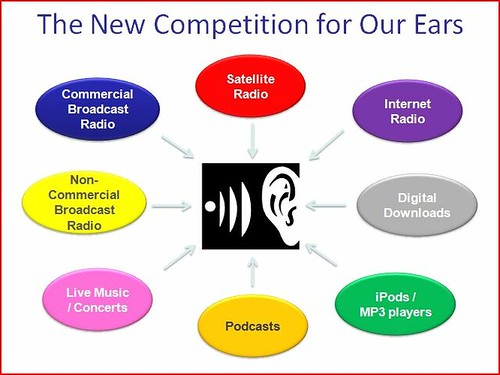
Continue reading →
In case you didn’t catch it the debate last night, Sen. Obama had some very encouraging things to say when asked about the role of government when it comes to media content. “[T]he primary responsibility is for parents,” Obama said. “And I reject the notion of censorship as an approach to dealing with this problem.” He then stressed the importance of making sure that parents have the tools to make these determinations for their families (something I’ve spent a lot of time stressing in my work):
“[I]t is important for us to make sure that we are giving parents the tools that they need in order to monitor what their children are watching. And, obviously, the problem we have now is not just what’s coming over the airwaves, but what’s coming over the Internet. And so for us to develop technologies and tools and invest in those technologies and tools, to make sure that we are, in fact, giving parents power — empowering parents I think is important.”
Good for him. That’s the exactly the right position, and one that his opponent Mrs. Clinton would be wise to adopt. After all, she’s had some rather misguided views on these issues through the years.
Here’s the transcript if you care to read more.
The Institute for Politics, Democracy & the Internet, part of the Graduate School of Political Management of The George Washington University, is hosting the Politics Online Conference 2008 on March 4th and 5th at the Renaissance Washington DC Hotel.
Because of my work on WashingtonWatch.com, and because I live a) online b) in Washington, D.C., this looks like an interesting conference.
Among other things, TLFers might enjoy the first day’s keynote, entitled:
Building a Broadband Strategy for America. I like America, and I like Broadband, so it’s got to be good – right?!
And here’s an exclusive for TLF readers – $50 off your admission! When you go to register, in the discount code (optional) field, enter “MINUS50” and you’ll get the savings. Convince 20 of your friends to come and you’ll save $1,000! Hard to pass up.

 The Technology Liberation Front is the tech policy blog dedicated to keeping politicians' hands off the 'net and everything else related to technology.