The Federal Communications Commission conducted a public hearing this week on network management before a group of law students – as opposed to, say, engineering students who are the ones who study network management – where lead witness Rep. Ed Markey (D-MA) declared
[T]he Internet is as much mine and yours as it is Verizon’s, AT&T’s or Comcast’s. Please keep front and center in your examination the needs and wishes of the community of users rather than a small coterie of carriers.
As a matter of law, Markey would have flunked if that were an exam question. But of course the government has a right to try to control whatever it wishes one way or another.
The interesting and relevant question is whether and to what degree it’s possible to proscribe network management practices which most reasonable people would consider inappropriate without unintentionally preventing network providers from trying to improve their services while earning a competitive return on their investment.
“[C]learly, complicated network architectures, Internet viruses, and capacity limitations raise real-world, complex and valid questions, conceded FCC Commissioner Michael J. Copps. “Our job is to figure out when and where you draw the line between discrimination and reasonable network management.”
Continue reading →
Tom Bell–who I regarded as the the equivalent of my Jedi master in the mid-90s–suggested in a post earlier today that:
“Copyright holders thus understandably fear that their customers have begun to treat expressive works like common property, free for all to use. That, the specter of copyism, does risk upsetting copyright policy, leading to a market failure in the production of expressive works. Even as we recognize that threat, however, we should also appreciate that technological advances have greatly reduced the costs of creating and distributing new works of authorship. Thanks to that deflation, we can increasingly count on authors who care little about the lucre of copyright — blockheads, as Samuel Johnson called them — to supply us with original expressive works.”
As his once lowly Padawan learner, I know to be cautious when questioning my old master’s wisdom. But I must humbly ask: How, dear master, does a video game this frickin cool and complex get created in a world devoid of serious copyright protections? It’s a question I have asked before here and I have never received an answer that satisfied my fear of losing some of the truly great content that gets created only because of the protections afforded by existing copyright standards.
I await your enlightenment, my master. Because I can’t imagine many “blockheads” providing us with expressive works like this without some sort of guarantee that their creative efforts will not be completely expropriated.
http://image.com.com/gamespot/images/cne_flash/production/media_player/proteus/gs/proteus_embed.swf
[More videos of “Star Wars: The Force Unleashed” can be found here.]
Just posted on SSRN: The Specter of Copyism v. Blockheaded Authors: How User-Generated Content Affects Copyright Policy. Here’s the abstract:
Technological advances, because they have radically lowered the costs of creating and distributing expressive works, have shaken the foundations of copyright policy. Once, those who held copyrights in sound recordings, movies, television shows, magazines, and the like could safely assume that the public would do little more than passively consume. Now, though, the masses have seized (peacefully acquired, really) the means of reproducing copyright works, making infringement cheap, easy, and, notwithstanding the law’s dictates, widespread. Copyright holders thus understandably fear that their customers have begun to treat expressive works like common property, free for all to use. That, the specter of copyism, does risk upsetting copyright policy, leading to a market failure in the production of expressive works. Even as we recognize that threat, however, we should also appreciate that technological advances have greatly reduced the costs of creating and distributing new works of authorship. Thanks to that deflation, we can increasingly count on authors who care little about the lucre of copyright – blockheads, as Samuel Johnson called them – to supply us with original expressive works. This paper describes the economic push and pull between distributed infringement and distributed authorship – between copyism and blockhead-created content, we might say – and how copyright policy should mediate those forces.
This free-standing article comes largely from various parts of chapters 1, 8, and 9 of my draft book, Intellectual Privilege: Copyright, Common Law, and the Common Good. As always, I welcome your comments.
[Posted at Intellectual Privilege, Agoraphilia, and The Technology Liberation Front.]
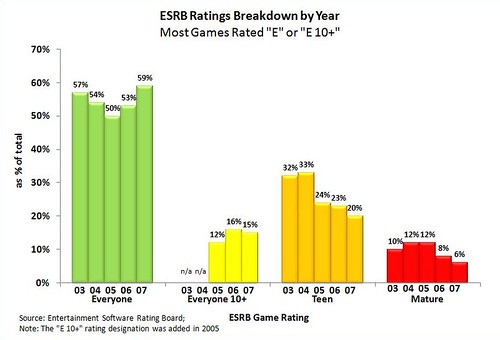
If the comments of some lawmakers and video game critics were any guide, the public would be led to believe that most video games are filled with explicit violence or sexual themes. But that’s a myth. The fact is, as I pointed out in my 2006 PFF study “Fact and Fiction in the Debate Over Video Game Regulation,” the vast majority of video games are appropriate for young kids. That is, the majority of video games are rated “E” for “Everyone” or “E 10+” for “Everyone 10 and older” by the Entertainment Software Rating Board (ESRB).
I decided to put together an updated chart illustrating this fact in preparation for a keynote address I will be delivering at a Penn State University conference in early April entitled, “Playing to Win: The Business and Social Frontiers of Videogames.” Here is the breakdown of ratings by major category from 2003-2007.
Continue reading →
Here’s Part 2 of Dan Mitchell’s series on the Laffer Curve. Part 1 is here.
We’re big fans of technology around here, but there are downsides, like having to see and hear Dan, when formerly we only had to read him.
http://www.youtube.com/v/YsB_rnzBA08&rel=1
The Institute for Health Freedom says that Google’s personal health records system gives consumers greater control over privacy than the rules issued under the Health Insurance Portability and Accountability Act. That should be no surprise:
“. . . [B]eing covered under HIPAA rules does not guarantee privacy; rather it gives government and the health-care industry control over your personal health information,” says Sue Blevins, founder and president of the Institute for Health Freedom.
Equal parts credit go to Google and discredit to the HIPAA law.
No better proof is needed that legislation and regulation are no way to get privacy protection.
One of the many reasons that those of who us cherish free markets and limited government oppose net neutrality regulation is because we believe it will be a major step down the slippery slope to far more comprehensive regulation of the Internet. Once we let this regulatory genie out of the bottle and the bureaucrats get their tentacles around the Net, a host of other misguided restrictions on Internet activities will likely follow.
One of the more destructive of these potential outcomes would be full-blown structural separation of broadband networks, such that government would force network owners to spin off their retail arms and become pure wholesalers of access (on government-set terms and price-controlled rates, of course). In a nutshell, this is the old regulatory playbook that did very little to benefit consumers or competition. Amazingly, however, we already have someone suggesting it as the logical next step after we get done slapping net neutrality mandates on the Internet. Writing in the
Boston Globe on Saturday, David Weinberger a fellow at the Harvard Berkman Center, says we need to take the next step and think about busting up broadband networks into atomistic bits:
“An Internet delivered by a tiny handful of old-technology providers, even if constrained by Net neutrality, doesn’t get us to the second vision. It doesn’t give us access laid like a blanket over the entire country, rich and poor alike. It doesn’t give us a Net that we make together, rather than a Net the contents of which we consume. For that, we need more than Net neutrality. We need a structural change. We gave the incumbent providers their chance. They have failed. The FCC could decide to once again require them to act as wholesalers to local Internet Service Providers, which would offer genuine competition on price, access, reliability, services, and whatever other differentiators an open market would devise.”
Back in 2002, Wayne Crews and I penned a paper for Cato entitled, “The Digital Dirty Dozen: The Most Destructive High-Tech Legislative Measures of the 107th Congress,” and we named a structural separation proposal floating through Congress at that time as the single most destructive measure of the year. What we said then of structural separation for older wireline telecom networks is every bit as true today regarding proposals to impose structural separation on broadband networks–perhaps even more so since we would be talking about structural separation for telco, cable and wireless networks. As Wayne and I argued back in ’02:
Continue reading →
I’d like to chime in in agreement with Adam on the ‘net sales tax issue. I also think there’s another problem with Magid’s argument that Adam didn’t mention:
By exempting out-of-state Internet retailers from collecting tax, the state is essentially discriminating in their favor, over businesses with a local presence which not only collect local and state taxes, but also pay local and state taxes themselves, hire local people who pay all sorts of taxes and also pay rent to local landlords who, in turn, pay property and income taxes that help support our schools and other services.
I love buying things online but I also love how local merchants add to the fabric of our communities. The business climate for independently owned local stores is tough enough. Why should they be forced to charge customers 8 percent more as a punishment for doing business in our communities and contributing to our local economy and job market?
Well, because these businesses
use state services. Customers get to brick-and-mortar businesses on state and local roads. These stores use local police and fire services. Their owners and employees go to government schools and use government-subsidized health care. And so, naturally, they’re taxed to help pay for these government services.
Amazon uses state and local services in Washington state, and so they’re taxed to help pay for services there. They don’t use Missouri public services, and so it’s reasonable that they’re not subject to Missouri taxes.
I hate to disagree with my friend Larry Magid, a technology analyst for CBS News, who writes this week in favor of a uniform online sales tax regime. Magid says he “can’t think of any good reason why customers of online retailers should shop tax-free while people who spend their money locally have to pay sales tax.” Well, I’ve got a couple of good reasons, Larry.
Back in 2003, Veronique de Rugy [now of the Mercatus Center] and I penned a lengthy Cato Institute white paper on this issue entitled, “The Internet Tax Solution: Tax Competition, Not Tax Collusion.” In that study, we addressed the arguments in favor of the so-called Streamlined Sales Tax Project (SSTP) and noted that a move toward more simplified tax regimes was certain laudable. In reality, however, the effort by states to build a “uniform” sales tax regime for online sales was less about achieving simplicity and more about raising taxes and imposing tax collection burdens on interstate commerce. Veronique and I pointed out that this created both economic and constitutional concerns since the SSTP was tantamount to a state-run sales tax cartel:
Continue reading →

 The Technology Liberation Front is the tech policy blog dedicated to keeping politicians' hands off the 'net and everything else related to technology.